
Generative AI is now part of how most students work but the line between legitimate help and academic misconduct is narrower, and more institution-specific, than the headlines suggest. Used well, AI is a study aid; used wrong, it is the fastest route to an integrity case. This guide answers the questions Vietnamese international students bring to MAAS advisors most often when they want to use AI without putting their degree at risk.
Author: MAAS Editorial Team · Reviewed by a MAAS subject mentor
Last updated: 2026-06-29
Category: academic-integrity

What counts as ethical AI use in academic work?
Direct answer: Ethical AI use means using the tool to support your own thinking, never to replace it, and being transparent when your institution requires it. Brainstorming questions, explaining a concept you then write up yourself, or summarising a paper you then read and cite directly are defensible. Generating the substance you submit as your own analysis is not.
Evidence: The Russell Group's principles on generative AI in education (2023) frame acceptable use around AI literacy and the requirement that students remain responsible for the integrity of their own work, rather than banning the tools outright. UNESCO's guidance for generative AI in education and research (2023) makes the same distinction: AI may support learning, but it must not substitute for the learner's own intellectual effort.
Example: A Vietnamese Business student at the University of Leeds used an AI tool to generate three possible angles for an essay on supply-chain resilience, then chose one, built her own argument, and wrote every paragraph herself. Her MAAS advisor confirmed this fell inside her module's stated policy, AI for ideation, authorship kept human. The same student asking AI to "write 1,500 words on supply-chain resilience" would have crossed the line her university draws.
Where is the line between AI assistance and academic misconduct?
Direct answer: Assistance helps you produce work you understand and could defend; misconduct submits work you did not genuinely produce. The boundary is not the tool; it is whether the submitted thinking is yours. Using AI to explain a statistical test is assistance; pasting AI-generated analysis into your results chapter is misconduct, even if you edit the wording. Patchwriting AI output, changing a few words to disguise its origin, is treated as a breach in its own right.
Evidence: Academic-integrity policies increasingly define misconduct by the act of misrepresenting authorship, not by which software was used: "it is not the use of the tools themselves that defines whether plagiarism or a breach of academic integrity has occurred, but whether any such use is made clear" (Perkins, 2023, p. 14). The Quality Assurance Agency's guidance for the AI era stresses that the obligation to submit one's own work is unchanged; AI simply makes the temptation to outsource it more accessible.
Example: A Vietnamese Engineering student at Monash asked AI to "improve" his discussion section and pasted the result in. His MAAS advisor flagged that the rewritten passage now contained claims he could not explain or source, a clear sign the analysis was no longer his. They reverted to his own draft and worked through the argument until he could defend every sentence, which is exactly what an examiner in a viva would expect.
How do you find out what your university actually allows?
Direct answer: Read your specific module's assessment brief first, then your programme handbook, then the university-wide academic-integrity policy, in that order, because the narrowest rule wins. AI permissions vary not just between universities but between modules in the same degree: one lecturer may encourage AI for ideation while another bans it entirely for a given assessment. When the brief is silent or ambiguous, ask the module leader in writing and keep the reply.
Evidence: Most UK and Australian universities have moved to tiered, course-level AI policies rather than a single institutional rule, precisely because appropriate use differs by discipline and assessment type (Russell Group, 2023). This is why a blanket assumption that "AI is allowed" is unsafe: permission is local and conditional.
Example: A Vietnamese postgraduate at the University of Sydney assumed AI grammar help was universally fine. Her MAAS advisor checked the specific assessment brief, which required all language support, including AI, to be declared. A two-line acknowledgement turned a potential integrity question into a non-issue. Without checking the module-level rule, she would have under-disclosed.
How do you disclose AI use properly when it is required?
Direct answer: State plainly which tool you used, for what task, and at what stage, in the format your institution specifies, usually a short acknowledgement statement or a methods note. A good disclosure names the tool, the purpose ("to check grammar," "to generate initial topic ideas"), and confirms that the analysis and writing are your own. Vague phrasing like "AI was used" is weaker than a specific, honest line, and over-claiming AI use you did not make is as unhelpful as hiding use you did.
Evidence: Transparency is the common thread across institutional AI policies and the UNESCO (2023) guidance: the value of a disclosure is that it lets an assessor judge the work accurately. Several journals and universities now provide a required wording or a dedicated field for AI acknowledgements, which removes the guesswork.
Example: A Vietnamese Education student at the University of Glasgow used AI to explain an unfamiliar coding concept, then wrote her methods section herself. Her MAAS advisor helped her add one sentence to her acknowledgements: that a named tool was used to clarify a concept, with all analysis and writing her own. The disclosure was accurate, specific, and matched her programme's stated format.
Where does AI genuinely help an honest student?
Direct answer: AI earns its place as a study aid, not a ghostwriter. Legitimate, defensible uses include explaining a difficult concept in plainer terms, generating practice questions to test your own understanding, checking the grammar and clarity of sentences you wrote, suggesting search terms for your literature search, and summarising a paper so you know whether to read it in full, after which you read and cite the original yourself. In every case you remain the author of the submitted ideas.
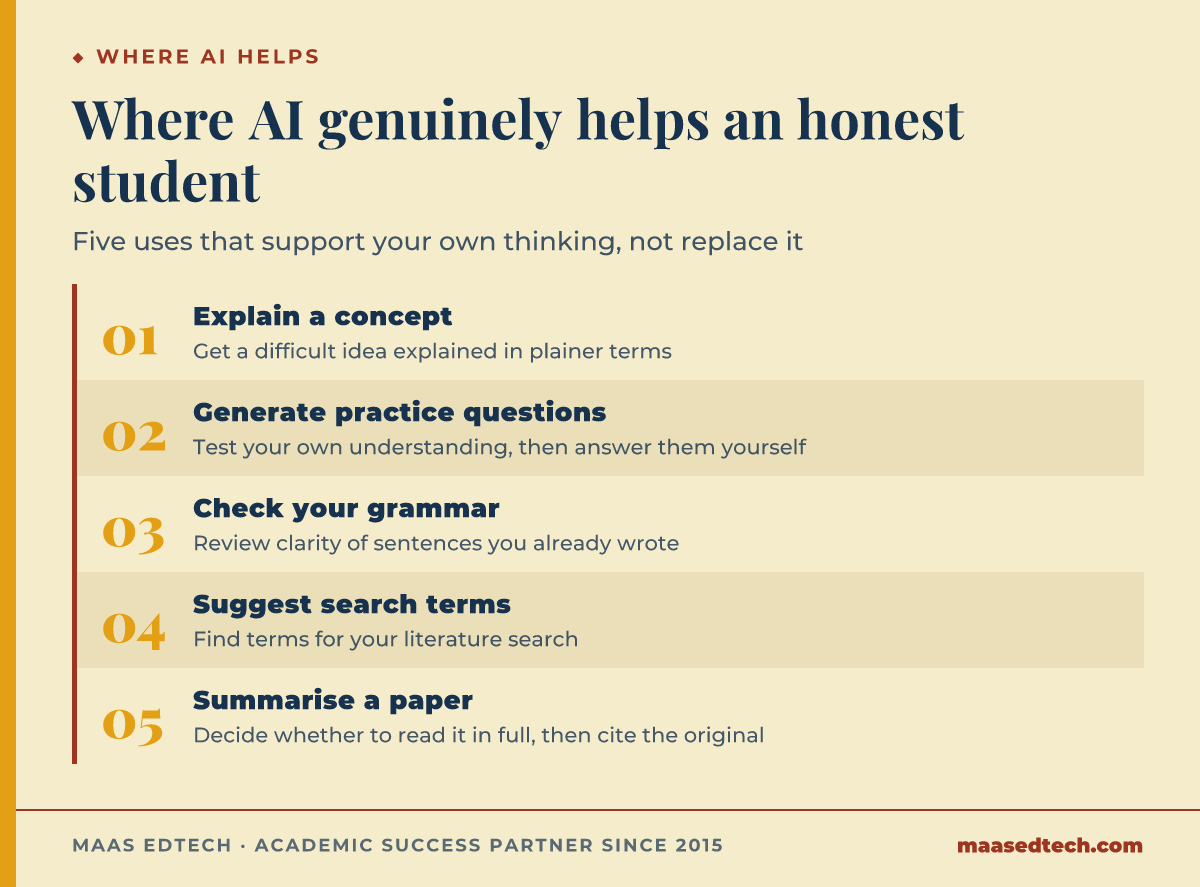
Evidence: The distinction between permitted assistance (ideation, language support, comprehension) and prohibited generation (producing submitted content) is the organising principle of current tiered AI policies (Russell Group, 2023; Perkins, 2023). What unites the permitted uses is that they strengthen your own understanding rather than replace your output.
Example: A Vietnamese Public Health postgraduate at the University of Birmingham used AI to generate ten practice exam questions on epidemiology, answered them herself, and used the gaps to guide her revision. Her MAAS mentor noted this was a textbook legitimate use, the AI tested her understanding; it did not sit the exam for her.
What are the risks of over-relying on AI as an ESL student?
Direct answer: Three risks compound for second-language writers. First, AI-polished text can read so uniformly that it triggers AI-detection flags on work that is largely your own (a false-positive risk that hits non-native writers hardest). Second, leaning on AI to phrase your ideas means you never build the academic-English skill examiners assess directly in vivas and exams.
Third, you can absorb confident but wrong AI output as fact, because verifying it requires the very expertise you are still developing. The fix is to use AI to understand, then write in your own voice.
Evidence: AI detectors disproportionately misclassify non-native English writing as machine-generated, because the simpler, more uniform style ESL students are taught mirrors the statistical pattern detectors penalise (Liang et al. 2023). Over-reliance also undermines the language development that is itself an assessed learning outcome in most postgraduate programmes.
Example: A Vietnamese Marketing student at RMIT routinely rewrote her drafts through AI until they "sounded academic." Two assignments were flagged for AI, despite being her own ideas, because the output was statistically uniform. Her MAAS advisor coached her to draft in her own words first and use AI only to check specific sentences, her flags stopped, and her spoken defence of the work became far stronger.
Frequently asked questions
Is using AI to check my grammar cheating?
Usually not, but check your module brief, some assessments that assess written English specifically restrict language tools, and some require you to declare grammar help. When permitted, checking grammar on sentences you wrote is a low-risk, legitimate use.
Can I use AI to write a first draft if I rewrite it myself?
This is risky. If the ideas, structure, and argument originate from the AI, rewriting the words does not make the thinking yours, and patchwriting is itself an integrity breach. Generating your own outline first, then writing from it, keeps you safely the author.
Will I get caught if I use AI?
The wrong question. AI detectors are unreliable in both directions; they miss real AI use and flag honest human writing so neither "getting away with it" nor "passing the checker" is a sound basis for a decision. Use AI in ways you could openly disclose, and the question disappears.
Do I have to disclose AI if I only used it to understand a concept?
Follow your institution's rule. Many treat comprehension support as permitted and not requiring disclosure, but some assessment briefs ask you to declare any AI use. When in doubt, a short, accurate acknowledgement costs nothing and protects you.
Can MAAS help me use AI within my university's rules?
Yes. A MAAS advisor can read your module's AI policy with you, identify which uses are permitted, help you write an accurate disclosure, and coach you to produce work that is genuinely your own, supporting your learning, never substituting for it.
Related resources
- Which AI tools can you use for university work, and which count as cheating?: the tool-by-tool decision guide, including translation and paraphrasing
- Using AI ethically in a literature review: the same principles applied to the specific task of screening and synthesising sources
- Why does your own writing get flagged as AI-generated?: AI-detection false positives and how to defend honest work
- Is 18% similarity on Turnitin bad, and what score is too high?: reading a similarity report without panicking
- How do you disclose AI use in a university research paper?: writing a compliant AI acknowledgement
- Academic Integrity Check service: similarity and AI-detection interpretation plus a pre-submission audit of your own work
- Academic Mentoring service: phase-by-phase coaching with the guidance of a MAAS expert
Want to use AI without risking your degree? Book a free consultation, a MAAS advisor will help you read your course's AI policy and build a workflow that keeps you the author.
References
- Liang, W., Yuksekgonul, M., Mao, Y., Wu, E., & Zou, J. (2023). GPT detectors are biased against non-native English writers. Patterns, 4(7), 100779. https://doi.org/10.1016/j.patter.2023.100779
- Perkins, M. (2023). Academic integrity considerations of AI large language models in the post-pandemic era: ChatGPT and beyond. Journal of University Teaching & Learning Practice, 20(2). https://doi.org/10.53761/1.20.02.07
- Russell Group. (2023). Russell Group principles on the use of generative AI tools in education. https://russellgroup.ac.uk/media/6137/rg_ai_principles-final.pdf
- UNESCO. (2023). Guidance for generative AI in education and research. UNESCO. https://doi.org/10.54675/EWZM9535
This article is part of the MAAS Journal series for Vietnamese international students. MAAS is an advisory partner; we coach students through the Outline → Draft → Final delivery model with developmental feedback from PhD-level mentors. We do not write, submit, or guarantee grades on a student's behalf.