
◆ Academic integrity
Which AI tools are allowed at university, and which count as cheating?
Using AI tools such as ChatGPT, Grammarly or Gemini is not automatically allowed just because you revise the output: most universities in 2026 do not ban AI outright, but allow it only where your course permits it and only if you declare it. The hard part is not the rule but the grey zone: grammar checkers, translation, and paraphrasing tools sit somewhere between "fine" and "misconduct" depending on how you use them. This guide gives Vietnamese students a practical, tool-by-tool map of what is usually safe, what is risky, and what crosses the line.
◆ Question 1 / 7 · The general rule
What is the general rule for using AI at university in 2026?
Direct answer: The default rule: use AI only if your course allows it, staying transparent about how you used it. Universities rarely treat AI as an authoritative source to cite; they ask you to acknowledge or declare it. Submitting AI-generated content as your own without disclosure is academic misconduct, and the same tool can be allowed in one unit, banned in another.
Evidence: A study of the top 50 US universities found that most guidelines were pitched at the course level rather than as one blanket rule: "94% of universities had faculty guidelines emphasizing the importance of establishing and communicating course-specific GenAI policies" (An et al., 2025). Moorhouse et al. (2023), analysing 50 leading global universities, found that where guidelines existed they primarily advised students to acknowledge or cite their AI use. The consistent thread is permission plus transparency.
Example: A Vietnamese student assumed that because one lecturer let her use ChatGPT to brainstorm, every unit allowed it. Her MAAS mentor showed her that a second unit's brief explicitly forbade any generative AI, and helped her check each course's rules before using a tool. Same student, same tool, two different rules.
◆ Question 2 / 7 · Safe or over the line
Which AI uses are usually safe, and which cross the line?
Direct answer: As a rule of thumb, using AI to help you think and check is usually acceptable with disclosure, while using AI to produce the words or ideas you submit is usually not. Brainstorming, outlining, and basic proofreading sit on the safe end; generating paragraphs and rewording sources with a spinner sit on the misconduct end. Translation and summarising live in the middle and depend entirely on your course's rules. When a use is not clearly allowed, treat it as needing permission and disclosure.
Eight common AI uses and how they usually stand
Each row sets an AI use against its typical status, with the reason.
AI use
Typical status, and why
Brainstorming ideas, exploring a topic
Usually allowed, disclose. You still do the thinking and writing.
Building an outline or structure
Usually allowed, disclose. The argument must remain yours.
Grammar and spell checking
Usually allowed. Fine for surface fixes; caution if it rewrites whole sentences.
Translating your own draft
Grey zone, check and disclose. Depends on the course; may affect a language assessment.
Summarising readings
Grey zone, check. Risk of misreading; verify against the source.
Paraphrasing or "rewording" sources
High risk. Patchwriting; the ideas and citations are still your responsibility.
Generating paragraphs or whole sections
Not allowed unless explicitly permitted. This is the content generation that counts as misconduct.
Coding assistance
Depends on the unit. Often allowed in computing with disclosure.
Save this figure
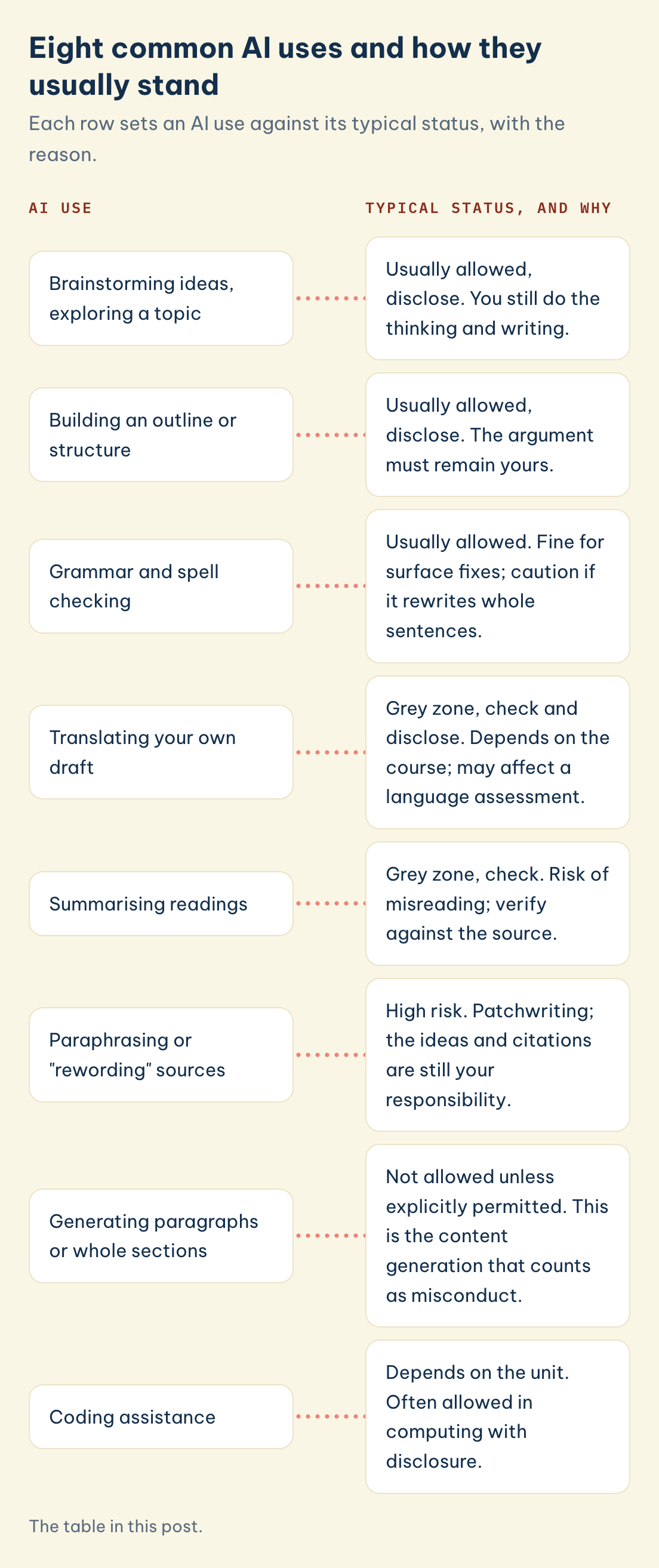
| AI use | Typical status | Why, and what to do |
|---|---|---|
| Brainstorming ideas, exploring a topic | Usually allowed, disclose | You still do the thinking and writing |
| Building an outline or structure | Usually allowed, disclose | The argument must remain yours |
| Grammar and spell checking | Usually allowed | Fine for surface fixes; caution if it rewrites whole sentences |
| Translating your own draft | Grey zone, check and disclose | Depends on the course; may affect a language assessment |
| Summarising readings | Grey zone, check | Risk of misreading; verify against the source |
| Paraphrasing or "rewording" sources | High risk | Patchwriting; the ideas and citations are still your responsibility |
| Generating paragraphs or whole sections | Not allowed unless explicitly permitted | This is the content generation that counts as misconduct |
| Coding assistance | Depends on the unit | Often allowed in computing with disclosure |
Evidence: University policies increasingly frame acceptable AI use around transparency and the student's own authorship, expecting acknowledgement of tools such as ChatGPT, QuillBot, or Grammarly rather than treating them as co-authors (Gonsalves, 2025). The line is drawn at who produces the substance of the work.
Example: A MAAS mentor helped a student sort her intended AI uses into three columns, safe, check-first, and avoid, before she started. She used AI to brainstorm and outline, disclosed it, and wrote every paragraph herself, staying comfortably on the right side of the line.
◆ Question 3 / 7 · Grammar checkers
Is using Grammarly or a grammar checker cheating?
Direct answer: Using a grammar and spelling checker for surface corrections is normally allowed and rarely counts as cheating, but be careful when the tool rewrites your sentences or generates new text. Fixing a comma or a verb tense is proofreading; letting a tool rephrase your argument for you shifts the authorship. If your grammar tool has an AI rewrite or "improve" feature, disclose that you used it, and keep the meaning and structure your own.
Evidence: Institutional guidance commonly lists grammar tools alongside other AI that should be acknowledged rather than banned, provided the student remains the author (Gonsalves, 2025). The concern is not the checker itself but the point at which it starts writing for you.
Example: A Vietnamese student worried that Grammarly's basic corrections were cheating. Her MAAS mentor reassured her that fixing surface errors is fine, but flagged one paragraph where the "rewrite" feature had changed her meaning, which she then rewrote in her own words.
◆ Question 4 / 7 · Translation
Is using AI or Google Translate to write your essay in English cheating?
Direct answer: It depends on your course, which is why this is the riskiest grey zone for Vietnamese students. Translating your own fully-written Vietnamese draft into English is usually treated more leniently than using AI to generate the English text for you, but many language and writing units count heavy translation as not your own work.
Two extra risks apply: your translated text can be wrongly flagged by an AI detector, and you may be assessed on English you cannot actually explain. Always check your unit's rule, disclose translation if you use it, and keep your original draft.
Evidence: Policies stress that students remain responsible for the work they submit and that transparency is expected (An et al., 2025). Separately, AI and paraphrased text, including machine-translated writing, is exactly the kind of content that unreliable detectors misclassify, raising the risk of a false accusation for second-language writers.
Example: A Vietnamese student wrote her essay in Vietnamese and used AI to translate it, then submitted the English version without a word of her own editing. Her MAAS mentor showed her the safer path: translate as a first draft, then rewrite it in her own English so she owned the language, and disclose the tool. For what to do if translated writing gets flagged, see our guide on what to do when you are accused of using AI.
◆ Question 5 / 7 · Paraphrasing tools
Is using QuillBot or a paraphrasing tool to reword your sources cheating?
Direct answer: In most cases, yes, if you use it to disguise someone else's words as your own. Paraphrasing tools that "spin" a source into new wording produce patchwriting, which universities treat as a form of plagiarism because the ideas and structure are still not yours. Real paraphrasing means understanding a source and re-expressing it in your own words, with a citation. A tool cannot do the understanding for you, and it cannot remove your responsibility to cite.
Evidence: Paraphrasing tools such as QuillBot appear in university AI guidance as tools to be declared, not as a shortcut around citation (Gonsalves, 2025). Rewording a source without genuine comprehension still misrepresents authorship and attribution.
Example: A student ran three journal articles through a spinner and submitted the output as his literature review. His MAAS mentor showed him it read as disconnected patchwork with no argument, and coached him to read each source, take his own notes, and write a synthesis in his own voice, with citations.
◆ Question 6 / 7 · What your course allows
How do you find out exactly what your course allows, and what should you do when unsure?
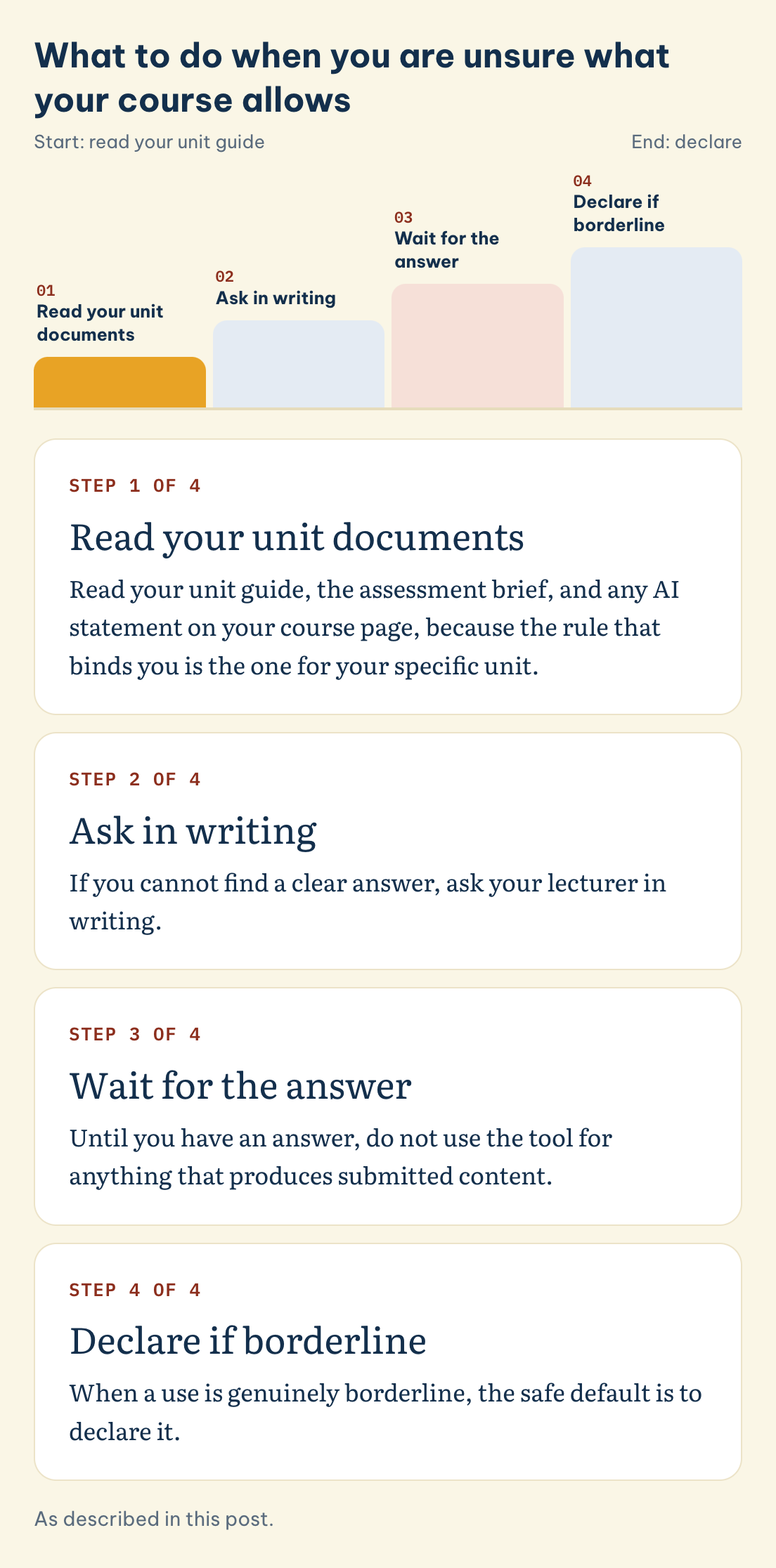
Direct answer: Read your unit guide, the assessment brief, and any AI statement on your course page, because the rule that binds you is the one for your specific unit, not a general university line. If you cannot find a clear answer, ask your lecturer in writing, and until you have one, do not use the tool for anything that produces submitted content. When a use is genuinely borderline, the safe default is to declare it; a disclosed, permitted use will not cost you marks, but an undeclared one can end in a misconduct case.
What to do when you are unsure what your course allows
Tap a step to see what to do.
Step 1 of 4
Read your unit documents
Read your unit guide, the assessment brief, and any AI statement on your course page, because the rule that binds you is the one for your specific unit.
Step 2 of 4
Ask in writing
If you cannot find a clear answer, ask your lecturer in writing.
Step 3 of 4
Wait for the answer
Until you have an answer, do not use the tool for anything that produces submitted content.
Step 4 of 4
Declare if borderline
When a use is genuinely borderline, the safe default is to declare it.
Save this figure
Evidence: An et al. (2025) found that the overwhelming majority of universities place the operative rules at the course level, so checking the unit is essential. Gonsalves (2025) found that 74% of students failed to declare their AI use, largely out of fear and confusion about what counted, which is precisely the trap that turns permitted help into an integrity problem.
Example: A Vietnamese student was unsure whether summarising tools were allowed, so her MAAS mentor helped her draft a two-line email to her lecturer. The reply gave her a clear yes-with-disclosure, and she proceeded with confidence instead of guessing. For the mechanics, see our guide on how to disclose AI use properly.
◆ Question 7 / 7 · Using AI safely
How can Vietnamese and ESL students use AI safely without losing marks or being flagged?
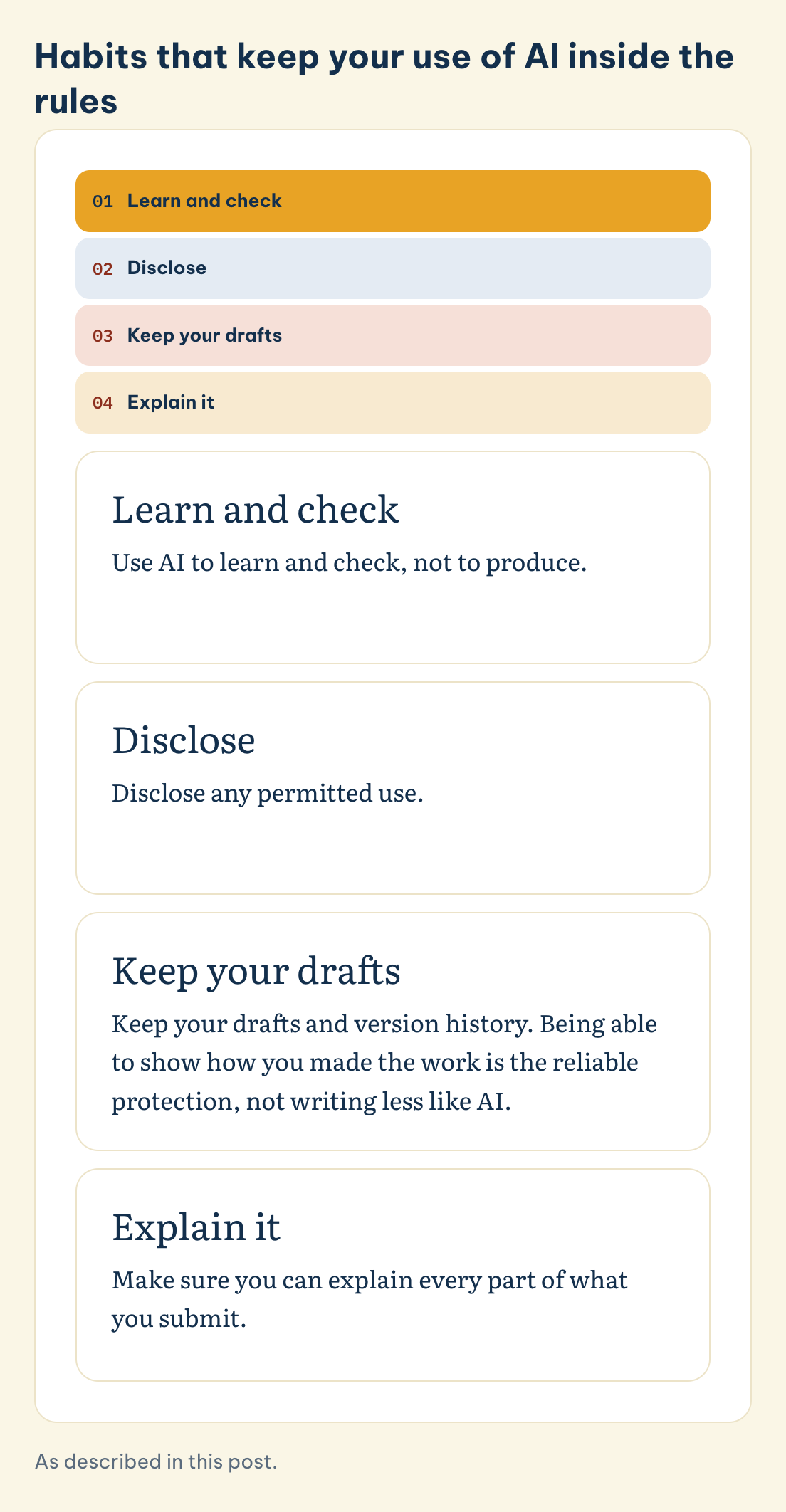
Direct answer: Use AI to learn and check, not to produce, and leave a clear trail. Disclose any permitted use, keep your drafts and version history, and make sure you can explain every part of what you submit. This protects you twice: it keeps you inside the rules, and it gives you evidence if an unreliable detector wrongly flags your second-language writing. The students who get into trouble are usually the ones who let AI write, hid it, and kept no proof of their own work.
Habits that keep your use of AI inside the rules
Tap a habit to see what the post advises.
Learn and check
Use AI to learn and check, not to produce.
Disclose
Disclose any permitted use.
Keep your drafts
Keep your drafts and version history. Being able to show how you made the work is the reliable protection, not writing less like AI.
Explain it
Make sure you can explain every part of what you submit.
Save this figure
Evidence: Because current detectors are imprecise and misclassify non-native writing, institutions increasingly emphasise transparency and student responsibility over detection scores (An et al., 2025). Being able to show how you made the work is the reliable protection, not writing "less like AI".
Example: After a scare, a Vietnamese student adopted a simple habit with her MAAS mentor: draft in a tool with version history, note every permitted AI use, and read anything AI touched so she could explain it. Her work stayed hers, and she had the evidence to prove it. For why original writing gets flagged in the first place, see our guide on why your own writing is flagged as AI.
Frequently asked questions
Is it cheating to use ChatGPT for university work?
Not automatically. It depends on your course and on how you use it. Using ChatGPT to brainstorm or clarify a concept, with disclosure where required, is often allowed; using it to write the text you submit is usually misconduct. Always check your unit's rule first.
Do I have to declare AI I only used for grammar?
Often yes, if your course requires declaring AI use, and it is safest to declare it either way. A short acknowledgement of a grammar or proofreading tool costs you nothing, while an undeclared use that is later questioned can cause real problems.
Will I lose marks if I admit I used AI?
Under most policies, no. Where AI use is permitted and properly declared, institutions state it should not reduce your grade. The penalties fall on undeclared or unauthorised use, not on honest disclosure.
Is using AI to translate my writing into English allowed?
Only if your course permits it, and you should disclose it. Translating your own draft is usually viewed more leniently than generating English text, but heavy reliance can breach a language assessment and can trigger a false AI flag. Rewrite the translation in your own words and keep your original.
Can MAAS help me use AI within the rules?
Yes. MAAS Academic Mentoring helps you understand your course's AI policy, use tools in permitted ways, disclose correctly, and keep evidence of your own work, all with PhD-level mentors. We coach you to work with AI honestly; we do not produce your work with it.
Want to use AI confidently and stay within the rules?
The safe use of AI is not a mystery; it is a small set of habits: check your course, use AI to think rather than to produce, disclose, and keep your drafts. A mentor helps you build those habits before a grey-zone decision becomes a misconduct meeting.
MAAS Academic Mentoring is an advisory partner. We help you read your unit's AI policy, decide what is safe, disclose properly, and protect your own authorship. Before the kick-off you see your mentor's anonymised capability profile, covering their degree, experience and field, and you confirm before the two of you start.
Bring your assessment brief and we will match you to a mentor in your discipline, 23% of our 100+ experts hold a PhD, within 48 hours when our network already covers that field. If it does not, MAAS opens a dedicated recruitment round for your case, which usually takes about two weeks.
Book a free 20-minute consultation with MAAS Academic Mentoring →
Related guides
- Which AI tools for research help at each stage of a project?: tools by stage, with free limits and the evidence for each
- How do you use AI ethically in your academic work?: the principles behind the permitted-versus-prohibited line
- How do you disclose AI use in a university research paper?: where and how to write an AI acknowledgement
- Accused of using AI when you wrote it yourself? A step-by-step guide: what to do if a detector wrongly flags your work
- Why does your own writing get flagged as AI-generated?: the false-positive mechanism, especially for multilingual writers
- How do you use AI ethically in a literature review?: legitimate AI help when synthesising sources
- Academic Integrity Check service: independent similarity and AI-detection review before you submit
- MAAS Academic Mentoring service: 1:1 coaching with PhD-level mentors in your discipline
References
- An, Y., Yu, J. H., & James, S. (2025). Investigating the higher education institutions' guidelines and policies regarding the use of generative AI in teaching, learning, research, and administration. International Journal of Educational Technology in Higher Education, 22, Article 10. https://doi.org/10.1186/s41239-025-00507-3
- Gonsalves, C. (2025). Addressing student non-compliance in AI use declarations: Implications for academic integrity and assessment in higher education. Assessment & Evaluation in Higher Education, 50(4), 592–606. https://doi.org/10.1080/02602938.2024.2415654
- Moorhouse, B. L., Yeo, M. A., & Wan, Y. (2023). Generative AI tools and assessment: Guidelines of the world's top-ranking universities. Computers and Education Open, 5, Article 100151. https://doi.org/10.1016/j.caeo.2023.100151
Tools & resources
- University of Melbourne. (n.d.). Artificial intelligence tools and technologies. Academic Integrity. Retrieved July 27, 2026, from https://academicintegrity.unimelb.edu.au/plagiarism-and-collusion/artificial-intelligence-tools-and-technologies
- Monash University. (n.d.). Acknowledging the use of generative AI. Retrieved July 27, 2026, from https://www.monash.edu/student-academic-success/build-digital-capabilities/create-online/acknowledging-the-use-of-generative-ai
This article is academic-integrity guidance for students using AI within their institution's rules, and does not replace your own work or your course's policy. MAAS Academic Mentoring is an advisory partner; we coach students to use AI honestly and do not produce work on a student's behalf.
A free 20-minute consultation with a MAAS mentor, to talk through your course's AI policy and how to disclose properly.
Book Free Discovery ▸