
◆ Academic integrity
What to do if you are accused of using AI when you wrote it yourself
If you are accused of using AI on work you wrote yourself, do not admit to it: ask in writing for the specific evidence and gather your drafts and version history first. It is frightening, and it happens more often to international and non-native English students than most people realise. An AI-detector score is not proof, and you have the right to respond with evidence. This guide walks Vietnamese students at Australian, UK, and US universities through exactly what to do, in order, if you are wrongly flagged.

◆ Question 1 / 7 · First steps
What should you do first if you are accused of using AI?
Direct answer: Stay calm and do not admit to something you did not do. Ask, in writing, for specific evidence behind the allegation: which work, section, and what the claim rests on. Do not delete anything, and gather your drafts and version history first. Panicking and apologising is the biggest mistake, since it can read as a confession even if innocent.
Evidence: Universities treat an academic-integrity allegation as a process with defined steps and a right of reply, not an instant verdict. The University of Melbourne, for example, publishes explicit student advice stating that a Turnitin AI indicator is not on its own evidence of misconduct and that students are given the chance to explain their work.
Example: A Vietnamese student at an Australian university received an email saying her essay was "76% AI" and replied within minutes apologising and offering to rewrite it. Her MAAS mentor stopped the spiral, helped her withdraw the apology's implication, and reframed her response around one question to the marker: "What specifically leads you to this conclusion, and may I show you my drafting history?" The tone shifted from confession to a fair inquiry.
◆ Question 2 / 7 · The score
Can an AI-detector score alone prove that you cheated?
Direct answer: No. A detector percentage is a probability estimate, not proof of authorship, and current tools are not accurate enough to decide a misconduct case on their own. Peer-reviewed testing has repeatedly found high false-positive rates and poor reliability, which is why a growing number of institutions say a detector score must not be the sole basis for an allegation. If your case rests only on a number, that is a weakness in the case, not in your work.
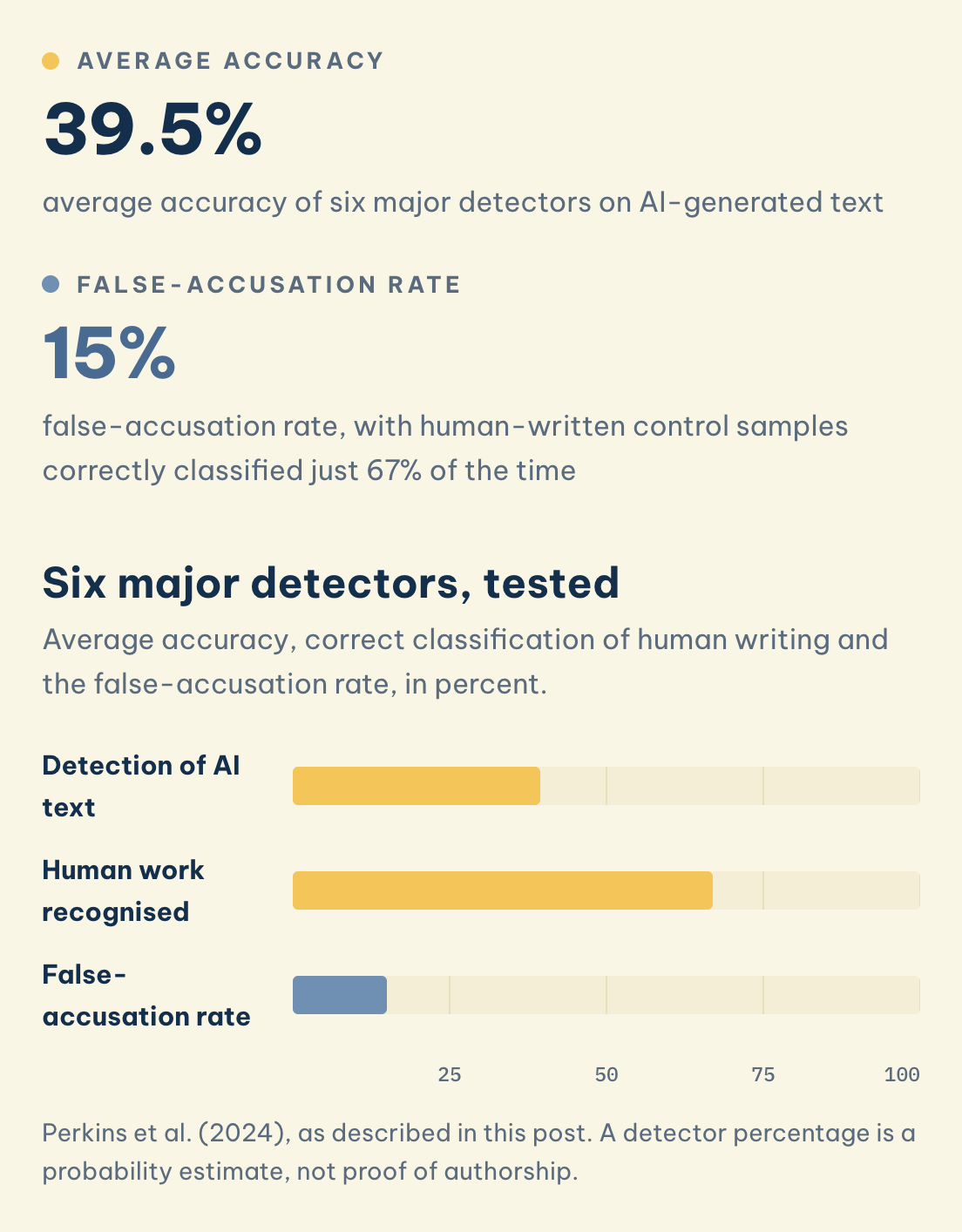
Average accuracy
39.5%
average accuracy of six major detectors on AI-generated text
False-accusation rate
15%
false-accusation rate, with human-written control samples correctly classified just 67% of the time
Six major detectors, tested
Average accuracy, correct classification of human writing and the false-accusation rate, in percent.
Save this figure
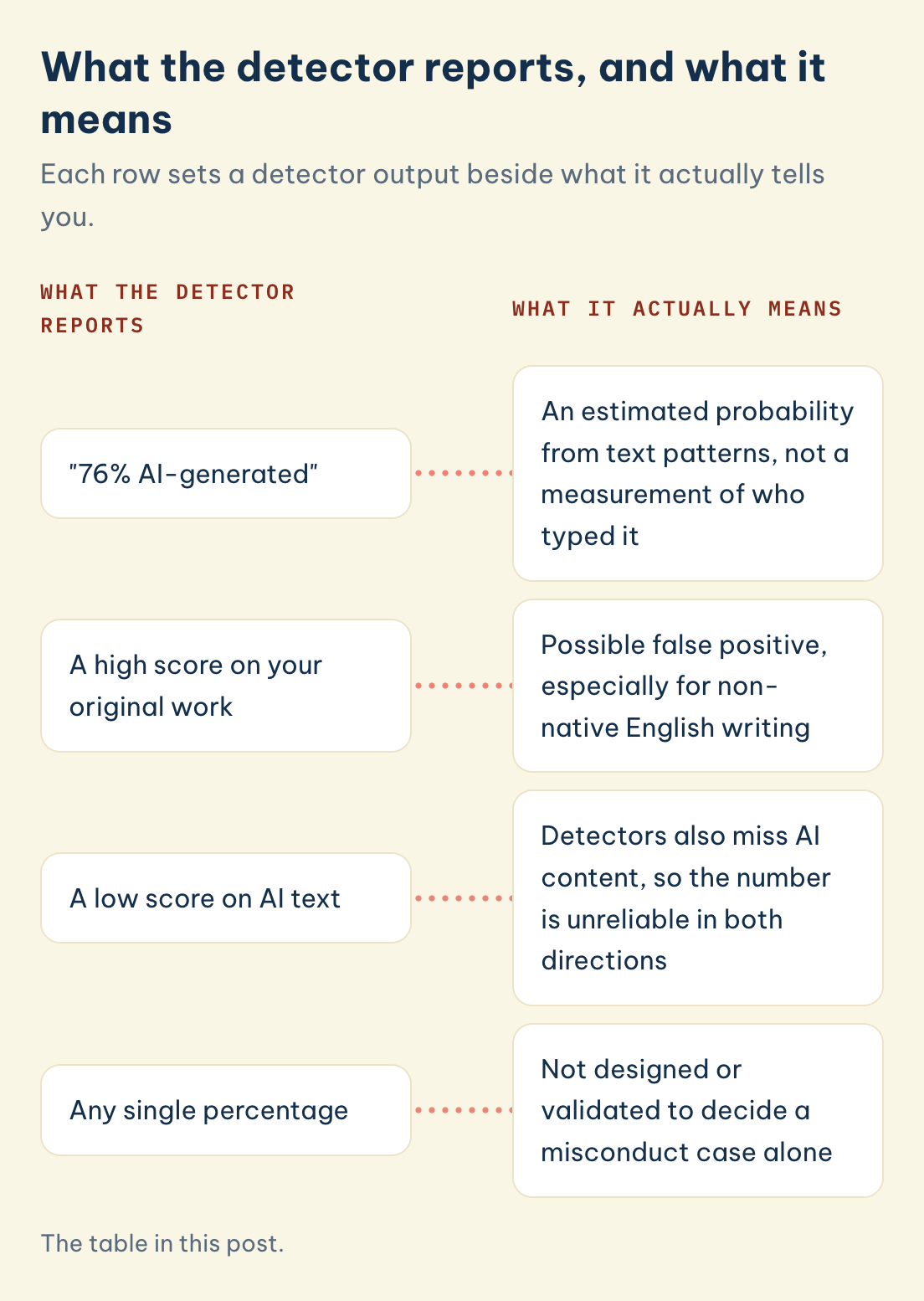
What the detector reports, and what it means
Each row sets a detector output beside what it actually tells you.
What the detector reports
What it actually means
"76% AI-generated"
An estimated probability from text patterns, not a measurement of who typed it
A high score on your original work
Possible false positive, especially for non-native English writing
A low score on AI text
Detectors also miss AI content, so the number is unreliable in both directions
Any single percentage
Not designed or validated to decide a misconduct case alone
Save this figure
Evidence: In a study of six major detectors, Perkins et al. (2024) found an average accuracy of only 39.5% on AI-generated text, and correctly classified human-written control samples just 67% of the time, producing a 15% false-accusation rate. A separate 2025 peer-reviewed review of AI-output detectors reached the same practical conclusion: no detector achieved full reliability, and detector scores "should not be the sole basis for taking negative actions against academics" (Erol et al., 2025). These are recent, peer-reviewed findings, not vendor marketing.
| What the detector reports | What it actually means |
|---|---|
| "76% AI-generated" | An estimated probability from text patterns, not a measurement of who typed it |
| A high score on your original work | Possible false positive, especially for non-native English writing |
| A low score on AI text | Detectors also miss AI content, so the number is unreliable in both directions |
| Any single percentage | Not designed or validated to decide a misconduct case alone |
Example: A MAAS mentor helped a student annotate the marker's own detector report, showing that the "flagged" passages were her literature-review sentences built from cited sources she could produce. Once the score was placed next to the evidence, the number lost its authority in the meeting.
◆ Question 3 / 7 · False flags
Why do AI detectors flag original writing, especially for non-native English students?
Direct answer: Detectors work by measuring how "predictable" your writing is, and clear, formulaic, textbook-style English looks statistically similar to AI text. Non-native English writers are flagged more often precisely because they tend to write in the careful, standard patterns that language courses teach. This is a documented bias, not a reflection of dishonesty. If you are a Vietnamese student writing in your second language, you are in a higher-risk group for false positives through no fault of your own.
Evidence: Liang et al. (2023) found that GPT-based detectors misclassified over half of non-native English writing samples as AI-generated, with an average false-positive rate of 61.3%, while rarely misclassifying native-writer samples. Weber-Wulff et al. (2023), testing detection tools across languages, similarly concluded that the tools are neither accurate nor reliable enough for high-stakes decisions.
Example: A Vietnamese student's introduction was flagged because it used the crisp, signposted structure his IELTS preparation had drilled into him. His MAAS mentor showed him that the "AI-like" quality was really second-language academic style, and helped him explain that to the panel with his earlier IELTS essays as supporting evidence. For a deeper explanation of the mechanism, see our guide on why your own writing gets flagged as AI.
◆ Question 4 / 7 · Evidence
What evidence can you gather to show the work is your own?
Direct answer: Assemble anything that shows the writing developed over time and that you understand it. The strongest items are your draft history, your research notes, and your ability to explain your own argument. Version history from Google Docs or Word, dated drafts, annotated readings, and your reference sources together tell a story that no detector score can override. Collect this before your meeting, not during it.
The evidence checklist to bring
Tap an item to see what to bring to the meeting.
Item 1 of 5
Drafts
Bring your draft and version history, such as the Google Docs "Version history" or tracked Word drafts.
Item 2 of 5
Notes
Bring your research notes, outlines and annotated sources.
Item 3 of 5
Sources
Bring your reference list and the actual articles you cited.
Item 4 of 5
Earlier work
Bring earlier assignments in the same writing style, to show consistency.
Item 5 of 5
Timeline
Bring a short written timeline of how and when you wrote each section.
Save this figure
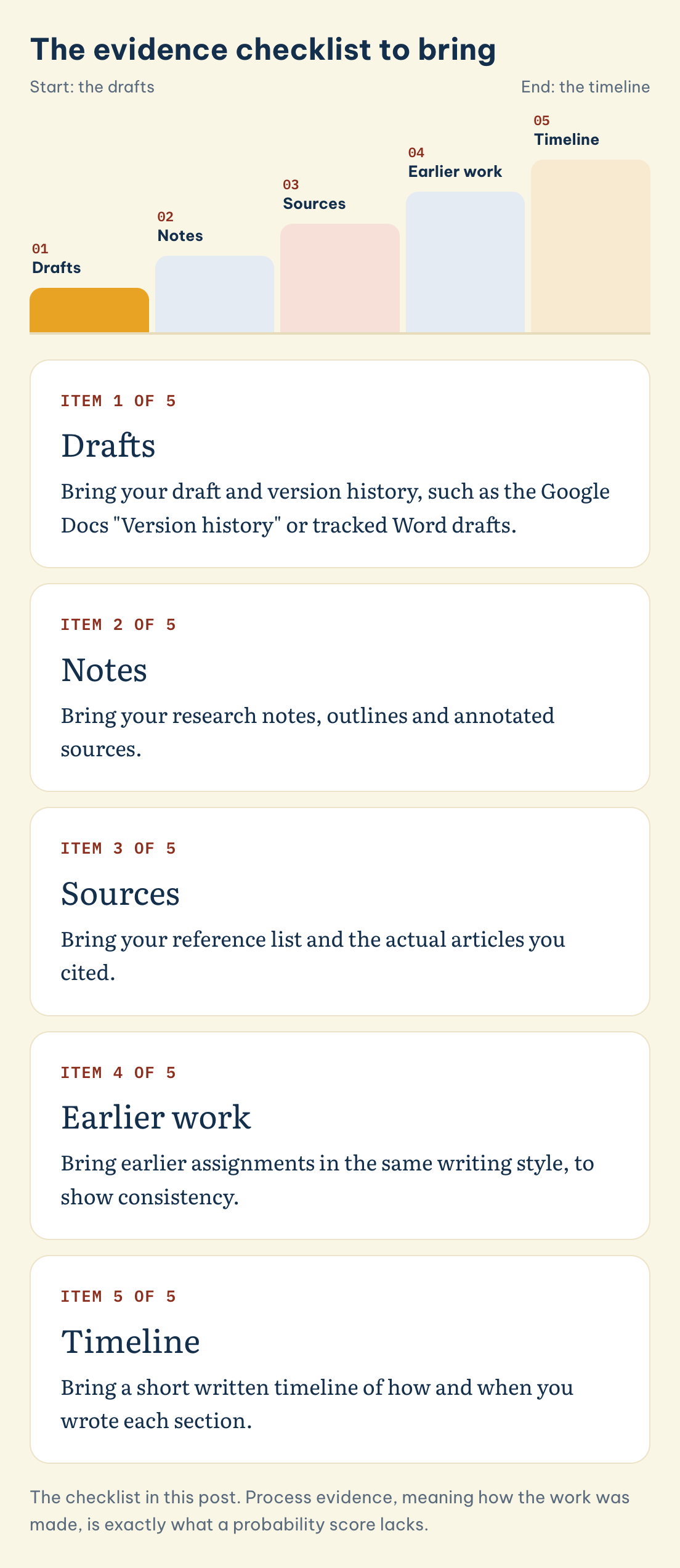
Evidence: Because detectors cannot prove authorship, integrity processes rely on the balance of evidence, and process evidence (how the work was made) is exactly what a probability score lacks. Demonstrating that you can discuss your sources and reconstruct your reasoning is persuasive precisely where the detector is weakest.
Example: A MAAS mentor coached a student to open her Google Docs version history in the meeting, showing 40 hours of edits across three weeks. The timeline, combined with her marked-up journal articles, closed the case in her favour without any further hearing.
Evidence checklist to bring:
- Draft and version history (Google Docs "Version history" or tracked Word drafts).
- Research notes, outlines, and annotated sources.
- Your reference list and the actual articles you cited.
- Earlier assignments in the same writing style, to show consistency.
- A short written timeline of how and when you wrote each section.
◆ Question 5 / 7 · Responding
How should you respond to your professor or an integrity panel?
Direct answer: Respond in writing, calmly and factually, and keep the focus on evidence rather than emotion. State clearly that the work is your own, ask what the allegation is specifically based on, and offer your drafting history and sources. Do not exaggerate, do not guess, and do not sign any admission you do not agree with. You are allowed to ask for the university's academic-integrity policy and for a support person to attend.
Evidence: Fair-process principles give students the right to know the case against them and to respond before a decision is made. Framing your reply around the documented unreliability of detectors, and around your own process evidence, addresses the case on its two weakest points: the score's accuracy and its inability to prove authorship.
Example: A Vietnamese student rehearsed three sentences with his MAAS mentor before the meeting: an opening that the work was his own, a question asking for the specific basis of the claim, and an offer to walk through his drafts. Having the words ready kept him composed and factual instead of defensive.
◆ Question 6 / 7 · The process
What does the formal academic-misconduct and appeal process usually look like?
Direct answer: Most universities follow a similar path: a marker raises a concern, you are notified and invited to a meeting or asked for a written response, a decision-maker or panel weighs the evidence, and an outcome is issued. If the outcome goes against you, there is almost always a right of appeal on defined grounds, such as procedural unfairness or new evidence. Always confirm the exact stages, deadlines, and appeal grounds in your own institution's academic-integrity policy, because they differ by university.
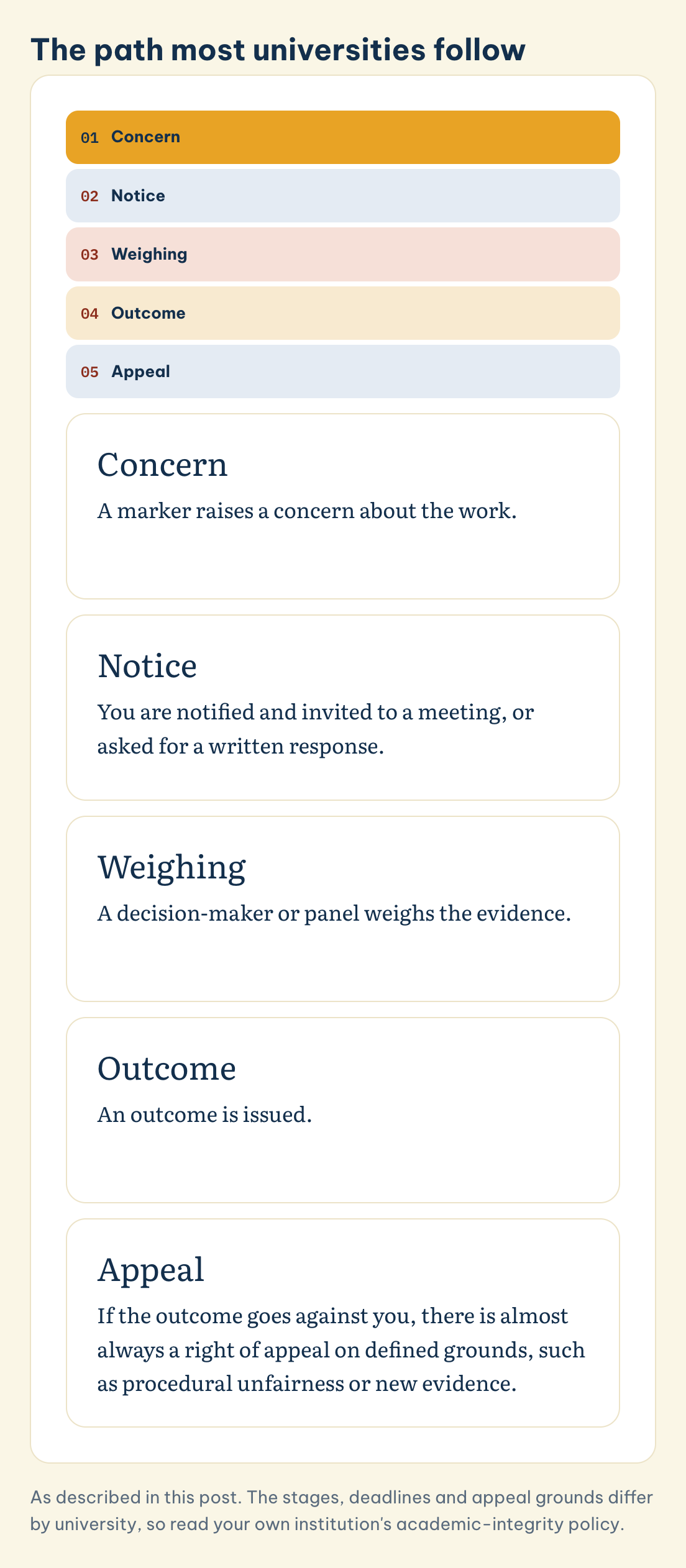
The path most universities follow
Tap a stage to see what happens. Confirm the exact stages, deadlines and appeal grounds in your own institution's policy.
Concern
A marker raises a concern about the work.
Notice
You are notified and invited to a meeting, or asked for a written response.
Weighing
A decision-maker or panel weighs the evidence.
Outcome
An outcome is issued.
Appeal
If the outcome goes against you, there is almost always a right of appeal on defined grounds, such as procedural unfairness or new evidence.
Save this figure
Evidence: Criterion-based misconduct procedures are published policy at Australian, UK, and US institutions, and appeal rights are a standard feature. Meeting the stated deadlines matters: a strong case can still fail if an appeal is lodged late or on grounds the policy does not recognise.
Example: A MAAS mentor helped a student read her university's procedure and realise she had ten working days to request a review on the ground of "new evidence", which was her Google Docs history. She lodged in time, on the correct ground, and the original finding was overturned.
◆ Question 7 / 7 · Next time
How can you protect yourself before submission next time?
Direct answer: Build a paper trail as you write, so authorship is never in doubt. Draft in a tool that keeps version history, save your notes and outlines, keep the sources you cite, and disclose any permitted AI help exactly as your unit allows. If you want reassurance before you submit, you can check your own work with an independent originality and AI-detection review and keep the report. Prevention is far easier than defending an allegation later.
Evidence: Because false positives cluster on clean, second-language academic writing, the reliable protection is not to write "less like AI", which would harm your marks, but to be able to prove how the work was made. Process evidence created before submission is the strongest shield.
A read of the draft itself is a different check from an originality report. An assignment audit and review works through your text in Track Changes with a comment on each edit, so you keep a dated record of what you wrote and what you changed, which is the kind of evidence a panel can actually read.
Example: After one frightening accusation, a Vietnamese student adopted a simple routine with her MAAS mentor: draft in Google Docs, keep every research note, and log permitted AI use. When she was informally questioned on a later essay, she produced the trail in five minutes and the query was dropped immediately. For where AI help is legitimate, see our guide on using AI ethically in academic work.
Frequently asked questions
What should I do if I get accused of using AI?
First, keep calm and never confess to something you did not do. Put a written request to the marker asking which piece of work, which section and what evidence the claim relies on. Keep every file, collect your drafts, version history, notes and sources ahead of any meeting, then answer factually and ask that the formal process and your right of reply be respected.
Should an AI writing detection score be the sole basis for negative action against academics?
No. A 2025 peer-reviewed review of AI-output detectors found that no detector achieved full reliability and that detector scores "should not be the sole basis for taking negative actions against academics" (Erol et al., 2025). A score is a probability estimate from text patterns, and false positives are a documented problem, especially for non-native English writing, so a case that rests only on a number is weak.
Is a Turnitin AI score enough to fail me?
On its own, no. Peer-reviewed studies show these tools are not reliable enough to prove authorship, and many institutions state that a score cannot be the sole basis for a finding. The decision rests on the balance of evidence, which is why your drafts and sources matter more than the percentage.
I am a non-native English speaker. Am I really more likely to be flagged?
Yes. Research has found false-positive rates above 60% for non-native English writing, because standard, carefully structured second-language prose resembles the patterns detectors associate with AI. This is a known bias you can raise in your response.
Should I just admit it to make the process easier?
No. Do not admit to something you did not do. An untrue admission can lead to a penalty you did not deserve and is very hard to reverse. Respond honestly, ask for the specific evidence, and present your own.
What if I did use AI in a way I thought was allowed?
Be honest about what you did and how you understood the rules, and point to your unit's stated AI policy. Permitted, disclosed assistance is different from misconduct, and being transparent early is far safer than hiding it.
Can MAAS help me prepare a response?
Yes. MAAS Academic Mentoring coaches you through gathering evidence, understanding your institution's process, and preparing a calm, factual response, with PhD-level mentors. We support you through a fair process; we do not write your work for you.
Facing an AI accusation and not sure what to do next?
If you have been flagged and you know the work is yours, the worst thing you can do is respond in panic. A mentor helps you turn fear into a clear, evidence-based reply that addresses the case on its weakest points.
MAAS Academic Mentoring is an advisory partner. We help you assemble your drafting history, understand your university's integrity policy, and rehearse your response, so the process stays fair and your original work is recognised. Every call is recorded with cameras off to protect your identity, and your materials stay confidential.
Bring your case and we will match you to an academic-integrity mentor, 23% of our 100+ experts hold a PhD, within 48 hours when our network already covers that field. If it does not, MAAS opens a dedicated recruitment round for your case, which usually takes about two weeks.
Book a free 20-minute confidential consultation with MAAS Academic Mentoring →
Related guides
- Why does your own writing get flagged as AI-generated?: the mechanism behind false positives and how detectors decide
- How accurate are AI writing detectors?: what the research says about reliability and error rates
- Similarity score vs AI score: what is the difference?: how to read the two numbers a report shows
- Where is AI assistance legitimate in academic work?: the line between permitted help and misconduct
- How to disclose AI use in a research paper: declaring permitted assistance the right way
- MAAS Academic Mentoring service: 1:1 coaching with PhD-level mentors in your discipline
- Academic Integrity Check service: independent similarity and AI-detection review before you submit
References
- Erol, G., Ergen, A., Gülşen Erol, B., Ergen, K., & Çelik Ertuğrul, D. (2025). Can we trust academic AI detective? Accuracy and limitations of AI-output detectors. Acta Neurochirurgica, 167, Article 214. https://doi.org/10.1007/s00701-025-06622-4
- Liang, W., Yuksekgonul, M., Mao, Y., Wu, E., & Zou, J. (2023). GPT detectors are biased against non-native English writers. Patterns, 4(7), Article 100779. https://doi.org/10.1016/j.patter.2023.100779
- Perkins, M., Roe, J., Vu, B. H., Postma, D., Hickerson, D., McGaughran, J., & Khuat, H. Q. (2024). Simple techniques to bypass GenAI text detectors: Implications for inclusive education. International Journal of Educational Technology in Higher Education, 21, Article 53. https://doi.org/10.1186/s41239-024-00487-w
- Weber-Wulff, D., Anohina-Naumeca, A., Bjelobaba, S., Foltýnek, T., Guerrero-Dib, J., Popoola, O., Šigut, P., & Waddington, L. (2023). Testing of detection tools for AI-generated text. International Journal for Educational Integrity, 19, Article 26. https://doi.org/10.1007/s40979-023-00146-z
Tools & resources
- University of Melbourne. (n.d.). Advice for students regarding Turnitin and AI writing detection. Academic Integrity. Retrieved July 27, 2026, from https://academicintegrity.unimelb.edu.au/plagiarism-and-collusion/advice-for-students-regarding-turnitin-and-ai-writing-detection
- RMIT University. (n.d.). Academic integrity. Retrieved July 27, 2026, from https://www.rmit.edu.au/students/student-essentials/rights-and-responsibilities/academic-integrity
This article is academic-integrity guidance for students defending genuine, original work, and does not replace your own work or your institution's policy. MAAS Academic Mentoring is an advisory partner; we coach students through a fair process and do not write or submit work on a student's behalf.
A free 20-minute confidential consultation with a MAAS mentor, to talk through your evidence and your university's process.
Book Free Discovery ▸