
◆ Academic integrity
Why do AI detectors like Turnitin flag my own writing as AI?
Turnitin flags your own writing as AI because its detector measures how statistically predictable your text is, and plain, even, clear second-language writing has the same low-surprise pattern as AI text. A false AI-writing flag is one of the most stressful messages an international student can receive: a professor reporting that a detector flagged an essay written entirely alone, late at night, in a second language. AI-detection false positives are real, they disproportionately affect non-native English writers, and panicking makes them worse. This guide explains why honest work gets flagged and what to do about it.
◆ Question 1 / 8 · How it works
How do AI detectors decide something was written by AI?
Direct answer: AI detectors estimate the statistical predictability of your text. AI-generated writing tends to be smooth, even, and low in surprise, so detectors flag writing that looks too uniform. The critical point: they measure a pattern correlated with AI, not proof of AI. A human writing in plain, even sentences can produce that same pattern.
Evidence: Detection tools rely on metrics such as perplexity (how surprising each word is) and burstiness (variation in sentence length and complexity). Low perplexity and low burstiness raise the AI score. These are probabilistic signals, which is why every major detector reports a likelihood, not a certainty and why their own documentation warns against using the score as sole evidence of misconduct (University of Melbourne, n.d.-b).
Example: A Vietnamese Public Health student at the University of Birmingham wrote a clear, methodical literature review entirely herself. Because she had been taught to write short, simple, consistent sentences, good ESL advice, the detector read that uniformity as "AI-like" and flagged it. Nothing was generated; her careful style simply matched the statistical fingerprint the tool looks for.
◆ Question 2 / 8 · ESL writers
Why are non-native English writers flagged more often?
Direct answer: Because the writing habits ESL students are taught, simpler vocabulary, shorter sentences, predictable structures, repeated connective phrases, happen to mirror the low-variation pattern detectors associate with AI. The very techniques that make second-language writing clear and correct also make it look statistically uniform, which inflates false-positive rates for international students specifically.
Evidence: A Stanford team ran seven widely used AI detectors over 91 TOEFL essays written by human non-native speakers and 88 essays written by US eighth graders. "Most GPT detectors use text perplexity to detect AI-generated text, which might inadvertently penalize non-native writers who use a more limited range of linguistic expressions" (Liang et al., 2023a). The average false-positive rate was 61.3% on the TOEFL essays while the same tools stayed near perfect on the US school essays, and 19.8% of the TOEFL essays were flagged by all seven detectors at once. When the researchers enriched the vocabulary of those same human-written TOEFL essays, false positives fell to 11.77%; when they simplified the US essays, flagging rose from 5.19% to 56.65% (Liang et al., 2023b). The detectors were reading lexical simplicity, which is exactly what competent second-language writing looks like on the page. Turnitin was not one of the seven tools tested, so the numbers are not a measurement of Turnitin, but the underlying mechanism is not specific to any one product.
Example: Two Vietnamese students at the same Australian university submitted equally honest essays. The one who wrote in longer, more idiomatic English passed the detector; the one who wrote in the careful, even style she had been drilled in was flagged. Same integrity, different surface texture and the detector only sees texture. Her MAAS advisor helped her document her drafting process to clear the flag.
◆ Question 3 / 8 · Thesis level
What changes when the flagged work is a thesis or a journal manuscript?
Direct answer: The mechanism is identical, but the stakes and the correct response are not. A flagged thesis chapter reaches a supervisor, an examination committee, or a journal editor rather than a module tutor; the accusation attaches to a research record rather than to one assignment; and the people judging it frequently have no written false-positive procedure to follow. Postgraduate researchers writing in English as an additional language sit at the exact point these tools handle worst.
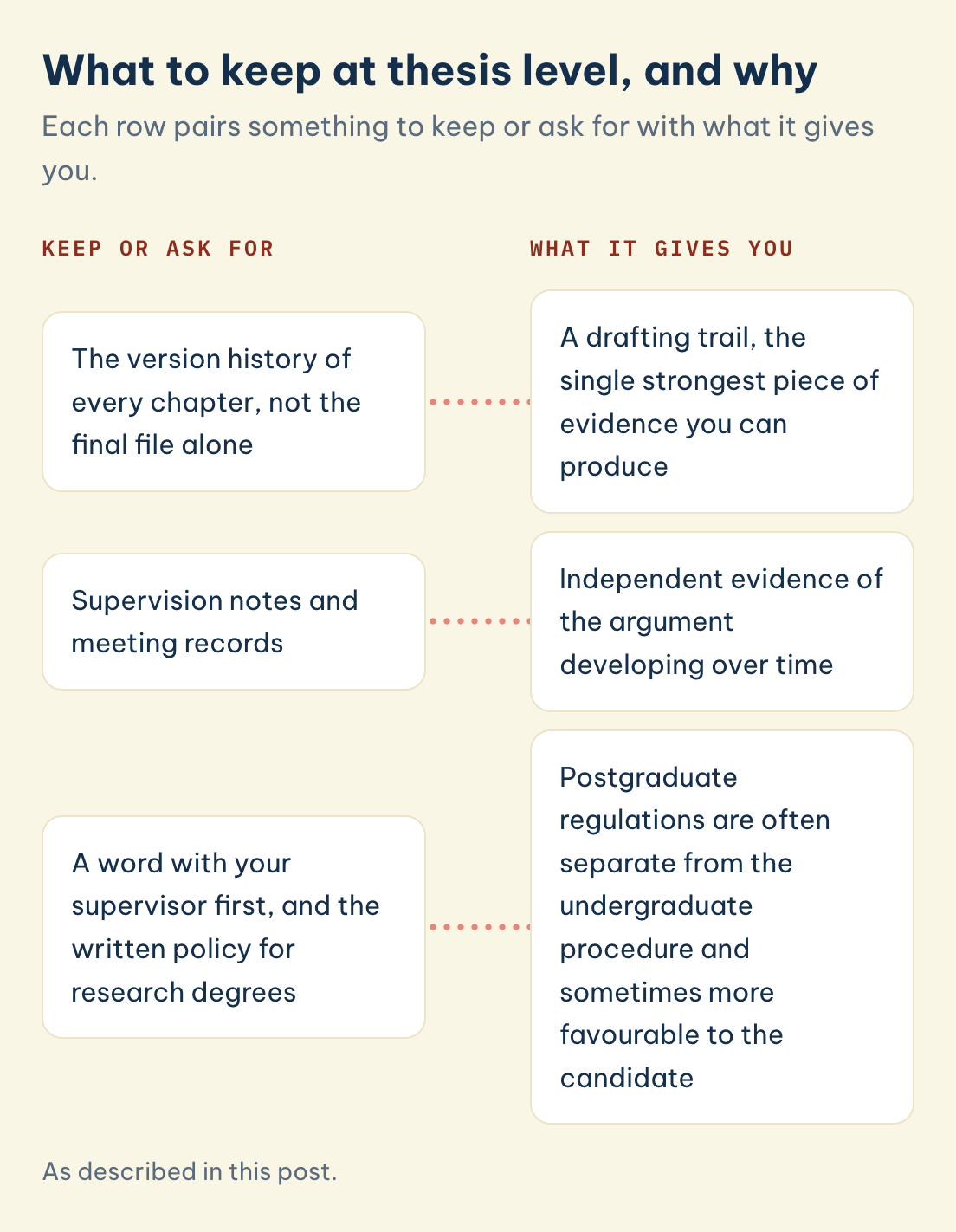
What to keep at thesis level, and why
Each row pairs something to keep or ask for with what it gives you.
Keep or ask for
What it gives you
The version history of every chapter, not the final file alone
A drafting trail, the single strongest piece of evidence you can produce
Supervision notes and meeting records
Independent evidence of the argument developing over time
A word with your supervisor first, and the written policy for research degrees
Postgraduate regulations are often separate from the undergraduate procedure and sometimes more favourable to the candidate
Save this figure
Evidence: Giray (2024) reviewed the experiences of scholars at institutions around the world and found that false positives fall disproportionately on non-native English speakers and on researchers with a distinctive writing style, producing accusations that can damage an academic career rather than a single grade. He also documents a second cost that rarely appears in accuracy statistics: a climate of anxiety and self-censorship, in which researchers begin editing their natural voice out of their work to avoid suspicion. That is the same lexical flattening Liang et al. (2023a) showed makes detector scores worse, so the defensive instinct actively increases the risk.
This heightened risk for postgraduate second-language researchers matters well beyond the traditional study-abroad route. A large share of master's and doctoral programmes in Taiwan, South Korea, Japan and Hong Kong are taught and examined in English, so candidates draft, defend and publish in English while living and thinking in another language every day. Their supervisors are often in the same position. When a detector score arrives, there may be nobody in the immediate chain of command who has read the research on false positives.
What to do differently at thesis level: keep the version history of every chapter rather than the final file alone, since a drafting trail is the single strongest piece of evidence you can produce. Keep supervision notes and meeting records, because they independently show the argument developing over time. Raise a detector score with your supervisor before responding formally, and ask which written policy applies to research degrees at your institution, as postgraduate regulations are often separate from the undergraduate academic-integrity procedure and are sometimes more favourable to the candidate.
One caution against overreading this. Detector behaviour varies sharply by tool, sample and configuration, and at least one study of a widely used detector found no false positives at all on genuine student work (Gosling et al. 2024). The honest position is that false positives are real, are not rare, and fall unevenly on second-language writers, not that every flag is wrong.
◆ Question 4 / 8 · Universities
Do universities still trust these detectors?
Direct answer: A growing number of them do not. Several universities have now switched the AI-detection feature off entirely, and the sector is visibly split between institutions that still run it and institutions that have concluded it cannot carry the weight of a misconduct case. This matters to you practically: if you are flagged, the reliability of the tool itself is a legitimate part of your response, and you can point to institutions that reached that conclusion after testing it.
Alleged misconduct cases
Nearly 6,000
at Australian Catholic University across nine campuses in 2024
Referrals dismissed
About a quarter
of all referrals, after investigation
Three universities that stopped relying on the detector
Tap an institution to see what it did.
University 1 / 3
Vanderbilt University
Disabled Turnitin's AI detector in August 2023, writing that it had no insight into how the tool works and did not believe AI detection was an effective tool to use.
University 2 / 3
Curtin University
Disabled the same feature across all campuses from 1 January 2026 while keeping ordinary text-matching active.
University 3 / 3
Australian Catholic University
Abandoned the tool in March 2025 after finding it ineffective.
Save this figure
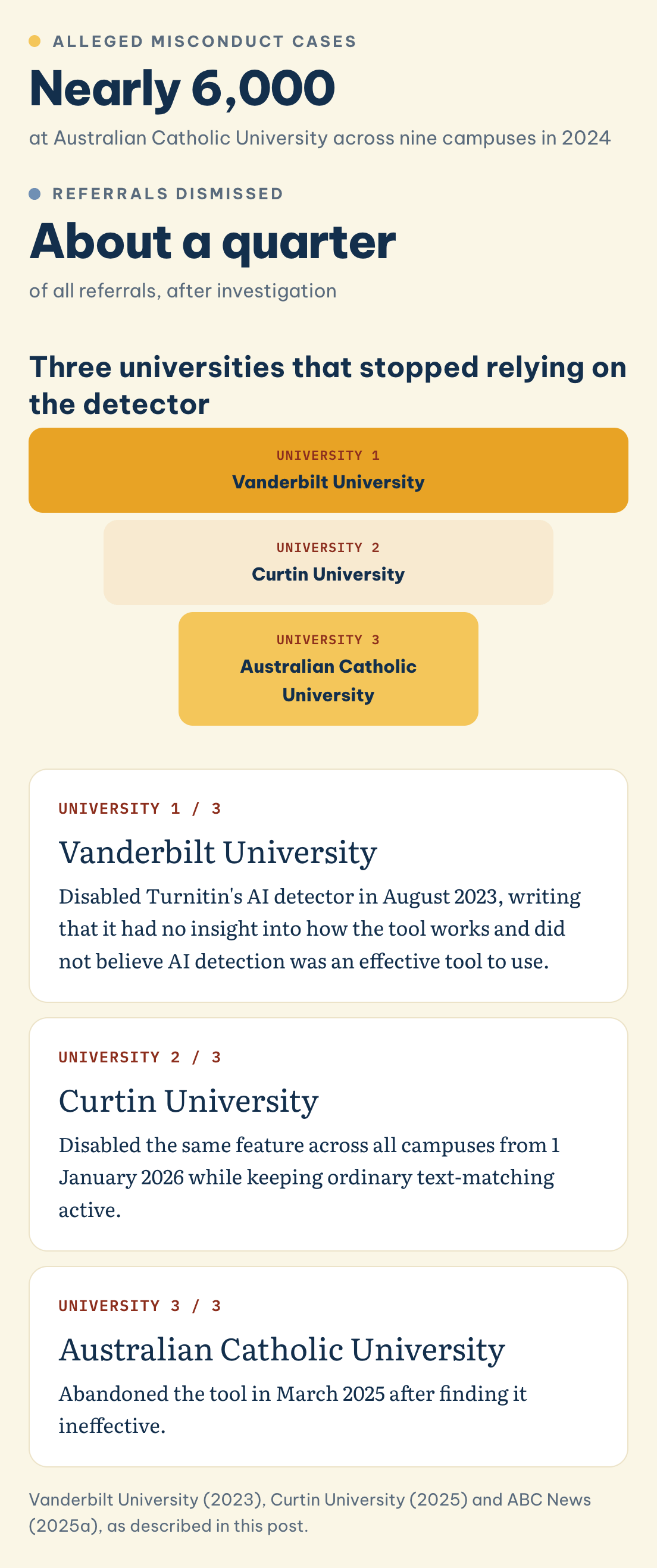
Evidence: Vanderbilt University disabled Turnitin's AI detector in August 2023, writing that it had no insight into how the tool works and did not believe AI detection was an effective tool to use (Vanderbilt University, 2023). Curtin University disabled the same feature across all campuses from 1 January 2026 while keeping ordinary text-matching active (Curtin University, 2025). An ABC News investigation found that Australian Catholic University registered nearly 6,000 alleged academic misconduct cases across its nine campuses in 2024, that around 90% of referrals related to AI use and around one quarter of all referrals were dismissed after investigation, and that ACU abandoned the tool in March 2025 after finding it ineffective (ABC News, 2025a). A follow-up report confirmed more than a dozen Australian institutions were still using detection technology (ABC News, 2025b).
What this means for you: Do not argue with the percentage. Argue about the evidence. Ask what your institution's own policy says about acting on a detector score, note that Turnitin's own guidance states the report should not be the sole basis for adverse action, and put your drafting trail in front of the panel. Institutions that tested the tool carefully are the ones that stopped relying on it, and that is a reasonable thing to say calmly in a meeting.
◆ Question 5 / 8 · If accused
What should I do the moment I'm accused of using AI?
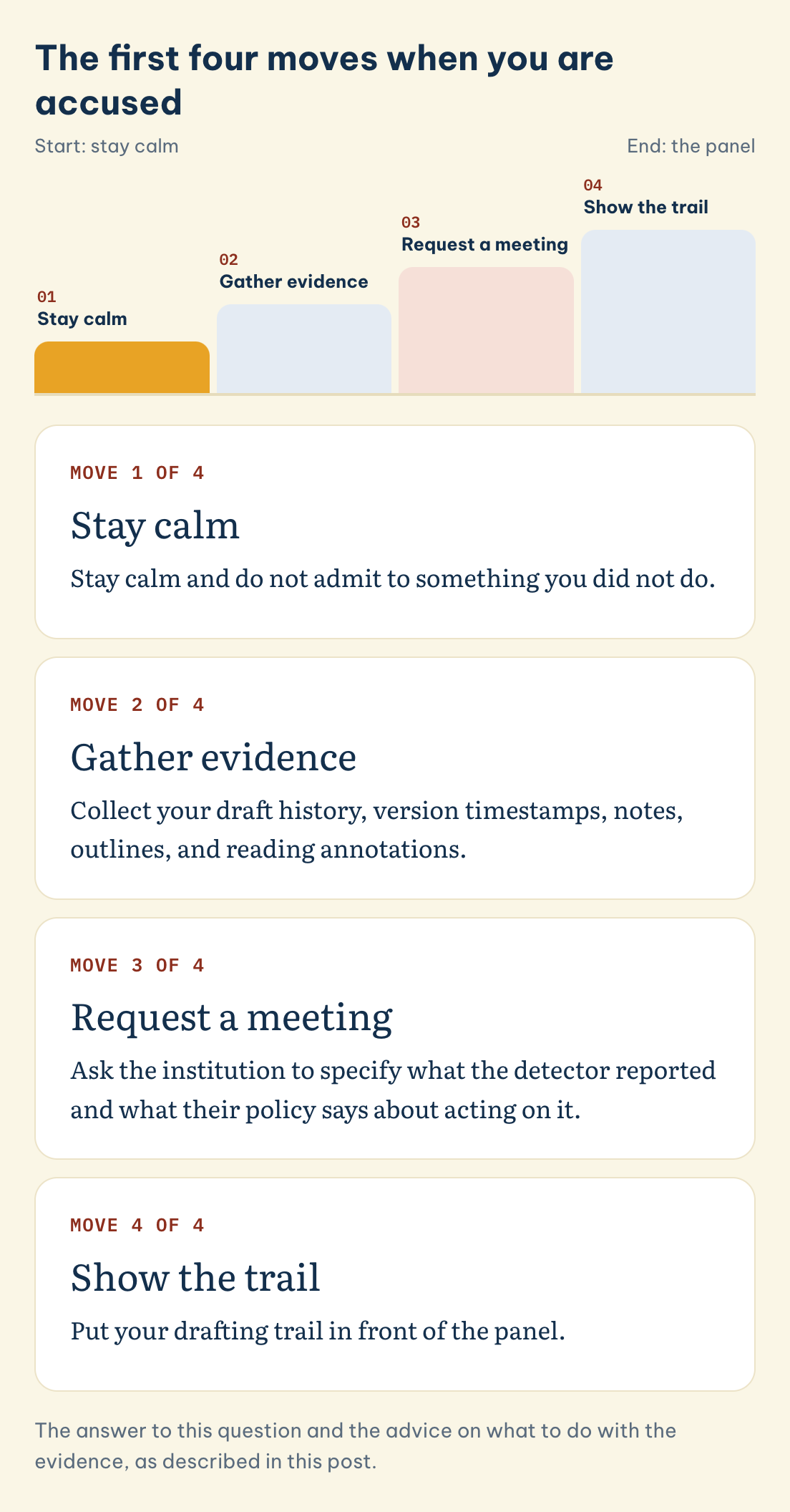
Direct answer: Stay calm, do not admit to something you did not do, and gather your evidence. Collect your draft history, version timestamps, notes, outlines, and reading annotations. Request a meeting and ask the institution to specify what the detector reported and what their policy says about acting on it. A detector flag is an allegation that you can rebut with evidence of your own process; it is not a conviction.
The first four moves when you are accused
Tap a move to see what it asks of you.
Move 1 of 4
Stay calm
Stay calm and do not admit to something you did not do.
Move 2 of 4
Gather evidence
Collect your draft history, version timestamps, notes, outlines, and reading annotations.
Move 3 of 4
Request a meeting
Ask the institution to specify what the detector reported and what their policy says about acting on it.
Move 4 of 4
Show the trail
Put your drafting trail in front of the panel.
Save this figure
Evidence: Most university misconduct procedures require corroborating evidence beyond a single detector score, and many have issued statements cautioning staff that AI-detection results are not reliable as sole proof (University of Melbourne, n.d.-b; Weber-Wulff et al. 2023). Your documented writing process, drafts, edits, comments, is the strongest counter-evidence, which is why version history matters so much.
Example: A Vietnamese Engineering student at the University of Glasgow was flagged and felt his English wasn't good enough to argue back. His MAAS advisor helped him assemble his Google Docs version history showing weeks of incremental edits, his handwritten outline, and his annotated sources. Presented with the drafting trail, the panel cleared him, the process record did the talking.
◆ Question 6 / 8 · Protection
How can I protect myself before submission?
Direct answer: Write in a way that preserves evidence of authorship. Draft in a tool that keeps version history, save your outlines and notes, and let your natural voice vary, mix sentence lengths, keep your own phrasing and the occasional imperfection. Uniformity invites flags; genuine human variation reduces them. None of this is about gaming the detector; it is about leaving a clear, honest trail that shows the work is yours.
Evidence: Institutions increasingly advise students to retain drafting evidence precisely because detector flags are unreliable; a documented process is the recognised safeguard (University of Melbourne, n.d.-a). Authentic human writing also naturally varies in rhythm and word choice, the opposite of the flat uniformity detectors penalise.
If you want a second read on a draft you have already written, an assignment audit and review returns the file with Track Changes switched on and a comment explaining every suggested edit, so the record of what you wrote and what you chose to change stays visible inside the document itself.
Example: After one scare, a Vietnamese Marketing student at RMIT adopted her MAAS advisor's habit: draft only in a version-tracked document, keep every outline, and read each paragraph aloud so her own voice came through. Her later submissions carried a clear authorship trail, and she stopped fearing the detector because she could always prove the work was hers.
◆ Question 7 / 8 · The line
Is "humanising" AI text or beating the detector ever acceptable?
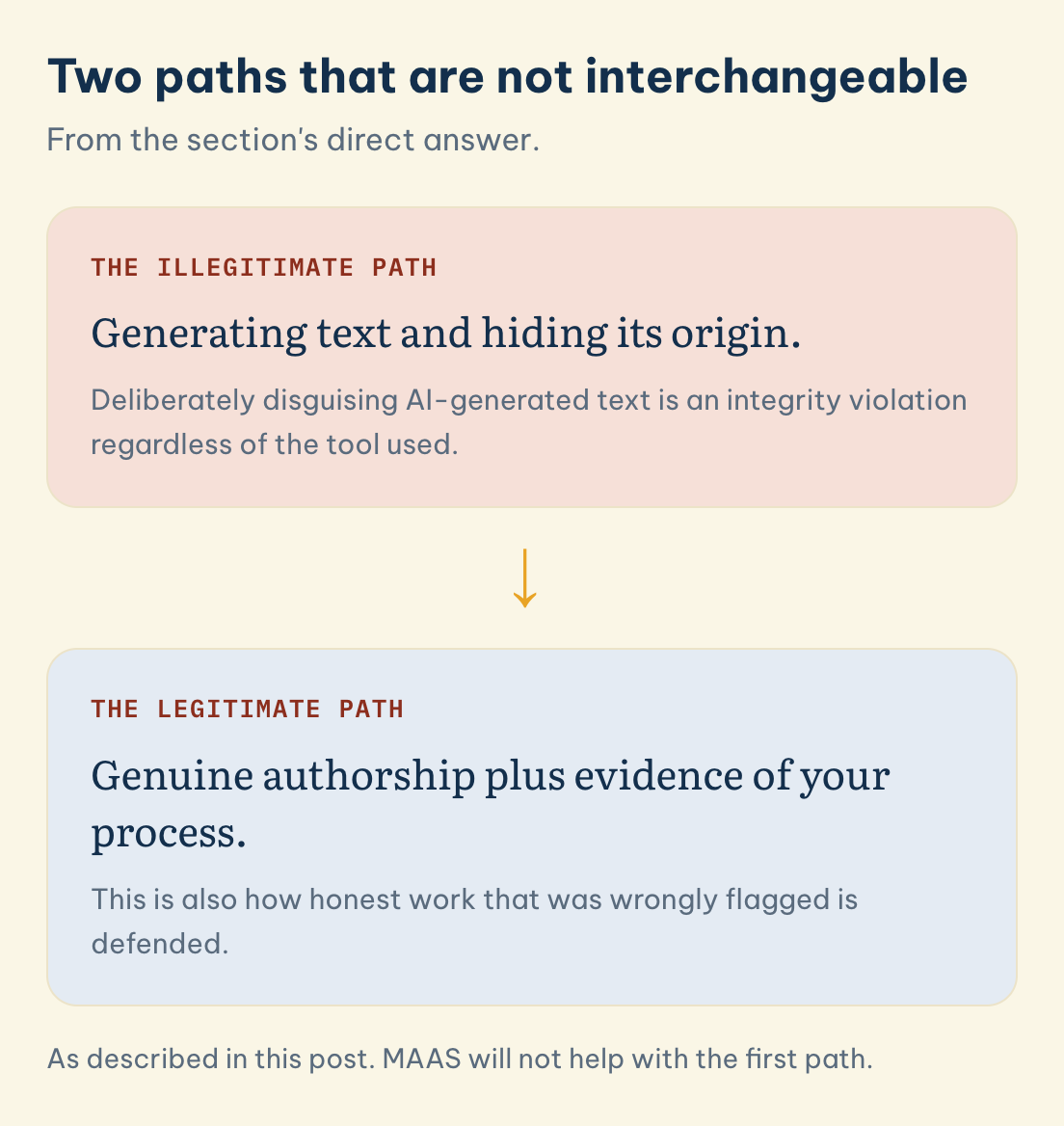
Direct answer: No and MAAS will not help you do it. Deliberately disguising AI-generated text to evade detection is an integrity violation regardless of the tool used, and it is a different thing entirely from defending honest work that was wrongly flagged. The legitimate path is genuine authorship plus evidence of your process; the illegitimate path is generating text and hiding its origin. Keep the line bright.
Two paths that are not interchangeable
From the section's direct answer.
The illegitimate path
Generating text and hiding its origin.
Deliberately disguising AI-generated text is an integrity violation regardless of the tool used.
The legitimate path
Genuine authorship plus evidence of your process.
This is also how honest work that was wrongly flagged is defended.
Save this figure
Evidence: Academic-integrity policies define misconduct by the act, submitting work that is not genuinely yours, or misrepresenting how it was produced, not by which tool was used. Evasion of detection is treated as an aggravating factor, not a clever workaround.
Example: A Vietnamese student once asked a MAAS advisor to "make AI text pass the checker." The advisor declined and explained why, then offered the real service instead: coaching him to write the piece himself, Outline → Draft → Final, so the work was genuinely his and no detector was a threat. He took that route and submitted with confidence.
◆ Question 8 / 8 · Legitimate use
Where is AI assistance legitimate in academic work?
Direct answer: AI can be a legitimate study aid when your institution permits it and you are transparent: brainstorming questions, explaining a concept you then write up yourself, checking grammar on your own sentences, or summarising a paper you then read and cite directly. It crosses the line when it generates the substance you submit as your own thinking. Always check your course's specific AI policy, because permissions vary widely between institutions and even modules.
Evidence: Many universities now publish tiered AI-use policies distinguishing permitted assistance (ideation, language support) from prohibited generation (producing submitted content). The common thread is transparency and genuine authorship of the ideas you submit.
Example: A Vietnamese postgraduate at the University of Leeds used AI to explain an unfamiliar statistical concept, then wrote her methodology section herself and cited the textbook she verified it against. Her MAAS advisor confirmed this fell within her programme's stated policy, assistance with understanding, authorship kept entirely human.
Frequently asked questions
Can an AI detector be wrong?
Yes, frequently. Detectors report a probability based on statistical patterns, and they misclassify honest writing, especially from non-native English speakers, at meaningful rates. A flag is an allegation to investigate, not proof.
Why does my own essay get flagged as AI?
Usually because your writing is clear, even, and predictable in structure, the same statistical pattern detectors associate with AI. Careful ESL writing habits make this more likely, even when every word is yours.
How do I prove I wrote it myself?
Keep and present your draft version history, outlines, notes, and annotated sources. A documented writing process is the strongest evidence that the work is genuinely yours, and most fair procedures weigh it heavily.
Does MAAS help students get AI text past detectors?
No. Evading detection is an integrity violation. MAAS coaches you to produce genuinely your own work and to defend honest writing that was wrongly flagged, never to disguise generated content.
Can MAAS help if I've been wrongly flagged?
Yes. The Academic Integrity Check and a MAAS advisor can help you interpret the report, assemble your process evidence, and prepare for an integrity meeting, supporting your own honest work, in line with your institution's policy.
Related resources
- Accused of using AI when you wrote it yourself? A step-by-step guide: what to do, in order, if you are wrongly flagged, with the evidence to gather
- Are AI "humanizer" tools safe to use for university work?: why disguising flagged text is a trap, and what to do instead
- Academic Integrity Check service: AI-detection and similarity-report interpretation plus a pre-submission audit of your own work
- Is 18% similarity on Turnitin bad, and what score is too high?: the companion guide on reading similarity reports
- Similarity score versus AI score: what is the difference?: why a low similarity score and a high AI score are not the same thing
- How do you disclose AI use in a university research paper?: turning permitted AI use into a clear acknowledgement
- Using AI ethically in a literature review: legitimate AI assistance versus crossing the line
- How do you use AI ethically in your academic work?: the permitted-versus-prohibited line across task types
- Can Turnitin detect ChatGPT and AI writing?: what AI detection can and cannot do
- How accurate are AI writing detectors, and how often are they wrong?: the false-positive evidence, and why it hits multilingual writers hardest
- How to write a methodology section examiners believe: authentic research design that is unmistakably your own
- Academic Mentoring service: phase-by-phase coaching, with the guidance of a MAAS expert
Flagged for AI on work you wrote yourself? Book a free consultation, a MAAS advisor will help you gather your evidence and prepare your response, supporting your own honest work.
References
- ABC News. (2025a). University wrongly accuses students of using artificial intelligence to cheat. https://www.abc.net.au/news/2025-10-09/artificial-intelligence-cheating-australian-catholic-university/105863524
- ABC News. (2025b). Over a dozen unis are using AI to catch AI, and getting it wrong. https://www.abc.net.au/news/2025-10-20/universities-using-ai-to-detect-students-cheating/105905804
- Curtin University. (2025). Update on Turnitin AI-detection tool. https://www.curtin.edu.au/news/oasis-news/update-on-turnitin-ai-detection-tool/
- Giray, L. (2024). The problem with false positives: AI detection unfairly accuses scholars of AI plagiarism. The Serials Librarian, 85(5-6), 181-189. https://doi.org/10.1080/0361526X.2024.2433256
- Gosling, S. D., Ybarra, K., & Angulo, S. K. (2024). A widely used Generative-AI detector yields zero false positives. Aloma, 42(2), 31-43. https://doi.org/10.51698/aloma.2024.42.2.31-43
- Liang, W., Yuksekgonul, M., Mao, Y., Wu, E., & Zou, J. (2023a). GPT detectors are biased against non-native English writers. Patterns, 4(7), Article 100779. https://doi.org/10.1016/j.patter.2023.100779
- Liang, W., Yuksekgonul, M., Mao, Y., Wu, E., & Zou, J. (2023b). GPT detectors are biased against non-native English writers. arXiv. https://doi.org/10.48550/arXiv.2304.02819
- University of Melbourne. (n.d.-a). Advice for students regarding Turnitin and AI writing detection. Academic Integrity. Retrieved July 4, 2026, from https://academicintegrity.unimelb.edu.au/plagiarism-and-collusion/advice-for-students-regarding-turnitin-and-ai-writing-detection
- University of Melbourne. (n.d.-b). Turnitin's AI writing detection tool. Academic Integrity. Retrieved July 4, 2026, from https://academicintegrity.unimelb.edu.au/staff-resources/turnitins-ai-writing-detection-tool
- Vanderbilt University. (2023). Guidance on AI detection and why we're disabling Turnitin's AI detector. Brightspace. https://www.vanderbilt.edu/brightspace/2023/08/16/guidance-on-ai-detection-and-why-were-disabling-turnitins-ai-detector/
- Weber-Wulff, D., Anohina-Naumeca, A., Bjelobaba, S., Foltýnek, T., Guerrero-Dib, J., Popoola, O., Šigut, P., & Waddington, L. (2023). Testing of detection tools for AI-generated text. International Journal for Educational Integrity, 19, Article 26. https://doi.org/10.1007/s40979-023-00146-z
This article is academic-integrity guidance and does not replace your own work or your institution's policy.
A free 20-minute discovery call with a MAAS advisor, to talk through your own evidence and your institution's policy.
Book Free Discovery ▸