

Finding 01
Not reliable
Epaphras and Mtenzi (2026) found the results of the three tools fluctuated unpredictably across repeated attempts, and concluded the tools "are not reliable".
◆ Academic integrity
No, AI humanizer tools are not safe to use for university work: they do not reliably avoid detection, they damage your writing, and if the text was AI, using one is still academic misconduct. They promise to rewrite text so it slips past AI detectors and are aggressively marketed to anxious students. This guide explains the real risks for Vietnamese students, and the safe path if your own writing has been wrongly flagged.
◆ Question 1 / 7 · What they are
Direct answer: AI humanizers are online tools that rewrite AI-generated or flagged text to look more human and evade AI detectors. Students turn to them for two reasons: some want to disguise AI-written work, others are honest students who panicked after a false flag. Both groups take a serious risk, because these tools solve neither problem safely.
Evidence: In a study of 19 humanizer and paraphrasing tools, Masrour et al. (2025) note that these tools are primarily marketed at students and that demand for bypassing AI detection is high, with humanizers among the most popular writing tools in some app stores. The marketing targets fear and temptation, not academic honesty.
Example: A Vietnamese student who had been falsely accused once came to MAAS asking which humanizer was "the safest" for her next essay. Her mentor showed her she was about to turn a false-alarm problem into a real misconduct problem, and walked her back to the honest, evidence-based approach instead.
◆ Question 2 / 7 · Do they work
Direct answer: No, not reliably. Independent testing shows their performance is inconsistent and often poor, and AI detectors are being rebuilt specifically to catch humanized text. A tool that evades one detector today may be caught by the same or another detector tomorrow, which means you can never be sure your gamble paid off. Betting your degree on an unreliable tool is a bad wager.
Iterations still flagged as AI
15 of 18
is how often one popular paraphraser left text flagged as AI when Epaphras and Mtenzi (2026) tested three humanizing tools
Epaphras and Mtenzi (2026) found the results of the three tools fluctuated unpredictably across repeated attempts, and concluded the tools "are not reliable".
In a study of 19 humanizer and paraphrasing tools, Masrour et al. (2025) note that these tools are primarily marketed at students. The post adds that the marketing targets fear and temptation, not academic honesty.
Masrour et al. (2025) built a detector that still caught 93.2% of humanized AI text, even when a humanizer was trained specifically to beat it.
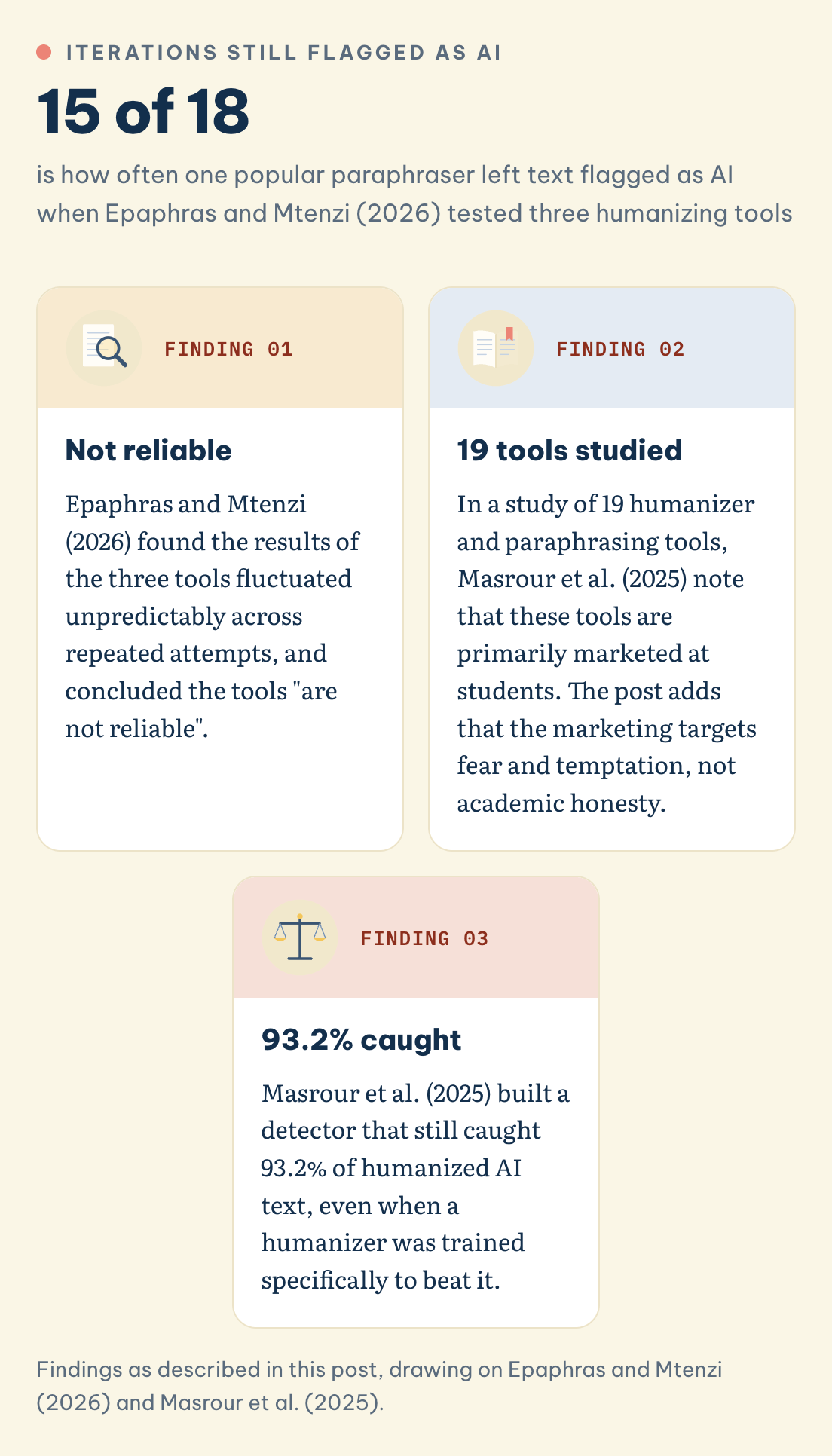
Evidence: Epaphras and Mtenzi (2026), testing three humanizing tools, found their results fluctuated unpredictably across repeated attempts, with one popular paraphraser leaving text flagged as AI in 15 of 18 iterations, and concluded the tools "are not reliable". Masrour et al. (2025) describe the same class of tools plainly: "AI humanizers are a new class of online software tools meant to paraphrase and rewrite AI-generated text in a way that allows them to evade AI detection software" (Masrour et al., 2025). Even after studying 19 of them, the same team went further and built a detector that still caught 93.2% of humanized AI text even when a humanizer was trained specifically to beat it, because the underlying machine patterns cannot be fully erased.
Example: A student assumed a humanizer had "cleaned" his text. His MAAS mentor pointed him to the evidence that these tools are inconsistent, and that a second detector could still flag the same passage, leaving him with no defence and a rewritten text he could not explain.
◆ Question 3 / 7 · Still misconduct
Direct answer: Yes. Making AI-generated work undetectable does not make it your own; it just hides the misconduct. If your course did not permit that AI use, submitting it, humanized or not, is a breach of academic integrity, and a successful evasion is still a violation, only one that is harder to catch. Universities treat disguising unauthorised AI as an aggravating factor, not a loophole.
Evidence: Academic-integrity policies define misconduct by whether the work is genuinely and honestly yours, not by whether a tool detected it. The entire purpose of a humanizer, to conceal authorship, runs directly against the transparency that university AI policies require.
Example: A MAAS mentor helped a student see the logic plainly: if he needed a tool to hide how the text was made, that was the clearest possible signal the text should not be submitted. He rewrote the assignment himself instead.
◆ Question 4 / 7 · If you were flagged
Direct answer: No, this is the most important warning in this guide. If your writing is genuinely your own, a humanizer does not help you and can hurt you: it may still leave the text flagged, it degrades your writing quality, and it replaces work you can defend with text you cannot explain. The real protection against a false flag is evidence that you wrote the work, not a tool that disguises it. Reaching for a humanizer can turn an innocent student into one who looks guilty.
Why a humanizer does not help writing that is your own
Tap a reason to see what the post warns.
It may still be flagged
A humanizer may still leave the text flagged, so it does not solve the false-flag problem.
It degrades the writing
It degrades your writing quality, and the damage can cost marks.
It removes your defence
It replaces work you can defend with text you cannot explain. Altering your genuine writing with a humanizer destroys exactly the authenticity you would want to demonstrate.
What protects you
The real protection against a false flag is evidence that you wrote the work, which means your drafting history and your ability to explain your work.
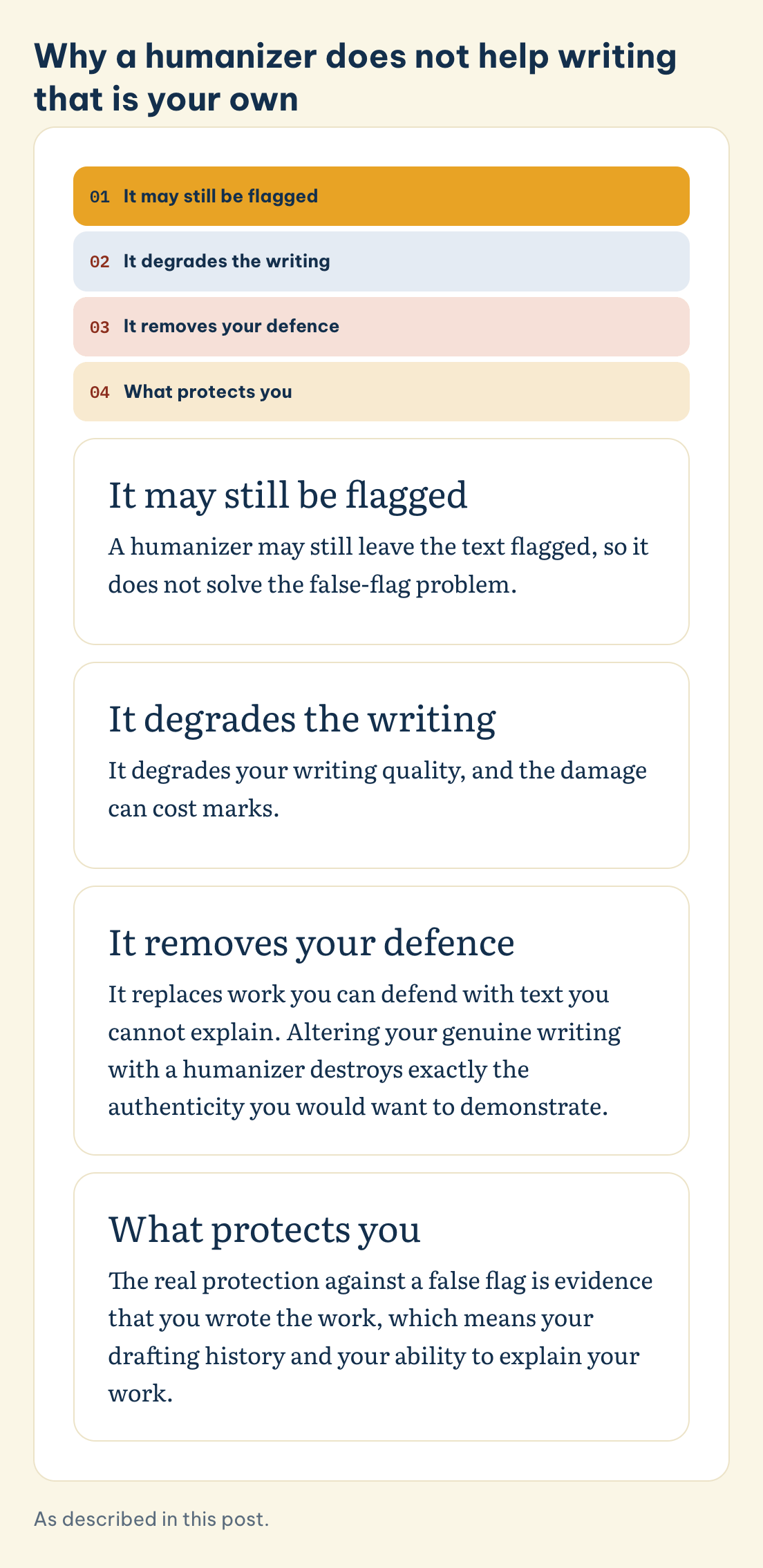
Evidence: Because detectors are unreliable and biased against non-native English writing, the defensible response to a false positive is your drafting history and your ability to explain your work, not further manipulation of the text. Altering your genuine writing with a humanizer destroys exactly the authenticity you would want to demonstrate.
Example: A Vietnamese student's honest essay was flagged, and she nearly humanized it in panic. Her MAAS mentor stopped her and helped her gather her Google Docs version history instead, which resolved the case cleanly. For the full step-by-step, see our guide on what to do when you are accused of using AI.
◆ Question 5 / 7 · Effect on quality
Direct answer: They usually make it worse. To fool a detector, these tools introduce odd phrasing, errors, and unnatural sentence patterns, the very features that lose marks. You can end up with text that is both still at risk of detection and visibly weaker than what you started with. Trading your grade for a failed evasion is the worst of both outcomes.
Evidence: Perkins et al. (2024) found that the techniques most effective at evading detection, such as inserting spelling errors, produced text that "would very likely receive poor marks" in a real assessment. Epaphras and Mtenzi (2026) similarly documented inconsistent, low-quality transformations from surface-level paraphrasing tools.
Example: A student showed his MAAS mentor a humanized paragraph that read awkwardly and had lost the precise academic terms his marker expected. The mentor helped him restore his own clear version, which was both stronger and honestly his.
◆ Question 6 / 7 · The real risks
Direct answer: The risks stack up quickly, and none of them are worth it. You face a misconduct finding, unreliable evasion, weaker writing and lower marks, and privacy exposure from pasting your work into an unknown third-party site. Set against a benefit that may not even materialise, the risk is heavily one-sided.
What humanizer tools promise, and the documented reality
Each row sets one promise against what the post documents.
The tool promises
The reality
"Undetectable" text
Inconsistent, and detectors are catching up.
A quick fix for a false flag
Still may be flagged, and destroys your best defence.
Better, more human writing
Often awkward, error-prone and lower-scoring.
A safe workaround
Disguising unauthorised AI is still misconduct.
Private and secure
Your full draft is sent to an unknown third party.
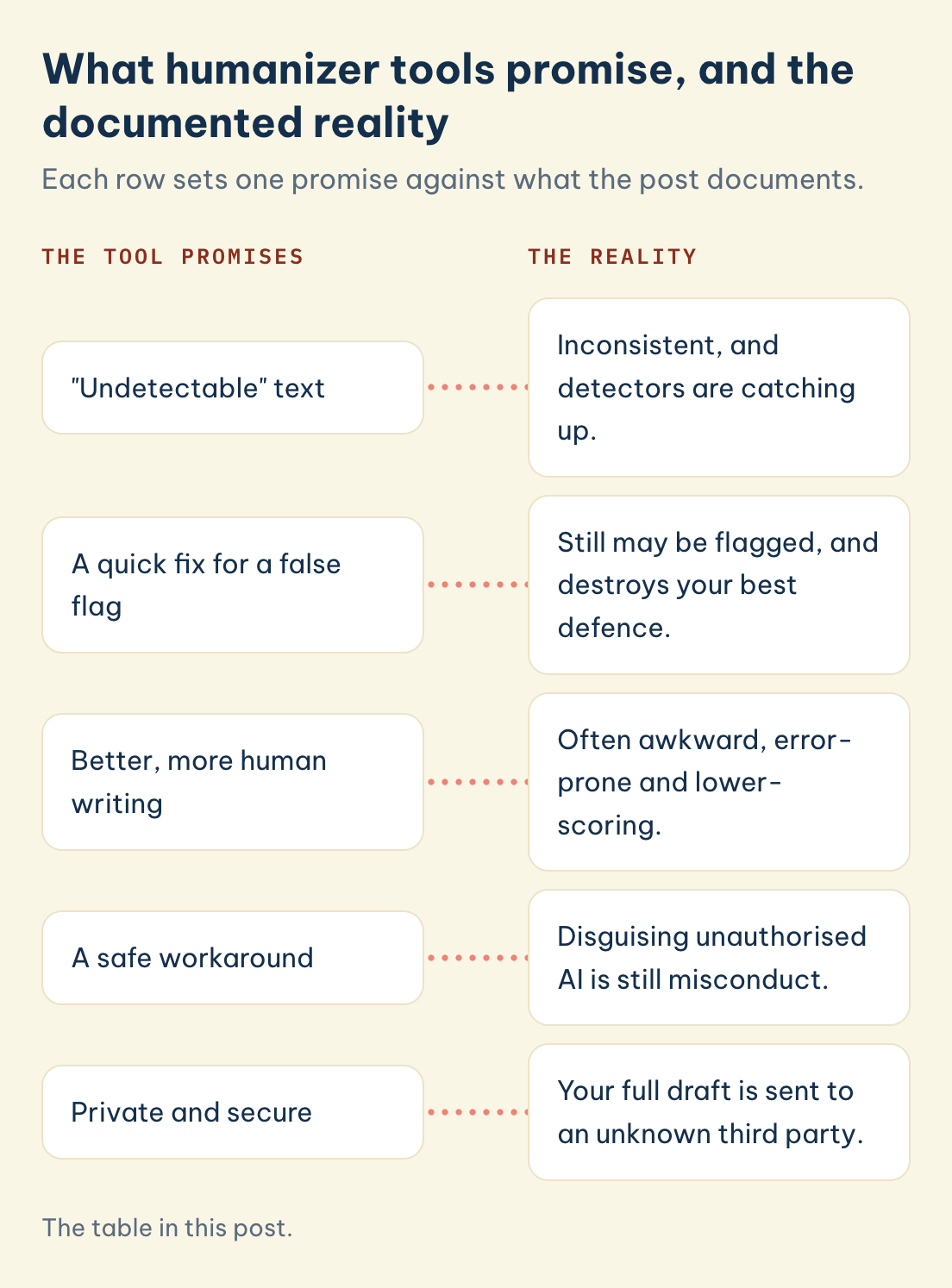
| The tool promises | The reality |
|---|---|
| "Undetectable" text | Inconsistent, and detectors are catching up |
| A quick fix for a false flag | Still may be flagged, and destroys your best defence |
| Better, more human writing | Often awkward, error-prone, and lower-scoring |
| A safe workaround | Disguising unauthorised AI is still misconduct |
| Private and secure | Your full draft is sent to an unknown third party |
Evidence: The combination of unreliable performance (Epaphras & Mtenzi, 2026), improving detection (Masrour et al., 2025), and quality damage (Perkins et al., 2024) means a humanizer exposes you to the penalty without securing the benefit. It is a bad trade under any honest accounting.
Example: A MAAS mentor drew this table out with a student on a whiteboard. Seeing every "promise" cancelled by a "reality", he decided the tool was not worth the risk to his visa and his degree.
◆ Question 7 / 7 · What to do instead
Direct answer: Split the situation in two. If the text really was AI-generated and your course did not allow it, do not submit it; write it yourself, using AI only in permitted, disclosed ways. If the text is genuinely yours but was flagged, do not alter it; gather your evidence, keep your drafts, and be ready to explain your work. In both cases, honesty plus evidence is stronger and safer than any tool that promises to hide something.
What to do instead, in two situations
Tap a situation to see the honest path.
Step 1 of 3
The text was AI-generated
If the text really was AI-generated and your course did not allow it, do not submit it. Write it yourself, using AI only in permitted, disclosed ways.
Step 2 of 3
The text is yours but flagged
If the text is genuinely yours but was flagged, do not alter it. Gather your evidence, keep your drafts, and be ready to explain your work.
Step 3 of 3
In both cases
Honesty plus evidence is stronger and safer than any tool that promises to hide something.
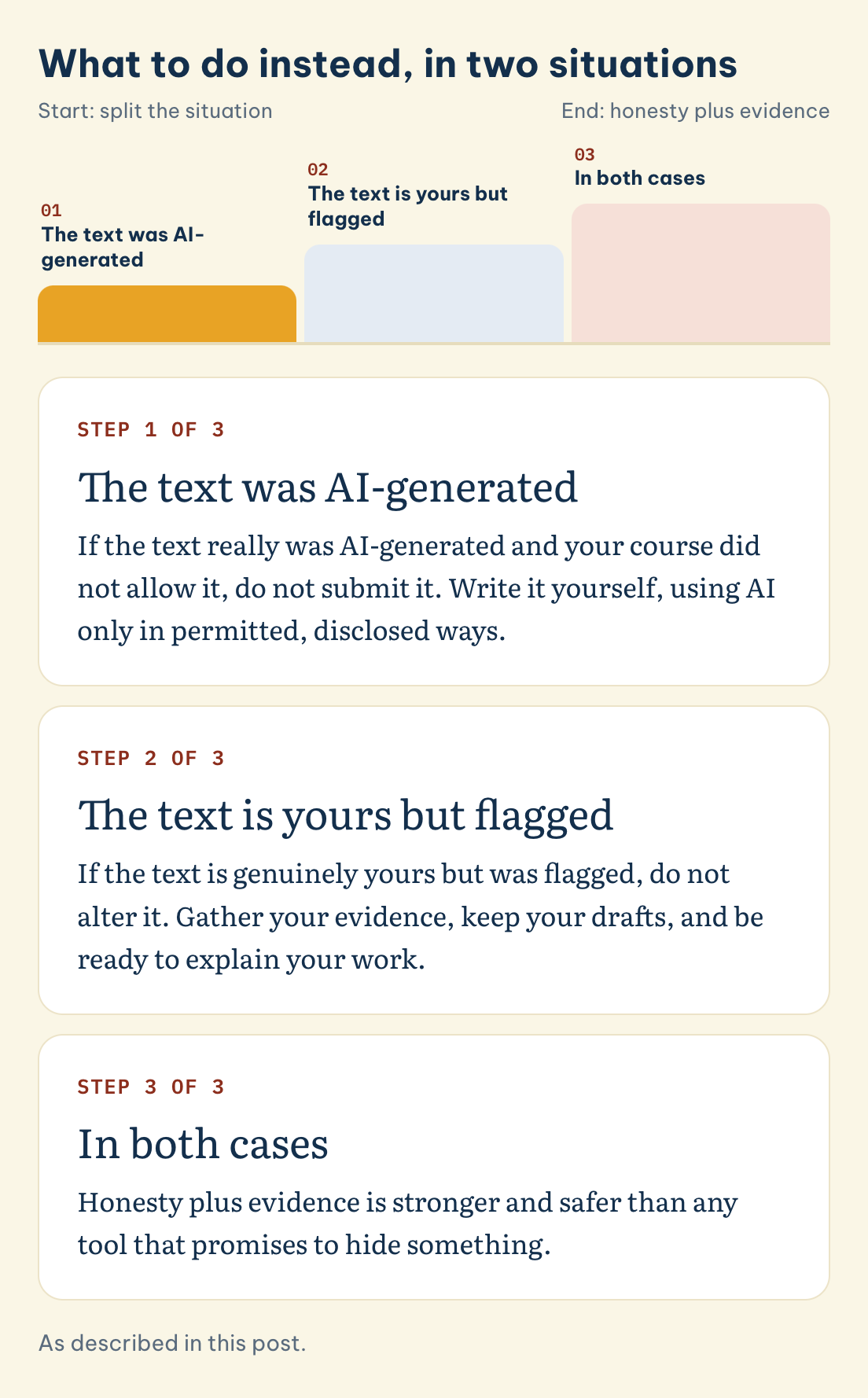
Evidence: University policies increasingly emphasise transparency and student responsibility over detector scores, so the reliable strategy is provable authorship and permitted, disclosed AI use, not concealment. This protects you whether or not a detector misfires.
Example: A Vietnamese student rebuilt her workflow with her MAAS mentor: draft in a tool with version history, use AI only to brainstorm and check with disclosure, and keep every note. She never needed a humanizer again, because she could always prove the work was hers. For what counts as permitted AI use, see our guide on which AI tools you can use for university work.
They are not illegal to exist, but using one to disguise unauthorised AI in your coursework is academic misconduct under university rules, which can lead to failure or expulsion. The legality of the tool is not the point; how you use it is.
Possibly. Detectors are increasingly built to catch humanized text, and humanized writing often reads oddly, which itself invites scrutiny. You cannot rely on it staying hidden, and if it surfaces, you have no honest explanation.
It is understandable, but a humanizer is the wrong tool. It can leave your work still flagged, weaken it, and remove your proof of authorship. Keep your drafts and version history instead; that is what actually protects honest work.
A grammar checker fixes surface errors in your own writing; a humanizer rewrites text specifically to deceive a detector. The first supports your authorship, the second tries to hide it, which is why one is generally acceptable and the other is not.
Yes. MAAS Academic Mentoring helps you respond to a false accusation with evidence, use AI within your course's rules, and keep proof of your own work, all with PhD-level mentors. We coach you to defend honest work, not to disguise it.
The fear that drives students to humanizers is real, but the tool makes things worse. What actually protects you is boring and reliable: write your own work, use AI only where allowed and disclose it, and keep the evidence that the writing is yours.
MAAS Academic Mentoring is an advisory partner. We help you respond to false flags with evidence, understand your course's AI rules, and build habits that keep you safe, without ever disguising or producing your work. If the approach of the mentor you are matched with does not suit the way you learn, you can change mentor.
Bring your situation and we will match you to a mentor in your discipline, 23% of our 100+ experts hold a PhD, within 48 hours when our network already covers that field. If it does not, MAAS opens a dedicated recruitment round for your case, which usually takes about two weeks.
Book a free 20-minute confidential consultation with MAAS Academic Mentoring →
This article is academic-integrity guidance warning students against tools that disguise authorship, and does not replace your own work or your institution's policy. MAAS Academic Mentoring is an advisory partner; we coach students to defend and produce honest work and never to conceal it.
A free 20-minute confidential consultation with a MAAS mentor, to talk through your evidence and your course's AI rules.
Book Free Discovery ▸