
Whether Turnitin can detect AI, ChatGPT included, is the question every anxious student types at 2am, worried the detector will catch it. The honest answer is more complicated, and more reassuring for students doing their own work, than either the "AI is undetectable" or the "you will definitely be caught" camps claim. This guide explains what AI detection can and cannot do, and why chasing or evading the detector is the wrong goal for an honest student.
Author: MAAS Editorial Team · Reviewed by a MAAS subject mentor
Last updated: 2026-06-29
Category: academic-integrity
Can Turnitin actually detect AI-generated text?
Direct answer: Partly, and unreliably. Turnitin's AI-writing indicator estimates how much of a document is likely AI-generated, separate from its similarity score. It flags some AI text, but also misses AI text and, more damagingly, flags human writing as AI. The output is a probability, not proof, and institutions are cautioned not to treat it as conclusive evidence alone.
Evidence: Independent testing of AI-text detection tools found that accuracy is inconsistent and degrades sharply once the text is lightly edited or paraphrased. The researchers state plainly: "the available detection tools are neither accurate nor reliable and have a main bias towards classifying the output as human-written rather than detecting AI-generated text" (Weber-Wulff et al., 2023). Detector vendors themselves report non-zero false-positive rates, which is why a flag is treated as a prompt to investigate, not a verdict.
Example: A Vietnamese Business student at the University of Manchester wrote her essay herself but had a section flagged as "likely AI." Her MAAS advisor explained the flag was a statistical estimate, not evidence, and helped her assemble her draft history to show the work was hers. The flag was an allegation she could answer, not a conviction.
How does Turnitin's AI detection actually work?
Direct answer: It looks at how predictable your writing is, not whether it matches a source. AI detectors measure statistical signals, chiefly perplexity (how surprising each word choice is) and burstiness (how much sentence length and complexity vary). AI text tends to be smooth, even, and low in surprise, so writing that looks unusually uniform scores as "AI-like." Crucially, this is a correlation with AI, not a fingerprint of it: a human can produce the same pattern.
Evidence: Detection methods rely on these probabilistic language metrics rather than any record of what a tool generated, which is why every major detector reports a likelihood and warns against using the score alone (Liang et al. 2023). Because the signal is statistical, anything that makes human writing more uniform, careful editing, simple sentence structures, heavy grammar-checking, can raise the score.
Example: A Vietnamese Engineering student at UNSW wrote in short, clean, consistent sentences, the style he had been drilled in as good academic English. The detector read that uniformity as machine-like. Nothing was generated; his careful style simply matched the pattern the tool penalises, the same mechanism explained in our guide on why honest writing gets flagged.
How accurate is AI detection, and who does it get wrong most?
Direct answer: Accuracy is uneven, and the errors are not random; they fall hardest on non-native English writers. Studies have shown popular detectors flag ESL writing as AI-generated far more often than native-speaker writing, because second-language writing is, on average, more uniform in vocabulary and structure. This means the students least able to argue back in fluent English are the most likely to be wrongly accused, which is precisely why a detector score cannot stand alone.
Evidence: A Stanford study found several widely used AI detectors misclassified the writing of non-native English speakers as AI-generated at strikingly high rates, while rarely misclassifying native writing, and concluded the tools are biased and unreliable as sole evidence (Liang et al. 2023). Broader testing reached the same verdict on accuracy across tools and conditions (Weber-Wulff et al. 2023).
Example: Two Vietnamese students at the same Australian university submitted equally honest essays; the one who wrote in longer, more idiomatic English passed the detector, while the one writing in the careful style she had been taught was flagged. Same integrity, different surface texture and the detector only sees texture.
Does "humanising" AI text or beating the detector ever work?
Direct answer: No and MAAS will not help you do it. Tools that claim to "humanise" AI text to evade detection are unreliable, and deliberately disguising AI-generated work is an academic-integrity violation regardless of the tool used. It is a different thing entirely from defending honest work that was wrongly flagged. Evasion is also treated as an aggravating factor if discovered, turning a borderline case into a serious one. Keep the line bright: produce your own work, and there is nothing to disguise.
Evidence: Integrity policies define misconduct by the act, submitting work that is not genuinely yours, or misrepresenting how it was produced, not by which software was involved (Perkins, 2023). Because detection is unreliable in both directions, "the checker passed it" is never a defence that misconduct did not occur.
Example: A Vietnamese student once asked a MAAS advisor to "make AI text pass Turnitin." The advisor declined and explained why, then offered the real alternative: coaching him to write the piece himself, Outline → Draft → Final, so the work was genuinely his and no detector was a threat. He took that route and submitted with confidence.
What should you do if your honest work is flagged as AI?
Direct answer: Stay calm, do not admit to something you did not do, and gather your evidence. Collect your draft version history, outlines, notes, and annotated sources, then request a meeting and ask the institution to specify exactly what was reported and what its policy says about acting on a detector score. A documented writing process is the strongest rebuttal, because it shows the work developed over time in your hands.
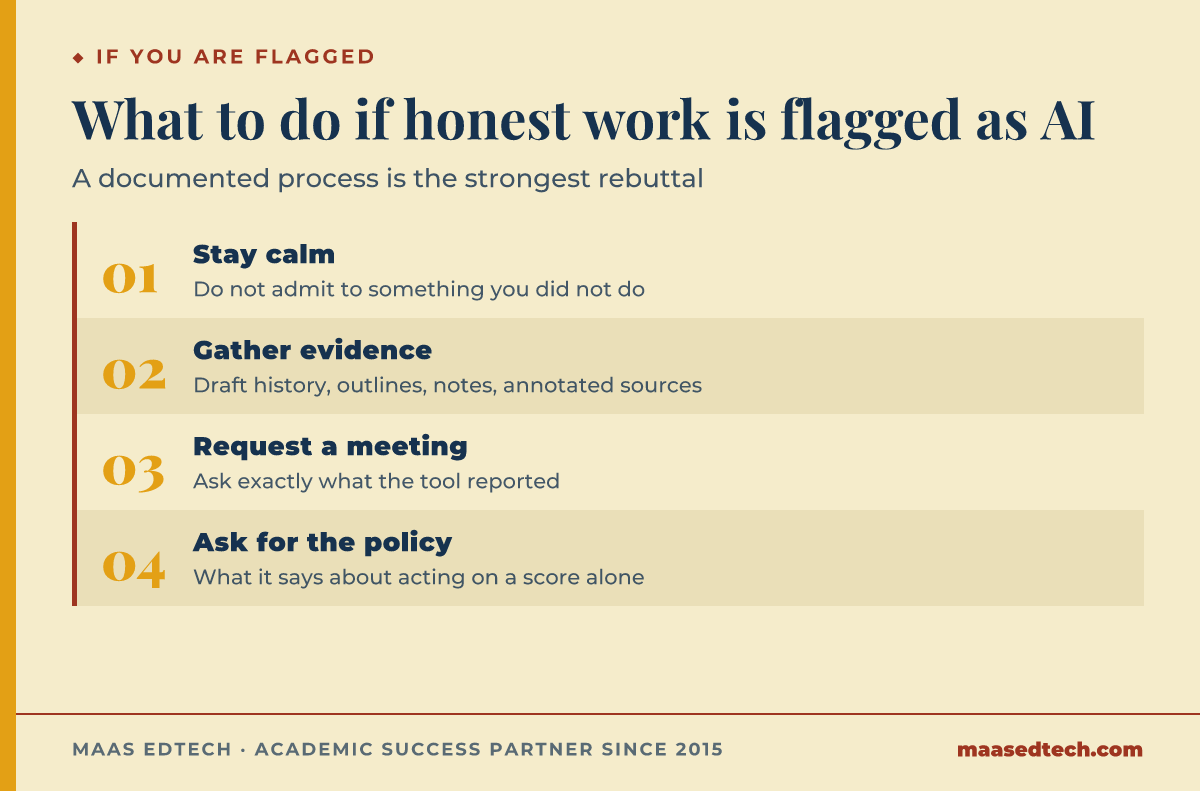
Evidence: Most university misconduct procedures require corroborating evidence beyond a single detector score, and many have issued explicit cautions that AI-detection results are not reliable as sole proof. Your process record, timestamps, edits, comments, is the recognised safeguard precisely because the detector cannot see it.
Example: A Vietnamese postgraduate at the University of Glasgow felt his English was not strong enough to argue back after an AI flag. His MAAS advisor helped him present his document version history showing weeks of incremental edits, plus his handwritten outline. Faced with the drafting trail, the panel cleared him, the process record did the talking.
What is the only reliable way to stay safe?
Direct answer: Write the work yourself and keep evidence that you did. Draft in a tool that preserves version history, save your outlines and notes, let your natural voice vary in sentence length and word choice, and use AI, if your institution permits it, only in ways you could openly disclose. None of this is about gaming the detector; it is about leaving an honest, visible trail so that a flag, if it ever comes, is easy to answer.
Evidence: Because detectors are unreliable in both directions, neither evading nor satisfying them is a sound strategy; the durable safeguard is genuine authorship plus a documented process, which is also what a viva or an integrity panel ultimately tests (Weber-Wulff et al. 2023). Authentic human writing naturally varies in rhythm, the opposite of the flat uniformity detectors penalise.
Example: After one scare, a Vietnamese Marketing student at RMIT adopted her MAAS advisor's habit: draft only in a version-tracked document, keep every outline, and read each paragraph aloud so her own voice came through. Her later submissions carried a clear authorship trail, and she stopped fearing the submission button.
Frequently asked questions
Can Turnitin detect ChatGPT specifically?
Turnitin's AI indicator estimates the likelihood that text is AI-generated in general; it does not name a specific tool. It catches some AI text and misses other AI text, and it sometimes flags human writing so its output is an estimate to investigate, never proof on its own.
Is a high AI score proof I cheated?
No. The AI indicator is a probability based on statistical patterns and is known to misclassify honest writing, especially from non-native English speakers. A high score is an allegation that fair procedures require corroborating evidence to act on.
Can paraphrasing tools hide AI text from detection?
Disguising AI-generated text is an integrity violation in itself, and paraphrasing tools tend to produce awkward prose that markers notice anyway. There is no safe way to pass off generated work as your own.
Why was my own essay flagged as AI?
Usually because it is clear, even, and predictable in structure, the same statistical pattern detectors associate with AI, and one that careful ESL writing produces more often. Our guide on why original writing gets flagged explains the mechanism in detail.
Can MAAS help if I have been wrongly accused?
Yes. The Academic Integrity Check and a MAAS advisor can help you interpret the report, assemble your process evidence, and prepare for an integrity meeting, supporting your own honest work, never disguising generated content.
Related resources
- Why does your own writing get flagged as AI-generated?: the companion guide on AI-detection false positives
- Is 18% similarity on Turnitin bad, and what score is too high?: reading a similarity report match by match
- Similarity score versus AI score: what is the difference?: how the similarity and AI-writing indicators differ and why both matter
- How do you use AI ethically in your academic work?: the permitted-versus-prohibited line, across task types
- How do you disclose AI use in a university research paper?: turning permitted AI use into a clear acknowledgement
- Academic Integrity Check service: similarity and AI-detection interpretation plus a pre-submission audit of your own work
Flagged for AI on work you wrote yourself? Book a free consultation, a MAAS advisor will help you gather your evidence and prepare your response, supporting your own honest work.
References
- Liang, W., Yuksekgonul, M., Mao, Y., Wu, E., & Zou, J. (2023). GPT detectors are biased against non-native English writers. Patterns, 4(7), 100779. https://doi.org/10.1016/j.patter.2023.100779
- Perkins, M. (2023). Academic integrity considerations of AI large language models in the post-pandemic era: ChatGPT and beyond. Journal of University Teaching & Learning Practice, 20(2). https://doi.org/10.53761/1.20.02.07
- Weber-Wulff, D., Anohina-Naumeca, A., Bjelobaba, S., Foltýnek, T., Guerrero-Dib, J., Popoola, O., Šigut, P., & Waddington, L. (2023). Testing of detection tools for AI-generated text. International Journal for Educational Integrity, 19, 26. https://doi.org/10.1007/s40979-023-00146-z
This article is academic-integrity guidance and does not replace your own work or your institution's policy. MAAS coaches students to produce genuinely their own work through the Outline → Draft → Final model; we do not write, submit, or disguise work on a student's behalf.