
Survey finding 01
63.5 of 75
The median score on an integrity-knowledge scale running from 15 to 75, from 60 valid responses out of 67 international respondents (Sanni-Anibire et al. 2021).
◆ Citation and referencing
Yes, you cite paraphrases: an assignment needs a citation for every sentence carrying an idea, argument, number, or wording that did not originate with you, including anything you rewrote in your own words. The only exception is common knowledge in your field. That single rule settles most cases, and this guide works through the ones it does not.
This guide covers the decision rule for which sentences need a citation, how the two halves of the system fit together, when to quote rather than paraphrase, who decides which referencing style you use, and why international students are flagged more often than their attitudes toward honesty would predict. Every claim traces to a university library guide, an official style body, or a peer-reviewed study, listed in full at the end.
◆ Part 1 / 7 · What it does
Direct answer: You cite a source every time you quote, paraphrase, or use a fact that is not common knowledge. Referencing happens in two places at once: an in-text citation showing where a specific idea came from, and a reference list at the end, and every in-text citation must match exactly one entry in that list.
RMIT University Library defines referencing as showing where you got your information from: any idea, argument, or piece of data that came from somewhere else should be traceable back to its origin (RMIT University Library, n.d.-c). Most Vietnamese and international students meet this system through APA Style, whose current guidance sits in the 7th edition of its Publication Manual, published in 2020 and now the default style named in course handbooks across business, education, and social science subjects. The tracing happens in two places at once: a short marker inside the text, in most styles an author's surname and a year, and a reference list at the end carrying the full publication details a reader would need to locate each source.
The stakes are practical. Incomplete or inaccurate referencing can lose marks or lead to a request to resubmit the work, and presenting another person's ideas without acknowledgement can be treated as plagiarism (RMIT University Library, n.d.-c). The same library counts referencing among the skills essential to academic writing rather than an administrative chore (RMIT University Library, n.d.-b), so a careless reference list reads as a signal about the rest of the work.
◆ Part 2 / 7 · Decision rule
Direct answer: You must cite anything taken from a source, whether quoted, paraphrased, or summarised. Your own reasoning and common knowledge do not need one. Widely known facts can stand alone, but specific facts, statistics, or findings that are not common knowledge require a citation even when fully reworded.
The rule is short: material taken from a source needs a citation; your own reasoning and common knowledge do not. Applying it honestly means walking through three cases.
APA Style's basic principles of citation state that both paraphrases and quotations require citations, and that you should cite only works you have actually read and used (American Psychological Association, n.d.). Putting a passage into your own words therefore does not release you from the citation, and the University of Oxford's plagiarism guidance closes the loophole many students hope exists: altering a few words, or closely following the structure of another author's argument, is still plagiarism if the author is not acknowledged (University of Oxford, n.d.).
Not every factual sentence needs a marker. The University of Pennsylvania Libraries describes common knowledge as facts that are widely known, the kind of information readers would accept without asking for proof, and such facts can stand without a citation (University of Pennsylvania Libraries, n.d.). When unsure whether something qualifies, cite it anyway; an unnecessary citation costs little, while a missing one can cost marks.
The same guidance is equally clear on the other side: specific facts, statistics, and research findings that are not widely known must be cited even when expressed entirely in your own words (University of Pennsylvania Libraries, n.d.). The moment a reader could reasonably ask where a number came from, the sentence owes them an answer, and paraphrasing the number does not cancel the debt.
◆ Part 3 / 7 · Two halves
Direct answer: In-text citations pair an author's surname with the year, using et al. from three authors onward, while each reference list entry names the author, date, title, and source in full for up to 20 authors. Before submitting, check both directions: every citation matches one entry, and every entry is cited somewhere.
In-text citation and reference list, side by side
Each row sets the two halves against one feature.
In-text citation
Reference list
A short marker inside the text, in most styles an author's surname and a year.
A list at the end carrying the full publication details a reader would need to locate each source.
For one or two authors, name them in every citation. For three or more, use only the first author's surname plus "et al." from the very first citation.
Works with up to 20 authors name every author in full. At 21 or more, the entry gives the first 19 authors, an ellipsis and the final author.
Every in-text citation corresponds to exactly one entry in the list.
Every entry is cited at least once in the text.
Referencing systems have two halves, and many of the avoidable marks are lost in the gap between them.
In an author-date system such as APA, every in-text citation pairs the author's surname with the year of publication (American Psychological Association, 2019). The counting rules are mechanical: for a work with one or two authors, name them in every citation, while for three or more you use only the first author's surname followed by "et al." from the very first citation (James Cook University Library, n.d.-a). Where the author is an organisation, its full name takes the author position.
Each entry answers four questions: who created the source, when, what it is called, and where to find it. APA Style names these the 4 elements of a reference: author, date, title, and source (American Psychological Association, 2022a). In the list the abbreviation logic reverses: works with up to 20 authors name every author in full, and only at 21 or more does the entry compress to the first 19 authors, an ellipsis, and the final author (James Cook University Library, n.d.-a).
The two terms are not interchangeable. A reference list contains only the works you actually cited in the assignment, while a bibliography can also include background reading you never cited, and APA Style requires reference lists rather than bibliographies (American Psychological Association, 2022d).
That distinction sets up the most useful pre-submission check. Read the finished assignment once with the reference list beside it and confirm the match in both directions: every in-text citation corresponds to exactly one entry in the list, and every entry is cited at least once in the text. A citation with no entry, or an entry with no citation, is an error a marker can spot in seconds.
◆ Part 4 / 7 · Quote or paraphrase
Direct answer: Quote directly only for exact definitions or a memorable phrase, keeping quotations under 40 words inline and blocking longer ones. Otherwise paraphrase, since it lets you synthesise sources while carrying your own argument, though it still needs a citation. For ideas read secondhand, use "as cited in" and reference only the source you read.
Three ways to bring another author's idea into your text
Tap a move to see when to use it and what it needs.
Quote directly
Quote when you reproduce an exact definition, when an author has said something memorably or succinctly, or when you want to respond to their exact wording. Every quotation carries a page number or other locator. A quotation under 40 words stays inside quotation marks in your paragraph, while one of 40 words or more becomes an indented block without quotation marks.
Paraphrase
For most of an assignment, paraphrase is the better instrument, since it lets you summarise and synthesise several sources at once while keeping the emphasis on your own argument. It still carries a citation, and swapping a few words or shadowing the original's structure is plagiarism rather than paraphrase.
As cited in
Use it when the idea appears inside another author's work and you have not read the original. Name the original author in the text with "as cited in" the source you read, in the pattern (Author X, Year, as cited in Author Y, Year), and enter only the source you read in the reference list. Use it sparingly and read the original where it is available.
Once a sentence needs a citation, you still have to decide what form the borrowed material takes.
APA Style's advice is to quote directly when reproducing an exact definition, when an author has said something memorably or succinctly, or when you want to respond to their exact wording, and to paraphrase in most other situations (American Psychological Association, 2022c). Every direct quotation carries a page number or other locator, and length changes the formatting: a quotation under 40 words stays inside quotation marks in your paragraph, while one of 40 words or more becomes an indented block without quotation marks (American Psychological Association, 2022c).
For most of an assignment, paraphrase is the better instrument, since it lets you summarise and synthesise several sources at once while keeping the emphasis on your own argument (American Psychological Association, 2022b). The paraphrase still carries a citation, and the bar for what counts as your own words is higher than many students assume: Oxford treats a passage with a few words swapped, or one that shadows the original's structure, as plagiarism rather than paraphrase (University of Oxford, n.d.). A habit that helps is to close the source before drafting the paraphrase, then reopen it only to check accuracy.
Sometimes the idea you want appears inside another author's work, taken from a source you have not read yourself. APA Style's rule keeps the reference list honest: name the original author in the text with "as cited in" the source you read, in the pattern (Author X, Year, as cited in Author Y, Year), and enter only the source you read in the reference list (American Psychological Association, 2022e). The same guidance asks you to use secondary citations sparingly and to read the original wherever it is available.
◆ Part 5 / 7 · Which style
Direct answer: Your course sets the referencing style, not you, so check with whoever marks the assignment. Business and social science units usually default to APA or Harvard, humanities to MLA, law to OSCOLA or AGLC, and some sciences to Vancouver. Citation generators save time but still need checking against the style guide.
The style is a course decision, not a personal preference. RMIT University Library's instruction is to check with whoever is marking the assessment about which referencing style to use (RMIT University Library, n.d.-b), and its Easy Cite tool covers 7 different styles side by side precisely because requirements differ between courses at the same institution (RMIT University Library, n.d.-a). Two assignments in the same semester can legitimately demand two different systems, so confirm before you build the list in the wrong one. Course handbooks are typically reissued every 12 months, so a style guide saved from a previous intake can already be out of date by the time an assignment is due. Style tends to follow discipline as much as institution: business and social science units in Australia and the UK usually default to APA or Harvard, humanities units often specify MLA, law units frequently require OSCOLA or AGLC, and some science units use the numbered Vancouver system instead of an author-date system. Where the choice is between APA and Harvard, the difference between APA and Harvard referencing lines them up. The Harvard style gets its own full treatment in Harvard referencing.
A caution belongs here about citation generators. Tools that assemble references automatically can save time, but RMIT is direct that generated output still has to be checked against the style guide, and relying on it unchecked can cost marks (RMIT University Library, n.d.-a). If your course uses APA, our APA 7th guide for entry-by-entry formats works through the templates one source type at a time, and step five of the 6-step assignment guide shows where referencing sits in the wider writing process. Referencing is one stage of the whole job, and how to do a university assignment walks through the rest.
◆ Part 6 / 7 · Numbered styles
Direct answer: Physics, engineering and chemistry mostly use numbered systems rather than author-date. IEEE puts the number on the line in square brackets, AIP defaults to a superscript numeral, and ACS accepts 3 in-text formats. Numbering follows order of appearance, so inserting a source mid-draft renumbers everything after it.
ACS in-text formats
3
are accepted, and the post says to pick one and use it throughout the paper
IEEE reference list
Up to six
names of all authors in the list, while in the text "et al." starts at 3 or more names
Three numbered systems, three habits
Tap a system to see how it handles the number.
System 1 / 3
IEEE
References appear on the line, in square brackets, inside the punctuation. Numbers are assigned by order of appearance and reused, and one number belongs to exactly one document. A number can carry a location, as in [3, Fig. 1], [3, Sec. 4.5] or [3, Appendix I].
System 2 / 3
AIP
Superscript numerals run consecutively through the text and sit after commas, periods, quotation marks, colons and semicolons, never where they might be mistaken for numbers with a different meaning. An author-date arrangement with an alphabetical list may be permitted in some cases.
System 3 / 3
ACS
Three in-text systems are acceptable, which are a superscript numeral, a number in parentheses and an author-date form, and you pick one and do not mix them. The choice decides the list order, since numerical in-text citations require a numerically ordered list and author-date citations an alphabetical one.
Author-date systems are not universal, and a student moving into a technical unit meets a different logic entirely. In a numbered system the reader is not told who said something at the point of reading, only where to look, and the reference list is ordered by first appearance in the text instead of alphabetically. That single change turns referencing from a formatting task at the end into a sequencing task you carry through the whole draft.
IEEE style is the one engineering students meet first. Its official guide states that references "appear on the line, in square brackets, inside the punctuation" and that "grammatically, they may be treated as if they were footnote numbers", so a sentence reads naturally with the bracket sitting inside the full stop (IEEE, 2018). Numbers are assigned by order of appearance and reused, a point 2 Australian library guides state in identical words: "citations are numbered in the order in which they appear in the text and each citation corresponds to a numbered reference", and "once a source has been cited, the same number is used in all subsequent references" (Murdoch University Library, n.d.; James Cook University Library, n.d.-b). The reference list itself lists "names of all authors, up to six names", switching to et al. beyond that, while in the text "et al." starts at 3 or more names, and one number belongs to exactly one document because IEEE instructs writers not to combine references (IEEE, 2018). A number can carry a location, as in [3, Fig. 1], [3, Sec. 4.5] or [3, Appendix I].
AIP style, used across physics, moves the number above the line. Its style manual instructs writers that "for references cited in the text use superscript numerals running consecutively through the text", and to "place citation indicators after commas, periods, quotation marks, colons, and semicolons" (American Institute of Physics, 1990). One warning in that manual is easy to trip over in a physics paper full of figures: "do not put citation indicators where they might be mistaken for numbers with a different meaning", which is why a citation never sits immediately after a variable or an exponent. Guidance for physics students at Hong Kong University of Science and Technology (n.d.) puts the same system plainly, as "citations indicated by superscript numerals in consecutive numerical order through the text, with the references themselves arranged in the same order at the end of the paper", with et al. used beyond 3 authors. AIP is not exclusively numeric, and its manual says so: an author-date arrangement with an alphabetical list "may be permitted in some cases" (American Institute of Physics, 1990). Library guidance at the University of Southern California (n.d.) makes the practical consequence explicit, since a numeric in-text style requires a numerically ordered list while an author-date style requires an alphabetical one.
ACS style, in chemistry, offers 3 in-text systems and forbids mixing them. Guidance from West Virginia University Libraries (n.d.) states the rule directly: "all three are acceptable, but it is important to pick one and use it throughout your paper. Do not use multiple formats in the same paper." The 3 options are a superscript numeral, a number in parentheses as in "the mineralization of TCE by a pure culture of a methane-oxidizing organism has been reported (6)", and an author-date form that names the first author, then et al. and the year, inside parentheses (Stonehill College Library, n.d.). Which one you pick decides the list order, since numerical in-text citations require a numerically ordered list and author-date citations an alphabetical one (Williams College Libraries, 2026). One detail dates older handouts: the author-date option is "not currently used in ACS publications", and the current rules sit in chapter 4.3 of The ACS Guide to Scholarly Communication.
The practical difference from Harvard or APA arrives when you add a source late. Inserting a new reference at paragraph 3 of a numbered draft pushes every later number up by 1, in the body and in the list. IEEE (2018) states the maintenance cost as a note to its own editors: "editing of references may entail careful renumbering of references, as well as the citations in text." The defence is to use your word processor's cross-reference or citation manager rather than typed digits, and to leave renumbering until the argument has stopped moving, which is the same reason the editing pass comes before the proofread.
◆ Part 7 / 7 · Why students are flagged
Direct answer: International students appear in misconduct reports far more often than domestic peers, at ratios around 3 to 1 and 2 to 1, yet their attitudes toward integrity are comparable. The gap traces to unfamiliarity with source-integration conventions, not dishonesty, though ignorance of the rules still offers no protection against a plagiarism charge.
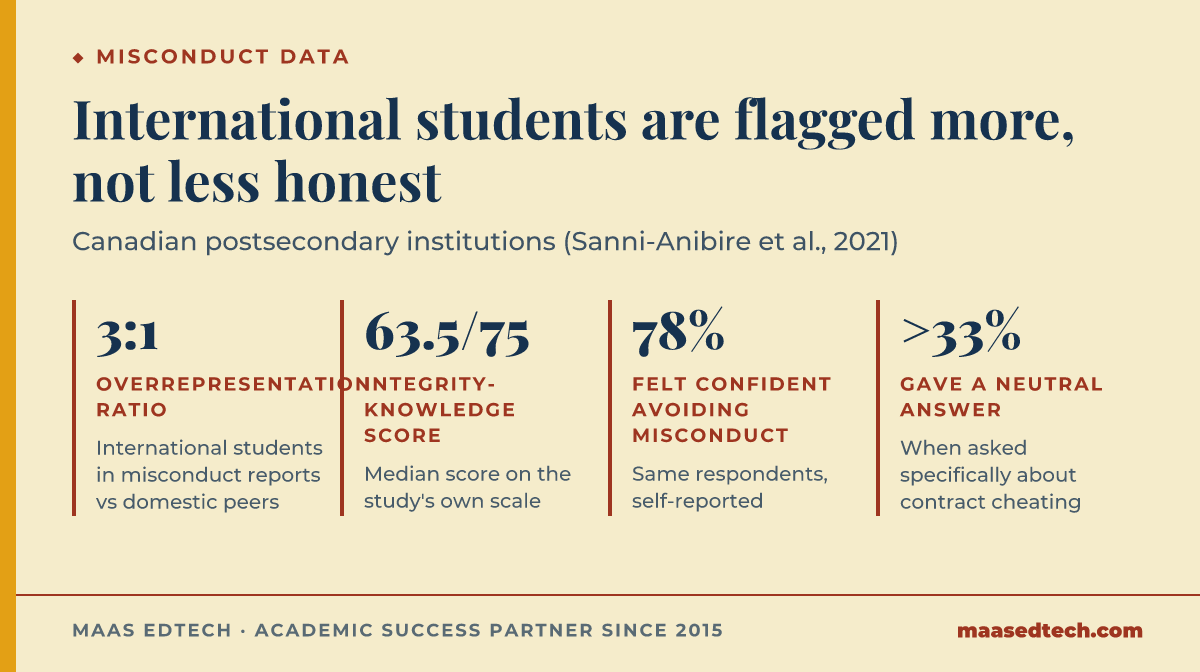
International students in misconduct reports
Around 3 to 1 and 2 to 1
are the ratios of over-representation relative to domestic students, while their attitudes toward integrity and self-reported misconduct are comparable (Sanni-Anibire et al. 2021)
The median score on an integrity-knowledge scale running from 15 to 75, from 60 valid responses out of 67 international respondents (Sanni-Anibire et al. 2021).
Said they felt confident about avoiding misconduct, hardly the profile of a group indifferent to the rules (Sanni-Anibire et al. 2021).
Gave a neutral answer when asked about contract cheating, evidence of a specific knowledge gap rather than a general disregard for the rules (Sanni-Anibire et al. 2021).
International students appear in academic misconduct reports considerably more often than their domestic peers, and it is worth being honest about both halves of that fact. Universities do have to investigate every suspected breach; an integrity process that looked away from some cases would protect no one.
The instructive finding sits behind the raw counts. A peer-reviewed review of academic integrity among international students at Canadian institutions reports over-representation in misconduct cases at ratios around 3 to 1 and 2 to 1 relative to domestic students, while finding their attitudes toward integrity, and their self-reported rates of misconduct, comparable (Sanni-Anibire et al. 2021). In the authors' own words, “International students are overrepresented (by ratios of 3:1 or 2:1) in reports of academic misconduct” (Sanni-Anibire et al. 2021). The underlying survey narrowed 67 international respondents down to 60 valid responses, and on an integrity-knowledge scale running from 15 to 75 the median score was 63.5, with 78% saying they felt confident about avoiding misconduct, hardly the profile of a group indifferent to the rules (Sanni-Anibire et al. 2021). The same respondents disagreed most on what counts as duplicate submission, or self-plagiarism, and more than 33% gave a neutral answer when asked about contract cheating, evidence of a specific knowledge gap rather than a general disregard for the rules (Sanni-Anibire et al. 2021). The gap has a named, unglamorous explanation: lack of knowledge of the conventions for integrating sources, compounded by expectations of academic integrity that differ between countries, so the rules a student mastered at home may not be the rules applied abroad (Sanni-Anibire et al. 2021).
Unfamiliarity, however, is not a safe harbour. Oxford states plainly that ignorance of referencing conventions offers no sure protection against a charge of plagiarism, even though intention affects how a case is treated, and penalties range from deducted marks to expulsion (University of Oxford, n.d.). Weighed together, the evidence supports a calmer conclusion: a referencing flag is usually the symptom of a learnable skills gap rather than a verdict on a student's honesty, so the productive response is to learn the conventions deliberately, and to understand what a similarity score does and does not mean before drawing conclusions from one.
Yes. APA Style states that both paraphrases and quotations require citations, and the University of Oxford's plagiarism guidance is explicit that altering a few words or closely following the structure of another author's argument is plagiarism if you do not acknowledge the author. Rewording changes the format of the debt, not the debt itself.
No. Facts that are widely known, which the University of Pennsylvania Libraries calls common knowledge, can stand without a citation. Specific facts, statistics, and research findings that are not widely known must be cited even when you express them entirely in your own words.
For a work with one or two authors, name them in every citation. For three or more authors, APA Style uses only the first author's surname plus "et al." from the very first citation, while the reference list still names all authors in full up to 20, as James Cook University's APA guide sets out.
A reference list contains only the works you actually cited in the assignment, and APA Style requires a reference list rather than a bibliography. A bibliography is broader: it can include background or further reading that never appears in your text.
It can be. The University of Oxford warns that genuine ignorance of referencing conventions offers no sure protection against a charge of plagiarism, although intent affects the penalty. Peer-reviewed research on international students suggests that unfamiliarity with source-integration conventions, not dishonesty, explains much of why they are over-represented in misconduct reports (Sanni-Anibire et al. 2021).
The style is set by your course, not chosen by you. RMIT University Library instructs students to check with whoever is marking the assessment about which referencing style to use, and different courses within the same university can require different styles, so confirm before you build the reference list. As a rough guide, business and social science units usually default to APA or Harvard, humanities units often specify MLA, and law units frequently require OSCOLA or AGLC, but the only reliable source is your own unit outline.
Use a secondary citation. In APA Style you name the original author in the text with "as cited in" the source you actually read, for example (Author X, Year, as cited in Author Y, Year), and only the source you read goes in the reference list. APA advises doing this sparingly and reading the original where it is available.
A referencing problem is easy to fix before the deadline but costly after. MAAS offers an academic integrity check that cross-checks in-text citations against the reference list, confirms your required style is applied consistently, and reviews the integrity of your paraphrasing, leaving the corrections for you to make.
A referencing problem found before the deadline is a fixable draft issue; the same problem found after submission is a mark deduction or a misconduct conversation. If you would rather know first, a MAAS reviewer can run an academic integrity check on your draft, cross-checking the match between in-text citations and reference list, the consistency of the style your course requires, and the integrity of your paraphrasing. The corrections, like the writing, remain yours to make.
A free 20-minute discovery call with a MAAS advisor, to talk through your referencing and your institution's policy.
Book Free Discovery ▸