
◆ Publishing advisory
How do you write the methods section of a research paper?
The methods section of a research paper explains what you did and why, in enough detail that another researcher could reproduce your study. For Vietnamese researchers and students, it is the part of a Scopus-targeted manuscript reviewers scrutinise first: weak methods sink an otherwise sound study before the findings are even read.
This guide answers the seven questions Vietnamese researchers ask MAAS publishing mentors most often at the methods stage.

◆ Question 1 / 7 · What it is for
What is the methods section, and what is it actually for?
Direct answer: The methods section describes what you did to answer your research question, your design, participants or materials, how you collected data, and how you analysed it. Its job is to let a reader judge whether your conclusions are valid and let another researcher reproduce the study. It reports procedures, not results.
Evidence: An informative methods section lets readers understand how and why the experiments were performed, reproduce the study with an expectation of success, and accept that the conclusions are valid given the design (Annesley, 2010, pages 897 to 901). The methods of original quantitative research rest on four basic elements, study design, setting and subjects, data collection, and data analysis, plus a statement on ethics (Kotz & Cals, 2013).
Example: A Vietnamese first-time author brought a MAAS mentor a methods section full of numbers she had observed. Her mentor suggested she separate the two: the methods described the procedure; the numbers moved to the results and a reviewer who had questioned her rigour accepted the revision.
◆ Question 2 / 7 · Structure
How should you structure a methods section?
Direct answer: Follow a fixed, predictable order: study design, setting and participants or materials, data collection, and data analysis, closing with ethics approval and consent. Use subheadings for each block. A reviewer should be able to map every method onto a matching result, so describe everything you later report and nothing you do not.
The five elements of a methods section
Tap an element to see what it reports and the mistake to avoid.
Study design
It reports the type of study and its rationale. The common mistake is naming a design without justifying it.
Setting and participants
It reports where, when, who, and the eligibility criteria. The common mistake is vague or missing inclusion criteria.
Data collection
It reports instruments, measures, and procedures. The common mistake is describing tools too thinly to reproduce.
Data analysis
It reports tests, models, and software. The common mistake is listing tests with no link to hypotheses.
Ethics
It reports the approval body, the reference number, and consent. The common mistake is omitting approval for human-subject work.
Save this figure
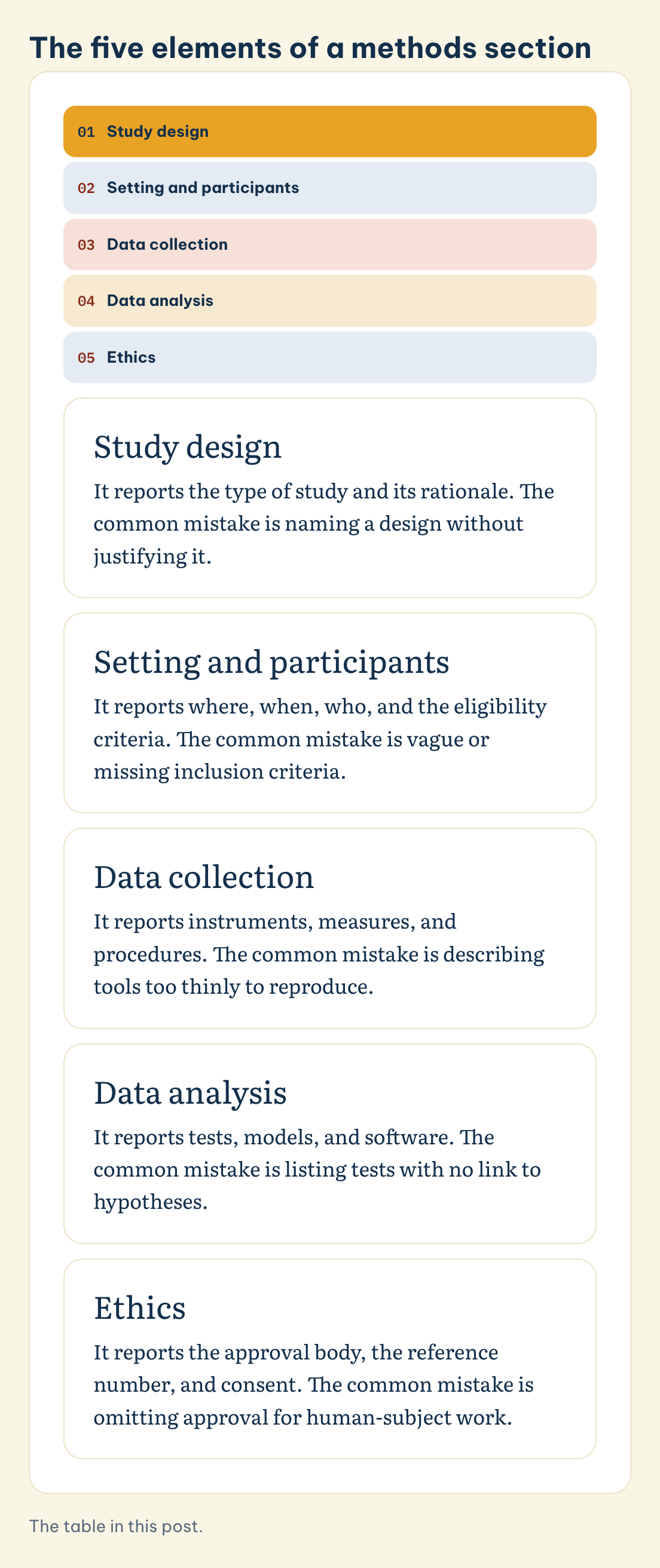
Evidence: The methods section of a quantitative paper is built from study design, setting and subjects, data collection, and data analysis, and it should report ethical approval and informed consent where human participants are involved (Kotz & Cals, 2013). For each "what you did" there should be a corresponding "what you found," so a reviewer can map every method onto a matching result (Annesley, 2010).
| Methods element | What it reports | Common mistake |
|---|---|---|
| Study design | The type of study and its rationale | Naming a design without justifying it |
| Setting and participants | Where, when, who, and eligibility criteria | Vague or missing inclusion criteria |
| Data collection | Instruments, measures, and procedures | Describing tools too thinly to reproduce |
| Data analysis | Tests, models, and software | Listing tests with no link to hypotheses |
| Ethics | Approval body, reference number, consent | Omitting approval for human-subject work |
Example: A MAAS-coached postgraduate had merged her sampling, instruments, and statistics into one dense paragraph. Her mentor suggested she split the section into labelled subheadings following the order above; the same content read as an auditable procedure a reviewer could check.
◆ Question 3 / 7 · How much detail
How much detail is enough for the methods section?
Direct answer: Enough that a competent researcher in your field could repeat the study and expect the same kind of result. Specify the who, what, when, where, how, and why of each procedure. If a detail would change whether the study could be reproduced, a dose, a sampling window, a model setting, include it.
Evidence: A successful methods section is a recipe: it combines what was done, when, where, who did it, and why, so a reader can understand and repeat the work (Annesley, 2010). Reporting guidelines exist because reproducible methods need named, checkable items, STROBE, for example, asks observational studies to state eligibility criteria, sources, and how variables were measured (von Elm et al. 2007).
Example: A Vietnamese researcher targeting a Q2 journal wrote only that she had "used a survey." Her MAAS mentor helped her add the instrument's source, number of items, response scale, sampling window, and response rate, the detail a reviewer needs to reproduce the work.
◆ Question 4 / 7 · Tense and voice
What tense, voice, and language should the methods section use?
Direct answer: Write the methods in the past tense, because the work is finished. Describe procedures plainly and in a logical order. You may use the first person and active voice where your target journal allows it, "we recruited" is clearer than "subjects were recruited" but consistency matters most. Keep ESL prose simple and direct.
Evidence: Because the methods report a completed study, they are written predominantly in the past tense, and clarity is served by describing procedures in the order they were carried out (Kotz & Cals, 2013). Plain, recipe-style description communicates a method more reliably than ornate prose (Annesley, 2010).
Example: A Vietnamese postgraduate writing in English as a second language had alternated between passive and active voice within one paragraph. Her MAAS mentor worked with her to standardise the section into consistent past-tense, active sentences; the methods read as precise rather than uncertain, which matters when a reviewer judges competence.
◆ Question 5 / 7 · Reporting guidelines
How do reporting guidelines shape your methods section?
Direct answer: Pick the reporting guideline that matches your study design and write your methods against its checklist before you submit. Each guideline tells you which methodological items a journal expects, which is the fastest way to avoid a methods-based desk rejection. Most Scopus journals name the guideline they require in their author instructions.
CONSORT 2010
25
checklist items in the 2010 version of CONSORT
PRISMA 2020
27
checklist items in the current PRISMA checklist
Which reporting guideline matches which design
Tap a guideline to see the design it serves and the methods items it governs.
Guideline 1 / 3
CONSORT
It serves a randomised controlled trial, and it governs randomisation, blinding, and outcomes.
Guideline 2 / 3
STROBE
It serves an observational study (cohort, case-control, cross-sectional), and it governs eligibility, sources, and variables.
Guideline 3 / 3
PRISMA
It serves a systematic review or meta-analysis, and it governs search, screening, and data extraction.
Save this figure
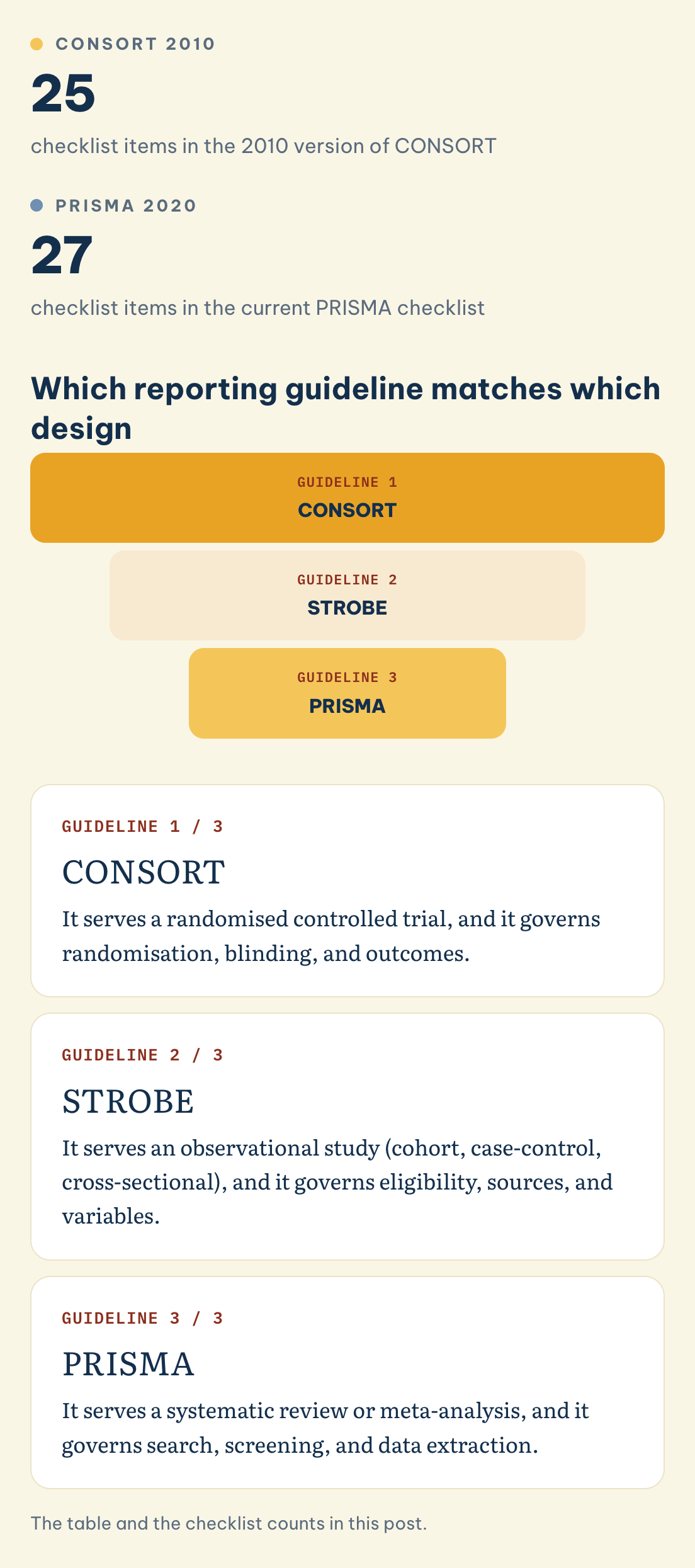
Evidence: Different designs have dedicated guidelines: CONSORT for randomised trials specifies how randomisation, blinding, and outcomes must be reported (Schulz et al. 2010); STROBE covers cohort, case-control, and cross-sectional studies (von Elm et al. 2007). Drafting the methods against the relevant checklist ensures each required element is present and checkable (Annesley, 2010).
| Study design | Reporting guideline | Methods items it governs |
|---|---|---|
| Randomised controlled trial | CONSORT | Randomisation, blinding, outcomes |
| Observational (cohort, case-control, cross-sectional) | STROBE | Eligibility, sources, variables |
| Systematic review or meta-analysis | PRISMA | Search, screening, data extraction |
Each of these checklists has grown through revision, which is itself a reason to check you are using the current version. CONSORT was first published in 1996 and revised in 2001 and again in 2010, and the 2010 version runs to 25 checklist items. PRISMA was first published in 2009 and updated in 2020, and its current checklist runs to 27 items. STROBE, cited above as von Elm et al. (2007), has stayed at one main version since that 2007 publication. Citing an outdated checklist version is a small, avoidable error that a mentor or a quick search catches before submission.
Example: A MAAS Publishing Advisory client preparing a cohort study had not heard of STROBE. Her mentor walked her through the checklist, and three omitted items, eligibility criteria, how a key variable was measured, and how she handled missing data, went into the methods before submission.
◆ Question 6 / 7 · Analysis and ethics
How do you describe statistical analysis and ethics in the methods?
Direct answer: State which analyses you ran, on which outcomes, and with which software and version, and pre-specify your primary analysis so reviewers see it was planned rather than chosen after seeing the data. For human-participant studies, name the ethics committee, the approval reference, and how you obtained consent. These two blocks are where reviewers look hardest.
What to state about analysis and ethics
Tap a step to see what to write.
Step 1 of 3
State the analyses
State which analyses you ran, on which outcomes, and with which software and version.
Step 2 of 3
Pre-specify the primary one
Pre-specify your primary analysis so reviewers see it was planned rather than chosen after seeing the data.
Step 3 of 3
Name the ethics approval
For human-participant studies, name the ethics committee, the approval reference, and how you obtained consent.
Save this figure
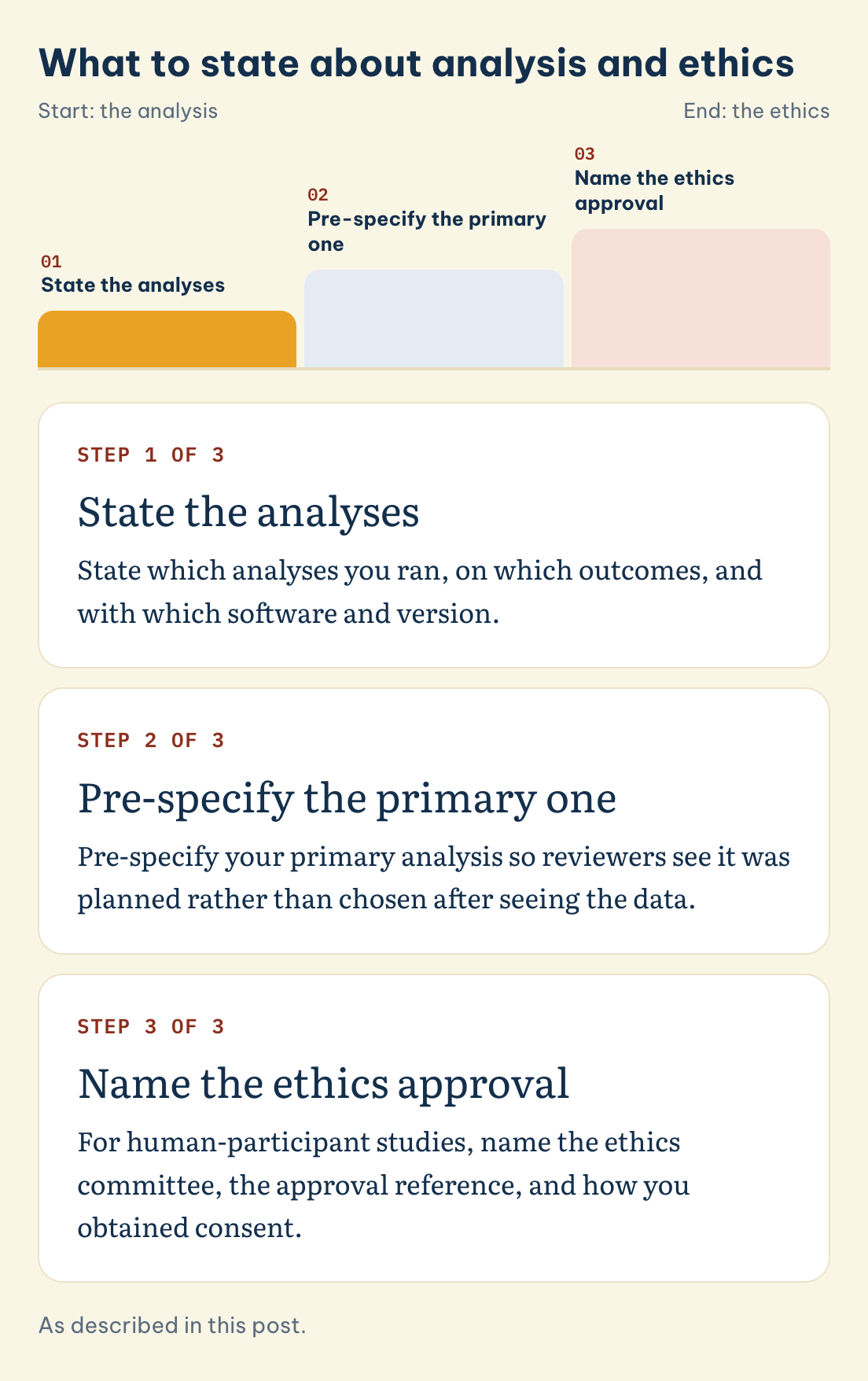
Evidence: The data-analysis element of the methods should describe the statistical approach for each objective and the software used, and the section should report ethical approval and informed consent where relevant (Kotz & Cals, 2013). International standards make this a precondition for publication: "All authors should seek approval to conduct research from an independent local, regional or national review body (e.g., ethics committee, institutional review board)" (International Committee of Medical Journal Editors, n.d.), so the integrity of human-subject research can be verified.
Example: A Vietnamese author had written "data were analysed statistically" and said nothing about ethics. Her MAAS mentor helped her name each test against the objective it served, add the software and version, and insert the ethics approval number and consent statement, turning a section a reviewer would have rejected into a defensible plan.
◆ Question 7 / 7 · Mistakes to avoid
What methods-section mistakes get a paper rejected, and how can Vietnamese and ESL researchers avoid them?
Direct answer: The recurring triggers are too little detail to reproduce the study, no link between analyses and hypotheses, missing ethics statements, a design that does not fit the question, and reporting results inside the methods. Avoid them by drafting against a reporting guideline and getting feedback from a mentor who has assessed manuscripts from the reviewer's side.
Five methods mistakes and the fix for each
Each row sets a mistake against why reviewers reject it and how to fix it.
The mistake
Why reviewers reject it, and the fix
Too little detail
The study cannot be reproduced. The fix is to add who, what, when, where, and how.
Analyses not tied to aims
It looks like fishing for results. The fix is to map each test to a hypothesis.
Missing ethics statement
Integrity cannot be verified. The fix is to name the committee, the number, and consent.
Design does not fit the question
It undermines every finding. The fix is to justify the design choice.
Results stated in methods
It blurs procedure and finding. The fix is to move all numbers to results.
Save this figure
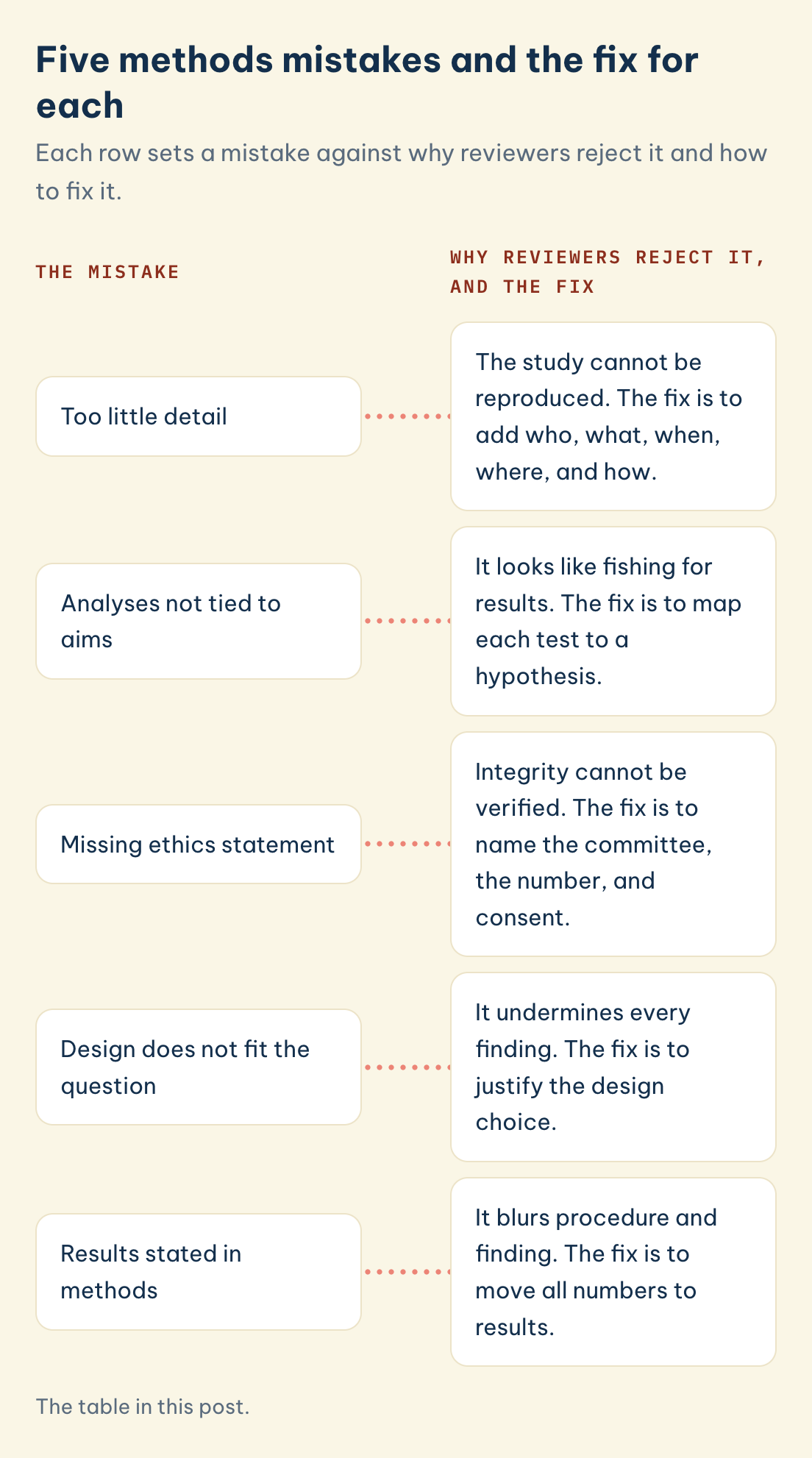
Evidence: Methods fail when they omit checkable detail, separate analyses from objectives, or leave out required ethics reporting (Kotz & Cals, 2013; International Committee of Medical Journal Editors, n.d.). As more Vietnamese researchers target Scopus Q1 and Q2 journals, a complete, guideline-aligned methods section is a low-cost way to clear the methodological bar rather than lose a sound study to avoidable gaps.
| Mistake | Why reviewers reject it | The fix |
|---|---|---|
| Too little detail | Study cannot be reproduced | Add who, what, when, where, how |
| Analyses not tied to aims | Looks like fishing for results | Map each test to a hypothesis |
| Missing ethics statement | Integrity cannot be verified | Name committee, number, consent |
| Design does not fit question | Undermines every finding | Justify the design choice |
| Results stated in methods | Blurs procedure and finding | Move all numbers to results |
Example: A MAAS mentor guided a Vietnamese author through the Outline → Draft → Final model: an outline fixing the methods order against STROBE, a draft describing each procedure in reproducible detail, and a final ESL polish, the mentor advising at each stage, the author writing throughout.
Frequently asked questions
What should the methods section of a research paper include?
Describe the study in the order a reader needs it: design, setting and participants or materials, data collection, then analysis, and end with ethics approval and informed consent when people took part (Kotz & Cals, 2013). Every method you list should have a matching result, and every result a method behind it (Annesley, 2010).
How long should the methods section be?
There is no fixed length; it should be exactly as long as it takes to let another researcher reproduce the study. Include every procedure you later report, leave out background that belongs in the introduction, and use subheadings to keep it navigable.
Should the methods section be written in the past or present tense?
Mostly the past tense, because you are describing a completed study. Keep the tense consistent and describe procedures in the order you carried them out, the easiest order for a reviewer to audit against your results.
Can I use the first person in the methods section?
Often yes. Many journals now accept "we recruited" or "we measured," and the active voice is usually clearer than the passive. Check your target journal's guidelines, then apply one consistent choice across the section.
What is the difference between the methods and the materials section?
In many fields they are combined as "Materials and Methods." Materials are what you used, instruments, reagents, datasets and methods are what you did with them. Either way, describe both in enough detail to reproduce the work.
Do I need to report ethics approval in the methods?
Yes, for any study involving human participants, animals, or identifiable data. Name the approving committee, give the reference number, and state how you obtained consent. Journals increasingly desk-reject human-subject papers that omit this.
Can MAAS help me write a stronger methods section?
Yes. MAAS Publishing Advisory coaches Vietnamese researchers through structuring methods, matching the right reporting guideline, and describing analysis and ethics correctly using a phase-by-phase model, with feedback from PhD-level mentors. Book a consultation through our contact page.
Ready to make your methods section Q1-ready?
A strong methods section lets a reviewer trust and reproduce your study, and it is far easier to write with an adviser whose own methods sections have faced reviewers. MAAS Publishing Advisory gives methodology its own phase, covering method design and the data work, with an optional block on experiment design, code pipelines and experiment runs for authors in AI and computer science. Each adviser holds multiple Q1 or Q2 papers under their own name, and 23% of MAAS experts hold a PhD. Book a free 20-minute consultation. MAAS matches you within 48 hours when our network already covers that field. If it does not, MAAS opens a dedicated recruitment round for your case, which usually takes about two weeks. We coach; you stay the author.
Book a Publishing Advisory consultation with MAAS Academic Mentoring →
Related guides
- How do you write the introduction section of a research paper?: frame the question your methods answer
- Qualitative, quantitative, or mixed methods: how do you choose?: pick the approach before you write the methods
- How do you write the results section of a research paper?: report what your methods produced
- How do you write the discussion section of a research paper?: interpret those results
- How do you choose the right statistical test for a Q1 publication?: the analysis your methods describe
- Which reporting guidelines should you use for your research paper?: CONSORT, PRISMA, STROBE
- How do you design a systematic review in the health sciences?: methods for a review-type paper
- Publishing Advisory service: service tiers for Scopus Q1/Q2 support
- Scopus publishing resource hub: guides across the submission journey
- Meet the MAAS experts: the PhD-level mentors behind our advisory
References
- Annesley, T. M. (2010). Who, what, when, where, how, and why: The ingredients in the recipe for a successful methods section. Clinical Chemistry, 56(6), 897–901. https://doi.org/10.1373/clinchem.2010.146589
- International Committee of Medical Journal Editors. (n.d.). Recommendations for the conduct, reporting, editing, and publication of scholarly work in medical journals. Retrieved June 27, 2026, from https://www.icmje.org/recommendations/
- Kotz, D., & Cals, J. W. L. (2013). Effective writing and publishing scientific papers, part IV: Methods. Journal of Clinical Epidemiology, 66(8), 817. https://doi.org/10.1016/j.jclinepi.2013.01.003
- Schulz, K. F., Altman, D. G., & Moher, D. (2010). CONSORT 2010 statement: Updated guidelines for reporting parallel group randomised trials. BMJ, 340, c332. https://doi.org/10.1136/bmj.c332
- von Elm, E., Altman, D. G., Egger, M., Pocock, S. J., Gøtzsche, P. C., & Vandenbroucke, J. P. (2007). The Strengthening the Reporting of Observational Studies in Epidemiology (STROBE) statement: Guidelines for reporting observational studies. PLoS Medicine, 4(10), Article e296. https://doi.org/10.1371/journal.pmed.0040296
This article is part of the MAAS Journal series for Vietnamese international postgraduate students and researchers. MAAS Publishing Advisory is an advisory partner; we coach authors through a phase-by-phase delivery model with developmental feedback from PhD-level, Scopus-published mentors. We do not write, submit, or guarantee acceptance of work on an author's behalf.
A free 20-minute consultation with a MAAS publishing mentor, to talk through your methods section and the reporting guideline your target journal names.
Book Free Discovery ▸