
The introduction section of a research paper has three parts: the problem, the existing solutions and the gap, ending in a clear research question, aim or hypothesis.
For Vietnamese researchers targeting Scopus Q1 and Q2 journals, the introduction is where most desk rejections are decided. An editor often forms an opinion within the first two paragraphs: if the problem is unclear or the gap is missing, the manuscript is screened out before the methods are even read. This guide answers the seven questions Vietnamese researchers ask MAAS publishing mentors most often when they reach the introduction stage. It completes the IMRaD set alongside our guides to the methods, results, and discussion sections.
Author: MAAS Research Methods Publishing Desk · Reviewed by a MAAS subject mentor
Last updated: 2026-06-28
Category: research-methods

What is the introduction of a research paper, and why does it decide your fate?
Direct answer: The introduction is the opening section of an IMRaD article. It tells the reader what is already known, what is missing, and what your study contributes, ending with a clear research question, aim, or hypothesis that the rest of the paper sets out to answer.
Evidence: Annesley (2010), in an editorial spanning 6 pages, compares it to setting the scene in theatre: a good introduction tells the reader what has happened (the context) and ends by giving a glimpse of what follows (the plot). Bahadoran et al. (2018) frame the same job as three signals an editor looks for, the problem, the existing solutions, and the main gap or limitation in current knowledge. When any of these is missing, the manuscript reads as if it has no reason to exist.
In MAAS publishing cases, an introduction problem is the single most common reason a first draft stalls. One Vietnamese health-sciences author came to us after a Q2 desk rejection whose entire feedback was one line: "the research question is not clear." We rebuilt the introduction around an explicit gap and a single stated aim; the resubmitted version cleared desk screening at a different Q2 journal within 3 weeks. Only the framing had changed.
How should you structure a research paper introduction?
Direct answer: Use the funnel structure: start broad, narrow steadily, and end at one specific point. The widest part introduces the general topic and why it matters; the middle reviews what is known and isolates the gap; the narrow end states your aim, question, or hypothesis and, briefly, your approach.
Evidence: Bahadoran et al. (2018) note that a hypothesis-testing paper introduction is usually only two to four paragraphs: the known, the unknown (the gap), the question or hypothesis, and sometimes the approach. The funnel is not decoration; it is the logic an editor uses to check whether your question genuinely follows from the literature. A common Vietnamese-author mistake is an introduction that stays broad for three paragraphs and never narrows, leaving the reader unsure what the study actually tests.
A simple way to self-check is to map each paragraph to a funnel stage before you submit:
| Funnel stage | What it answers | Typical length |
|---|---|---|
| Broad context | Why does this topic matter? | 1 paragraph |
| What is known | What has prior research established? | 1 paragraph |
| The gap | What is still missing or contested? | 1 short paragraph |
| Aim / hypothesis | What does this study do about it? | 2–4 sentences |
In a recent MAAS mentoring engagement, an author's introduction had four "context" paragraphs and no gap statement. We cut it to three paragraphs mapped to the table above; the reviewer's later comment was "well-motivated study."
What is the CARS model, and how do Vietnamese researchers apply it?
Direct answer: CARS, Create a Research Space, is John Swales's model of how research introductions actually work. Swales (1990) describes three rhetorical "moves": establishing a territory, establishing a niche, and occupying the niche. Each move uses a few optional steps, and together they convert background reading into a justified contribution.
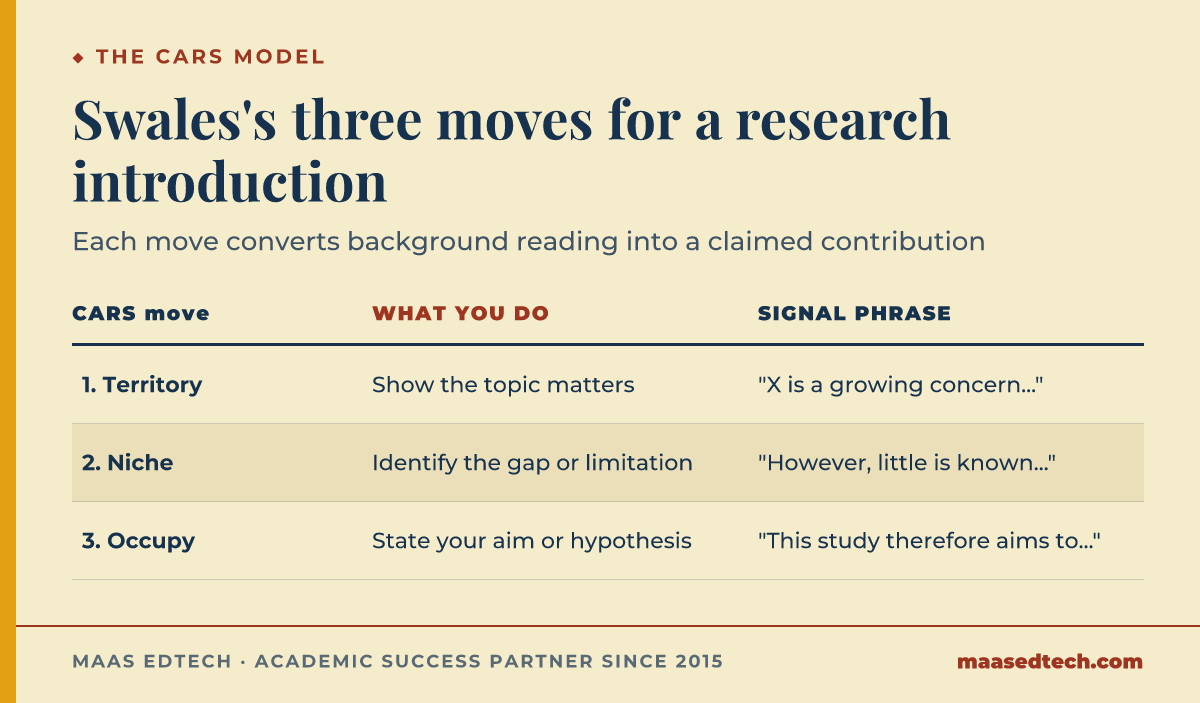
Evidence: The model maps almost perfectly onto the funnel. Move 1 claims the topic's importance and reviews prior work; Move 2 signals a gap, a weakness, or an unresolved question; Move 3 states your purpose, announces the present study, and (in many fields) previews the findings or structure (Swales, 1990; Swales & Feak, 2012). For ESL writers, the value of CARS is that it gives you the exact signposting language native reviewers expect, so your reasoning reads as confident rather than tentative.
| CARS move | What you do | Signal phrases |
|---|---|---|
| 1, Establish a territory | Show the topic matters; summarise prior research | "X is a growing concern…"; "Previous studies have shown…" |
| 2, Establish a niche | Identify the gap, conflict, or limitation | "However, little is known about…"; "Few studies have examined…" |
| 3, Occupy the niche | State your aim, question, or hypothesis | "This study therefore aims to…"; "We hypothesised that…" |
MAAS mentors regularly run a "CARS audit" with Vietnamese authors: highlight each sentence as Move 1, 2, or 3. One engineering author found his draft was 90% Move 1 with no Move 2, exactly why reviewers could not see his contribution. Two niche sentences fixed it without new data.
How do you turn a literature gap into a clear aim or hypothesis?
Direct answer: A gap is not a complaint that "no one has studied X." It is a precise statement of what is unknown, contested, or untested, written so that your aim becomes the obvious next step. The strongest gaps connect directly to a method you can actually deliver.
Evidence: Kram et al. (2023), in a short commentary of 3 pages, argue that a clear, succinct research question is the thread that logically connects every section of a manuscript, when the question is sharp, the introduction, methods, and discussion align almost automatically. Bahadoran et al. (2018) add that the introduction should end by stating the hypothesis and the methodological approach used to test it. Practically, that means moving from "this gap exists" to "therefore this study asks/tests…" in adjacent sentences. For deeper work on this step, see our guides to identifying a research gap and writing research questions and objectives.
A MAAS social-sciences mentee had a vivid two-paragraph gap but no stated aim, the reader had to guess the study's purpose. We added one sentence ("This study therefore examines whether…") and a one-line hypothesis. The manuscript stopped reading like background and started reading like research.
How long should the introduction be, and how many citations does it need?
Direct answer: For most empirical Q1/Q2 articles, the introduction runs roughly 10–15% of the paper, often three to five paragraphs or around 500–800 words, though you should always follow the target journal's guidance first. The goal is sufficiency, not length: enough background to justify the question, and no more.
Evidence: Bahadoran et al. (2018) caution that the introduction is not a literature review, cite only the work needed to establish the territory and the gap, and save exhaustive comparison for the discussion. The International Committee of Medical Journal Editors (n.d.), whose recommendations more than 5,000 journals worldwide have at one point claimed to follow, similarly advises that the introduction state the study's purpose and summarise the rationale without reviewing the subject extensively. The ICMJE's own instruction: "Provide a context or background for the study (that is, the nature of the problem and its significance)" (International Committee of Medical Journal Editors, n.d.). Over-citation is a real ESL trap: authors who feel they must "prove" they read everything bury the gap under 50 sources.
A useful MAAS heuristic is one job per citation: each reference should establish the territory or sharpen the gap. In one Q1 engagement, we cut the citation count from 38 to 19, keeping only those that did one of those jobs. The reviewer called the revised introduction "focused and easy to follow."
How is a journal-article introduction different from a dissertation introduction?
Direct answer: A journal-article introduction is short, single-purpose, and funnels to one question in a few paragraphs. A dissertation introduction is a full chapter that also frames the whole project, scope, structure, significance, and sometimes a roadmap of later chapters.
Evidence: The rhetorical logic (CARS, funnel) is the same, but the scale and audience differ: journal editors want speed and a sharp gap, while examiners want to see that you understand your field's breadth (Swales & Feak, 2012). Vietnamese postgraduates often make the mistake of compressing a thesis chapter into a paper and keeping all the scope-setting, which makes the article's introduction feel slow. If you are writing the thesis version, our dissertation introduction guide covers the chapter-level structure in detail.
| Feature | Journal article | Dissertation chapter |
|---|---|---|
| Length | 3–5 paragraphs | Several pages |
| Goal | Justify one question fast | Frame the whole project |
| Roadmap of structure | Often optional | Usually expected |
A MAAS author repurposing a thesis chapter into a Q2 submission kept 6 pages of scope-setting in the paper draft. We extracted the single research question, rebuilt a four-paragraph funnel, and moved the rest to the discussion and methods, submittable without losing any underlying work.
What introduction mistakes most often trigger desk rejection?
Direct answer: The recurring killers are a missing or vague gap, no explicit aim or hypothesis, an introduction that doubles as a literature review, and language so unclear the editor cannot follow the logic. Each tells an editor the paper is not ready, regardless of the data quality.
Evidence: Editorial analyses consistently list an unclear research question among the top reasons manuscripts are screened out before peer review, with poor language a close second (Bahadoran et al. 2018; Kram et al. 2023). For ESL authors the two often compound: a buried gap plus awkward phrasing makes a sound study look weak. Keep any AI writing assistance within your journal's disclosure rules, never as a substitute for your own reasoning.
In MAAS publishing engagements, a pre-submission introduction audit, gap present? aim stated? citations doing one job each? language clear? is the cheapest lever for avoiding desk rejection. One Vietnamese author's manuscript had cleared its science but failed twice on framing; after a single mentored introduction rebuild, it passed desk screening and reached full peer review, coached through the Outline → Draft → Final model.
Frequently asked questions
Should the introduction include the study's main findings?
In many fields, no, findings belong in the abstract, results, and discussion. Some disciplines (and the CARS model's optional Move 3 step) do allow a brief preview of principal findings, so check recent articles in your target journal before deciding.
Do I write the introduction first or last?
Many experienced authors draft a rough introduction to guide the study, then rewrite it last once the results are known. Writing it last lets you align the stated gap and aim precisely with what the paper actually delivers.
How many paragraphs should a research paper introduction have?
For a hypothesis-testing paper, two to four paragraphs is common: the known, the gap, the aim or hypothesis, and sometimes the approach. Follow your journal's word limit rather than a fixed paragraph count.
Can I reuse my literature review chapter as my paper introduction?
Not directly. A thesis chapter is far broader than a journal introduction. Extract the single research question and build a short funnel around it, then move the wider context to the discussion or a separate review.
Where do I state my hypothesis in the introduction?
At the narrow end, in the final paragraph, immediately after the gap. State it even if your results later disprove it, so the reader knows exactly what the study tested.
Can MAAS help me write my research paper introduction?
Yes. MAAS publishing mentors coach Vietnamese researchers through the introduction phase by phase; you keep full authorship while a Scopus-published advisor gives developmental feedback on your gap, aim, and structure. Book a free consultation lasting 15 minutes and we will match you with a discipline-appropriate mentor within 48 hours when our network already covers that field. If it does not, MAAS opens a dedicated recruitment round for your case, which usually takes about two weeks.
Ready to make your introduction reviewer-proof?
MAAS Publishing Advisory pairs Vietnamese researchers with advisers who hold multiple Q1 or Q2 papers under their own name, and 23% of our experts hold a PhD. The adviser reviews your introduction together with the discussion, once the abstract, methods and results have been worked through, and the work stays yours throughout. The international track runs 26 one-to-one sessions over typically 4 to 10 months. Start with a free consultation lasting 15 minutes and we will match you with a mentor within 48 hours when our network already covers that field. If it does not, MAAS opens a dedicated recruitment round for your case, which usually takes about two weeks.
Explore our publishing advisory service, the Scopus publishing resource hub, or meet our experts.
References
- Annesley, T. M. (2010). "It was a cold and rainy night": Set the scene with a good introduction. Clinical Chemistry, 56(5), 708–713. https://doi.org/10.1373/clinchem.2010.143628
- Bahadoran, Z., Jeddi, S., Mirmiran, P., & Ghasemi, A. (2018). The principles of biomedical scientific writing: Introduction. International Journal of Endocrinology and Metabolism, 16(4), Article e84795. https://doi.org/10.5812/ijem.84795
- International Committee of Medical Journal Editors. (n.d.). Recommendations for the conduct, reporting, editing, and publication of scholarly work in medical journals. Retrieved June 28, 2026, from https://www.icmje.org/recommendations/
- Kram, J. J. F., Vedder, L. S., Fay, B., & Simpson, D. (2023). A clear, succinct research question portends the rest of the story. Journal of Patient-Centered Research and Reviews, 10(4), 198–200. https://doi.org/10.17294/2330-0698.2066
- Swales, J. M. (1990). Genre analysis: English in academic and research settings. Cambridge University Press.
- Swales, J. M., & Feak, C. B. (2012). Academic writing for graduate students: Essential tasks and skills (3rd ed.). University of Michigan Press.
This article is part of the MAAS Journal series for Vietnamese international postgraduate students and researchers. MAAS Publishing Advisory is an advisory partner; we coach authors through a phase-by-phase delivery model with developmental feedback from PhD-level, Scopus-published mentors. We do not write, submit, or guarantee acceptance of work on an author's behalf.