
◆ Research methods
Mixed methods research vs qualitative vs quantitative: how to choose
Mixed methods research suits only questions that need both numeric and narrative data, so match qualitative, quantitative, or mixed methods to your question. For Vietnamese researchers targeting Scopus journals or a dissertation, this decision shapes your sampling, data, analysis, and whether reviewers find your study coherent.
This guide answers the seven questions Vietnamese researchers ask MAAS mentors most often when choosing a methodology.

◆ Question 1 / 7 · The difference
What's the difference between qualitative, quantitative, and mixed methods research?
Direct answer: Quantitative research measures variables as numbers and tests relationships or differences statistically. Qualitative research explores meaning, experience, and process through words, images, or observation. Mixed methods research combines both in one study, integrating numeric and narrative data to answer a question neither approach could answer alone. The three differ in what counts as evidence, not in rigour.
Evidence: These approaches sit on a continuum, distinguished by whether the researcher works mainly with closed-ended numeric data, open-ended text data, or a deliberate combination of both, the framing Creswell and Creswell set out in Research Design: Qualitative, Quantitative, and Mixed Methods Approaches (2023), published by SAGE. Mixed methods is not simply using two techniques. Johnson et al. (2007), writing in the Journal of Mixed Methods Research, define it precisely as "the type of research in which a researcher or team of researchers combines elements of qualitative and quantitative research approaches" (Johnson et al., 2007, p. 123).
Example: A Vietnamese postgraduate said she wanted to "do both" because she could not decide. Her MAAS mentor reframed the choice around her question (measure how much changed, or understand why), and the approach became obvious.
◆ Question 2 / 7 · Quantitative
When should you choose a quantitative approach?
Direct answer: Choose quantitative when your question asks how much, how many, how often, or whether a relationship or difference exists, and when you can measure your variables reliably. It suits hypothesis testing, generalising from a sample to a population, and comparing groups. If your aim is to confirm, quantify, or predict, the logic of measurement and statistics fits.
Evidence: Quantitative designs are appropriate when the problem calls for identifying factors that influence an outcome, testing a theory, or examining relationships among measured variables, and they rely on probability sampling so results can be generalised (Creswell & Creswell, 2023). Statistical software such as SPSS or R runs the analysis, but the tool never decides whether the design fits the question.
Example: A Vietnamese researcher asked whether a teaching intervention improved exam scores. Her MAAS mentor confirmed a quantitative design, measurable outcome, two comparable groups, clear hypothesis and helped her plan the sample size first.
◆ Question 3 / 7 · Qualitative
When should you choose a qualitative approach?
Direct answer: Choose qualitative when your question asks how or why, when you are exploring a phenomenon that is not yet well understood, or when meaning, context, and lived experience are the point. It suits small, purposefully selected samples and produces rich, detailed accounts rather than numbers. If your aim is to understand or interpret, qualitative logic fits.
Evidence: Qualitative research is the approach of choice when a concept needs exploring because little has been written about it, or when context and participants' voices must be understood in depth, and it relies on small, purposefully selected samples rather than statistically representative ones (Creswell & Creswell, 2023). Coding software such as NVivo or MAXQDA organises the material, but the interpretive work behind the codes is still the researcher's.
Example: A MAAS-coached student wanted to understand why first-year Vietnamese students disengage from online classes. Her mentor steered her toward in-depth interviews rather than a survey, because she needed reasons she could not have listed in advance. For survey items, see questionnaire question types.
◆ Question 4 / 7 · Mixed methods
When does a mixed methods design make sense?
Direct answer: A mixed methods design makes sense when one type of data cannot fully answer your question, when you need both to measure something and to explain it. It is a deliberate choice with a named design and a plan for how the strands connect, not an excuse to collect everything.
The three mixed methods designs the post compares
Tap a design to see how it works and when to use it.
Convergent
How it works: collect quantitative and qualitative data in parallel, then compare. Use it when: you want to corroborate or contrast two views of the same issue.
Explanatory sequential
How it works: quantitative first, then qualitative to explain the numbers. Use it when: your results need follow-up to interpret why they occurred.
Exploratory sequential
How it works: qualitative first, then quantitative to test or generalise. Use it when: you must explore a concept before you can measure it validly.
Save this figure
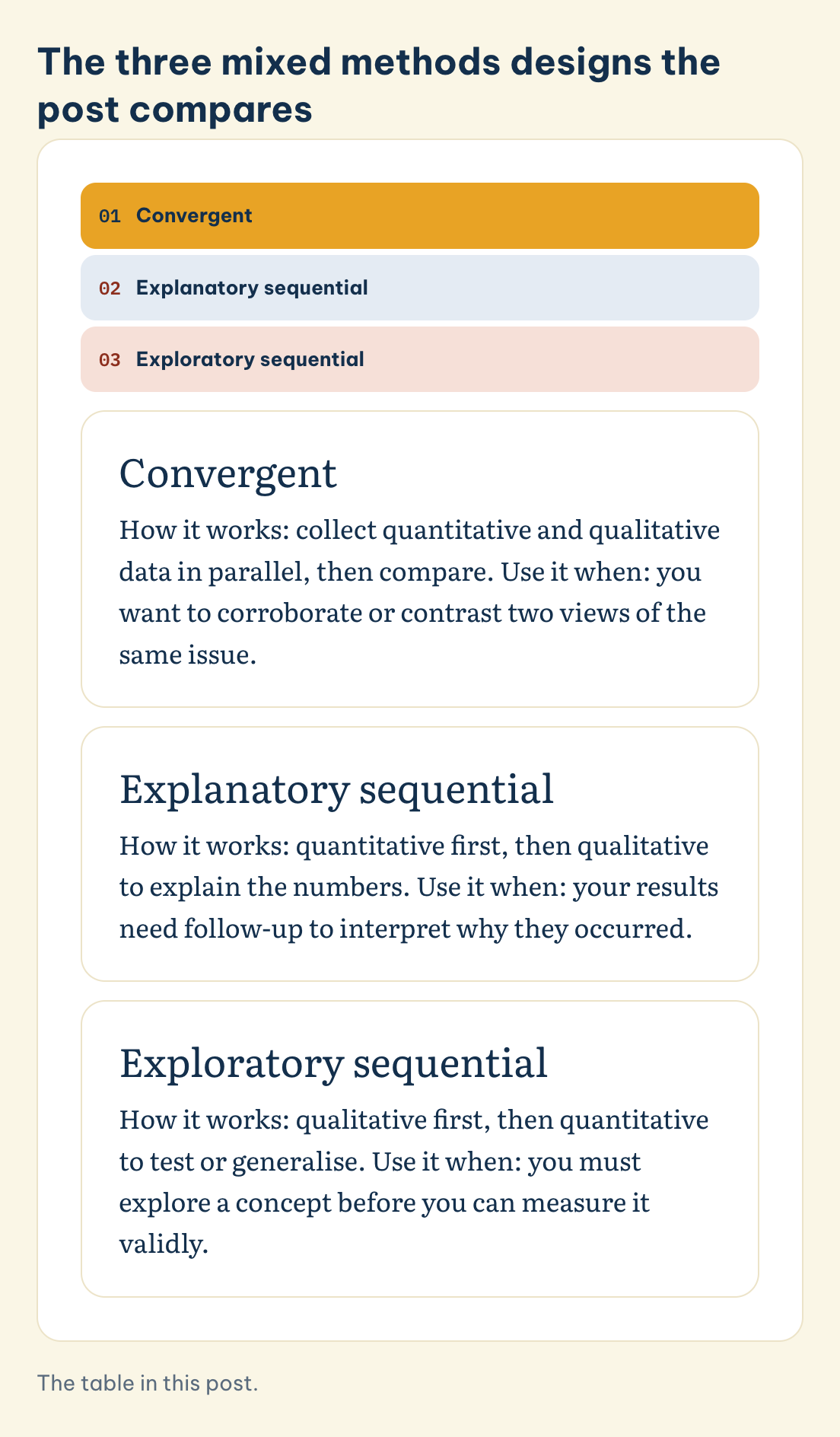
Evidence: Mixed methods is justified when the research question genuinely requires integration, for instance, quantifying an outcome and then explaining the mechanism behind it and each design specifies the timing and priority of the two strands (Creswell & Creswell, 2023). Janice Morse's mixed-methods notation, capital letters for the priority strand and a plus sign for a concurrent one, gives you a compact way to label your own design instead of writing a paragraph of description. A design without a clear integration rationale adds complexity without insight.
| Mixed methods design | How it works | Use it when |
|---|---|---|
| Convergent | Collect quantitative and qualitative data in parallel, then compare | You want to corroborate or contrast two views of the same issue |
| Explanatory sequential | Quantitative first, then qualitative to explain the numbers | Your results need follow-up to interpret why they occurred |
| Exploratory sequential | Qualitative first, then quantitative to test or generalise | You must explore a concept before you can measure it validly |
Example: A Vietnamese author measured patient outcomes but could not explain a surprising result. Her MAAS mentor added an explanatory sequential strand, patient interviews after the survey so the qualitative data accounted for the unexpected numbers.
For the convergent, explanatory sequential and exploratory sequential designs in depth, including the integration levels Fetters et al. (2013) set out, see our guide to the main mixed methods research designs.
◆ Question 5 / 7 · Sampling, data, analysis
How do the three approaches differ in sampling, data, and analysis?
Direct answer: Quantitative work uses probability sampling, numeric data, and statistical analysis to test hypotheses. Qualitative work uses purposeful sampling, textual or visual data, and thematic or interpretive analysis to build understanding. Mixed methods combines both and adds a layer of integration. The differences keep you from borrowing one tradition's logic for the other's data.
Quantitative and qualitative research, side by side
Each row sets one dimension of quantitative research beside the same dimension of qualitative research.
Quantitative
Qualitative
Question: how much, whether, how related
Question: how, why, what is it like
Sampling: probability, larger samples
Sampling: purposeful, smaller samples
Data: numbers, closed-ended
Data: words, images, open-ended
Analysis: statistical tests, models
Analysis: thematic, interpretive coding
Judged by: validity, reliability, generalisability
Judged by: credibility, transferability
Save this figure
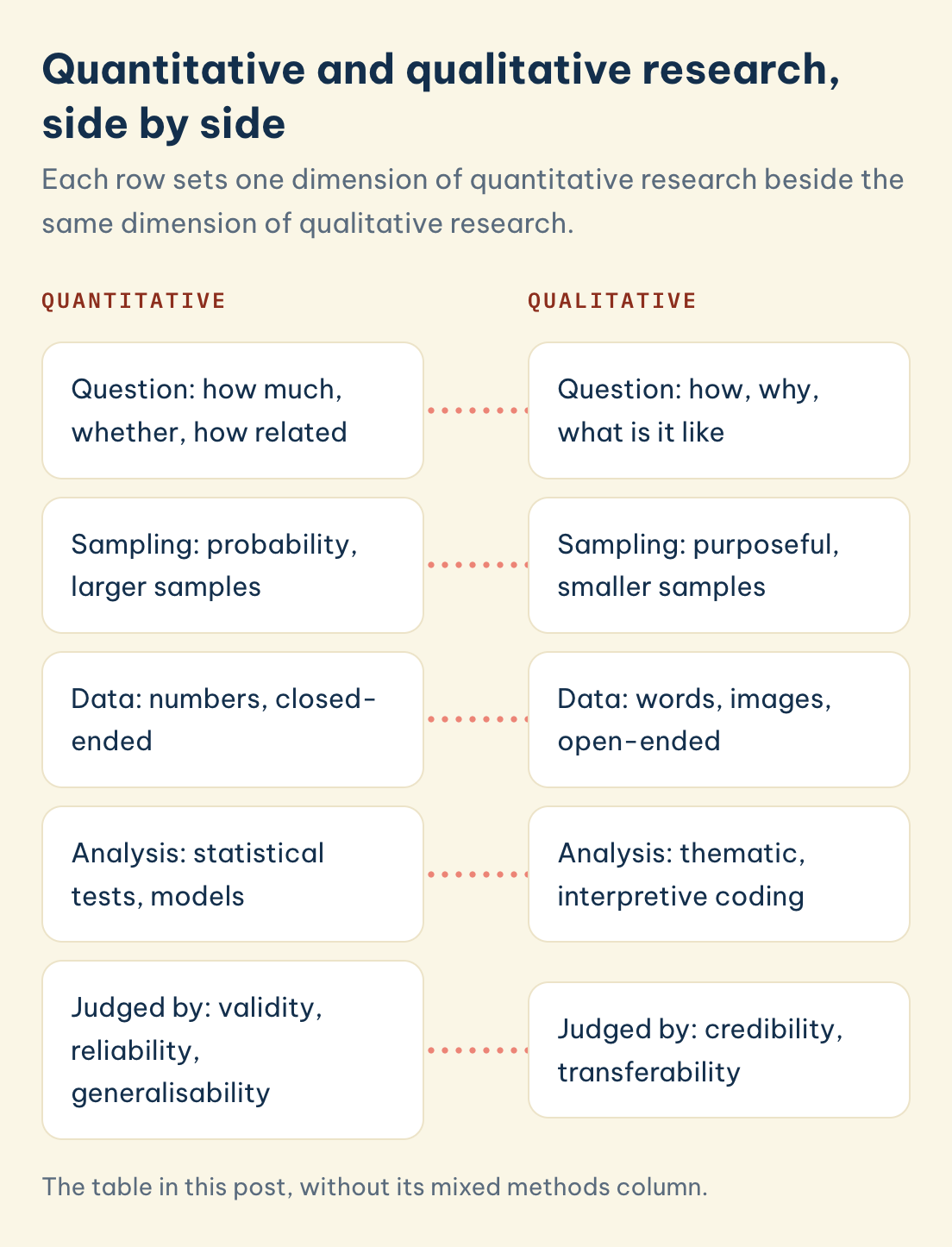
Evidence: The approaches differ systematically across sampling logic, data type, analysis, and the standards used to judge quality, and mismatching them misreads the tradition, a point Bryman (2016) also makes in Social research methods, published by Oxford University Press. Purposeful and probability sampling answer different questions and are not interchangeable (Palinkas et al., 2015), the argument developed in Administration and Policy in Mental Health and Mental Health Services Research.
| Dimension | Quantitative | Qualitative | Mixed methods |
|---|---|---|---|
| Question | How much, whether, how related | How, why, what is it like | Both, plus how they connect |
| Sampling | Probability, larger samples | Purposeful, smaller samples | Both, by strand |
| Data | Numbers, closed-ended | Words, images, open-ended | Both |
| Analysis | Statistical tests, models | Thematic, interpretive coding | Both, plus integration |
| Judged by | Validity, reliability, generalisability | Credibility, transferability | Rigour of both plus integration quality |
Example: A Vietnamese researcher judged her qualitative interview study by a quantitative standard, "is the sample big enough to generalise?" and panicked. Her MAAS mentor explained that ten rich interviews are judged by credibility and depth, not size.
◆ Question 6 / 7 · Integration
How do you actually integrate qualitative and quantitative data in a mixed methods study?
Direct answer: Integration is the defining feature of mixed methods, and it has to be planned, not left to the discussion section. Connect the strands by building one on the other, merging the datasets to compare them, or embedding one in a larger design. A joint display, a table placing quantitative and qualitative results side by side, makes the integration visible.
Evidence: Integration occurs at the design, methods, and interpretation and reporting levels, through connecting, building, merging, or embedding the strands, as Fetters, Curry, and Creswell (2013) set out in Health Services Research. Joint displays are a widely recommended tool for arraying quantitative and qualitative findings together so the added value of integration is clear, as Guetterman et al. (2015), part of the mixed methods research group at the University of Michigan, show in the Annals of Family Medicine. Reporting checklists such as COREQ or SRQR for the qualitative strand, STROBE for an observational quantitative strand, and the mixed-methods-specific GRAMMS, all listed in the EQUATOR Network's library of reporting guidelines, exist for the same reason: to make that reporting explicit rather than implied.
Example: A MAAS Academic Mentoring client had reported her survey and interview results in separate chapters with no link. Her mentor helped her build a joint display matching each statistical finding to the interview theme that explained it, turning two parallel studies into one integrated argument.
◆ Question 7 / 7 · Common mistakes
What mistakes do Vietnamese and ESL researchers make when choosing a method, and how can you avoid them?
Direct answer: The recurring mistakes are choosing a method before fixing the research question, defaulting to mixed methods to look thorough, applying one tradition's standards to the other's data, and collecting two datasets with no plan to integrate them. Avoid them by writing your question first, letting it dictate the approach, and getting feedback from a mentor in your discipline.
Evidence: The methodology should follow from the research question, not the reverse, and a mixed methods study without a genuine integration rationale adds complexity without insight, a warning John Creswell and his son David Creswell repeat across editions, and Fetters et al. (2013) note that integration offers many gains yet remains limited in practice. Scholars such as Tashakkori and Teddlie helped establish mixed methods as a distinct third tradition rather than a compromise between the other two. As more Vietnamese researchers target Scopus Q1 and Q2 journals, a well-matched design is a low-cost way to clear the methodological bar rather than lose a sound study to an avoidable mismatch.
| Mistake | Why it weakens the study | The fix |
|---|---|---|
| Method chosen before the question | Design does not fit the aim | Finalise the research question first |
| Mixed methods to "look thorough" | Two strands, no integration | Only mix if the question requires it |
| Wrong quality standard | Misjudges valid work | Match standards to the tradition |
| No integration plan | Strands never connect | Plan a joint display up front |
| Sample logic borrowed wrongly | Sampling does not fit the design | Use probability or purposeful by strand |
Example: A MAAS mentor guided a Vietnamese author phase by phase, from matching the research question to an explanatory sequential design, to planning the joint display at the outline and data stage, to reviewing each chapter the author wrote, the mentor advising, the author writing throughout.
Frequently asked questions
Is qualitative or quantitative research better?
Neither is better in the abstract; the right choice depends entirely on your research question. Quantitative suits measuring and testing, qualitative suits exploring and understanding, and a question that needs both points to a mixed methods design.
Is mixed methods always stronger than a single approach?
No. Mixed methods is stronger only when your question genuinely needs both kinds of data and you plan how to integrate them. Adding a second strand with no integration rationale increases workload and can weaken a study rather than strengthen it.
How big should my sample be for each approach?
Quantitative studies size the sample to detect an effect with adequate statistical power, often against the small, medium, and large effect-size conventions Jacob Cohen (1988) established, so they tend to be larger. Qualitative studies use purposeful sampling and stop at data saturation, the point where new interviews stop adding insight, so they are usually much smaller and judged differently. In an experiment published in Field Methods, Guest, Bunce, and Johnson (2006) analysed 60 interviews with women in two West African countries and found that saturation had occurred within the first 12 interviews, with basic elements of the overarching themes present as early as 6, a result that shows why a rigorous qualitative study can still stop at a small sample size.
Can I change my approach after I start collecting data?
It is far better to settle the approach before data collection, because the method shapes your sampling, instruments, and ethics application. Changing midway often means re-doing earlier steps, so invest the time in choosing correctly at the design stage.
Do Scopus journals prefer one approach over another?
Journals indexed in Scopus and Web of Science mostly accept all three approaches; what they require is a design that fits the question and is reported rigorously. Check your target journal's recent articles and author guidelines to see which approaches and reporting standards it expects.
What are the main types of mixed methods research design?
There are three, and Creswell and Creswell (2023) note that each one specifies the timing and priority of the two strands. A convergent design collects quantitative and qualitative data in parallel and compares them. An explanatory sequential design runs the quantitative strand first, then uses qualitative data to explain the numbers. An exploratory sequential design starts qualitative, then tests or generalises with quantitative data.
Can MAAS help me choose the right research methodology?
Yes. MAAS Academic Mentoring pairs you with a senior expert in your discipline to match your approach to the research question, plan your sampling and integration, and review how you report the design, while you remain the author of your thesis. Learn more and book a free 20-minute consultation at Academic Mentoring.
Ready to match the right method to your research question?
MAAS thesis and dissertation mentoring pairs you with a senior expert in your discipline (23% of our experts hold doctorates) to match your method to your question phase by phase, while you write every word yourself. You can start with a free 20-minute consultation.
Book an Academic Mentoring consultation with MAAS →
Related guides
- How do you write research questions and objectives?: the question your method must fit
- How do you do a thematic analysis for your dissertation?: analysing a qualitative dataset
- How do you write the methods section of a research paper?: report the design you chose
- How do you choose the right statistical test for a Q1 publication?: analysis for a quantitative design
- How do you design a systematic review in the health sciences?: a review-type methodology
- How do you calculate the sample size for a research study?: sizing a quantitative sample
- How do you identify a research gap?: what your study sets out to fill
- How do you write a theoretical framework for a thesis or dissertation?: the lens your chosen method has to serve
- Publishing Advisory service: publishing advisory support for Scopus Q1/Q2 submissions
- Scopus publishing resource hub: guides across the submission journey
- Meet the MAAS experts: the experts behind our advisory
References
- Bryman, A. (2016). Social research methods (5th ed.). Oxford University Press.
- Cohen, J. (1988). Statistical power analysis for the behavioral sciences (2nd ed.). Lawrence Erlbaum Associates.
- Creswell, J. W., & Creswell, J. D. (2023). Research design: Qualitative, quantitative, and mixed methods approaches (6th ed.). SAGE Publications.
- Fetters, M. D., Curry, L. A., & Creswell, J. W. (2013). Achieving integration in mixed methods designs: Principles and practices. Health Services Research, 48(6 Pt 2), 2134–2156. https://doi.org/10.1111/1475-6773.12117
- Guest, G., Bunce, A., & Johnson, L. (2006). How many interviews are enough? An experiment with data saturation and variability. Field Methods, 18(1), 59–82. https://doi.org/10.1177/1525822X05279903
- Guetterman, T. C., Fetters, M. D., & Creswell, J. W. (2015). Integrating quantitative and qualitative results in health science mixed methods research through joint displays. The Annals of Family Medicine, 13(6), 554–561. https://doi.org/10.1370/afm.1865
- Johnson, R. B., Onwuegbuzie, A. J., & Turner, L. A. (2007). Toward a definition of mixed methods research. Journal of Mixed Methods Research, 1(2), 112–133. https://doi.org/10.1177/1558689806298224
- Palinkas, L. A., Horwitz, S. M., Green, C. A., Wisdom, J. P., Duan, N., & Hoagwood, K. (2015). Purposeful sampling for qualitative data collection and analysis in mixed method implementation research. Administration and Policy in Mental Health and Mental Health Services Research, 42(5), 533–544. https://doi.org/10.1007/s10488-013-0528-y
This article is part of the MAAS Journal series for Vietnamese international postgraduate students and researchers. MAAS Publishing Advisory is an advisory partner; we coach authors through a phase-by-phase delivery model with developmental feedback from experienced, Scopus-published mentors. We do not write, submit, or guarantee acceptance of work on an author's behalf.
A free 20-minute consultation with MAAS Academic Mentoring, to match your method to your research question.
Book Free Discovery ▸