
◆ Thesis mentoring
Braun and Clarke thematic analysis: how do you do it?
Braun and Clarke thematic analysis is a six-phase method for identifying patterns of meaning in qualitative data such as interviews. For Vietnamese researchers writing a dissertation or targeting a Scopus journal, doing it well means following a transparent, phased process, not just summarising what participants said.
This guide answers the seven questions Vietnamese postgraduates ask MAAS mentors most often when running a thematic analysis for the first time.

◆ Question 1 / 7 · What it is
What is thematic analysis, and when should you use it?
Direct answer: Thematic analysis (TA) is a method for finding, interpreting, and reporting patterns, themes, across a qualitative dataset. Use it when your research question is about meaning, experience, or perception, and your data are words rather than numbers. It suits interviews, focus groups, and open survey answers across many theoretical positions.
Evidence: Braun and Clarke (2006) describe TA as an accessible and theoretically flexible approach for identifying and analysing patterns within qualitative data, independent of any single epistemology. That flexibility is its strength: unlike grounded theory or discourse analysis, TA does not commit you to one philosophical tradition, so it fits both realist and constructionist questions (Terry et al. 2017). Braun and Clarke's own opening line makes the case for learning it properly: "Thematic analysis is a poorly demarcated, rarely acknowledged, yet widely used qualitative analytic method within psychology" (Braun & Clarke, 2006).
Example: A Vietnamese MEd candidate had twelve teacher interviews and no idea how to "analyse" them beyond quoting. Her MAAS mentor confirmed her question, how teachers experience fairness in online exams, was a meaning question, so TA fit, and they mapped the phases before she touched the transcripts.
◆ Question 2 / 7 · The six phases
What are the six phases of Braun and Clarke's thematic analysis?
Direct answer: The canonical process has six recursive phases: familiarising yourself with the data, generating initial codes, constructing themes, reviewing themes, defining and naming themes, and producing the report. The phases are not strictly linear; you move back and forth as understanding deepens but every phase must be visible in your write-up.
The six phases of Braun and Clarke's thematic analysis
Tap a phase to see what you do and the common pitfall for researchers writing in English as a second language.
Phase 1 of 6
Familiarisation
Read and re-read all data and note first impressions. Common ESL pitfall: skimming translations instead of immersing in the original.
Phase 2 of 6
Initial coding
Tag meaningful segments with concise labels. Common ESL pitfall: coding only surface topics, not underlying meaning.
Phase 3 of 6
Constructing themes
Cluster related codes into candidate themes. Common ESL pitfall: treating a data-collection question as a theme.
Phase 4 of 6
Reviewing themes
Check themes against coded extracts and the whole dataset. Common ESL pitfall: keeping a theme with only one supporting extract.
Phase 5 of 6
Defining and naming
Write a clear scope and name for each theme. Common ESL pitfall: vague names like "challenges" that could mean anything.
Phase 6 of 6
Reporting
Weave extracts and analytic narrative into the write-up. Common ESL pitfall: listing quotes with no interpretation.
Save this figure
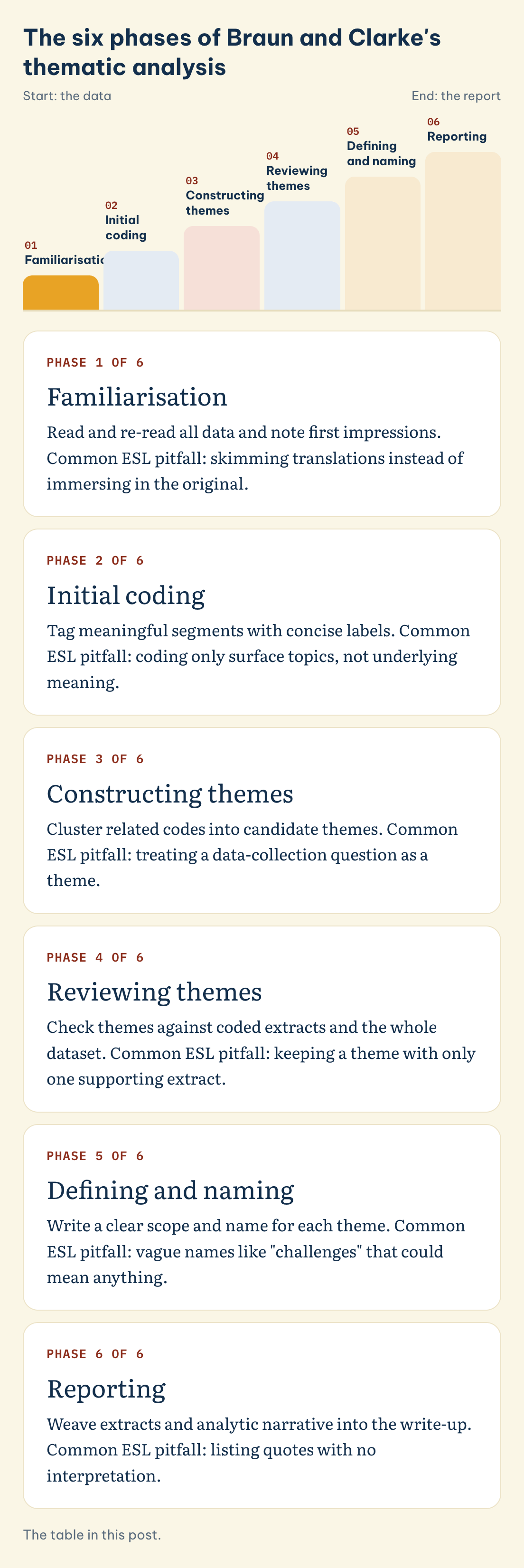
Evidence: Braun and Clarke (2006) set out these six phases as a systematic guide, stressing that analysis is recursive rather than linear, with the analyst moving back and forth between phases. Later work reframed the approach as reflexive thematic analysis and clarified that "themes" are actively constructed by the researcher, not passively "discovered" (Braun & Clarke, 2019).
| Phase | What you do | Common ESL pitfall |
|---|---|---|
| 1. Familiarisation | Read and re-read all data; note first impressions | Skimming translations instead of immersing in the original |
| 2. Initial coding | Tag meaningful segments with concise labels | Coding only surface topics, not underlying meaning |
| 3. Constructing themes | Cluster related codes into candidate themes | Treating a data-collection question as a theme |
| 4. Reviewing themes | Check themes against coded extracts and the whole dataset | Keeping a theme with only one supporting extract |
| 5. Defining & naming | Write a clear scope and name for each theme | Vague names like "challenges" that could mean anything |
| 6. Reporting | Weave extracts and analytic narrative into the write-up | Listing quotes with no interpretation |
Example: A MAAS mentor walked a nursing student through the phases as an Outline → Draft → Final loop, mapping codes to themes, reviewing them against extracts, then tightening names, with the mentor advising and the student coding at every step.
◆ Question 3 / 7 · Reflexive or coding-reliability
What's the difference between reflexive and coding-reliability thematic analysis?
Direct answer: Reflexive TA treats the researcher's interpretation as a resource and does not use multiple coders to measure agreement. Coding-reliability TA uses a structured codebook and often reports inter-coder agreement to demonstrate consistency. They rest on different assumptions, so you should choose one deliberately and report the version you used.
Reflexive and coding-reliability thematic analysis, side by side
Each row sets one feature of reflexive thematic analysis beside the same feature of the coding-reliability version.
Reflexive TA
Coding-reliability TA
Role of researcher: subjectivity is a resource
Role of researcher: subjectivity is a bias to control
Codebook: evolves organically
Codebook: fixed early, applied by coders
Multiple coders: not required
Multiple coders: central, and agreement is reported
Themes: constructed, analytic outputs
Themes: often summaries of a data domain
Best fit: solo, interpretive projects
Best fit: team, structured, applied projects
Save this figure
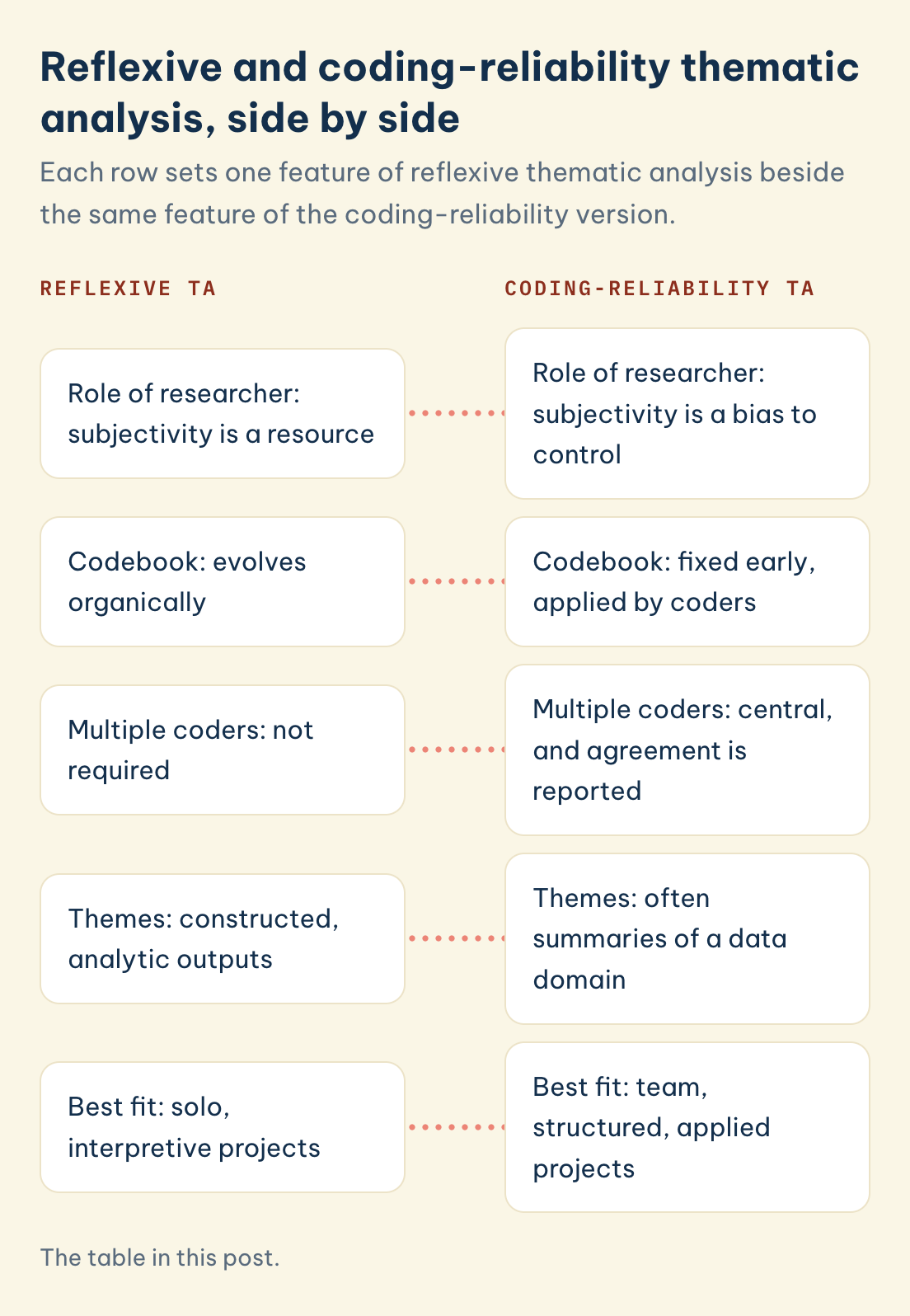
Evidence: Braun and Clarke (2021) argue that TA is not a single method but a family of approaches that differ paradigmatically and procedurally, and caution against importing coding-reliability standards such as inter-rater agreement into reflexive TA. Applied or coding-reliability variants foreground a shared codebook and suit team-based or positivist projects (Guest et al. 2012).
| Feature | Reflexive TA | Coding-reliability TA |
|---|---|---|
| Role of researcher | Subjectivity is a resource | Subjectivity is a bias to control |
| Codebook | Evolves organically | Fixed early, applied by coders |
| Multiple coders | Not required | Central; agreement reported |
| Themes | Constructed, analytic outputs | Often summaries of a data domain |
| Best fit | Solo, interpretive projects | Team, structured, applied projects |
Example: A Vietnamese PhD student assumed a Q1 reviewer would demand a second coder and a kappa score. Her MAAS mentor showed her reflexive design did not need one; they strengthened her audit trail and reflexivity statement instead, what her target journal expected.
◆ Question 4 / 7 · Coding and themes
How do you code qualitative data and build themes?
Direct answer: Coding means attaching short, meaningful labels to segments of data relevant to your question. Work systematically through the whole dataset, code inclusively, then group related codes into candidate themes. A theme is a pattern of shared meaning organised around a central idea, not a bucket of everything mentioned about a topic.
Evidence: Braun and Clarke (2006) distinguish coding, which stays close to the data, from theme construction, which organises codes into broader patterns; they warn that themes do not simply "emerge" but are built through active analytic work. Byrne (2022) shows in a worked example how initial codes are progressively collapsed into candidate themes and refined against the data.
Example: A MAAS mentor reviewed a management student's 60 codes and noticed three co-occurring around "being watched." Instead of a flat topic list, they built a theme, surveillance as care versus control, that carried an argument, later praised as the strongest chapter.
◆ Question 5 / 7 · Theme or topic
How do you know if a theme is really a theme, and not just a topic?
Direct answer: A genuine theme has a central organising concept, is supported by data across several participants, and does analytic work in answering your question. A topic simply names a subject area. Test each candidate by asking: what is its core idea, does the evidence hold together, and does it tell part of my story?
Evidence: Braun and Clarke (2021) identify "topic summaries" masquerading as themes as one of the most common problems in published TA, arguing that a theme should be underpinned by a shared meaning or central concept, not a shared topic. Reviewing themes against both the coded extracts and the whole dataset is what separates a defensible theme from a heading (Nowell et al. 2017).
Example: A Vietnamese author's draft had a "theme" called communication. Her MAAS mentor asked what it argued; there was no answer. They split it into silence as self-protection and code-switching to belong, two themes with real analytic points.
◆ Question 6 / 7 · Rigour
How do you make your thematic analysis trustworthy and rigorous?
Direct answer: Demonstrate rigour by keeping an audit trail, writing a reflexivity statement, defining your themes precisely, and reporting your process transparently so a reader can follow how you moved from data to findings. In qualitative work, credibility, dependability, and confirmability replace quantitative reliability language.
Evidence: Nowell et al. (2017) map each phase of TA onto Lincoln and Guba's trustworthiness criteria, credibility, transferability, dependability, and confirmability and recommend documenting decisions in enough detail for readers to judge the process. Braun and Clarke (2021) add that quality in reflexive TA comes from a coherent, well-executed analysis, not from coding-reliability metrics.
Example: A MAAS mentor helped a public-health student keep a one-page decision log recording why codes merged and themes changed. When Reviewer 2 questioned her transparency, she drew on the log in her response letter, resolving it in one round.
◆ Question 7 / 7 · Mistakes to avoid
What mistakes do Vietnamese and ESL researchers make in thematic analysis?
Direct answer: The most damaging mistakes are using interview questions as themes, quoting without interpreting, mixing incompatible TA versions, and skipping reflexivity. Each is fixable if you name your approach, code for meaning rather than topic, and let your analytic voice carry the findings.
Thematic analysis mistakes and their fixes
Tap a mistake to see why it costs marks or a rejection and how to fix it.
Questions as themes
Why it costs marks or a rejection: it shows analysis stopped at the interview guide. Fix: build themes around meaning, not the schedule.
Quotes, no interpretation
Why it costs marks or a rejection: the reader cannot see your argument. Fix: follow each extract with analytic commentary.
Mixed TA versions
Why it costs marks or a rejection: the method section contradicts the analysis. Fix: name reflexive or coding-reliability and stay consistent.
No reflexivity statement
Why it costs marks or a rejection: reviewers question rigour. Fix: reflect on how your position shaped coding.
Over-claiming saturation
Why it costs marks or a rejection: saturation is contested in reflexive TA. Fix: justify sample size by information power instead.
Save this figure
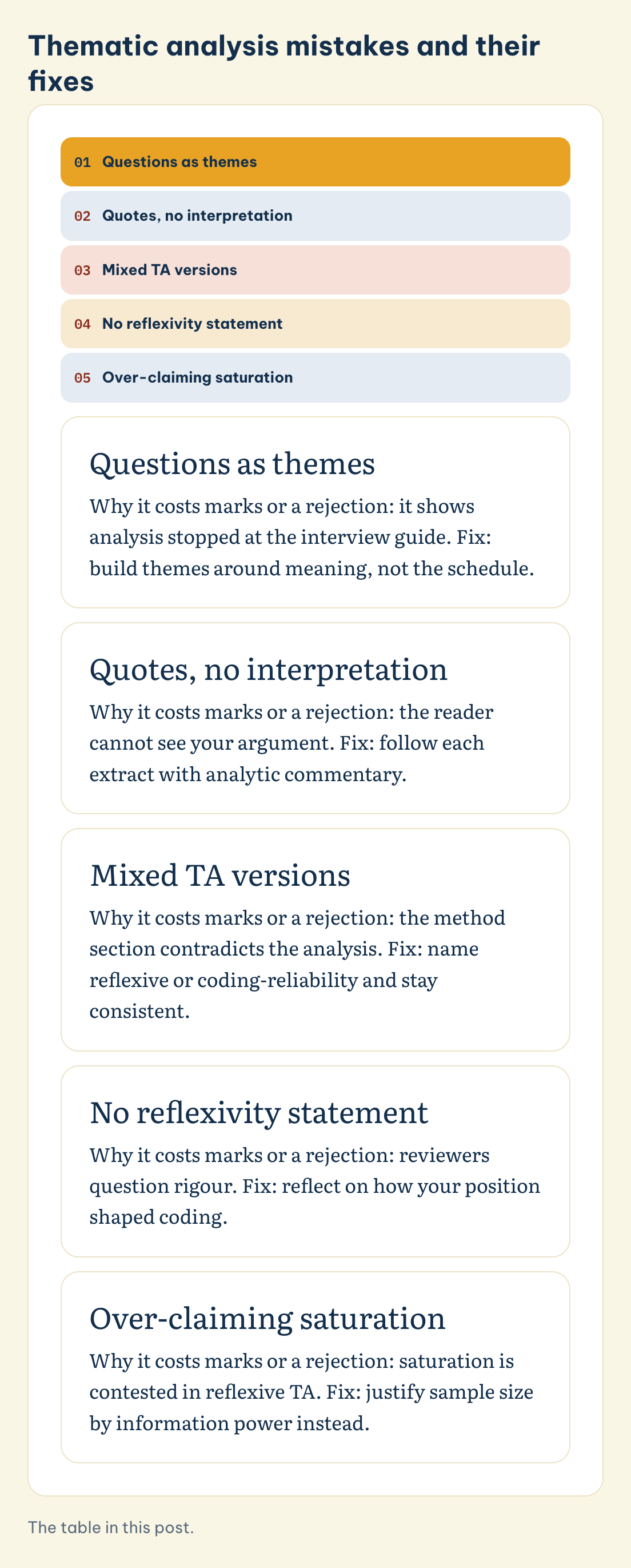
Evidence: Braun and Clarke (2021) catalogue recurring weaknesses including a mismatch between the stated method and what was actually done, and themes that are really data-collection questions. For researchers working in a second language, the added risk is staying at the descriptive surface rather than interpreting underlying meaning (Terry et al. 2017).
| Mistake | Why it costs marks or a rejection | Fix |
|---|---|---|
| Questions used as themes | Shows analysis stopped at the interview guide | Build themes around meaning, not the schedule |
| Quotes without interpretation | Reader cannot see your argument | Follow each extract with analytic commentary |
| Mixing TA versions | Method section contradicts the analysis | Name reflexive or coding-reliability and stay consistent |
| No reflexivity statement | Reviewers question rigour | Reflect on how your position shaped coding |
| Over-claiming saturation | Saturation is contested in reflexive TA | Justify sample size by information power instead |
Example: A Vietnamese mentee lost marks on a first submission for "descriptive" analysis. With her MAAS mentor she recoded for meaning, added interpretation after each quote, and named her reflexive approach; the resubmission moved up a grade band.
Frequently asked questions
How many themes should a thematic analysis have?
There is no fixed number, but most dissertation-scale studies report two to six themes, sometimes with subthemes. Aim for as many as your data can support with depth; a handful of well-evidenced themes beats a long list of thin ones.
Do I need software like NVivo to do thematic analysis?
No. Software such as NVivo or a spreadsheet helps you organise codes and extracts, but it does not do the analytic thinking for you. Many strong theses are coded by hand; the method matters more than the tool.
How big should my sample be for thematic analysis?
It depends on the richness of your data and the scope of your question rather than a set target. Reflexive TA authors increasingly justify sample size by "information power", how much relevant information the sample holds, instead of claiming data saturation.
Can I use AI tools to help with coding?
You can use AI to help organise or summarise data if your institution and journal permit it and you disclose it, but the interpretive work of building themes must remain yours. Outsourcing interpretation to a model undermines the method and academic integrity.
Is thematic analysis suitable for a mixed methods study?
Yes. Thematic analysis often handles the qualitative strand of a mixed methods design, and its findings can be integrated with quantitative results through a joint display. Report the TA version with full rigour.
What is the difference between Braun and Clarke's 2006 thematic analysis and reflexive thematic analysis?
Braun and Clarke (2006) set out the original six recursive phases. Their later work (2019) reframed the approach as reflexive thematic analysis, where the researcher actively constructs themes instead of discovering them. In 2021 they added that coding-reliability tools such as inter-rater agreement do not belong in reflexive TA, so say in your methods section which version you followed.
Can MAAS help me run a thematic analysis for my dissertation?
Yes. MAAS Academic Mentoring coaches Vietnamese researchers through choosing a TA approach, coding for meaning, constructing and defending themes, and reporting transparently, using a phase-by-phase model with feedback from postgraduate-qualified mentors. Book a consultation through our contact page.
Ready to turn your transcripts into defensible themes?
Coding qualitative data is easier with a mentor who has already supervised research in your discipline. MAAS Academic Mentoring guides your project phase by phase while you research and write every word yourself, and its outline-and-data phase covers how to collect, process and code your data. Each session is recorded with cameras off and sent to you afterwards, and 23% of MAAS experts hold a PhD. MAAS matches you within 48 hours when our network already covers that field. If it does not, MAAS opens a dedicated recruitment round for your case, which usually takes about two weeks. Start with a free 20-minute consultation, and the kick-off that follows is free and not counted as a paid session. We coach; you stay the author.
Book an Academic Mentoring consultation with MAAS →
Related guides
- Qualitative, quantitative, or mixed methods: how do you choose?: pick the approach before you analyse
- How do you write research questions and objectives?: the question your themes must answer
- How do you write the methods section of a research paper?: report your TA process
- How do you write the results section of a research paper?: present themes with extracts and commentary
- Dissertation mentoring resource hub: guides across the dissertation journey
- Publishing Advisory service: support for Scopus Q1/Q2 submissions
- Meet the MAAS experts: the postgraduate-qualified mentors behind our coaching
References
- Braun, V., & Clarke, V. (2006). Using thematic analysis in psychology. Qualitative Research in Psychology, 3(2), 77–101. https://doi.org/10.1191/1478088706qp063oa
- Braun, V., & Clarke, V. (2019). Reflecting on reflexive thematic analysis. Qualitative Research in Sport, Exercise and Health, 11(4), 589–597. https://doi.org/10.1080/2159676X.2019.1628806
- Braun, V., & Clarke, V. (2021). One size fits all? What counts as quality practice in (reflexive) thematic analysis? Qualitative Research in Psychology, 18(3), 328–352. https://doi.org/10.1080/14780887.2020.1769238
- Byrne, D. (2022). A worked example of Braun and Clarke's approach to reflexive thematic analysis. Quality & Quantity, 56(3), 1391–1412. https://doi.org/10.1007/s11135-021-01182-y
- Guest, G., MacQueen, K. M., & Namey, E. E. (2012). Applied thematic analysis. SAGE Publications.
- Nowell, L. S., Norris, J. M., White, D. E., & Moules, N. J. (2017). Thematic analysis: Striving to meet the trustworthiness criteria. International Journal of Qualitative Methods, 16(1). https://doi.org/10.1177/1609406917733847
- Terry, G., Hayfield, N., Clarke, V., & Braun, V. (2017). Thematic analysis. In C. Willig & W. Stainton Rogers (Eds.), The SAGE handbook of qualitative research in psychology (2nd ed. pp. 17–37). SAGE Publications.
This article is part of the MAAS Journal series for Vietnamese postgraduate researchers. MAAS Academic Mentoring is an advisory partner; we coach authors through a phase-by-phase delivery model with feedback from postgraduate-qualified mentors. We do not write, submit, or guarantee acceptance of work on an author's behalf.
A free 20-minute consultation with MAAS Academic Mentoring, to talk through how you code your data and build your themes.
Book Free Discovery ▸