
◆ Thesis mentoring
Why do committees fail or ask for major revisions at a thesis defence, and how do you avoid it?
Very few candidates fail a thesis defence outright, but many walk out with major revisions they could have avoided. Examiners are not looking for a Nobel Prize; they are checking that the work is genuinely yours, that it holds together, and that you can defend your choices. This guide sets out the failure modes that most often send a master's thesis back for major changes, and how Vietnamese students can prevent each one before facing the hội đồng.

◆ Question 1 / 7 · Do they fail it
Do committees often fail a thesis at the defence?
Direct answer: Outright failure is rare, but that is not the outcome to plan around. Examiners are reluctant to fail a thesis, because it represents years of work and creates work for everyone. The realistic risk is not "fail" but "major revisions and resubmit," which costs months. Preparing well moves your outcome from major revisions toward minor corrections or a clean pass.
Evidence: Interviewing 30 experienced examiners who had assessed more than 300 theses, Mullins and Kiley (2002), publishing in Studies in Higher Education, found only 10 reports of an outright fail, and documented a strong reluctance to fail because of the effort involved for the student, supervisor, and examiner. The common negative outcome is a request for substantial revision, not outright rejection.
Example: A Vietnamese student came to MAAS terrified of failing. Her mentor reframed the real target: not "avoid a fail", which was unlikely, but "avoid the major-revisions verdict" that would delay her graduation by a semester. That shift changed what she prepared.
◆ Question 2 / 7 · What examiners notice
What is the single weakness examiners react to most?
Direct answer: Sloppiness. Typographical errors, inconsistent referencing, and careless mistakes do more damage than their size suggests, because examiners read them as a signal that the underlying research may also be careless. A thesis full of small errors makes an examiner start to doubt your data and your conclusions. Fixing surface sloppiness is the cheapest, highest-return preparation you can do.
Evidence: Mullins and Kiley (2002) reported that the most frequent complaint across all disciplines was "sloppiness", and that examiners treat typos and referencing mistakes as an indicator that "the research itself might not be rigorous". One examiner described being "flipped" from a reasonable to a critical frame of mind by careless errors, which is difficult to reverse.
Example: A MAAS mentor ran a Vietnamese student's near-final thesis through a single proofreading and referencing pass, catching dozens of small inconsistencies. The content did not change, but the examiners met a clean, confident document and never entered the sceptical frame that sloppiness triggers.
◆ Question 3 / 7 · What triggers revisions
Which weakness most often gets a thesis sent for major revisions?
Direct answer: A weak or uncritical literature review, closely followed by a confused methodology. When the review only summarises sources instead of building an argument, or when the method does not clearly fit the research question, examiners lose confidence in the whole thesis. These are the chapters where "major revisions" verdicts are usually born, because they undermine everything built on top of them.
Evidence: In an analysis of re-examined theses, Holbrook et al. (2004), publishing in Melbourne Studies in Education, found that critical examiner comments about the literature review were a strong indicator of theses "at the margin" that required major revision and resubmission. Examiner-report research similarly shows methodology is judged on whether the candidate can justify the choices made, not merely list methods, a distinction Creswell and Creswell (2018), writing for SAGE Publications, also draw between describing a design and defending why it fits the research question.
Example: A Vietnamese student's literature review listed 40 studies with no through-line. Her MAAS mentor coached her to reorganise it around three debates her research would speak to, starting from a fresh search on Google Scholar and Web of Science for review articles that already mapped the field, turning a catalogue into an argument, exactly the shift examiners look for.
◆ Question 4 / 7 · Explaining your work
What happens if you cannot explain or defend your own work?
Direct answer: Not being able to explain or defend your own work is the most dangerous failure at the oral defence, because the viva exists partly to confirm the work is genuinely yours. If you cannot explain why you chose a method, what your results mean, or what you actually argued, examiners begin to doubt your authorship and your understanding. Memorising your thesis is not enough; you must understand it well enough to answer unscripted questions about your own choices.
Evidence: Tan (2023), publishing in Discover Education, found that examiners see the viva primarily as gatekeeping, and that a core purpose is verifying authenticity, checking that the candidate genuinely did the work. Tan writes that "the study contributes to the conceptualisation of the purposes of the PhD viva, encompassing gatekeeping, empowerment, dialogue, and enculturation, which can provide valuable guidance for examiner practices" (Tan, 2023). Mullins and Kiley (2002), also in Studies in Higher Education, likewise list "not being able to explain at the end of the thesis what had actually been argued" among the marks of a poor thesis. The defence tests understanding, not recitation.
Example: A Vietnamese student could recite her chapters but froze when an examiner asked "why this sample and not a larger one?". Her MAAS mentor drilled her on the reasoning behind every choice until she could defend each decision in her own words, which is what carried her through the real viva.
◆ Question 5 / 7 · Your contribution
Why does an unclear contribution sink a thesis?
Direct answer: Because "what is new here?" is the question examiners most want answered. Tinkler and Jackson (2004), writing for Open University Press, describe this as the single question a thesis must answer to satisfy an examiner, and a thesis that cannot state its contribution clearly reads as not worth the degree. You do not need a world-changing discovery; you need a clear, defensible statement of what your work adds to existing knowledge. If your examiners have to hunt for your contribution, they will mark the thesis down for it.
Evidence: Examiner studies consistently rank a significant, clearly-stated contribution among the top criteria, and rate theses negatively when the contribution is "questionable" or hard to locate (Mullins & Kiley, 2002; Tan, 2023). Examiners value a modest but genuine addition to the field far above an overclaimed or vague one.
Example: A MAAS mentor asked a student to finish the sentence "before my thesis we did not know X, and now we do" in one line. He could not, at first. Building that one sentence, and checking it against Google Scholar to confirm nobody had already said the same thing, forced him to sharpen his whole conclusion, and it became the anchor of his defence.
◆ Question 6 / 7 · Vietnamese and ESL students
How do Vietnamese and ESL students specifically get tripped up at the defence?
Direct answer: The common traps are language under pressure, over-memorising instead of understanding, and becoming defensive when challenged. Answering in a second language while nervous makes it tempting to recite prepared text, which collapses the moment an examiner asks something unexpected. Treating tough questions as attacks, rather than invitations to clarify, also reads badly. The fix is understanding plus rehearsal, not more memorising.
Evidence: Because the defence assesses your ability to articulate and justify your work, not just the written thesis (Tan, 2023), second-language candidates are most exposed exactly where recitation replaces understanding. Confidence and independence, which examiners reward, come from knowing your work deeply enough to think aloud, the same trait Trafford and Leshem (2008) identify as separating candidates who pass calmly from those who struggle.
Example: A Vietnamese student practised her viva only in English scripts and panicked at the first off-script question. Her MAAS mentor switched her to practising the reasoning in whichever language helped her think, then articulating it in English, so understanding led and language followed. For a full preparation routine, see our guide on how to prepare for a viva as an ESL student.
◆ Question 7 / 7 · Avoiding them
How do you avoid these failures before your defence?
Direct answer: Do five things in the weeks before: proofread ruthlessly to remove sloppiness, turn your literature review into an argument, be able to justify every methodological choice, write your contribution in one clear sentence, and rehearse a mock defence with unscripted questions.
Five failure modes and the fix for each
Tap a failure mode to see what to do about it before your defence.
Sloppiness (typos, referencing)
A dedicated proofreading and reference-check pass.
Weak literature review
Reorganise around debates, not a list of studies.
Confused methodology
Prepare a justification for each design choice.
Cannot explain your work
Rehearse the reasoning, do not memorise the text.
Unclear contribution
Write "what we did not know, and now do" in one line.
Save this figure
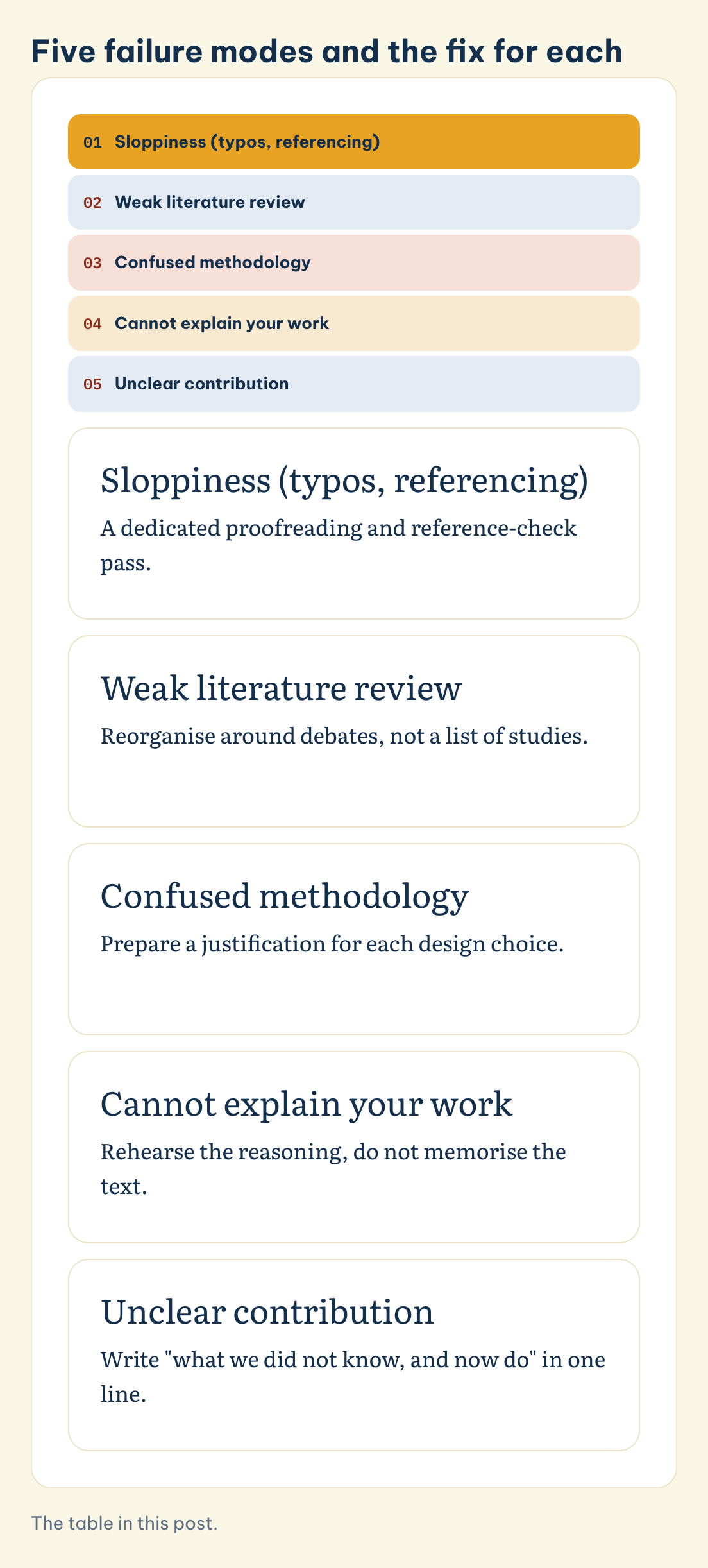
A typical defence opens with a short presentation, often 10 to 15 minutes, before the committee moves to questions, so your rehearsal should cover both parts. Each targets a specific failure mode above. The candidates who sail through are not the most brilliant; they are the ones who closed these predictable gaps in advance.
| Failure mode | The fix before your defence |
|---|---|
| Sloppiness (typos, referencing) | A dedicated proofreading and reference-check pass |
| Weak literature review | Reorganise around debates, not a list of studies |
| Confused methodology | Prepare a justification for each design choice |
| Cannot explain your work | Rehearse the reasoning, do not memorise the text |
| Unclear contribution | Write "what we did not know, and now do" in one line |
Evidence: Each of these fixes maps directly onto what examiner-report research identifies as the difference between a marginal and a sound thesis (Mullins & Kiley, 2002; Holbrook et al., 2004). Trafford and Leshem (2008), also published by Open University Press, reach a similar conclusion from a different angle, arguing that candidates should build their argument around the viva from the earliest stages of writing rather than treating preparation as a last-minute add-on. None requires new research; they require targeted preparation of what you already have.
Example: A working Vietnamese professional ran a full mock defence with a MAAS mentor two weeks before the real one. The mock surfaced three weak answers and a shaky contribution statement, all fixable in time. At the hội đồng, there were no surprises left.
Frequently asked questions
Can I fail my master's thesis defence?
It is possible but uncommon; Mullins and Kiley (2002), in Studies in Higher Education, recorded only 10 outright fails among 300 theses reviewed by 30 examiners, so outright failure is rare. The far more likely negative outcome is being asked for major revisions and a resubmission, which delays your graduation. Preparing well is mostly about avoiding that verdict, not a dramatic fail.
How important are typos really?
More than they seem. Mullins and Kiley (2002) describe examiners being "flipped" into a critical frame of mind by careless errors, which reads as a sign that the research may also be careless, which can shift their whole reading of your thesis. A clean proofread is one of the highest-value things you can do before submitting.
What if I do not understand an examiner's question?
Ask them to clarify or rephrase; that is completely acceptable and better than guessing, consistent with Tan's (2023) view of the defence as a conversation about understanding rather than a memory test. Take a moment before answering, and if you genuinely do not know, say what you would do, for example checking Google Scholar, to find out rather than bluffing.
How do I state my contribution if my research feels small?
Frame it honestly and specifically. A modest, clear contribution, "this study provides the first evidence of X in the Vietnamese context", is stronger than a vague claim to have transformed the field. Tinkler and Jackson (2004) make the same point: examiners reward a real, defensible addition over an overclaimed one.
Can MAAS help me prepare for my defence?
Yes. MAAS Academic Mentoring runs mock defences, drills the reasoning behind your choices, tightens your contribution statement, and helps you clear sloppiness, all with PhD-level mentors. We prepare you to defend your own work; we do not do the work for you.
Facing your defence and want no surprises?
The failures that send a thesis back for major revisions are predictable, which means they are preventable. A mentor helps you find and fix them while there is still time, and rehearses the defence until you can answer calmly.
MAAS Academic Mentoring is an advisory partner. We run mock defences, coach you to justify every choice, sharpen your contribution, and clear the sloppiness examiners punish, so you walk in ready. Viva and defence rehearsal sits outside the standard mentoring package and is scoped and quoted on its own.
Bring your thesis and defence date, and we will match you to a research mentor in your discipline within 48 hours when our network already covers that field. If it does not, MAAS opens a dedicated recruitment round for your case, which usually takes about 2 weeks. Of our 100+ experts, 23% hold a PhD and 43% a master's degree.
Book a free 20-minute defence-preparation consultation with MAAS Academic Mentoring →
Related guides
- How do you prepare for a viva or defence as an ESL student?: the full preparation routine, question by question
- How do you write your master's thesis yourself, from proposal to defence?: the roadmap that leads to a defensible thesis
- How do you write a methodology examiners believe?: justifying your design so it survives questioning
- How do you write a dissertation conclusion?: stating your contribution clearly at the end
- How do you plan a dissertation timeline?: leaving time for the proofreading and rehearsal that prevent failures
- MAAS Academic Mentoring service: phased, 1:1 coaching including mock defences with PhD-level mentors
References
- Creswell, J. W., & Creswell, J. D. (2018). Research design: Qualitative, quantitative, and mixed methods approaches (5th ed.). SAGE Publications.
- Holbrook, A., Bourke, S., Lovat, T., & Dally, K. (2004). PhD theses at the margin: Examiner comment on re-examined theses. Melbourne Studies in Education, 45(1), 89–113. https://doi.org/10.1080/17508487.2004.9558608
- Mullins, G., & Kiley, M. (2002). "It's a PhD, not a Nobel Prize": How experienced examiners assess research theses. Studies in Higher Education, 27(4), 369–386. https://doi.org/10.1080/0307507022000011507
- Tan, W. C. (2023). Purpose-driven oral examination: Insights from doctoral viva examiners. Discover Education, 2, Article 52. https://doi.org/10.1007/s44217-023-00083-6
- Tinkler, P., & Jackson, C. (2004). The doctoral examination process: A handbook for students, examiners and supervisors. Open University Press.
- Trafford, V., & Leshem, S. (2008). Stepping stones to achieving your doctorate: By focusing on your viva from the start. Open University Press.
Tools & resources
- Vitae. (n.d.). Your viva. Retrieved July 27, 2026, from https://www.vitae.ac.uk/doing-research/doing-a-doctorate/completing-your-doctorate/your-viva
This article is study-skills guidance for students preparing to defend their own thesis. MAAS Academic Mentoring is an advisory partner; we coach students through mock defences and preparation and do not write or submit work on a student's behalf.
A free 20-minute defence-preparation consultation with MAAS Academic Mentoring, to talk through where your thesis is most exposed.
Book Free Discovery ▸