
◆ Thesis mentoring
How do you write a master's thesis yourself, from proposal to defence?
Learning how to write a master's thesis feels overwhelming because it is one large project, not because you cannot do it. Students who finish well are rarely the most gifted writers. They follow a staged process, close to the model Rudestam and Newton (2015) describe, and use their supervisor's feedback instead of avoiding it. This guide gives Vietnamese master's students a realistic roadmap, from proposal to the defence panel, and shows where MAAS Academic Mentoring helps.
◆ Question 1 / 7 · The stages
What are the stages of a master's thesis, from start to defence?
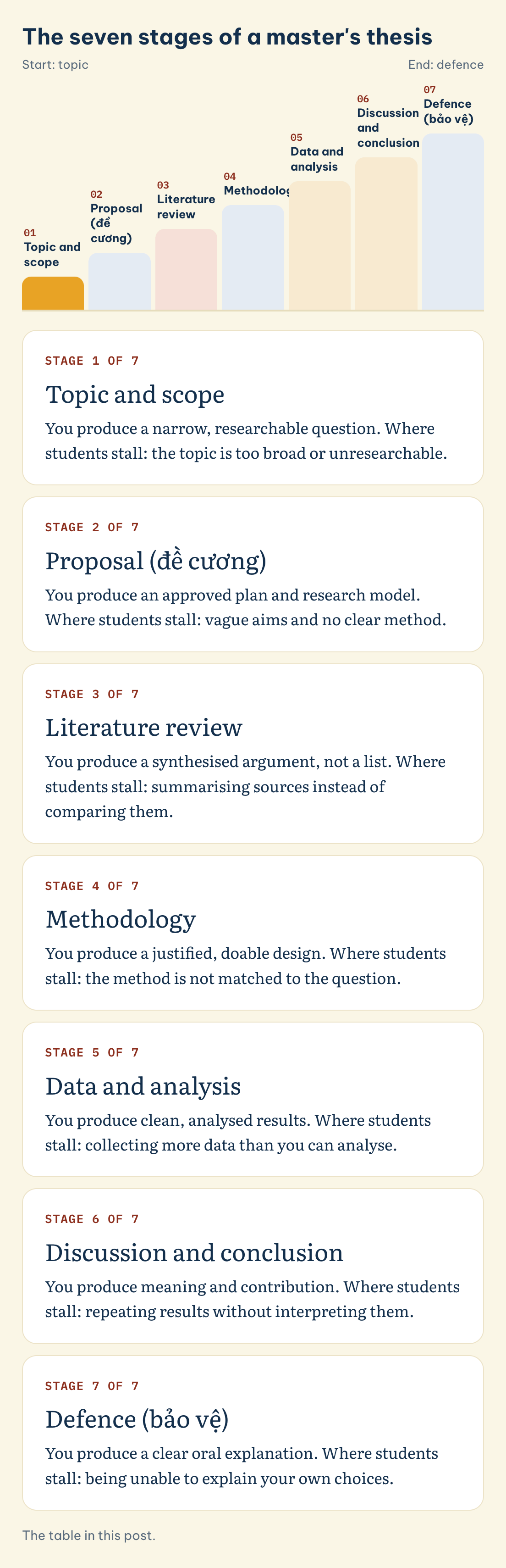
Direct answer: A master's thesis moves through a predictable sequence: narrow a topic, write a proposal, review the literature, design your methodology, collect and analyse data, then write findings, discussion, and conclusion, and finally defend the work before a panel. Treating the thesis as one deadline is the classic mistake; seven linked stages is what makes it finishable.
The seven stages of a master's thesis
Tap a stage to see what you produce and where students stall.
Stage 1 of 7
Topic and scope
You produce a narrow, researchable question. Where students stall: the topic is too broad or unresearchable.
Stage 2 of 7
Proposal (đề cương)
You produce an approved plan and research model. Where students stall: vague aims and no clear method.
Stage 3 of 7
Literature review
You produce a synthesised argument, not a list. Where students stall: summarising sources instead of comparing them.
Stage 4 of 7
Methodology
You produce a justified, doable design. Where students stall: the method is not matched to the question.
Stage 5 of 7
Data and analysis
You produce clean, analysed results. Where students stall: collecting more data than you can analyse.
Stage 6 of 7
Discussion and conclusion
You produce meaning and contribution. Where students stall: repeating results without interpreting them.
Stage 7 of 7
Defence (bảo vệ)
You produce a clear oral explanation. Where students stall: being unable to explain your own choices.
Save this figure
Evidence: The chapter spine, introduction, literature review, methodology, findings, discussion, and conclusion, is near-universal across disciplines and institutions, which is why supervisors and rubrics expect it. Rudestam and Newton (2015) set out this same staged sequence in their book Surviving Your Dissertation, now in its fourth edition, and it is the model most supervisor handbooks still point students toward. In Vietnam, most master's programmes add two formal checkpoints on top of this: a detailed proposal (đề cương) approved before you write, and an oral defence before a panel who question and grade the work.
| Stage | What you produce | Where students stall |
|---|---|---|
| 1. Topic and scope | A narrow, researchable question | Topic too broad or unresearchable |
| 2. Proposal / đề cương | Approved plan and research model | Vague aims, no clear method |
| 3. Literature review | A synthesised argument, not a list | Summarising sources instead of comparing them |
| 4. Methodology | A justified, doable design | Method not matched to the question |
| 5. Data and analysis | Clean, analysed results | Collecting more data than you can analyse |
| 6. Discussion and conclusion | Meaning and contribution | Repeating results without interpreting them |
| 7. Defence / bảo vệ | A clear oral explanation | Cannot explain your own choices |
Example: A Vietnamese student came to MAAS with 60 sources and no question. A literature review commonly draws on 40 to 80 sources for a master's thesis, so her 60 sources were not the problem, the missing question was. Her mentor did not write anything for her; he helped her turn a broad interest into one narrow question, and suddenly the literature review had a spine to follow.
◆ Question 2 / 7 · Planning the time
How long does a master's thesis take, and how should you plan the time?
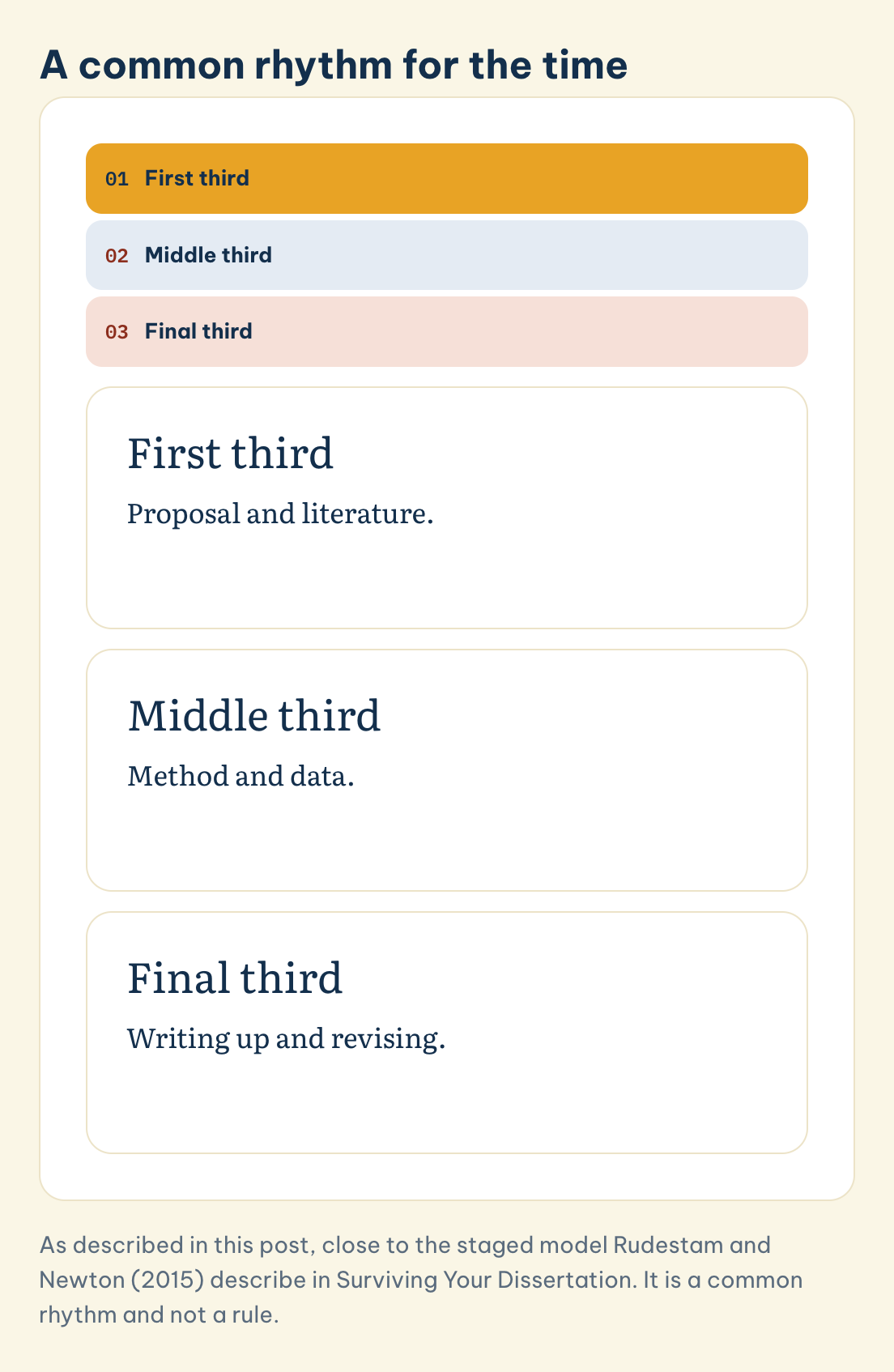
Direct answer: Plan backwards from your submission and defence dates, not forwards from today, and give the stages that reliably overrun, data collection and the discussion chapter, extra buffer. A common rhythm, close to the staged model Rudestam and Newton (2015) describe in Surviving Your Dissertation, is to spend the first third on proposal and literature, the middle third on method and data, and the final third on writing up and revising. Write a little across the whole timeline rather than saving all the writing for the end, when panic sets in.
A common rhythm for the time
Tap a third to see what it holds.
First third
Proposal and literature.
Middle third
Method and data.
Final third
Writing up and revising.
Save this figure
Evidence: Because each stage depends on the one before, a slipped proposal deadline pushes everything else late. Milestones agreed with your supervisor, one per stage, let you catch slippage early while there is still time to recover.
Example: A MAAS mentor helped a working professional map her thesis onto her real calendar, protecting 2 hours every Sunday. She missed no stage deadline because each one was small and scheduled. For the detailed method, see our guide on how to plan a dissertation timeline.
◆ Question 3 / 7 · The hardest part
Which part of a master's thesis do students find hardest, and why?
Direct answer: For most students, the discussion chapter is the hardest (Sadouki, 2023), because it asks you to interpret your results rather than just report them. Narrowing the topic and citing sources correctly are the next most common struggles. Knowing this in advance lets you budget more time and support for the discussion, instead of being surprised by it in the final weeks.
Evidence: In a survey of 120 master's students writing in English as a foreign language in Algeria, Sadouki (2023) found that the discussion section was rated the most difficult part of the thesis to write, with topic selection and referencing, commonly APA or Harvard style, also among the top reported challenges. These are precisely the stages where interpretation, not effort, is what the marker rewards.
Example: A Vietnamese student's results chapter was strong but his discussion simply restated the numbers. His MAAS mentor coached him with one repeated question, "so what does this result mean for your research question?", until every result was interpreted. The data did not change; the chapter moved up a full band.
◆ Question 4 / 7 · Talent or process
Do you need to be a "natural writer", or does the process matter more?
Direct answer: The process matters far more than raw writing talent, and writing in your second language does not doom you to a lower grade. Students who believe they can improve, and who treat writing as drafting and revising rather than getting it right first time, tend to earn higher marks (Mendoza et al., 2023). If you are a Vietnamese student worried that English is holding you back, the evidence is reassuring: a sound process closes most of the gap.
Evidence: In a study of 283 master's thesis writers in an English-medium university, Mendoza et al. (2023) found that stronger self-efficacy and adaptive writing conceptions were linked to higher thesis grades, and, importantly, found no significant difference in outcomes between first-language and second-language writers. Confidence built through process, not native fluency, predicted success. Rudestam and Newton (2015) and Mendoza et al. (2023) both frame revision, not raw talent, as what separates finishers from stallers.
Example: A MAAS mentor helped an anxious student replace "my English is not good enough" with a drafting routine: write a rough version, get feedback, revise. Three drafts later her chapter was clear, and her belief that she could finish had grown with the pages.
◆ Question 5 / 7 · Supervisor and mentor
How should you work with your supervisor and a mentor to actually finish?
Direct answer: Engage with feedback instead of avoiding it, especially when it comes as questions rather than fixes. A supervisor who asks "why did you choose this method?" is guiding you to strengthen the work, the same pattern Nangimah and Walldén (2023) documented, not attacking it. Bring specific drafts and specific questions to each meeting, act on the feedback before the next one, and keep a written record of what was agreed. The students who stall are usually the ones who go quiet when the feedback feels hard.
Evidence: Research on thesis supervision by Nangimah and Walldén (2023) found that many students respond to feedback by resisting or avoiding it, and are frustrated when supervisors phrase feedback as questions, even though that questioning is meant to develop their thinking. Nangimah and Walldén write that "most students in both contexts are product-oriented and focus more on strategic action" (Nangimah & Walldén, 2023, p. 12). Their study compared supervision practices across universities in Sweden and Indonesia, and the same resistance pattern showed up in both settings, which is why it is worth planning for rather than assuming it will not apply to you. Students who instead treated feedback as guidance made stronger progress. Working with the process, not against it, is what moves a thesis forward.
Example: A Vietnamese student used to disappear for weeks after difficult feedback. His MAAS mentor set a simple loop: the mentor sets one chapter task, the student writes it, submits it for review, gets feedback, and moves on. The student stayed the author of every word, and the steady rhythm carried him to submission.
◆ Question 6 / 7 · Paying someone
Is it worth paying someone to write your thesis for you?
Direct answer: No. Having a thesis written for you is academic misconduct at every serious university, and the risks are severe: failure, expulsion, and having your degree revoked even years later. Beyond the rules, a bought thesis cannot survive the defence, because you will be questioned in detail on choices you did not make and cannot explain. The honest, safer path is to write it yourself with real guidance, which also leaves you with the research skills the degree is supposed to prove.
Evidence: A master's defence exists precisely to confirm that the work is yours; panels probe your methodology, your data, and your reasoning. A student who did not do the work cannot defend it, and institutions treat contract cheating as one of the most serious integrity breaches, with penalties that can follow the qualification for its lifetime.
Example: A student who was tempted to outsource came to MAAS instead. Her mentor showed her that the same money spent on coaching would leave her able to defend her own work, and holding a degree that no future review could take away. She wrote every chapter herself, with guidance, and passed her defence with confidence.
◆ Question 7 / 7 · How a mentor helps
How can a mentor help you write your master's thesis yourself, faster?
Direct answer: MAAS Academic Mentoring coaches you through each stage in order, sets one focused task at a time, reviews your draft, and hands it back for you to improve, so you keep moving without ever handing over authorship. The value is direction and momentum: turning a vague topic into a researchable question, decoding your supervisor's feedback, and keeping the discussion chapter on track, the exact difficulty Sadouki (2023) documented as hardest for master's students. You write every word; the mentor makes sure you are writing the right thing at the right time.
Evidence: A phased, homework-based model, proposal, then chapter by chapter with a review loop, close to the staged approach Rudestam and Newton (2015) recommend, matches how theses are actually examined and keeps the student as sole author. It addresses the exact points where students stall, topic scope, feedback, and interpretation, without crossing into doing the work for them. MAAS mentors also check every citation against APA 7th before a chapter goes back to you.
Example: A working Vietnamese professional finishing a master's part-time used MAAS Academic Mentoring through the full arc: topic and proposal, then one chapter per phase with a review round each time. She met every checkpoint, defended her own research, and kept the skills. For the final stage, see our guide on how to prepare for a viva or defence as an ESL student.
Frequently asked questions
How long should a master's thesis be?
It varies by programme and discipline, commonly 15,000 to 25,000 words, but always confirm the exact range in your own faculty's regulations. As a rough guide within that total, the literature review commonly runs 3,000 to 5,000 words, the methodology chapter 2,000 to 3,000 words, and the discussion chapter 3,000 to 4,000 words. Length matters less than whether each chapter does its job; a tight, well-argued thesis beats a padded one.
What is the đề cương, and why does it matter so much?
The đề cương is your approved research proposal or outline, and it is the foundation everything else rests on. A typical proposal runs 2,000 to 4,000 words, short enough to force a clear question before you commit months to it. A clear question, a justified method, and a realistic plan approved here save you from rewriting whole chapters later. Weak proposals are the single biggest cause of thesis delays.
I am writing in English as my second language. Am I at a disadvantage?
Not as much as you may fear. Research on master's thesis writers found no significant grade difference between first- and second-language writers when the writing process was sound (Mendoza et al., 2023). Focus on drafting and revising, and use feedback actively, rather than trying to write perfect English on the first attempt.
What happens at the defence, and how do I prepare?
You present your research briefly and then answer the panel's questions about your choices, your data, and your conclusions. Prepare by knowing your own thesis deeply, anticipating the obvious questions, and practising clear, calm answers. Being able to explain why you did what you did matters more than defending every detail.
Can MAAS help me write my thesis without writing it for me?
Yes. MAAS Academic Mentoring coaches you phase by phase, from the proposal through each chapter, reviewing every draft you write, with mentors who hold a doctorate or a master's degree with supervisory experience. Defence rehearsal can be added later and is quoted separately. You remain the sole author; we make sure you are writing the right thing at the right time. We do not write your thesis for you.
Ready to write your master's thesis with real support?
If the size of the project is what frightens you, the fix is not to hand it over, it is to break it into stages and never face the whole thing at once. That is exactly what MAAS Academic Mentoring provides.
MAAS Academic Mentoring is an advisory partner, built around how Nangimah and Walldén (2023) found students actually engage with feedback. We coach you from a vague idea to a defended thesis through a phased, homework-based model, you write each chapter, we review it and guide the next, so the work and the skills stay yours. Each phase is signed off on its own before the next one opens, and the kick-off session is free and not counted as a paid session.
Bring your topic or your draft proposal, and we will match you to a research mentor in your discipline, 23% of our 100+ experts hold a PhD, within 48 hours when our network already covers that field. If it does not, MAAS opens a dedicated recruitment round for your case, which usually takes about 2 weeks.
Book a free 20-minute master's thesis consultation with MAAS Academic Mentoring →
Related guides
- How do you plan a dissertation timeline?: building a realistic, milestone-based schedule you can keep
- How do you write a dissertation or thesis proposal?: getting the đề cương approved so later chapters go smoothly
- How do you choose a dissertation topic with enough literature?: narrowing a broad interest into a researchable question
- How do you write a methodology examiners believe?: matching your design to your research question
- How do you prepare for a viva or defence as an ESL student?: answering the panel with calm, clear reasoning
- Dissertation coaching vs going it alone: which is right for you?: deciding how much support you actually need
- MAAS Academic Mentoring service: phased, 1:1 coaching with PhD-level mentors in your discipline
References
- Mendoza, L., Lindblom-Ylänne, S., Lehtonen, T., & Hyytinen, H. (2023). Understanding master's thesis writers in a Finnish EMI context: Writing conceptions, apprehension about grammar, self-efficacy for thesis writing and thesis grade. International Journal of Educational Development, 103, Article 102874. https://doi.org/10.1016/j.ijedudev.2023.102874
- Nangimah, M., & Walldén, R. (2023). How supervisors provide and students react to EAL thesis supervision: Voices from Sweden and Indonesia. Frontiers in Education, 8, Article 1118436. https://doi.org/10.3389/feduc.2023.1118436
- Rudestam, K. E., & Newton, R. R. (2015). Surviving your dissertation: A comprehensive guide to content and process (4th ed.). Sage Publications.
- Sadouki, F. (2023). Investigating challenges in thesis writing for non-native MA students of English: The case of second-year MA students of English in Algeria. Bulletin of the Transilvania University of Braşov, Series IV: Philology and Cultural Studies, 16(65)(2), 93. https://doi.org/10.31926/but.pcs.2023.65.16.2.7
Tools & resources
- Monash University. (n.d.). Writing a thesis. Monash University Learning HQ. Retrieved July 27, 2026, from https://www.monash.edu/learnhq/write-like-a-pro/annotated-assessment-samples/postgraduate/thesis
This article is study-skills guidance for students writing their own master's thesis. MAAS Academic Mentoring is an advisory partner; we coach students through a phase-by-phase model and do not write or submit work on a student's behalf.
A free 20-minute master's thesis consultation with MAAS Academic Mentoring, to talk through where you are in the seven stages.
Book Free Discovery ▸