
◆ Thesis and dissertation
Dissertation coaching vs going it alone: which is right for you?
Dissertation coaching pairs you with a mentor for structure, methodology, and revision feedback, while going it alone means relying only on your supervisor and your own process. Both can end in a strong submission. The right choice depends on how much structure your programme gives you, how confident you are writing in academic English, and how much risk you can afford to carry on a project that runs for months.
This guide compares the two paths honestly, including when going it alone is the smarter call, and answers the questions international and Vietnamese postgraduate students ask the MAAS mentoring team most often.
◆ Section 1 / 7 · At a glance
Dissertation coaching vs going it alone, at a glance
Direct answer: Going it alone means self-set deadlines, supervisor-only feedback, and free support, with a main risk of drift and late surprises. Dissertation coaching adds a mentor-built chapter timeline, weekly check-ins, and academic-English coaching for a paid fee on top of your programme, with the main risk being a provider that crosses integrity lines. You stay the author either way.
| Factor | Going it alone | With a dissertation coach (advisory) |
|---|---|---|
| Structure and deadlines | You set and police every internal deadline | A mentor builds a chapter timeline and holds you to it |
| Methodology feedback | Mainly from supervisor meetings, often weeks apart | Focused feedback between supervisor meetings |
| Academic English and ESL support | Self-edited, university writing centre | Coaching on academic English and reviewer-ready clarity |
| Accountability | Self-driven | Weekly check-ins keep momentum |
| Cost | Free, included in your fees | A paid advisory layer on top of your programme |
| Main risk | Drift, isolation, late surprises | Choosing a provider that crosses integrity lines |
| Who stays the author | You | You, always |
| Best for | Confident writers with responsive supervision | Students who keep stalling on structure, method, or English |
Use the table as a filter, then read the sections below for the reasoning behind each row.
◆ Section 2 / 7 · The real difference
What is the real difference between dissertation coaching and going it alone?
Direct answer: Going it alone means your only structured support is your supervisor and university services. Coaching adds a mentor who plans chapters, pressure-tests methodology, and gives fast feedback between those touchpoints. For a sense of scale, a UK doctoral thesis in more discursive subjects may be as long as 100,000 words (Quality Assurance Agency for Higher Education [QAA], 2020).
Evidence: Supervision quality and regular, structured guidance are repeatedly linked to whether postgraduate students finish and finish well (Phillips & Pugh, 2015; Wisker, 2012). When supervision is thin or infrequent, students carry more of the planning load themselves, which is exactly the gap a coach fills.
Example: A MAAS client in a hands-off programme was technically free to email her supervisor any time, yet she went a month between useful replies. A mentor did not replace the supervisor. He gave her a weekly half-hour to turn vague worries into specific questions, so her rare supervisor meetings became far more productive.
◆ Section 3 / 7 · Going it alone
When is going it alone the right choice?
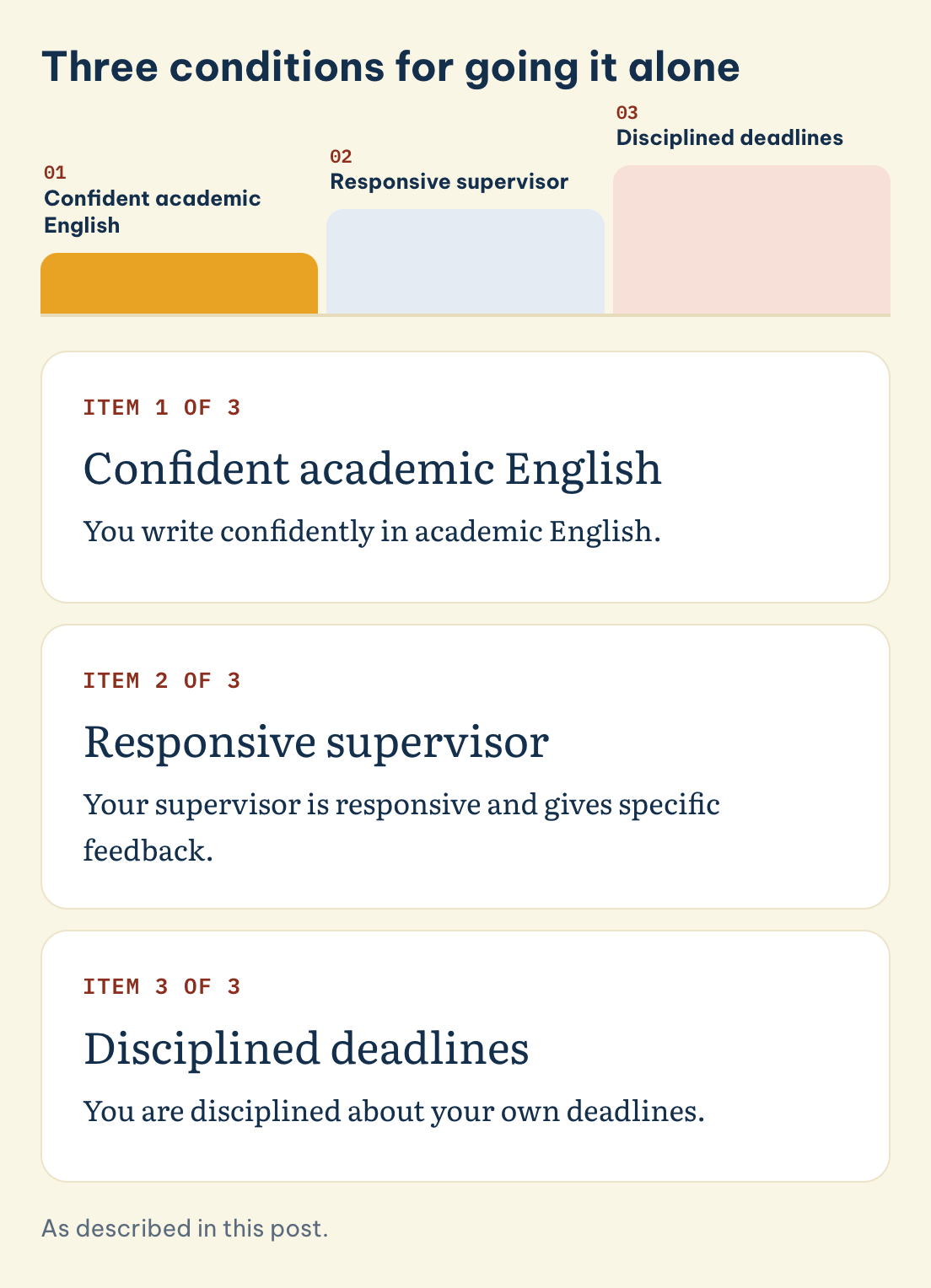
Direct answer: Going it alone is the right call when you write confidently in academic English, your supervisor is responsive and gives specific feedback, and you are disciplined about your own deadlines. If those three conditions hold, the free support built into your fees is often enough, and adding a coach would mostly buy reassurance you do not need.
Three conditions for going it alone
Tap a condition to read it as the post puts it. They are items to check against your own situation, not steps.
Item 1 of 3
Confident academic English
You write confidently in academic English.
Item 2 of 3
Responsive supervisor
Your supervisor is responsive and gives specific feedback.
Item 3 of 3
Disciplined deadlines
You are disciplined about your own deadlines.
Save this figure
Evidence: University writing centres, library research-skills sessions, and supervisor office hours exist precisely to support independent candidates, and confident students who use them well rarely need more. The honest position any reputable advisor should take is that institution-first support comes first (Wisker, 2012), a position echoed in the UK's Quality Assurance Agency for Higher Education (QAA) guidance on research degrees, which expects universities to provide named supervisors and regular, structured contact throughout the candidature, and in similar guidance from Advance HE on postgraduate research supervision.
Example: A strong MAAS enquirer already had a clear plan, a supportive supervisor, and good drafting habits. We told her she did not need paid coaching for the main chapters and suggested a single pre-submission review instead. Recommending less is part of giving honest advice.
◆ Section 4 / 7 · When coaching helps
When does dissertation coaching make the difference?
Direct answer: Coaching earns its place when you keep stalling on the same things: an unclear structure, a methodology you cannot defend, feedback you struggle to act on, or academic English that hides good ideas. A coach shortens the loop between getting stuck and getting moving, which protects your timeline when the stakes and the word count are both high.
Evidence: Doctoral attrition is high. In baseline data from doctoral programmes at 30 US and Canadian universities, only 57% of students who started between 1992-93 and 1994-95 had completed within 10 years, ranging from 64% in Engineering to 49% in Humanities, which left about 43% without the degree at that mark (Sowell et al., 2008). Lovitts (2001) traces much of this to structural isolation and weak day-to-day support rather than ability, which is the precise gap a mentoring layer is designed to close. That gap matters more the thinner supervision gets: reviewing 163 empirical studies on the doctoral experience, Sverdlik et al. (2018) conclude that "these findings emphasize the importance of a collaborative supervisory relationship based on shared interests, collegiality, and agreed upon mutual responsibilities" (Sverdlik et al., 2018, p. 369), exactly the responsive, structured relationship a coach is built to supply when a supervisor cannot.
Example: A MAAS client had a strong dataset but kept rewriting her methodology chapter without progress. Two focused sessions clarified her research design and the justification an examiner would expect. She stopped circling, finished the chapter in a fortnight, and defended the design confidently in her viva.
◆ Section 5 / 7 · Coaching or writing for you
Is dissertation coaching the same as paying someone to write it?
Direct answer: No, and the distinction matters more than any other point in this guide. Legitimate coaching is advisory: a mentor reviews your drafts, teaches the moves a published researcher makes, and coaches you to revise, while you research, write, and submit your own work. A service that writes the dissertation for you is an academic integrity breach and a serious risk to your degree. MAAS does not write or submit work for students, and we never guarantee a grade.
Evidence: Research writing is something students learn through guided practice and feedback, not something that can be outsourced without losing the learning the degree is meant to certify (Wisker, 2012; Phillips & Pugh, 2015). Every legitimate model keeps the student as the sole author. In England, the Skills and Post-16 Education Act 2022 went further and made it a criminal offence to provide or advertise essay-mill services to students, which is the exact line legitimate coaching stays on the right side of.
Example: A prospective MAAS client asked, half-joking, whether we could "just finish" his results chapter before a deadline. We declined and offered the alternative that actually helps: a focused session to plan the analysis so he could write it himself in time. He made the deadline with work he could defend.
◆ Section 6 / 7 · Cost in time and money
How much does the choice cost, in time and money?
Direct answer: Going it alone costs no money but can cost time, because the expensive failures are silent: weeks lost to an unclear structure, a late methodology rethink, or a major revision you could have anticipated. Coaching costs money but is designed to buy that time back by catching problems early. Weigh the fee against the cost of a delayed submission or an extra resubmission, which carry their own financial and personal price.
Evidence: Time-to-completion and non-completion are well-documented risks in postgraduate study, and they cluster around structural and supervisory gaps rather than raw ability (Lovitts, 2001). Many taught master's programmes allocate a single 12 to 15 week term for the whole dissertation, often worth 60 credits out of a taught master's total, which leaves little slack for a rethink once a supervisor flags a problem late (Phillips & Pugh, 2015). Spending to reduce those gaps is a calculated trade, not a luxury.
Example: A MAAS client weighing the cost of advisory support had already lost a full term to a stalled literature review. For her, a few coached sessions that unblocked the chapter were cheaper than another term of fees and lost income. For a student who is on track, the same spend would not be justified.
◆ Section 7 / 7 · International students
Do international and Vietnamese students (UK, Singapore) benefit more from coaching?
Direct answer: Often yes, for two specific and avoidable reasons rather than any difference in ability. International and ESL students more often lose marks to academic-English clarity and to unfamiliar expectations about structure and critical voice, not to weak ideas. Coaching that targets those two gaps tends to pay off most for Vietnamese students studying in the UK, Singapore, and similar systems, who are managing a new academic culture and a second language at the same time.
Evidence: Supervising international candidates well means attending to academic writing and cultural expectations explicitly, which is a recognised part of good postgraduate supervision rather than an optional extra (Wisker, 2012). Many UK and Singapore postgraduate programmes set entry requirements around IELTS 6.5 to 7.0 (or an equivalent TOEFL score), yet examiners still expect near-native academic register by the final submission, a gap that opens up fast once the thesis moves past general English. Where supervision does not cover it, a coach can.
Example: A Vietnamese MAAS client in a UK programme had strong analysis buried under unclear academic English. Her mentor coached her on argument structure and reviewer-ready phrasing in English and Vietnamese, so the examiner finally saw the quality of the underlying work. She remained the author throughout.
For the statistics chapter in particular, our guide to thesis statistics help shows which tasks a helper can share and which stay yours.
Frequently asked questions
Is dissertation coaching cheating?
No, when it stays advisory. Coaching on structure, methodology, and revising your own drafts is legitimate, the same way a writing centre or a supportive supervisor is. It becomes a breach only if someone writes or submits the work for you, which MAAS does not do.
Can I just use my university's free support instead?
Often yes, and you should try it first. Your supervisor, writing centre, and library sessions are included in your fees. Many writing centres run 30 to 45 minute one-to-one sessions, sometimes capped at 3 to 5 visits a term, so book early rather than waiting for a crisis. Consider paid coaching only if you keep stalling on the same problems despite using them.
Will my supervisor know I work with a coach?
That is your choice. Many students mention they have a private mentor; others keep it private. Either way the dissertation must be your own work, which is a firm rule for both your university and MAAS.
Does coaching guarantee a better grade?
No. No one can guarantee a grade, because your examiners decide. A coach improves your process and your draft, which improves your odds, and any provider promising a guaranteed result is a warning sign.
Do you coach students studying in the UK and Singapore?
Yes. MAAS offers remote dissertation mentoring for Vietnamese and international students in the UK, Singapore, and other systems, in English and Vietnamese, around your university's submission calendar.
How do I start without committing to a full programme?
Begin with one focused session or a single pre-submission review. A good coach will tell you honestly whether you need more support or whether you are already on track.
Ready to decide with a clear head?
If your structure and feedback are enough to finish well, go it alone with confidence; if you keep stalling, MAAS pairs you with a discipline-matched mentor from a network where 23% of experts hold PhDs, and your first 20-minute consultation is free.
The choice is not coaching versus your own ability. It is whether the structure and feedback around you are enough to finish well, on time, with work you can defend. If they are, go it alone with confidence. If you keep stalling on structure, methodology, or academic English, a mentor is the faster way through.
MAAS pairs you with a discipline-matched mentor who holds a doctorate, or a master's with supervisory experience, within 48 hours when our network already covers that field, or in about two weeks if MAAS has to recruit for it. The work runs phase by phase and each phase is signed off on its own, so you can stop after the proposal or continue to submission. Your first 20-minute consultation is free, and you stay the author of every word.
Book a free 20-minute dissertation consultation with MAAS →
Related guides
- How do you write your master's thesis yourself, from proposal to defence? · the full self-write roadmap, and where a mentor helps
- How do you prepare for a viva voce defence when English is your second language? · defending the work you wrote yourself
- How do you write a methodology section that examiners actually believe? · the chapter coaching most often unblocks
- How do you write a literature review for a PhD as a Vietnamese student? · structure, critical voice, and gap framing
- Academic Mentoring (1-on-1) · the week-by-week dissertation coaching cycle
- Dissertation & thesis mentoring hub · proposal-to-submission support and templates
- Meet the MAAS expert network · the postgraduate-qualified mentors behind this guide
References
- Lovitts, B. E. (2001). Leaving the ivory tower: The causes and consequences of departure from doctoral study. Rowman & Littlefield.
- Phillips, E. M., & Pugh, D. S. (2015). How to get a PhD: A handbook for students and their supervisors (6th ed.). Open University Press.
- Quality Assurance Agency for Higher Education. (2020). Characteristics statement: Doctoral degree. QAA. https://www.qaa.ac.uk/docs/qaa/quality-code/doctoral-degree-characteristics-statement-2020.pdf
- Sowell, R., Zhang, T., & Redd, K. (2008). Ph.D. completion and attrition: Analysis of baseline program data from the Ph.D. Completion Project. Council of Graduate Schools. https://cgsnet.org/publications/phd-completion-and-attrition-analysis-of-baseline-program-data
- Sverdlik, A., Hall, N. C., McAlpine, L., & Hubbard, K. (2018). The Ph.D. experience: A review of the factors influencing doctoral students' completion, achievement, and well-being. International Journal of Doctoral Studies, 13, 361–388. https://doi.org/10.28945/4113
- Wisker, G. (2012). The good supervisor: Supervising postgraduate and undergraduate research for doctoral theses and dissertations (2nd ed.). Palgrave Macmillan.
A free 20-minute consultation with MAAS Academic Mentoring, to decide whether your structure and feedback are enough or whether an adviser would help.
Book Free Discovery ▸