How do you plan a dissertation timeline from the deadline?
+7 parts+4 figures, 2 of them interactive+Linked to the dissertation handbook+11 min read
Reviewed by MAAS-EXP-07, PhD in Social Science and Tourism & Hospitality (Vietnam)
Enter two dates and get a dated timeline. The tool counts backwards from your submission date, spreads the stages in the proportions of one published example plan, and then checks the two dates that universities do publish: the latest full draft and the ethics lead time.
Author: MAAS Academic Skills Publishing Desk · Reviewed by a Principal Academic Mentor
Last updated: 2026-10-09
Category: thesis-dissertation
Worked examples
Or load a worked example:
Sheffield length: 119 days
Undergraduate | 2026-10-12 → 2027-02-08
The span equals the 119 task-days, so every stage keeps its example length in days.
Some milestones fall on a Saturday or Sunday. The tool does not move them (a tool choice), so shift them yourself if you do not work weekends.
Background reading weekend
Literature review weekend
Design and write methodology
Ethics review
Data collection
Data analysis
Produce figures
Write discussion
Draft to supervisor
Act on feedback
Formatting and bibliography weekend
Editing and proofreading
Proportions from the University of Sheffield's example plan, not a rule. Each date is the end of its stage.
Cardiff summer dates: 80 days
Taught master's | 2026-06-22 → 2026-09-10
Cardiff runs these dates. They are above the 77-day span of the Napier timeline, so there is no short-span warning, but the 6-week ethics lead time no longer fits and the tool says so.
Some milestones fall on a Saturday or Sunday. The tool does not move them (a tool choice), so shift them yourself if you do not work weekends.
The ethics submission dates fall before your start date, so the span is too short for the published lead time.
Background reading weekend
Literature review
Design and write methodology
Ethics review
Data collection
Data analysis weekend
Produce figures
Write discussion weekend
Draft to supervisor
Act on feedback
Formatting and bibliography
Editing and proofreading
Proportions from the University of Sheffield's example plan, not a rule. Each date is the end of its stage.
Too short: 11 days
Taught master's | 2026-10-12 → 2026-10-23
Several milestones share a date and the tool says so instead of pretending otherwise.
Only 11 days. Edinburgh Napier's taught master's timeline runs 77 days, from week 1 to the week-12 submission. Check the scope with your supervisor.
Several milestones land on the same day. The span is too short to give every stage its own date.
The latest date for a full draft (2026-10-09) is before your start date, so the span is too short to leave 2 weeks for feedback.
The ethics submission dates fall before your start date, so the span is too short for the published lead time.
Background reading same day as another
Literature review same day as another
Design and write methodology same day as another
Ethics review same day as another
Data collection same day as another
Data analysis same day as another
Produce figures same day as another
Write discussion same day as another
Draft to supervisor same day as another
Act on feedback same day as another
Formatting and bibliography same day as another
Editing and proofreading same day as another
Proportions from the University of Sheffield's example plan, not a rule. Each date is the end of its stage.
PhD starting 2026-10-01
PhD | 2026-10-01
Three month milestones and no proportions, because none are published.
Research plan in place month 24
Research complete, writing up begins month 36
Thesis submitted (full-time limit) month 48
Part1
◆ Part 1 / 7 · Start from the deadline
Start from the deadline, not from day one
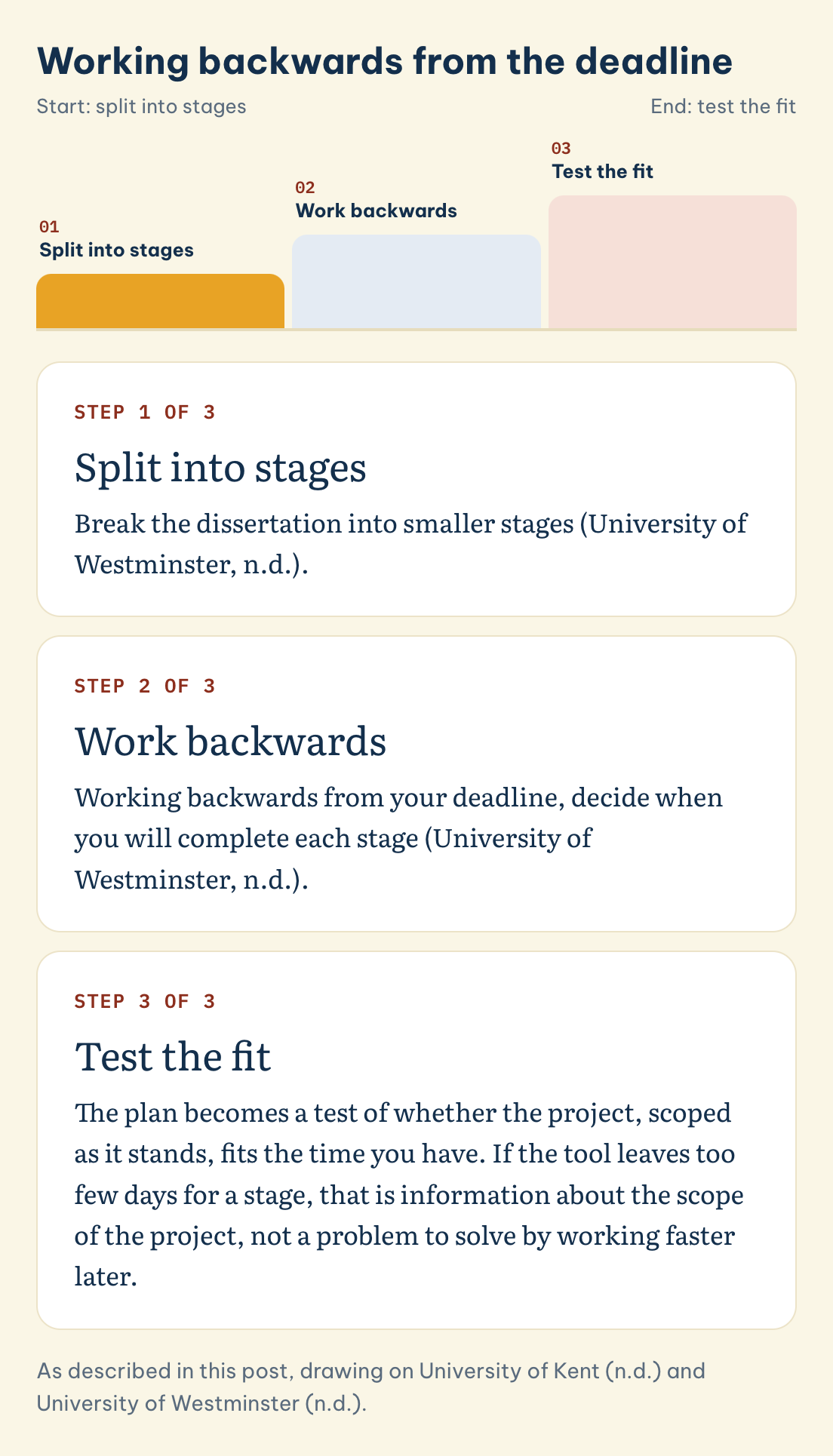
Direct answer: A dissertation timeline works backwards from your submission date. Kent says the scheduling of individual activities is "always worked backwards from the deadline", and Westminster gives a two-step method: split the project into stages, then decide backwards from the deadline when each ends (University of Kent, n.d.; University of Westminster, n.d.).
Break the dissertation into smaller stages (University of Westminster, n.d.).
Step 2 of 3
Work backwards
Working backwards from your deadline, decide when you will complete each stage (University of Westminster, n.d.).
Step 3 of 3
Test the fit
The plan becomes a test of whether the project, scoped as it stands, fits the time you have. If the tool leaves too few days for a stage, that is information about the scope of the project, not a problem to solve by working faster later.
As described in this post, drawing on University of Kent (n.d.) and University of Westminster (n.d.).Save this figure
The most common planning error is building the schedule forwards from the start date, which lets the early stages sprawl and squeezes writing into whatever time is left. The principle fits in one sentence: the scheduling of individual activities is always worked backwards from the deadline, so the time you have for each task is a function of the overall project schedule (University of Kent, n.d.). The same instruction comes as two steps: break the dissertation into smaller stages, then, working backwards from your deadline, decide when you will complete each stage (University of Westminster, n.d.).
Working backwards changes what the plan is for. It becomes a test of whether the project, scoped as it stands, fits the time you have. If the tool leaves too few days for a stage, that is information about the scope of the project, not a problem to solve by working faster later.
Part2
◆ Part 2 / 7 · Phases and durations
Break the project into phases with honest durations
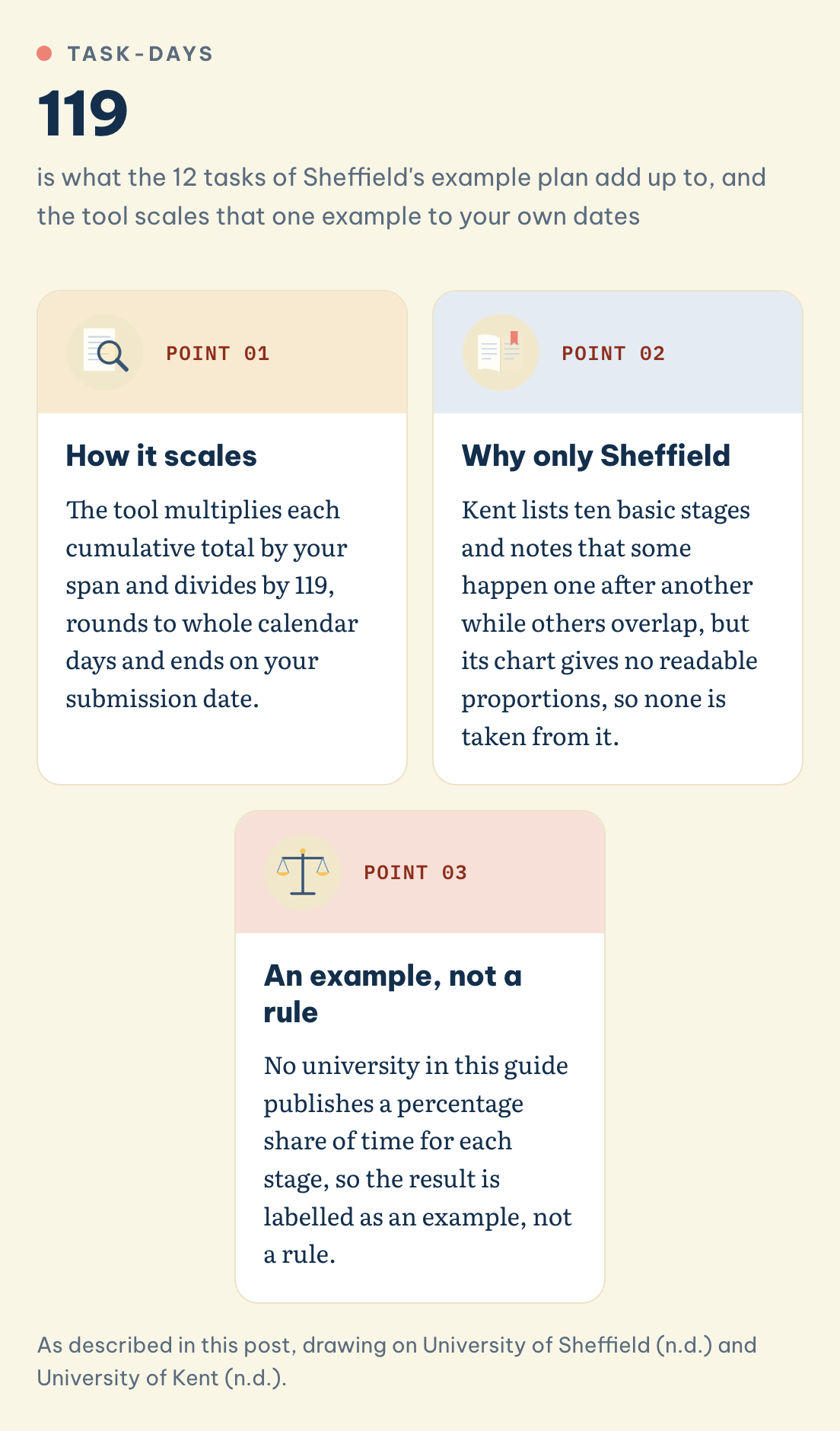
Direct answer: No university in this guide publishes a percentage share of time for each stage. The only worked example is Sheffield's: 12 tasks adding up to 119 task-days. This tool scales that one example to your own dates and labels it as an example, not a rule (University of Sheffield, n.d.).
Task-days
119
is what the 12 tasks of Sheffield's example plan add up to, and the tool scales that one example to your own dates
Point 01
How it scales
The tool multiplies each cumulative total by your span and divides by 119, rounds to whole calendar days and ends on your submission date.
Point 02
Why only Sheffield
Kent lists ten basic stages and notes that some happen one after another while others overlap, but its chart gives no readable proportions, so none is taken from it.
Point 03
An example, not a rule
No university in this guide publishes a percentage share of time for each stage, so the result is labelled as an example, not a rule.
As described in this post, drawing on University of Sheffield (n.d.) and University of Kent (n.d.).Save this figure
Sheffield asks you to list the tasks you must complete between now and the deadline and then estimate how long each takes, and offers one plan "for example" (University of Sheffield, n.d.). Its twelve tasks run from background reading to editing and proofreading (University of Sheffield, n.d.). The tool multiplies each cumulative total by your span and divides by 119, rounds to whole calendar days and ends on your submission date. Kent lists ten basic stages and notes that some happen one after another while others overlap, but its chart gives no readable proportions, so none is taken from it (University of Kent, n.d.).
Two phases need a deliberate allowance because they are outside your control. Both are shown as separate checks above, each with its source, instead of being hidden inside the proportions.
Part3
◆ Part 3 / 7 · Milestones
Set milestones and use them with your supervisor
Direct answer: Create intermediate milestones that tell you whether you are on schedule. Use the first supervisor meeting to agree the overall timeline. Sussex advises students to discuss and agree appropriate activities and milestones with their supervisor, so treat the dates above as a draft for that conversation (University of Sussex, n.d.).
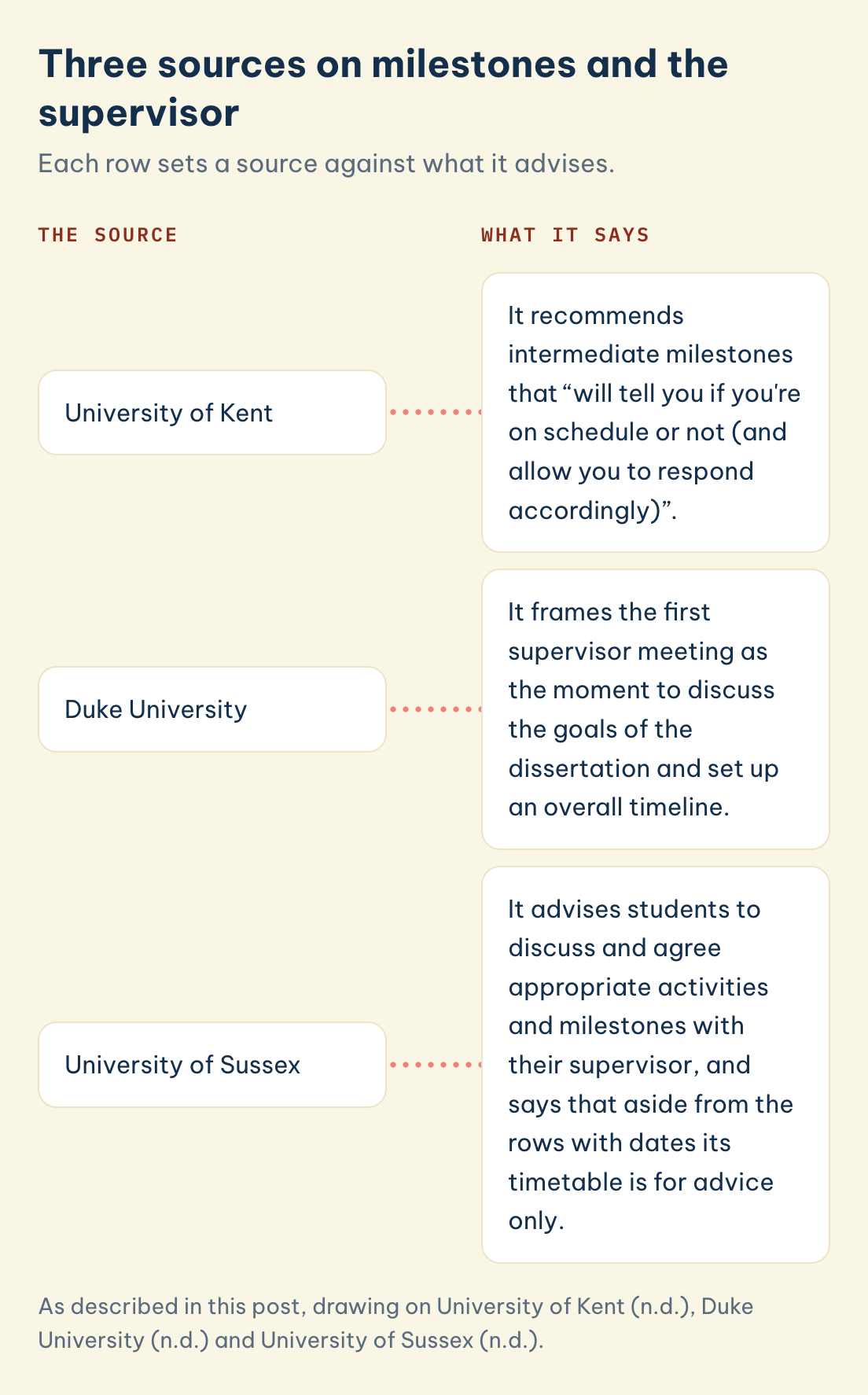
Three sources on milestones and the supervisor
Each row sets a source against what it advises.
The source
What it says
University of Kent
It recommends intermediate milestones that “will tell you if you're on schedule or not (and allow you to respond accordingly)”.
Duke University
It frames the first supervisor meeting as the moment to discuss the goals of the dissertation and set up an overall timeline.
University of Sussex
It advises students to discuss and agree appropriate activities and milestones with their supervisor, and says that aside from the rows with dates its timetable is for advice only.
As described in this post, drawing on University of Kent (n.d.), Duke University (n.d.) and University of Sussex (n.d.).Save this figure
Kent recommends intermediate milestones that "will tell you if you're on schedule or not (and allow you to respond accordingly)" (University of Kent, n.d.). Duke frames the first supervisor meeting as the moment to discuss the goals of the dissertation and set up an overall timeline (Duke University, n.d.). Sussex states that, aside from the rows with dates, its timetable is for advice only and that activities and milestones should be agreed with the supervisor (University of Sussex, n.d.).
Part4
◆ Part 4 / 7 · Buffer
Build in buffer for the phases that reliably overrun
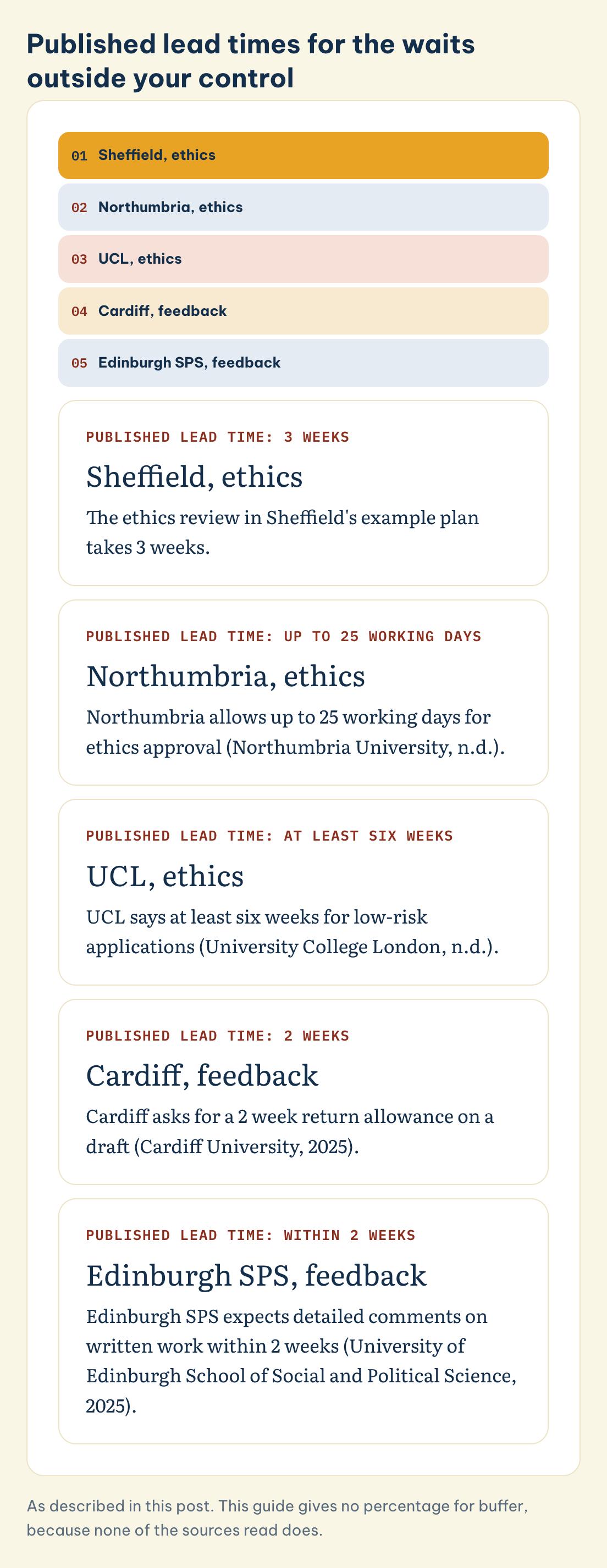
Direct answer: Two waits sit outside your control and have published lead times: ethics approval takes 3 to 6 weeks at the universities listed in the checks, and supervisors take about 2 weeks to respond to written work (Northumbria University, n.d.; University College London, n.d.; Cardiff University, 2025).
Published lead times for the waits outside your control
Tap a source to see its lead time. Ethics approval takes 3 to 6 weeks at the universities listed, and supervisors take about 2 weeks to respond.
Published lead time: 3 weeks
Sheffield, ethics
The ethics review in Sheffield's example plan takes 3 weeks.
Published lead time: Up to 25 working days
Northumbria, ethics
Northumbria allows up to 25 working days for ethics approval (Northumbria University, n.d.).
Published lead time: At least six weeks
UCL, ethics
UCL says at least six weeks for low-risk applications (University College London, n.d.).
Published lead time: 2 weeks
Cardiff, feedback
Cardiff asks for a 2 week return allowance on a draft (Cardiff University, 2025).
Published lead time: Within 2 weeks
Edinburgh SPS, feedback
Edinburgh SPS expects detailed comments on written work within 2 weeks (University of Edinburgh School of Social and Political Science, 2025).
As described in this post. This guide gives no percentage for buffer, because none of the sources read does.Save this figure
For ethics, approval "must be in place before you begin collecting data", and many projects are delayed while researchers wait, so start early (Sheffield Hallam University, n.d.). Northumbria allows up to 25 working days (Northumbria University, n.d.) and UCL says at least six weeks for low-risk applications (University College London, n.d.). For feedback, Cardiff asks for a 2 week return allowance on a draft (Cardiff University, 2025), and Edinburgh SPS expects detailed comments on written work within 2 weeks (University of Edinburgh School of Social and Political Science, 2025). Cardiff also advises that you allow some slack, particularly towards the end of the project (Cardiff University, 2025). Sheffield also says to build in "some contingency time" but gives no number (University of Sheffield, n.d.).
This guide does not give a percentage for buffer, because none of the sources read does.
Part5
◆ Part 5 / 7 · Write throughout
Write across the whole timeline, not only at the end
Direct answer: Leaving all the writing until analysis finishes is avoidable, because writing does not need to wait for a finished argument. Sheffield says writing "can and should be part of all stages" of the dissertation process (University of Sheffield, n.d.).
Sheffield says to write up as you go along (University of Sheffield, n.d.). A methodology chapter can usually be drafted once the design is settled, well before data collection ends. A chapter drafted early can go to your supervisor early, which starts the feedback clock sooner. At the other end of the document, the dissertation conclusion guide covers the final chapter, and how to write a dissertation shows where each chapter sits. For the separate question of words per chapter, see the chapter word-count breakdown, and for the question the project must answer, see writing research questions and objectives.
Part6
◆ Part 6 / 7 · Gantt chart or table
Use a Gantt chart, or a simple table, to see the whole plan at once
Direct answer: No guidance cited here requires a Gantt chart. Cardiff recommends presenting the timetable as a project plan (Gantt chart) and allowing some slack. A table of stages against dates, like the list above, does the same job (Cardiff University, 2025).
Westminster describes a Gantt chart as a bar chart that shows which tasks overlap and which start only once an earlier task is finished (University of Westminster, n.d.). If a full chart feels like overhead, a table built in Excel or Google Sheets with stages down one side and dates across the top forces every stage to claim a span of time and shows at once when the plan does not fit the weeks you have.
Part7
◆ Part 7 / 7 · Revise the plan
Revise the plan when the plan turns out to be wrong
Direct answer: Treat a week-one timeline as a draft. Update the dates when a stage overruns and renegotiate the remaining stages against a deadline that has not moved, rather than letting later stages quietly absorb the delay. Sussex says it is better to have a draft you can change than nothing (University of Sussex, n.d.).
Students should not be afraid to change their mind, especially if an unrealistic plan is preventing progress (University of Sussex, n.d.). Revising is different from abandoning: a shift of 2 weeks in the literature review should appear as a matching reduction somewhere later, not as a silent gap. Run the tool again with the new dates and compare.
When you want help keeping a schedule on track
A mentor who checks your dates against your project
MAAS academic mentoring pairs you with a postgraduate-qualified mentor who reviews your schedule against the scope of your project, flags the stages most likely to slip and checks in against your milestones. The reading, the research decisions and the writing remain your own.
What should a dissertation project plan or timetable include?
Name every stage from topic and methodology through ethics, data collection, analysis and writing up, give each an end date, and add the two sourced checks: the latest draft date and the ethics lead time. A table of stages against dates, or a Gantt chart, makes the plan visible.
How far in advance should I plan my dissertation timeline?
As soon as your topic and deadline are confirmed, and again at your first supervisor meeting. Duke University frames that meeting as the moment to discuss the goals of the dissertation and set up an overall timeline (Duke University, n.d.).
Should I plan forwards from today or backwards from the deadline?
Backwards. The University of Kent states that the scheduling of individual activities is always worked backwards from the deadline, so the time available for each task is set by the overall schedule (University of Kent, n.d.).
How much time should I leave for ethics approval?
The universities in this guide publish between 3 and 6 weeks: Sheffield's example plan 3 weeks, Northumbria up to 25 working days, UCL at least 6 weeks. Check your own committee and start early (Sheffield Hallam University, n.d.).
How long before the deadline should my supervisor see a full draft?
Allow 2 weeks at least. Cardiff asks for a 2 week return allowance and Edinburgh SPS expects detailed comments within 2 weeks, so the tool shows submission minus 14 days as the latest date. At Edinburgh the supervisor reads only one chapter, so check your own department (Cardiff University, 2025; University of Edinburgh School of Social and Political Science, 2025).
Is a Gantt chart necessary, or is a simple list enough?
Either works if it makes the whole schedule visible at once. Westminster and Sheffield both recommend Gantt charts because they show overlaps and blockers, but a table achieves the same visibility (University of Sheffield, n.d.; University of Westminster, n.d.).
How long is a taught master's dissertation timeline?
Edinburgh Napier's MSc timeline runs 12 weeks, from the first supervisor meeting in week 1 to submission in week 12, which is 77 days (Edinburgh Napier University, n.d.). The tool warns below 77 days.
How do I plan a PhD timeline?
PhD guidance gives calendar months, not proportions. Imperial asks for a research plan by 24 months that shows how the student will complete by 36 months and start writing up, and lists submission by 48 months for full-time students, with a writing-up period of at most 12 months (Imperial College London, n.d.). The tool lists the month 24, 36 and 48 milestones.
Is it a problem if I have to change my timeline partway through?
No. The University of Sussex advises that it is better to have a draft you can change than nothing, and that changing an unrealistic plan is expected practice (University of Sussex, n.d.).
How is a timeline different from a word-count plan?
A timeline schedules when each stage happens. A word-count plan sets how many words each chapter gets. They are companion documents; see the dissertation chapter word-count breakdown for the second one.
Tom's Planner and the University of Leicester's Excel Gantt chart template, both referenced through the University of Westminster's planning guide, offer ready-made templates for a visual project schedule.
A free 20-minute discovery call with a MAAS advisor, to talk through your timeline and the milestones to agree with your supervisor.