
◆ Student Success
How do you give an academic presentation without reading your slides?
Category: student-success
Last updated: 2026-10-23
Most students who read their slides aloud during a seminar presentation are not lazy, they are frightened of forgetting what comes next. The slide feels like a safety rail, so the eyes go to the screen, the voice flattens and the audience reads ahead faster than the speaker can talk. The fix is not memorising a script. It is moving the script off the slide and into short notes that only prompt you, and then rehearsing until the prompts are enough.
Direct answer: Put only key points, figures and images on your slides, and keep what you plan to say in brief cue cards or speaker notes written as keywords, not full sentences. Rehearse aloud with the slides several times, time each run, and look at the audience while you speak. Read word for word only when you quote a source.
This guide is written for university assessments in the UK and Australia, where a presentation is usually marked on content, structure and delivery together. Your own marking criteria decide the weighting, so read the brief before you plan.
◆ Question 1 / 8 · What a presentation is
What is a public presentation in a university setting?
Direct answer: A public presentation at university is a timed, assessed talk to tutors and classmates, usually supported by slides and followed by questions. It tests whether you can explain an argument out loud, with evidence, to people who hear it once and cannot re-read it, which is why it differs from submitting the same content as an essay.
Labaree (2026) puts the difference plainly in the University of Southern California research guide: your audience "has just one chance to hear your talk; they can't re-read your words if they get confused." A written essay lets a marker go back over a dense paragraph. A spoken talk does not, so the structure has to be easier to follow and the key points have to be repeated. The UNSW Academic Skills toolkit asks students to check whether the brief wants them to answer a set question, present an argument or discuss something critically, because the same topic can be delivered in different ways (UNSW Sydney, n.d.). For a fuller breakdown of how marks are usually split between argument and delivery, see the guide on what a graded presentation rubric measures.
◆ Question 2 / 8 · Why reading costs marks
Why does reading your slides aloud cost you marks?
Direct answer: Reading slides aloud duplicates what the audience can already see, so they read ahead, stop listening and lose interest. It also turns your back or your eyes away from the room, and markers notice the missing eye contact and the flat, scripted voice. Most university guides list it as the first habit to drop.
The research on slideshows points the same way. Kosslyn et al. (2012) analysed slideshows from academic research, business and other fields and found that, on average, each one broke about six of the eight psychological principles they tested, and not a single slideshow was free of flaws. One of the most frequently broken principles was Limited Capacity, meaning slides carried more information than an audience can take in at once. Under either of their scoring methods, 31.4% of slideshows had slides containing more text than could be read aloud in about 1 minute. Their warning about the usual rescue strategy is direct: "presentation techniques designed to compensate for poorly designed slides (such as reading aloud slides with miniscule text), may sometimes backfire" (Kosslyn et al., 2012, p. 18). In a survey of 205 presentation-goers in the same paper, about 14% of them students, 61% said at least some presentations they watched were flawed because the presenter did not know how to use the equipment, which is another sign that rehearsal with the actual slides matters as much as the content.
◆ Question 3 / 8 · Slides versus notes
What should go on your slides and what should stay in your notes?
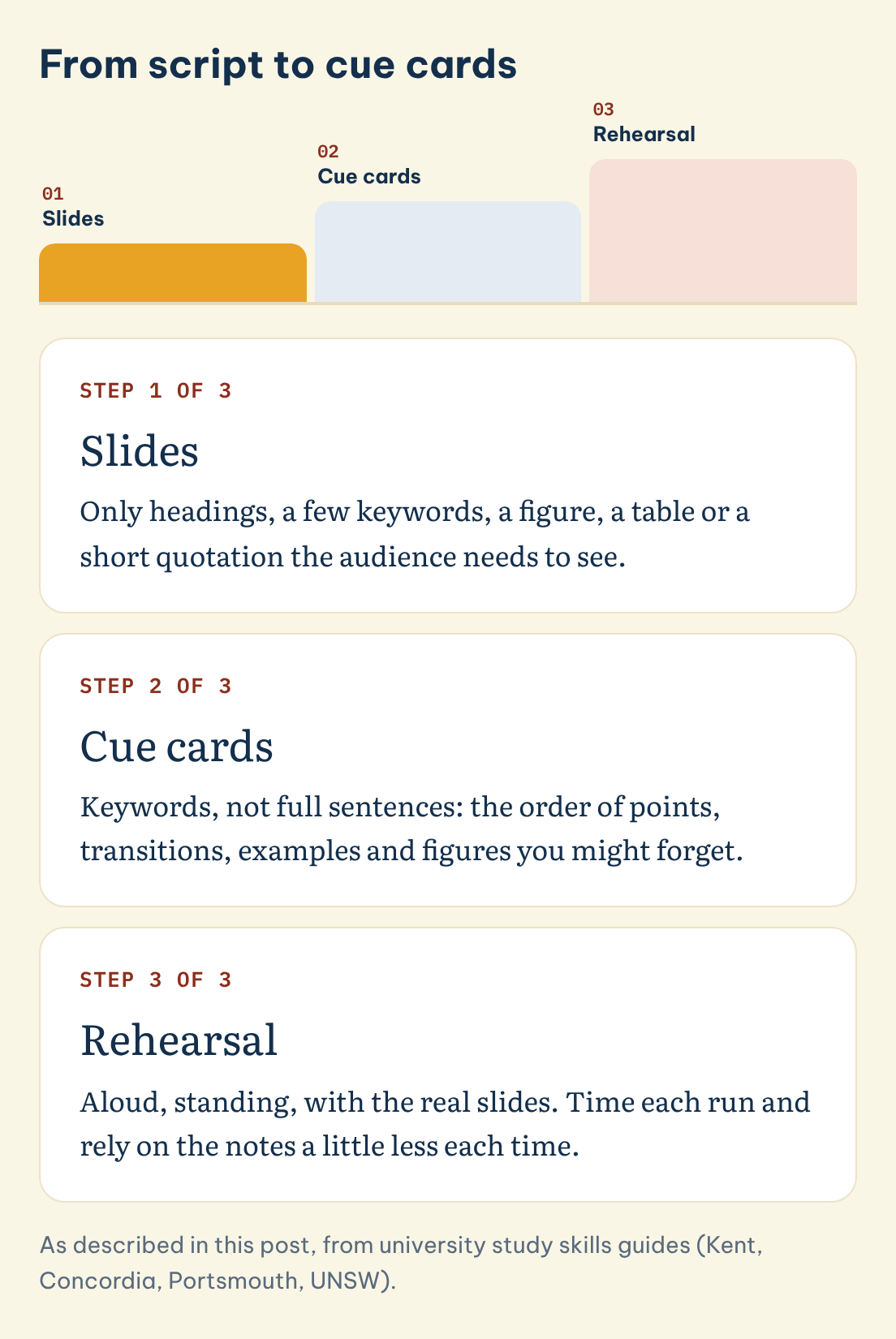
Direct answer: Slides carry what the audience needs to see: headings, a few keywords, a figure, a table or a short quotation. Your notes carry what you need to remember: the order of points, transitions, examples and the exact figures you might forget. If a sentence only makes sense when spoken, it belongs in your notes.
From script to cue cards
Tap a step to see how the post says your words move off the slide.
Step 1 of 3
Slides
Only headings, a few keywords, a figure, a table or a short quotation the audience needs to see.
Step 2 of 3
Cue cards
Keywords, not full sentences: the order of points, transitions, examples and figures you might forget.
Step 3 of 3
Rehearsal
Aloud, standing, with the real slides. Time each run and rely on the notes a little less each time.
Save this figure
The University of Kent compares the three common ways of preparing what you will say, and each has a trade-off (University of Kent, n.d.). A full script helps with timing but pulls your attention onto the page. Cue cards encourage a more spontaneous delivery but make it easier to lose track of time. PowerPoint speaker notes keep talk and slides in step and separate what you say from what you show. The table below summarises that comparison.
| Method | What it helps with | What to watch for |
|---|---|---|
| Full script | Timing and not forgetting content | Your focus drifts to the page, not the audience |
| Cue cards with keywords | A natural, flexible delivery | Losing track of time or details |
| Speaker notes in PowerPoint | Keeping your talk and slides in step | Needs presenter view on the room's computer |
Concordia University gives the clearest rule for notes: do not write full sentences, because "if you have full sentences, you may be very tempted to read the notes instead of telling the audience the information" (Concordia University, n.d.). Number your cards so you always know where you are in the talk.
◆ Question 4 / 8 · Five speaking skills
What are the five public speaking skills that matter most in an assessed talk?
Direct answer: Five skills carry most of the weight in a seminar presentation: a clear structure with signposting, a steady pace, eye contact, purposeful body language, and handling questions. Each one is easier when you are not reading, because your eyes and attention are free to work on the room rather than on the text.
University guides describe these skills in slightly different words, but they overlap closely. The University of Portsmouth advises standing at roughly 45 degrees to the screen and not speaking to it, moving your gaze around the room, pausing at the end of key points, and using signposting phrases such as "Next, I would like to move on to..." (University of Portsmouth, n.d.). UNSW adds that verbal signposting like "firstly, secondly, thirdly" guides the audience, and that nervous speakers often rush, so pausing to emphasise key points helps (UNSW Sydney, n.d.). For questions, Portsmouth suggests telling the audience at the start when you will take them, and saying clearly if you cannot answer one and offering to follow up. Treat these five as the checklist for your final rehearsal, not as a list to memorise in the night before.
◆ Question 5 / 8 · Pace and timing
How fast should you speak, and how much should you prepare per minute?
Direct answer: Slower than feels natural. Trent University lists 100 to 120 words per minute as a typical rate for a formal presentation, compared with 120 to 150 in general conversation and 150 to 160 for audiobooks and radio. UNSW suggests planning roughly 400 words per five minutes of talk, which leaves room for pauses, slide changes and visuals.
Trent's three bands are 100 to 120 words per minute for a presentation, 120 to 150 for conversation and 150 to 160 for audiobooks and radio. These two figures come from different guides and measure slightly different things, so use them as a range rather than a rule. Trent University's rate describes how fast a speaker talks (Trent University, n.d.), while the UNSW planning figure of 400 words per five minutes, about 80 words a minute, describes how much script to prepare, and it already allows for the moments when you point at a chart or wait for a question (UNSW Sydney, n.d.). A practical test from Trent is to record one minute of your rehearsal, count the words, and compare the count with the rate above. If you are well above it, you are probably rushing, and an audience hearing the material for the first time will struggle to keep up. Students presenting in their second language often speak faster under pressure, so build in deliberate pauses between slides.
◆ Question 6 / 8 · Rehearsing with cue cards
How do you rehearse so that cue cards are enough on the day?
Direct answer: Rehearse aloud, standing up, with the real slides, at least several times. Start alone, record yourself on your phone, then present to a friend. Time every run and cut content rather than speeding up. Each rehearsal should rely on the notes a little less, until the keywords alone are enough to trigger each point.
The University of Portsmouth frames the target well: practise "until you cannot get it wrong, not just until you get it right" (University of Portsmouth, n.d.). UNSW recommends starting alone, recording yourself, and then rehearsing in front of a friend or colleague, while also running the slides so that your words and visuals stay aligned (UNSW Sydney, n.d.). The University of Kent lists what rehearsal reveals: parts you find hard to put into words, parts you do not fully understand, and the real length of the talk (University of Kent, n.d.). That second point matters most for an academic presentation. If a section only makes sense when you read it, it usually means the idea is not yet clear in your own head, and the fix is to revise the content, not the slide.
◆ Question 7 / 8 · Presentation anxiety
What if presenting makes you very anxious?
Direct answer: You are in the majority. In a study of 1,135 undergraduates, 63.9% reported fear of public speaking, and 89.3% wanted classes to improve it. Anxiety is the most common reason students cling to their slides, so preparation that reduces it, such as rehearsal and good notes, also reduces reading.
The two headline figures from Marinho et al. (2017) are 63.9% reporting fear of public speaking and 89.3% wanting classes to improve it. The same study also found that fear was more common among students who rarely spoke in front of groups, which suggests that repeated, low-stakes practice is one of the few things a student can directly change. The respondents were 1,135 undergraduates aged 17 to 58. That is one study of one student population, so the exact percentage will not transfer to every cohort, but the pattern matches what university skills guides say. UNSW describes practice as the only way to combat nerves (UNSW Sydney, n.d.), and Trent University suggests that if eye contact feels uncomfortable you can begin by looking at a few fixed points around the room and build up from there (Trent University, n.d.). If anxiety is severe enough to stop you presenting at all, speak to your university's student support or disability service, which can advise on adjustments.
◆ Question 8 / 8 · How MAAS helps
How MAAS supports your presentation preparation
With MAAS Presentation & Slide Design support, a discipline-matched expert works with you on the structure of your talk, the content of each slide and the way your speaker notes are laid out, so the slides support what you say rather than replace it. You keep ownership of the argument and the delivery. Read more on the presentation and slide design service.
Frequently asked questions
Is it acceptable to look at notes during a university presentation?
Yes. Most university guides expect notes and only advise against reading a full script. Glance at a keyword, look up, and speak. Number your cards or use speaker notes so you never lose your place.
Should I memorise my presentation word for word?
No. Memorised scripts sound flat and are hard to recover if you lose a line. Learn the structure and the key points, and let the wording vary from rehearsal to rehearsal.
How many words should be on each slide?
There is no single rule, but university guides agree on minimal text. If a slide needs more than a short heading and a few keywords, move the detail into your notes or show it as a figure instead.
Can I read a quotation directly from my slide?
Yes. Reading word for word is appropriate when you quote a source, because the exact wording matters. Show the quotation, read it, then explain in your own words why it matters to your argument.
What should I do if I lose my place?
Pause, look at your next cue card or the current slide heading, and use a signposting phrase such as "Moving on to the next point" to restart. A short silence feels longer to you than it does to the audience.
How long before the presentation should I start rehearsing?
Start rehearsing as soon as the slides are drafted, not the night before. Several timed runs spread over a few days let you cut content and reduce your reliance on notes.
Related guides
References
- Concordia University. (n.d.). Preparing presentation notes. Retrieved October 23, 2026, from https://www.concordia.ca/students/success/learning-support/resources/oral-presentations/presentation-notes.html
- Kosslyn, S. M., Kievit, R. A., Russell, A. G., & Shephard, J. M. (2012). PowerPoint® presentation flaws and failures: A psychological analysis. Frontiers in Psychology, 3, Article 230. https://doi.org/10.3389/fpsyg.2012.00230
- Labaree, R. V. (2026). Giving an oral presentation. Organizing your social sciences research paper, University of Southern California Libraries. Retrieved October 23, 2026, from https://libguides.usc.edu/writingguide/assignments/oralpresentation
- Marinho, A. C. F., de Medeiros, A. M., Gama, A. C. C., & Teixeira, L. C. (2017). Fear of public speaking: Perception of college students and correlates. Journal of Voice, 31(1), 127.e7–127.e11. https://doi.org/10.1016/j.jvoice.2015.12.012
- Trent University. (n.d.). Delivering an oral presentation (public speaking). Retrieved October 23, 2026, from https://www.trentu.ca/academicskills/how-guides/how-present-university-and-beyond/delivering-oral-presentation-public-speaking
- University of Kent. (n.d.). Giving an oral presentation. Retrieved October 23, 2026, from https://student.kent.ac.uk/studies/giving-an-oral-presentation
- University of Portsmouth. (n.d.). Speaking skills and presentations. Retrieved October 23, 2026, from https://library.port.ac.uk/academic-support/presentations-and-group-work/speaking-skills-and-presentations
- UNSW Sydney. (n.d.). Preparing & delivering presentations. Retrieved October 23, 2026, from https://www.unsw.edu.au/student/managing-your-studies/academic-skills-support/toolkit/presenting
This article is part of the MAAS Journal series for Vietnamese international students. With MAAS Presentation & Slide Design support, a discipline-matched expert coaches you on structure, slides and speaker notes, with the expert alongside you from outline to final deck. You prepare and deliver your own presentation.
Not sure how this guide applies to your own case? Talk it through with MAAS in a free 20-minute consultation.
Book a free consultation ▸