
◆ Dissertation
What goes on each slide of a thesis defence deck?
Category: thesis-dissertation
Last updated: 2026-09-15

Most candidates build the defence deck last, in the week the thesis goes to the committee, and they build it as a compressed retelling of the document. That approach misreads the room, because the examiners have already read the document. It also misses something that has been measured directly: across 130 student presenters, the slide format the presenter used changed how well that presenter understood their own material, not merely how well the audience followed it (Aippersbach et al., 2013).
Direct answer: A defence deck carries the argument, not the thesis. The departmental guides reviewed here converge on a spine of roughly 15 slides: title, problem statement, significance, theoretical foundation, research questions, methodology, method detail, findings, conclusions, implications, recommendations, and one references slide. The spoken commentary expands each slide rather than reading it aloud.
Where a rule below comes from 1 institution rather than a general standard, this article says so, because defence conventions differ by department and the binding document is always your own faculty guide.
◆ Section 1 / 11 · What the deck must do
What does a defence deck have to do that the thesis has not already done?
Direct answer: A defence deck selects rather than compresses. It has to state the contribution in a form a committee can interrogate inside the 20 to 30 minutes many faculties allow, which means identifying the 3 or 4 claims that must be accepted for the contribution to stand and building only the slides that carry them.
A defence deck has one job the written thesis cannot do, which is to state the contribution in a form a committee can interrogate within the 20 to 30 minutes many faculties allow. Graduate studies guidance from University of Rochester states the selection test directly: "Your slides should encapsulate the work and focus on its most salient contributions." Selection, not compression, is the operation being asked for.
The distinction produces two different decks. Compression takes a thesis of 40,000 words across 5 chapters and shrinks each chapter proportionally, which yields a deck where the literature review occupies as many slides as the findings. Selection asks which 3 or 4 claims a committee must accept for the contribution to stand, then builds only the slides carrying those claims. Valdosta State University names the first failure mode plainly in its College of Education guide: "Present enough detail to be convincing, but not so much that you get 'lost in the weeds!'"
Evidence on what examiners weigh supports the selection frame. A 2026 scoping review screened 12,107 records down to 19 studies of examiner practice published between 2009 and June 2025, and identified 6 recurring themes including scholarly contribution, methodology, and communication (Laflamme et al., 2026), following the JBI and PRISMA-ScR reporting standards in Cogent Education 13(1). Roughly 10 of those 19 studies came from Anglo-Saxon systems including Australia, New Zealand, Malaysia and the United Kingdom, with 4 from Scandinavia, so the evidence base is international rather than local to any one country.
◆ Section 2 / 11 · The standard slide order
What is the standard slide order, and which university publishes it?
Direct answer: The fullest published spine comes from Valdosta State University, whose 2 page College of Education guide runs from title through problem statement at slide 4, theoretical foundation, conceptual framework, numbered research questions, methodology, findings, conclusions and a single references slide. University of Tennessee at Chattanooga publishes a similar 12 part structure capped at 30 slides.
The fullest published spine comes from Valdosta State University, whose College of Education lists in its 2 page defence guide the sequence as title, researcher background kept very brief, topic background, problem statement, significance, theoretical foundation, conceptual framework, numbered research questions, methodology with justification, method detail covering sample and reliability and limitations, findings structured as in the results chapter, conclusions, implications, recommendations, a single references slide, and a closing acknowledgement.
Two features of that order repay attention. The problem statement arrives at slide 4, before any literature, which forces a candidate to name the gap before describing the field. The theoretical foundation and the conceptual framework then occupy separate slides, because the first names the tradition the study sits inside, such as Critical Theory or Social Constructivism, while the second names the 2 or 3 specific constructs the study measures and the relationships predicted between them.
University of Tennessee at Chattanooga adds quantitative limits to a similar 12 part structure in its doctoral guide. The University of Tennessee at Chattanooga guide caps the deck at no more than 30 slides excluding references, restricts slide text to keywords rather than complete sentences with research questions given as the stated exception, advises against an agenda slide, and asks candidates to rebuild statistical tables inside presentation software rather than pasting output images from SPSS, Stata or R.
The rebuilding instruction is more consequential than it first appears. Output pasted from SPSS or Stata arrives at the size and typeface that package chose, carries columns the analysis produced but the argument does not need, and cannot be edited to highlight the coefficient the candidate is about to discuss. Rebuilding the table in PowerPoint or Keynote forces a decision about which 2 or 3 numbers are actually load bearing for the claim on that slide.
◆ Section 3 / 11 · Does every university agree
Do all universities impose the same structure?
Direct answer: No. University of Texas at Tyler declines to fix a format at all and leaves the shape to the supervisor. Treat any published slide order as a starting draft, then reconstruct your own faculty expectation from 3 sources, which are your supervisor instruction, 2 or 3 recent decks from the same unit, and the written assessment criteria.
Universities do not agree on structure, and at least one guide says so in writing. Guidelines published by University of Texas at Tyler decline to fix a format: "The format itself is not as important as the substance and should reflect the most effective way to communicate to the audience." Under that policy the supervisor, not the graduate school, sets the shape of the deck.
That disagreement is the practical reason to treat any published slide order, including the Valdosta State sequence above, as a starting draft rather than a specification. A candidate in a department with no published format has to reconstruct the expectation from 3 other sources: the supervisor's own instruction, 2 or 3 decks from recent graduates of the same unit, and any written assessment criteria the faculty applies to the defence itself, a set of 3 checks that takes under 2 hours.
Research on examination committees suggests why formats vary so widely. A qualitative study running 6 interview groups with experienced committee members across 3 Swedish research universities described committee evaluation in Minerva 62(3) as gradual rather than settled at a single checkpoint, with the criteria in play widening as the examination proceeds (Elmgren et al., 2024). A committee treating the defence as one stage of a longer judgement has less reason to standardise a deck than a committee treating it as a discrete performance.
That same study reported the criteria committees describe themselves as applying, which include scientific rigour and originality, the significance and contribution of the thesis, its literary merits, the accuracy of presentation, and what the authors call a clear doctoral voice. Only 1 of those 5 criteria concerns the document's surface, which is a useful corrective for a candidate spending the final week on slide aesthetics.
◆ Section 4 / 11 · How slides should be built
What does published evidence say about how the slides themselves should be built?
Direct answer: Write sentence headlines, not topic phrases. In a geoscience course, students taught with sentence headline slides answered 79% of recall questions correctly against 69% for phrase headlines. Among 130 student presenters, those preparing with sentence headlines scored 12.55 out of 20 on understanding their own material against 10.68.
The strongest evidence in academic settings concerns headlines. The Assertion Evidence approach, documented by the Penn State University engineering communication group, replaces the topic phrase at the top of each slide with a full sentence stating the claim, and replaces the bullet list in the body with visual evidence supporting that claim (Alley & Neeley, 2005), published in Technical Communication 52(4). Among 62 engineers, faculty and graduate students who had used the approach for at least 3 months, 57% reported being mostly receptive and only 4% mostly averse, with the remaining 39% between those positions.
Recall data from teaching contexts point the same direction. In a geoscience course run across 4 sections of roughly 200 students each, 15 examination questions measuring recall of slide content produced 79% correct answers from students taught with sentence headlines against 69% from students taught with phrase headlines, a difference significant at p less than .001 by chi square test (Alley et al., n.d.). Of those 15 questions, 7 showed significant differences individually, with 3 at p less than .001, 3 at p less than .005, and 1 at p less than .025, across a combined cohort of about 800 students.
The finding most relevant to a defence candidate concerns the presenter rather than the audience. Among 130 student presenters, those preparing with sentence headline slides scored 12.55 out of 20 on measures of understanding their own presented material against 10.68 for the comparison group, and averaged 0.93 conceptual errors against 1.12, a difference significant at t(51) equals 2.62, p equals 0.01, reported to the ASEE Annual Conference (Aippersbach et al., 2013). Writing the slide as a claim appears to force the claim to be resolved before the defence begins, which is why deck construction belongs earlier in the schedule than most candidates place it.
A synthesis of 30 articles on examiner behaviour published in Assessment & Evaluation in Higher Education 39(5), 563–576 adds a reason to care about surface quality even when the substance is sound, naming as 1 of its 11 examiner practices that examiners are irritated and distracted by presentation errors (Golding et al., 2014). That synthesis concerned the written thesis rather than slides, so applying it to a deck is an inference rather than a measured result, and this article marks it as such.
◆ Section 5 / 11 · Examiner frameworks
Which criteria do examiner frameworks actually name?
Direct answer: Two published frameworks name them. De Vita and Begley (2023) call theirs the Seven Attributes Framework, covering structure, originality, contribution, theory, criticality, rigour and clarity. Hodgson (2020) offers a parallel seven theme set that overlaps it on three of its seven items. Most entries in both lists sit closer to reasoning than to prose.
Two published frameworks name the attributes examiners look for, and both are worth reading before deciding what a slide should assert. The Seven Attributes Framework set out by De Vita and Begley (2023) lists structure, originality, significant contribution, theory, criticality, rigour and clarity. De Vita and Begley (2023, p. 1884) put it plainly: "hardly any attention has been paid in related literature to Postgraduate Researchers’ (PGRs) perceptions of the key attributes that make a PhD thesis excellent." A parallel seven theme framework from Hodgson (2020) names mastery and command, argument, coherence, independence, criticality, depth and breadth, and clarity and accuracy, which overlaps the De Vita and Begley (2023) list on 3 of its 7 items.
Placing the 2 lists side by side is more informative than reading either alone. Clarity and criticality appear on both lists under almost the same names, and originality in De Vita and Begley (2023) pairs with independence in Hodgson (2020), a theme that framework glosses as originality and ownership of the work. Roughly 5 of the 7 attributes in each list describe the reasoning rather than the writing, which tells a candidate where the slides should spend their space.
The scoping review that collected these frameworks placed communication as 1 of its 6 themes alongside scholarly contribution, literature review, methodology, analysis and results, and publishability (Laflamme et al., 2026). Communication earning a theme of its own, in a review screening 12,107 records down to 19 studies published between 2009 and 2025, is the closest thing available to evidence that how a candidate presents carries weight independent of what the thesis contains.
Engineering education research reaches a compatible conclusion from a different direction. Alzayed and Alzamel (2023), writing in the Journal of Engineering Research 11(1), 329–339, examined presentation practice within engineering programmes and treated slide construction as a component of professional competence rather than a cosmetic layer added at the end.
◆ Section 6 / 11 · How much per slide
How much material should one slide carry?
Direct answer: Enough for about 1 minute of speaking. Alley and Neeley recommend limiting slide count so at least 1 minute can be spent on each slide, and Chattanooga caps a deck at 30 slides, so a 30 minute defence supports roughly 30 slides holding 6 to 10 keywords each.
Limits that size a defence deck
Each row sets a limit on the deck beside who sets it, and the last row is this post's own reading of how much one slide can carry.
Limit
Who sets it
A ceiling of 30 slides, excluding references
University of Tennessee at Chattanooga
At least 1 minute can be spent on each slide
Alley and Neeley (2005)
A slide of 6 to 10 keywords supports roughly 1 minute of spoken expansion
This post's own reading
Save this figure
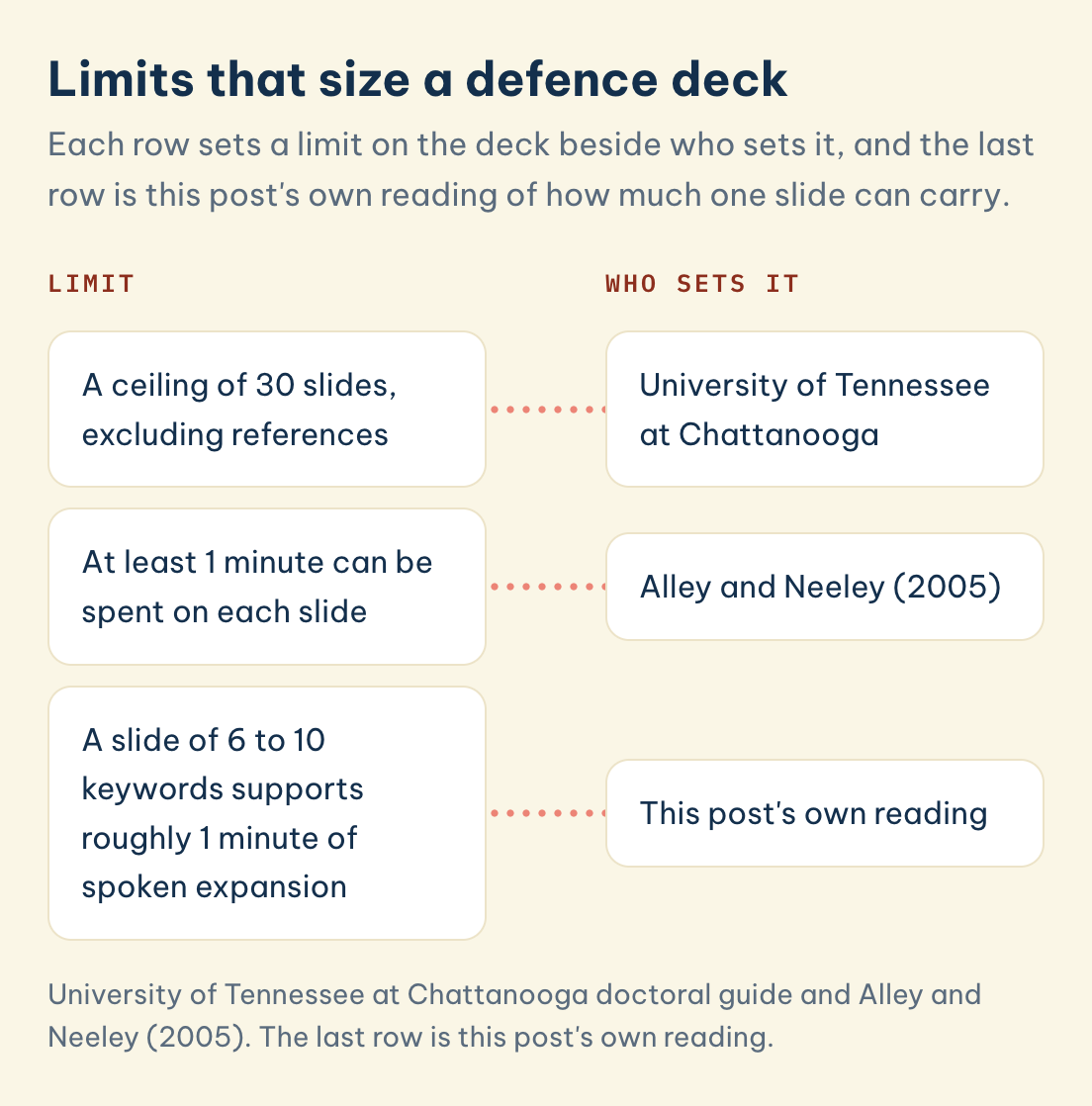
One published quantity rule exists, and it works backwards from time rather than from content. Alley and Neeley (2005) recommend limiting slide count so that "at least 1 minute can be spent on each slide." Applied to a defence, that rule makes deck size a function of the time the faculty allots, which is a number a candidate has to look up rather than assume.
Combining the two published limits produces a workable bracket. The Chattanooga ceiling of 30 slides and the 1 minute floor together imply that a deck approaching 30 slides belongs to a defence of about 30 minutes, and that a shorter slot needs a proportionally shorter deck rather than the same deck delivered faster. A candidate who has not confirmed the allotted time cannot size the deck, which makes that confirmation the first task rather than a detail to settle in the final week.
The keyword restriction interacts with this arithmetic. A slide holding 6 to 10 keywords supports roughly 1 minute of spoken expansion, whereas a slide holding full paragraphs invites reading aloud, and the Valdosta State guide names that failure directly: "Except for things like the research questions, do not just read the slides. Your oral presentation should explain or expand on what is on the slides."
◆ Section 7 / 11 · Software and files
Which software and file decisions matter before the day?
Direct answer: Export discipline matters more than software choice. PowerPoint, Keynote, Google Slides and Beamer each fail differently on an unfamiliar machine, and exporting to PDF removes 3 of those 4 failure modes at the cost of animation. Confirm the aspect ratio too, since 16:9 on a 4:3 projector loses roughly 25% of the width.
Software choice matters less than export discipline, but a few decisions are worth settling early rather than in the hour before a defence. Microsoft PowerPoint, Apple Keynote, Google Slides and LaTeX Beamer all produce acceptable decks, and each of those 4 tools fails differently on an unfamiliar machine. PowerPoint substitutes fonts it cannot find, Keynote files do not open on Windows machines at all, Google Slides needs a network connection the seminar room may not provide, and Beamer output is already fixed as a PDF.
Exporting to PDF before the day removes 3 of those 4 failure modes at the cost of animation. Rochester graduate studies guidance accepts progressive disclosure, advising "Don't clutter your slides – if necessary have things come up on mouse clicks", so a candidate who relies on click by click reveals should carry both the native file and a PDF fallback rather than only one.
Statistical output deserves its own decision. University of Tennessee at Chattanooga asks candidates to rebuild tables inside presentation software rather than pasting images from a statistics package, which applies equally to SPSS, Stata, R and Python output. A rebuilt table lets the candidate drop the 4 or 5 columns the argument does not use and enlarge the 2 or 3 that carry the claim, while a pasted screenshot fixes every one of those decisions at whatever the software produced.
Aspect ratio is the last mechanical item and the cheapest to get wrong. A deck built at 16:9 and projected on a 4:3 system loses roughly 25% of its horizontal space, since 4:3 gives 1.33 units of width per unit of height against 1.78 or gains letterboxing, which pushes text off the visible area. Confirming the room hardware, or simply designing with generous margins, costs nothing and prevents a visible problem in the first 30 seconds.
◆ Section 8 / 11 · The references slide
What belongs on the references slide?
Direct answer: Only the sources you actually cite while presenting, which is normally 8 to 15 entries rather than the 200 to 400 in the thesis. Keep the thesis style, add the DOI where one exists, and split into 2 slides at readable size rather than shrinking 15 entries to 10 point.
A defence deck carries 1 references slide, and its purpose differs from the reference list in the thesis. Valdosta State University restricts that slide to sources actually cited during the presentation itself, which is normally between 8 and 15 entries rather than the 200 to 400 in the document. The slide exists so a committee member can check an attribution mid question, not to demonstrate reading breadth.
Formatting follows whatever style the thesis uses, most commonly APA 7th in education and social science, or IEEE and Vancouver in engineering and medicine, and the DOI belongs on the entry whenever one exists so an examiner can locate the work immediately. A references slide set in the same 24 point body type as the rest of the deck will not fit 15 entries, and shrinking it to 10 point defeats the purpose, so 2 references slides at a readable size is the better trade than 1 unreadable one.
◆ Section 9 / 11 · Delivery and Q&A
How do the spoken delivery and the Q&A differ from slide preparation?
Direct answer: The deck is a fixed document, while delivery and Q&A are two skills needing separate rehearsal. At University of Arizona Global Campus, a defence runs about 60 minutes, 20 to 30 for presenting, the rest for Q&A, so confirm the split with your faculty, and practise recognising the three question types MIT describes for doctoral general exams.
The published timing structure for a defence gives the Q&A segment roughly equal or greater weight than the presentation itself, not a minor add on at the end. University of Arizona Global Campus's ADP Oral Defense Tips describes a defence running about 60 minutes, with 20 to 30 minutes for the presentation and the remaining 30 minutes for committee questions. Because the two segments occupy comparable time, rehearsing delivery and Q&A separately makes more sense than pouring all preparation into the slides and treating the Q&A as improvisation.
The "expand, don't read" principle already stated for slide construction applies equally to spoken delivery. The ADP Oral Defense Tips guidance states it directly: "Not read directly from your slides. Keep your presentation conversational, but still scholarly." The practical rehearsal method is recording the presentation and reviewing the playback, timing it to stay close to the roughly 20 minute mark per University of Phoenix, School of Advanced Studies defence preparation guidance, and practising with another person acting as the audience.
Three recurring question types, per MIT CEE Communication Lab's guidance for doctoral general exams, are clarifying questions when a listener has not understood a point, justify or explain questions when the committee wants the reasoning behind a methodological choice, and extrapolate or reach questions when the committee asks about implications beyond the study's narrow scope. Recognising which type a question belongs to helps a candidate answer the actual point rather than rambling. Per this guidance's description of that exam committee, committee members also ask differently depending on their own expertise: a supervisor already deeply involved in the research tends to ask less, a committee member with a closely related research direction tends to ask deeper technical questions, and a member outside the field tends to ask about the work's broader significance.
MIT CEE Communication Lab guidance also states that reaching "I don't know" is expected when genuinely true, provided the candidate explains how they would tackle the question with more time and resources, and never makes something up. A small MIT survey of 6 graduate students preparing for their 2023 general exams found all 6 ranked the Q&A as the most anxiety inducing part, though the sample is too small to generalise. Per University of Arizona Global Campus's ADP Oral Defense Tips, knowing when to stop rather than rambling on an unprepared topic also helps, and a candidate who speaks fast when nervous can take a few breaths before starting the presentation and plan short pauses while presenting, a skill that becomes easier with more rehearsal.
◆ Section 10 / 11 · What is unmeasured
What is still unmeasured about defence slides?
Direct answer: Nobody has measured defence decks directly. The peer reviewed studies here measure teaching slides and student presentations, while the examiner studies measure judgements of the written thesis. The departmental guides here are all North American, and no source located here describes practice at a Vietnamese university.
Direct measurement of defence decks is a genuine gap in the literature, and any article claiming otherwise is overreaching. The peer reviewed studies available measure teaching slides and student presentations rather than doctoral defences, and the examiner studies measure judgements of the written thesis. No study located here observed a set of defence decks and recorded which design features preceded a pass, a minor correction or a major revision.
Two consequences follow. The slide design evidence here transfers by argument rather than by direct measurement, since a defence deck and a teaching deck share the task of carrying a claim to an expert audience but differ in stakes. And the departmental guides on slide order carry more weight than they would in a field with dense empirical evidence, because they encode what particular committees have asked for over many years.
The geographic distribution of the evidence is also worth stating plainly. The departmental guides cited above are all North American, the examiner studies are Swedish and Australian, and the scoping review drew about 10 of its 19 studies from Anglo-Saxon systems. No source in this article describes practice at a Vietnamese university, so a candidate defending in Vietnam should treat every structural recommendation here as a hypothesis to check against their own faculty regulation.
◆ Section 11 / 11 · How MAAS works on the deck
How MAAS works on a defence deck with you
Direct answer: MAAS builds the deck as an argument before any visual work. A discipline matched expert checks the slide order against your faculty's guidance where such guidance exists, and trims every slide to a single claim with its supporting evidence. You build and present the defence yourself, while the expert challenges weak reasoning across the rehearsal sessions.
MAAS EdTech works through the deck as an argument before any visual treatment begins, which means agreeing which claims the committee must accept, then building only the slides that carry those claims. A discipline matched expert reviews the sequence against your own faculty guidance where such guidance exists, helps you tighten each slide to 1 claim with its supporting evidence, and rehearses the spoken expansion with you so the commentary adds to the slide instead of repeating it. A timed speaker script and delivery rehearsal coaching are part of the same process, led by the same expert who works on the deck with you. You build and present your own defence, and the expert sets direction across the rehearsal sessions and challenges weak reasoning. Book a free 20-minute discovery call to start.
Frequently asked questions
How many slides should a thesis defence deck have?
No general standard exists. One published ceiling is 30 slides excluding references at the University of Tennessee at Chattanooga, and one published floor is 1 minute of speaking time per slide (Alley & Neeley, 2005). Since defence durations vary by faculty, confirm your allotted time first, then size the deck to it.
Should the deck include a literature review section?
Valdosta State University places a conceptual framework slide drawing on the literature, but places it after the problem statement rather than before it. The purpose of that slide is to name the constructs the study measures, not to survey the field, so it cites the specific authors whose constructs the study actually uses.
Is it acceptable to read from the slides?
Published departmental guidance advises against it, with research questions named as a common exception. Valdosta State University asks that oral commentary explain or expand what appears on the slide, which is the practical reason those same guides restrict slide text to keywords rather than sentences.
Do committees actually notice slide quality?
Direct measurement of defence slides in peer reviewed work is scarce, which is a real gap. The available indirect finding is that a synthesis of 30 studies of examiner practice reported examiners being distracted by presentation errors (Golding et al., 2014), and that examiner criteria include communication alongside contribution and methodology (Laflamme et al., 2026).
Does slide design change anything for the presenter?
Yes, and this is the one directly measured effect. Among 130 student presenters, those using sentence headline slides scored 12.55 out of 20 on understanding of their own material against 10.68, with 0.93 conceptual errors against 1.12 (Aippersbach et al., 2013).
Which universities publish a full slide by slide defence guide?
Among the guides located for this article, Valdosta State University publishes the most detailed sequence at roughly 15 named sections, and the University of Tennessee at Chattanooga publishes the most explicit limits at 30 slides with keyword only text. The University of Rochester offers selection principles without a fixed order, and the University of Texas at Tyler declines to fix a format at all.
Should statistical tables be screenshots from SPSS?
No. The University of Tennessee at Chattanooga guide asks for tables rebuilt inside the presentation file rather than pasted from a statistics package, which applies to SPSS, Stata, R and Python alike. Rebuilding lets a candidate drop unused columns and enlarge the 2 or 3 figures the claim depends on.
What file should be carried into the room?
Carry both the native file and a PDF export. Microsoft PowerPoint substitutes missing fonts, Apple Keynote will not open on a Windows machine, and Google Slides needs a network connection, so a PDF removes 3 failure modes at the cost of click by click reveals that the University of Rochester guide explicitly permits.
Does any of this evidence come from Vietnam?
No. Every source cited here is North American, Scandinavian, Australian or from the wider Anglo-Saxon system. A candidate defending at a Vietnamese institution should treat these structures as hypotheses to verify against their own faculty regulation rather than as established local practice.
How long should the spoken presentation be at a defence?
Per University of Arizona Global Campus's timing structure, a defence runs about 60 minutes, split into 20 to 30 minutes of presenting and the remainder for Q&A. This is not a script to read aloud, but spoken commentary that expands the slides, timed to whatever window the faculty has confirmed.
What kinds of questions do committees usually ask?
Per MIT CEE Communication Lab's guidance for doctoral general exams, that exam committee typically asks 3 types of questions: clarifying an unclear point, justifying a methodological choice, and extrapolating implications beyond the study's narrow scope, and individual committee members tend to ask differently depending on their own area of expertise.
Related guides
- What does a graded presentation rubric measure?: how marks are allocated when a presentation is assessed within a taught course
References
Aippersbach, C., Alley, M., & Garner, J. (2013). How slide design affects a student presenter's understanding of the presented material. ASEE Annual Conference & Exposition. https://peer.asee.org/how-slide-design-affects-a-student-presenter-s-understanding-of-the-presented-material.pdf
Alley, M., & Neeley, K. A. (2005). Rethinking the design of presentation slides: A case for sentence headlines and visual evidence. Technical Communication, 52(4), 417–426. https://writing.engr.psu.edu/2005_alley_neeley.pdf
Alley, M., Schreiber, M., Ramsdell, K., Muffo, J., & Borrego, M. (n.d.). Testing the effect of sentence headlines in teaching slides. ASEE Annual Conference & Exposition. https://peer.asee.org/testing-the-effect-of-sentence-headlines-in-teaching-slides.pdf
Alzayed, M. A., & Alzamel, L. G. (2023). Engineering students' presentation skills and professional competence. Journal of Engineering Research, 11(1), 329–339. https://doi.org/10.36909/jer.16963
De Vita, G., & Begley, J. (2023). A framework of ‘doctorateness’ for the social sciences and postgraduate researchers’ perceptions of key attributes of an excellent PhD thesis. Studies in Higher Education, 49(11), 1884–1899. https://doi.org/10.1080/03075079.2023.2281540
Elmgren, M., Lindberg-Sand, Å., & Sonesson, A. (2024). Evaluation practices of doctoral examination committees: Boundary-work under pressure. Minerva, 62(3), 427–456. https://doi.org/10.1007/s11024-024-09523-5
Golding, C., Sharmini, S., & Lazarovitch, A. (2014). What examiners do: What thesis students should know. Assessment & Evaluation in Higher Education, 39(5), 563–576. https://doi.org/10.1080/02602938.2013.859230
Hodgson, D. (2020). Helping doctoral students understand PhD thesis examination expectations: A framework and a tool for supervision. Active Learning in Higher Education, 21(1), 51–63. https://doi.org/10.1177/1469787417742020
Laflamme, L., Andersson, I., Liljegren, L., & Salmi, L.-R. (2026). What examiners emphasize in their assessment of doctoral theses: Scoping review. Cogent Education, 13(1), 2699012. https://doi.org/10.1080/2331186X.2026.2699012
Tools & resources
- Valdosta State University, College of Education. Preparing a presentation for your dissertation defense: Guidelines. https://www.valdosta.edu/colleges/education/deans-office/documents/dissertation-defense-guide.pdf
- University of Tennessee at Chattanooga. Doctoral program guide: Pre-defense process. https://www.utc.edu/health-education-and-professional-studies/applied-leadership-and-learning/doctoral-program-guide/dissertation-process/predefense
- University of Rochester. A guide for graduate students preparing for a PhD defense. https://www.rochester.edu/college/gradstudies/assets/pdf/preparing-for-PhD-thesis-defense.pdf
- University of Texas at Tyler. Guidelines for the conduct of a thesis defense. https://www.uttyler.edu/academics/colleges-schools/graduate/thesis-dissertation/guidelines-conduct-thesis-defense/
- MIT CEE Communication Lab. Handling the Q&A session. https://mitcommlab.mit.edu/cee/commkit/handling-the-question-and-answer-session/
- University of Arizona Global Campus. ADP oral defense tips. https://uagcmedia.static.arizona.edu/Doctoral/Resources/ADP_Oral_Defense_Tips.pdf
- University of Phoenix, School of Advanced Studies. Preparing for oral defense and presenting research findings. https://www.phoenix.edu/content/dam/edu/research/doc/2023/preparing-oral-defense-presenting-research-findings.pdf
A free 20-minute consultation is a conversation about your situation and the slide deck you are building for your defence.
Book a free consultation ▸