
◆ Publishing advisory
How do you respond to a major revision from a Scopus journal?
A major revision from a Scopus journal means the editor will likely publish your paper once you address every reviewer concern in full. It is an invitation, not a rejection and for Vietnamese researchers, a major revision is the most common route into a Q1 or Q2 journal, and the stage where a publishable paper is most often won or lost.
The difference between authors who succeed at this stage and those who stall is rarely the quality of the science. It is the discipline of the revision: how you read the decision letter, plan the work, rebuild the manuscript, and document every change. This guide answers the seven questions Vietnamese researchers ask MAAS publishing mentors most often when a "major revision" email lands in their inbox.

◆ Question 1 / 7 · What it means
What does a "major revision" decision actually mean?
Direct answer: A major revision is a conditional acceptance signal: the editor sees publishable value but wants substantive changes before deciding. It sits between a minor revision (small, quick fixes) and a "reject and resubmit" (rebuild and try again). Unlike an outright reject, a major revision keeps your paper alive at the same journal and gives you a roadmap to acceptance.
Evidence: Elsevier, founded in 1880 and headquartered in Amsterdam, is one of the publishers whose author guidance MAAS mentors check first, and it describes revision decisions as the journal expressing continued interest conditional on the author resolving reviewer concerns (Elsevier, n.d.). Annesley (2011), writing in Clinical Chemistry volume 57, issue 4, pages 551 to 554, notes that first-round acceptance is uncommon and that most eventually published papers pass through at least one substantive revision round, making the response a decisive, not incidental, part of publishing.
Example: A MAAS Publishing Advisory client targeting a Q2 health journal received a decision with 14 reviewer comments and read it as a near-rejection. The decision word was "major revision." After a structured three-week revision with a mentor, the paper was accepted on the second round, the comments had been a checklist, not a verdict.
◆ Question 2 / 7 · Read and plan
How should you read the decision letter and plan the revision before writing anything?
Direct answer: Read the full letter twice, then wait a day before acting. Separate the editor's framing from the reviewers' lists, and sort every comment into three buckets: changes you agree with, changes you can partly accommodate, and points you will respectfully defend. Map each comment to a concrete task and an owner before you touch the manuscript.
The four decision outcomes and what each asks of you
Tap a decision to see what it means, the typical action and the usual deadline.
Usual deadline: Days
Accept
Publishable as is (rare on first submission). The typical action is final proofs only.
Usual deadline: 14 to 30 days
Minor revision
Small fixes, which the editor re-checks. The typical action is wording, references and clarifications.
Usual deadline: 30 to 90 days
Major revision
Conditional interest, and the paper goes back to the reviewers. The typical action is substantive changes plus a response letter.
Usual deadline: No fixed clock
Reject and resubmit
Rebuild, and the paper is treated as a new submission. The typical action is major reworking and a new submission.
Evidence: Noble (2017), in PLOS Computational Biology volume 13, issue 10, recommends treating the response as a structured project rather than an emotional reaction, and Williams (2004), in the Journal of the American Academy of Dermatology volume 51, issue 1, pages 79 to 83, advises authors to extract the actionable substance from even harshly worded reviews. Both stress that planning the revision, not rushing to rewrite, is what produces a coherent second-round manuscript.
Example: A Vietnamese PhD candidate coached by MAAS built a simple revision tracker: a table listing each reviewer comment, the planned action, the responsible author, and the manuscript location to be changed. The table turned 22 scattered comments into a finite to-do list, and nothing was missed when the response letter was assembled.
The four decision outcomes and what each one asks of you, look like this:
| Decision | What it means | Typical action | Usual deadline |
|---|---|---|---|
| Accept | Publishable as is (rare on first submission) | Final proofs only | Days |
| Minor revision | Small fixes; editor re-checks | Wording, references, clarifications | 14–30 days |
| Major revision | Conditional interest; back to reviewers | Substantive changes + response letter | 30–90 days |
| Reject and resubmit | Rebuild; treated as a new submission | Major reworking, new submission | No fixed clock |
◆ Question 3 / 7 · The response document
How do you organise the response document, cover letter, summary, and point-by-point replies?
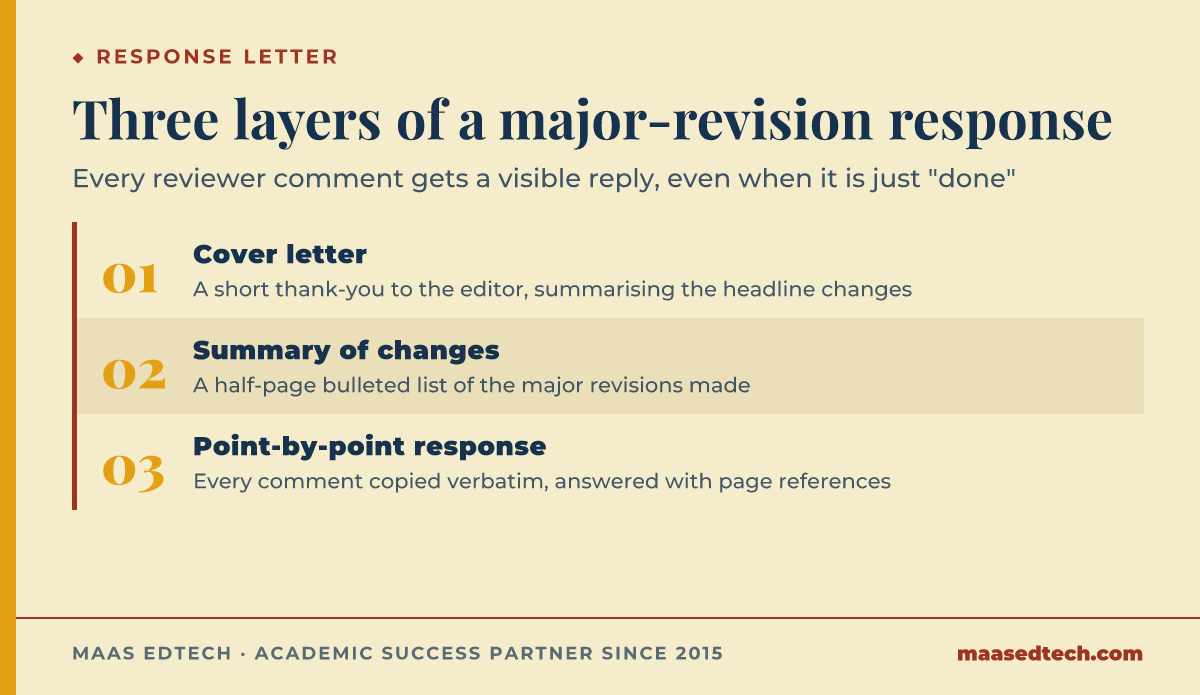
Direct answer: Build three layers. A short cover letter to the editor thanking them and summarising the headline changes; a half-page bulleted summary of major revisions; and a point-by-point response that copies each comment verbatim and answers it directly beneath, with page and line references. Every comment gets a visible reply, even when the answer is simply "done."
The three layers of a response document
Tap a layer to see what it holds.
Step 1 of 3
Cover letter
A short letter to the editor thanking them and summarising the headline changes.
Step 2 of 3
Bulleted summary
A half-page bulleted summary of the major revisions.
Step 3 of 3
Point-by-point replies
Copy each comment verbatim and answer it directly beneath, with page and line references. Every comment gets a visible reply, even when the answer is simply done.
Evidence: Frontiers and Springer Nature author guidance both prescribe the comment-in-bold / response-below format with manuscript locations so reviewers can verify changes quickly (Frontiers, n.d.; Springer Nature, n.d.). Frontiers frames the point-by-point discipline as owed to the reviewer's role: "Peer reviewers are tasked with ensuring that published research meets high standards of clarity, rigor, and credibility" (Frontiers, n.d.), and its current guidance, still live in 2026, breaks the response process itself into 7 numbered steps, from cataloguing every comment to addressing feedback you cannot act on, steps 1 to 7, which is why a reply that skips a point reads as a refusal to engage with that standard, not a shortcut. Both publishers are large enough that this format functions as a de facto industry standard rather than house style: Frontiers, founded in 2007 and based in Lausanne, Switzerland, publishes more than 230 journals, and Springer Nature was formed in a 2015 merger of Springer Science+Business Media with the Nature Publishing Group. Annesley (2011) and Noble (2017) agree that addressing every single point and showing exactly where each change appears, is the strongest predictor of a smooth second round.
Example: A MAAS-coached author structured each entry as: "Reviewer 2, Comment 4: [pasted comment]. Response: We agree and have added a limitations paragraph (p. 15, lines 320–334): '[new text].'" Reviewer 2 returned the second round with one line, "all concerns addressed", because verification took minutes, not a re-read.
◆ Question 4 / 7 · Requests you cannot do
What if a reviewer asks for new experiments, data, or analyses you cannot fully do?
Direct answer: You do not have to do everything, but you must respond to everything. Where a request is feasible, do it and show the result. Where it is not, no access to the sample, out of scope, or beyond the study design, explain the constraint honestly, offer the strongest available alternative (a re-analysis, a sensitivity check, or a framing as a stated limitation and future-work direction), and let the editor judge.
Evidence: Williams (2004) advises authors to distinguish requests that strengthen the paper from those that exceed its scope, and to justify partial responses with evidence rather than silence. Elsevier's guidance confirms that a reasoned, transparent explanation of what could not be done is acceptable when supported by a clear rationale (Elsevier, n.d.).
Example: A reviewer asked a MAAS client in a Medical AI study to collect an external validation cohort she could not access within the timeline. Rather than ignore it, she added an internal cross-validation, acknowledged external validation as a limitation, and named it as the next study. The editor accepted the compromise, and the paper progressed to acceptance.
◆ Question 5 / 7 · The timeline
How long do you have, and how do you manage the major-revision timeline?
Direct answer: Major revisions usually carry a 30-to-90-day deadline stated in the decision email, against 14 to 30 days for a minor one. Do not sacrifice completeness for speed, a thorough revision beats a fast, thin one. If you need more time, email the handling editor before the deadline; extensions are routinely granted when requested early.
Evidence: Elsevier's author FAQ confirms that revision deadlines appear on the submission-system dashboard and that authors may request extensions through the system or directly from the editor (Elsevier, n.d.). Annesley (2011) reinforces that editors value a complete, well-documented response over a rushed one that leaves comments half-answered.
Example: A MAAS Publishing Advisory client in a joint Vietnam–Australia programme had 60 days, needed to re-run a statistical model, and emailed the editor for two extra weeks. The editor agreed the same day. The short, well-communicated delay had no effect on the final acceptance.
◆ Question 6 / 7 · The second round
What happens in the second round, and what if it is rejected after revision?
Direct answer: In the second round the same reviewers usually check whether you addressed their points, so consistency between your letter and the manuscript matters most. Many papers are accepted or sent for a quick minor revision here. If the paper is rejected after a major revision, the detailed comments make it far easier to place at a well-matched alternative journal.
Evidence: Noble (2017) emphasises that a transparent, point-by-point letter builds reviewer trust across rounds and reduces back-and-forth. Springer Nature's guidance notes that second-round review focuses on whether prior concerns were resolved, which is why precise location references shorten the cycle (Springer Nature, n.d.).
Example: A Vietnamese researcher coached by MAAS had a Q1 submission rejected after one major revision because of fit, not quality. Using the reviewers' detailed feedback, she reframed the contribution and submitted to a better-matched Q2 journal, where it was accepted within months, the first round had effectively peer-reviewed the paper for free.
◆ Question 7 / 7 · Mistakes to avoid
What mistakes turn a winnable major revision into a rejection?
Direct answer: The avoidable failures are predictable: skipping comments, arguing instead of evidencing, hiding changes the reviewer cannot find, missing the deadline without asking, and submitting English that obscures the revisions. Each one signals that the author did not take the round seriously and a second rejection is far harder to recover from than the first.
Avoidable failures
5
are predictable, and each signals that the author did not take the round seriously
Common reasons
2
are the most common reasons a revision fails according to both Annesley (2011) and Williams (2004), unanswered comments and defensive tone, even when the science is sound
Five mistakes that turn a winnable major revision into a rejection
Tap a mistake to see how the post advises avoiding it.
Mistake 1 / 5
Skipping comments
Every comment needs a visible response in your letter, even if it is "done, see p. 7."
Mistake 2 / 5
Arguing instead of evidencing
Disagree politely and with evidence. Acknowledge the point, explain your reasoning with a citation or data, and offer a compromise such as a stated limitation.
Mistake 3 / 5
Hiding changes the reviewer cannot find
Give clear manuscript locations, because responses without them force reviewers to re-read the paper, which slows and sours the decision.
Mistake 4 / 5
Missing the deadline without asking
If you need more time, email the handling editor before the deadline. Extensions are commonly granted when requested early.
Mistake 5 / 5
English that obscures the revisions
Each of the five failures signals that the author did not take the round seriously, and English that obscures the revisions is one of them.
Evidence: Annesley (2011) and Williams (2004) both identify unanswered comments and defensive tone as the most common reasons a revision fails despite sound science. Frontiers (n.d.) warns that responses without clear manuscript locations force reviewers to re-read the paper, which slows and sours the decision. Committee on Publication Ethics (n.d.) guidance, from a body founded in 1997 that now counts more than 13,000 member journals and publishers, treats an evidenced, courteous disagreement with a reviewer as legitimate conduct, while it treats concealing a change or arguing without support as the kind of conduct that damages an author's standing with an editor.
Example: A MAAS mentor reviewing a client's draft response found three comments answered only in the manuscript but not in the letter, and one reply that disagreed without a citation. They added explicit letter entries with page references and supported the disagreement with two sources. The corrected response went back clean, and the reviewers raised no further objections.
Frequently asked questions
Is a major revision a rejection?
No. A major revision means the journal is interested and will reconsider your paper after you address the comments. It is one of the most common paths to publication in Scopus Q1 and Q2 journals.
Do I have to address every reviewer comment?
Yes. Every comment needs a visible response in your letter, even if it is "done, see p. 7." Leaving comments unanswered is the fastest route to a second rejection.
Can I refuse to make a change a reviewer requested?
Yes, politely and with evidence. Acknowledge the point, explain your reasoning with a citation or data, and offer a compromise such as a stated limitation. Editors respect a well-argued defence.
What is the difference between major and minor revision?
Minor revision means small fixes that the editor re-checks quickly. Major revision means substantive changes that go back to the original reviewers for a second round.
How long does a major revision usually take?
Journals typically give 30 to 90 days. If you need more time, email the handling editor before the deadline, extensions are commonly granted when requested early.
Can MAAS help me respond to a major revision?
Yes. MAAS Publishing Advisory coaches Vietnamese researchers through the full revision cycle, interpreting the decision, planning the work, drafting the response letter, and refining the manuscript, using a phase-by-phase model with PhD-level, Scopus-published mentors.
Ready to turn "major revision" into "accepted"?
The decision email is not the end of the process; it is the stage where most Scopus papers are actually earned. With a mentor who has sat on both sides of peer review, a daunting list of reviewer comments becomes a clear, answerable plan.
MAAS Publishing Advisory matches you with a discipline-matched adviser within 48 hours when our network already covers that field. If it does not, MAAS opens a dedicated recruitment round for your case, which usually takes about two weeks. When reviewer comments come back, the adviser reads them with you and coaches you through the response letter, and on the international track a paper typically goes through 2–3 review rounds of 2–4 months each, with 4 to 12 or more months from submission to publication. Your revision is checked by someone who holds multiple Q1 or Q2 papers under their own name, drawn from 100+ experts of whom 23% hold a PhD. Start with a free 15-minute consultation, and the project kick-off that opens the plan is also free and does not count as a paid session.
Book a Publishing Advisory consultation with MAAS →
Related guides
- What is a desk rejection, and how do you avoid one?: clearing the editor's triage before your paper ever reaches review
- How long does peer review take for a Scopus journal?: realistic timelines for the wait before this decision arrives
- How do you respond to reviewer comments on a Scopus journal submission?: the response letter, disagreements, and language criticism in depth
- How does a Vietnamese researcher get published in a Scopus Q1 or Q2 journal?: the full publication journey before revisions
- How do you write a cover letter to a journal editor?: the one-page letter that framed your submission before this decision arrived
- What happens in each stage of a Scopus publication project?: the method MAAS uses through every revision round
- Publishing Advisory service: full service tiers for Scopus Q1/Q2 support
- Scopus Publishing resource hub: response-letter templates and revision checklists
- Meet the MAAS expert network: the PhD-level mentors behind every revision
References
- Annesley, T. M. (2011). Top 10 tips for responding to reviewer and editor comments. Clinical Chemistry, 57(4), 551–554. https://doi.org/10.1373/clinchem.2011.162388
- Committee on Publication Ethics. (n.d.). Guidance for authors. Retrieved June 12, 2026, from https://publicationethics.org/guidance
- Elsevier. (n.d.). How to revise and resubmit your article. Retrieved June 12, 2026, from https://www.elsevier.com/researcher/author/submit-your-paper
- Frontiers. (n.d.). How to respond to reviewer comments. Retrieved June 12, 2026, from https://www.frontiersin.org/for-authors/submitting-research/how-to-respond-reviewer-comments
- Noble, W. S. (2017). Ten simple rules for writing a response to reviewers. PLOS Computational Biology, 13(10), Article e1005730. https://doi.org/10.1371/journal.pcbi.1005730
- Springer Nature. (n.d.). Responding to reviewers. Retrieved June 12, 2026, from https://www.springernature.com/gp/authors
- Williams, H. C. (2004). How to reply to referees' comments when submitting manuscripts for publication. Journal of the American Academy of Dermatology, 51(1), 79–83. https://doi.org/10.1016/j.jaad.2004.01.049
This article is part of the MAAS Journal series for Vietnamese international postgraduate students and researchers. MAAS Publishing Advisory is an advisory partner; we coach authors through a phase-by-phase delivery model with developmental feedback from PhD-level, Scopus-published mentors. We do not write, submit, or guarantee acceptance of work on an author's behalf.
A free 15-minute consultation with a MAAS publishing mentor, to talk through your decision letter and how to plan the revision.
Book Free Discovery ▸