
◆ Publishing advisory
How long does peer review take for a Scopus journal?
Peer review for a Scopus journal usually takes two to four months from submission to first decision, but the exact time varies widely by field and journal. For Vietnamese researchers working to a graduation deadline or a funding milestone, that uncertainty is stressful so it helps to know the realistic ranges, what drives the delays, and which parts of the wait you can actually control.
This guide answers the seven questions Vietnamese researchers ask MAAS publishing mentors most often once their manuscript status changes to "under review" and the waiting begins.

◆ Question 1 / 7 · On average
How long does peer review actually take, on average?
Direct answer: For most Scopus-indexed journals, expect roughly two to four months from submission to the first decision, and six to twelve months from submission to final acceptance. Averages cluster around 15 to 17 weeks for the first full review round, but the spread is large: some papers are desk-rejected in days, while others sit in review for over half a year.
Evidence: Huisman and Smits (2017) analysed thousands of author-reported submissions and found the whole review process averages about 17 weeks. Community data compiled by SciRev (n.d.) puts the first review round at about 13 weeks on average across all outcomes, 12 weeks when the paper is accepted and 16 when it is rejected. Springer Nature (n.d.) tells authors a decision is usually made in less than three months.
Example: A MAAS Publishing Advisory client submitting a Q2 health-sciences paper received the first decision in 11 weeks and final acceptance at 7 months, after one major-revision round. We had set her expectation at "plan for three to six months" from the start, so the wait felt normal rather than alarming.
◆ Question 2 / 7 · The stages
What are the stages of peer review, and how long does each take?
Direct answer: The wait is not one block of time; it is a chain of stages, each with its own typical duration. Knowing where your manuscript sits in the chain tells you whether the silence is normal or worth a polite query.
The eight stages a manuscript moves through
Tap a stage to see what happens and how long it typically takes.
Stage 1 of 8
Checks
Submission checks: format, scope and a plagiarism screen. Typical duration: 1 to 7 days.
Stage 2 of 8
Editor
Editor assignment: the handling editor takes the paper. Typical duration: 3 to 10 days.
Stage 3 of 8
Desk
Desk decision: the editor rejects the paper or sends it to review. Typical duration: 1 to 4 weeks.
Stage 4 of 8
Invite
Finding reviewers: inviting and securing 2 to 3 reviewers. Typical duration: 1 to 6 weeks.
Stage 5 of 8
Review
The review itself: reviewers read and report. Typical duration: 3 to 10 weeks.
Stage 6 of 8
Decision
First decision: the editor weighs the reports and emails the author. Typical duration: a few days after reviews return.
Stage 7 of 8
Revise
Revision and re-review: the author revises and reviewers re-check. Typical duration: 1 to 3 months.
Stage 8 of 8
Proofs
Production: copy-editing, proofs and publication. Typical duration: 2 to 8 weeks.
Save this figure
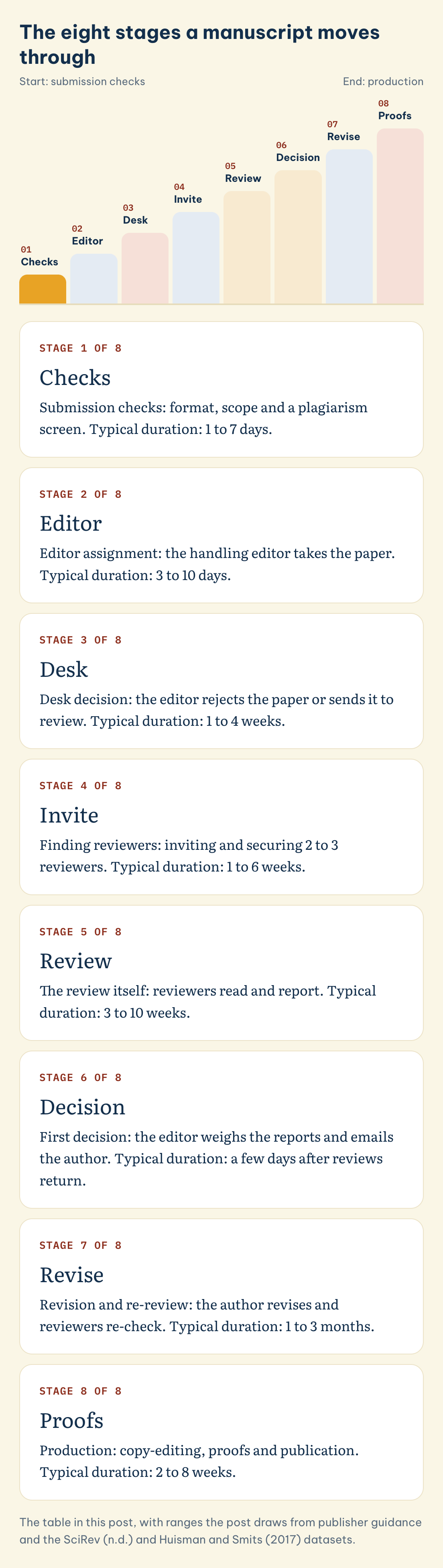
Evidence: Elsevier (n.d.), Springer Nature (n.d.), and PLOS (n.d.) describe the same broad pipeline across their journals: technical checks, editor assignment, a possible desk decision, reviewer invitation and review, the first decision, then revision and production. PLOS states plainly: "After agreeing to review, external peer reviewers typically have 10 days to submit their review" (PLOS, n.d.). The table below shows realistic ranges drawn from publisher guidance and the SciRev (n.d.) and Huisman and Smits (2017) datasets.
| Stage | What happens | Typical duration |
|---|---|---|
| Submission checks | Format, scope, plagiarism screen | 1–7 days |
| Editor assignment | Handling editor takes the paper | 3–10 days |
| Desk decision | Editor rejects or sends to review | 1–4 weeks |
| Finding reviewers | Inviting and securing 2–3 reviewers | 1–6 weeks |
| Review itself | Reviewers read and report | 3–10 weeks |
| First decision | Editor weighs reports, emails author | A few days after reviews return |
| Revision + re-review | Author revises; reviewers re-check | 1–3 months |
| Production | Copy-editing, proofs, publication | 2–8 weeks |
Example: A MAAS-coached author was anxious after 5 weeks of silence. The status was still "finding reviewers", entirely normal for a niche topic, where Huisman and Smits (2017) note the search for willing experts is a common bottleneck. We advised waiting; reviews came back two weeks later.
◆ Question 3 / 7 · Why so long
Why does peer review take so long?
Direct answer: The single biggest cause is reviewer availability. Reviewing is unpaid, voluntary work that busy academics fit around their own deadlines, so editors often invite five or more people before two accept. Narrow topics, holiday periods, long manuscripts, and papers that need careful checking all add weeks.
Evidence: Huisman and Smits (2017) found that one-third of journals take more than two weeks even for an immediate desk rejection, and one-sixth take more than four weeks, before review has begun. Springer Nature (n.d.) explicitly links delays to article length, the availability of reviewers when a topic is narrow, and the depth of checking a manuscript needs.
Example: A MAAS client's interdisciplinary paper blending public health and data science took 18 weeks to first decision. The handling editor later explained she had approached seven reviewers to assemble a panel that covered both fields. The delay reflected the paper's breadth, not any problem with its quality.
◆ Question 4 / 7 · By field
How long does peer review take by field and journal type?
Direct answer: Field matters more than most authors expect. Medical and health sciences tend to be fastest, natural sciences sit in the middle, and social sciences, economics, and the humanities are slowest. Within any field, high-prestige journals are not necessarily slower, but they reject more papers at the desk stage.
Typical first-round review time by field
Tap a field to see its typical first round and the post's note on it.
First-round review: About 10 to 12 weeks
Medical and health sciences
Often the fastest.
First-round review: About 14 weeks
Natural sciences
Middle of the range.
First-round review: About 17 weeks
Social sciences and humanities
A longer reviewer search.
First-round review: Up to about 25 weeks
Economics and business
Slowest on average.
Save this figure
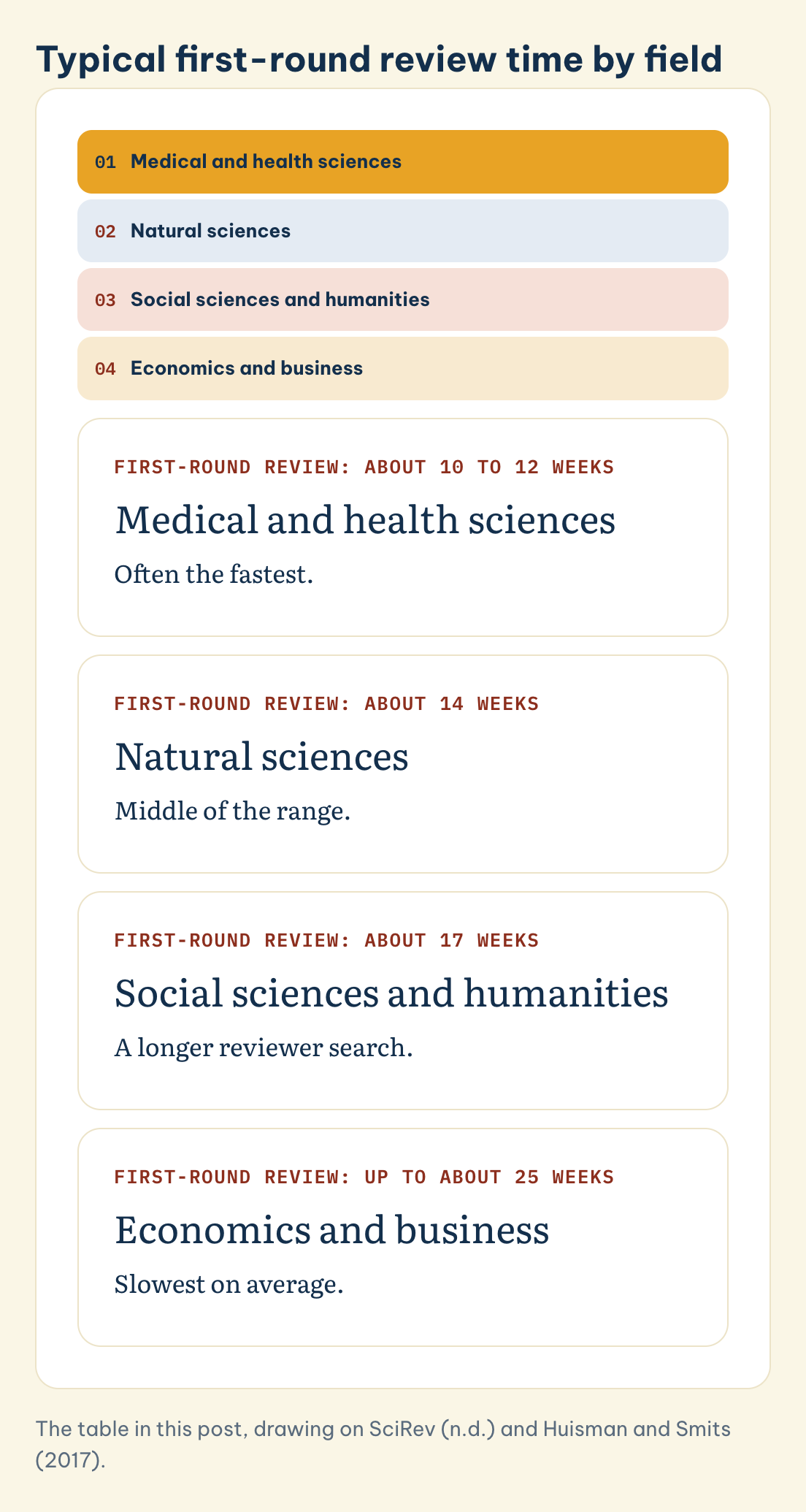
Evidence: SciRev (n.d.) reports a first review round of about 10 weeks in medical sciences, 14 weeks in the natural sciences, and 17 weeks in the social sciences and humanities. Huisman and Smits (2017) found medicine fastest at roughly 12 weeks for the whole process and economics and business slowest at about 25 weeks.
| Field | Typical first-round review | Note |
|---|---|---|
| Medical / health sciences | ~10–12 weeks | Often the fastest |
| Natural sciences | ~14 weeks | Middle of the range |
| Social sciences / humanities | ~17 weeks | Longer reviewer search |
| Economics / business | up to ~25 weeks | Slowest on average |
Example: Two MAAS clients submitted in the same month, one to a clinical journal, one to a management journal. The clinical author had a decision in 9 weeks; the management author waited 20. Same effort, different field norms. We plan publication timelines around the field, not a single global average.
◆ Question 5 / 7 · Checking a journal
How can you check a specific journal's review time before submitting?
Direct answer: You can estimate a journal's speed before you commit. Many journals publish a "time to first decision" figure on their homepage; Elsevier titles show it under Journal Insights, and author communities log real experiences for thousands of journals. Use these to shortlist journals whose speed fits your deadline.
If you are reading the literature rather than submitting to it, our guide on how to tell if an article is peer reviewed shows the same journal checks from the student side.
Evidence: Elsevier (n.d.) advises authors to consult each journal's published metrics and to contact the editor if a submission runs well beyond the stated average. Independent figures are available because SciRev (n.d.) aggregates author-reported review durations by journal, including desk-rejection and first-round times.
Example: A MAAS Publishing Advisory client with a hard scholarship deadline needed acceptance within five months. We compared three candidate Q2 journals' published first-decision times and community data, then targeted the one averaging eight weeks to first decision. She made her deadline with a month to spare.
◆ Question 6 / 7 · If it takes too long
What should you do if peer review is taking too long?
Direct answer: Wait until the journal's stated average has clearly passed before you act, usually that means at least eight to twelve weeks for a first decision. Then send one short, courteous email to the handling editor asking for a status update, quoting your manuscript ID. Polite, infrequent inquiries are completely acceptable; chasing weekly is not.
Evidence: Elsevier (n.d.) confirms authors may ask the editor when a decision is overdue relative to the journal's norm. The Committee on Publication Ethics (n.d.) frames timely, transparent communication as a shared responsibility of editors and authors, which makes a measured status request a legitimate part of the process rather than a nuisance.
Example: A MAAS-coached author had heard nothing 16 weeks after submitting to a journal whose average was 10. We helped her draft a three-sentence inquiry: thanks, manuscript ID, and a request for an expected timeline. The editor apologised, explained a reviewer had dropped out, and returned a decision within two weeks.
◆ Question 7 / 7 · Vietnamese and ESL authors
Do Vietnamese or ESL researchers face longer timelines, and how do you avoid extra delays?
Direct answer: The review itself does not run slower for Vietnamese or ESL authors, but two avoidable delays are more common, a desk rejection for scope or language that sends you back to the start, and a longer revision round when feedback is harder to interpret. Both are preventable by submitting a well-matched, well-edited manuscript the first time.
Evidence: Huisman and Smits (2017) report that authors take an average of 39 days to prepare a revision, ranging from 29 days in public health to 64 days in economics and business, time that compounds if the first submission was not review-ready. A clean, on-scope submission avoids the weeks lost to a desk rejection documented across publisher guidance (Elsevier, n.d.; Springer Nature, n.d.).
Example: A MAAS client had a first paper desk-rejected after three weeks for being out of scope. Through the Outline → Draft → Final model, a mentor helped her match the work to a fitter journal and tighten the English before resubmission. The second journal sent it straight to review and accepted it after one revision round, the early rejection had cost her a month she did not need to lose.
Frequently asked questions
How long does peer review take on average?
For most Scopus journals, plan for about two to four months to a first decision and six to twelve months to final acceptance. The first review round averages roughly 15 to 17 weeks, but ranges from days (desk rejection) to over six months.
What is the difference between "time to first decision" and "submission to acceptance"?
Time to first decision is how long until you hear back after the initial review. Submission to acceptance is the full journey including revisions. The first is shorter; always check which figure a journal is quoting.
Is a fast first decision good or bad?
It depends. A very fast decision can mean an efficient journal or a desk rejection that never reached reviewers. Read the decision itself; speed alone tells you little about the outcome.
How long should I wait before emailing the editor?
Wait until the journal's own average time to first decision has clearly passed, usually at least eight to twelve weeks. Then send one polite inquiry with your manuscript ID.
Does paying an article processing charge make review faster?
No. An APC is an open-access publication fee paid only after acceptance. It does not buy faster review, and any journal promising guaranteed fast acceptance for a fee is a warning sign of a predatory outlet.
Can MAAS help me plan my publication timeline?
Yes. MAAS Publishing Advisory helps Vietnamese researchers shortlist journals by realistic speed, prepare a review-ready submission, and manage the wait and revisions using a phase-by-phase model. Book a consultation through our contact page.
Ready to plan a realistic publication timeline?
The peer-review clock is mostly out of your hands but choosing the right-speed journal, submitting a review-ready manuscript, and revising efficiently are all within your control, and they are where months are saved. With a mentor who has reviewed for Scopus journals, the wait becomes a plan instead of a worry.
MAAS Publishing Advisory is built around the real clock rather than a promised date. On the international track that means 2–3 review rounds of 2–4 months each and 4 to 12 or more months from submission to publication, so MAAS does not promise the journal's decision or when it arrives. Advisers hold multiple Q1 or Q2 papers under their own name, and 23% of our experts hold a PhD. MAAS matches you within 48 hours when our network already covers that field. If it does not, MAAS opens a dedicated recruitment round for your case, which usually takes about two weeks. Your first 20-minute consultation is free.
Book a Publishing Advisory consultation with MAAS Academic Mentoring →
Related guides
- How do you choose the right Scopus journal?: matching your paper to a well-fitting, right-speed journal
- What is a desk rejection, and how do you avoid one?: avoiding the fastest, most frustrating delay
- How do you respond to a major revision from a Scopus journal?: managing the revision stage that follows the first decision
- How do you respond to reviewer comments on a Scopus submission?: writing the response letter that earns acceptance
- How do you write a cover letter to a journal editor?: the one-page letter that starts the clock on this whole timeline
- Should you publish in a conference or a journal first?: picking the venue that sets your timeline
- Publishing Advisory service: full service tiers for Scopus Q1/Q2 support
- Scopus Publishing resource hub: journal-selection and timeline planning templates
- Meet the MAAS expert network: the PhD-level mentors behind this guide
Tools & resources
- Elsevier Journal Insights, per-journal review-speed and time-to-first-decision data: https://journalinsights.elsevier.com
- SciRev, community database of journal review times by field: https://scirev.org
References
- Committee on Publication Ethics. (n.d.). Core practices. Retrieved June 25, 2026, from https://publicationethics.org/core-practices
- Elsevier. (n.d.). When can I expect a decision from the editor? Retrieved June 25, 2026, from https://www.elsevier.support/publishing/answer/when-can-i-expect-a-decision-from-the-editor
- Huisman, J., & Smits, J. (2017). Duration and quality of the peer review process: The author's perspective. Scientometrics, 113(2), 633–650. https://doi.org/10.1007/s11192-017-2310-5
- PLOS. (n.d.). Editorial and peer review process. Retrieved June 25, 2026, from https://journals.plos.org/plosone/s/editorial-and-peer-review-process
- Springer Nature. (n.d.). Editorial process after submission. Retrieved June 25, 2026, from https://support.springernature.com/en/support/solutions/articles/6000251301-editorial-process-after-submission
- SciRev. (n.d.). Duration of the first review round. Retrieved June 25, 2026, from https://scirev.org/analyses/first-round/
This article is part of the MAAS Journal series for Vietnamese international postgraduate students and researchers. MAAS Publishing Advisory is an advisory partner; we coach authors through a phase-by-phase delivery model with developmental feedback from PhD-level, Scopus-published mentors. We do not write, submit, or guarantee acceptance of work on an author's behalf.
A free 20-minute consultation with a MAAS publishing adviser, to talk through a realistic publication timeline for your paper.
Book Free Discovery ▸