
Evidence 01
Roughly 15%
Manuscripts with a text-similarity rate above roughly 15% were frequently rejected without review, and duplicate submissions were screened out outright (Wu et al., 2024).
◆ Publishing advisory
A desk rejection (or desk reject) is an editor's decision to reject a manuscript before peer review, often within days, and it is the most common way manuscripts fail. For Vietnamese researchers aiming at a Scopus Q1 or Q2 journal, it is also the most avoidable kind of rejection, because it rarely reflects the quality of your data. It reflects fit, framing, and a handful of preventable presentation problems an editor spots in minutes.
The editor's triage checklist is predictable. Once you know what a handling editor scans for before assigning reviewers, you can clear most hurdles yourself. This guide answers the seven questions Vietnamese researchers ask MAAS publishing mentors most often when a paper is returned without reaching a reviewer.

◆ Question 1 / 7 · Desk or peer review
Direct answer: A desk rejection, also called editor triage or initial screening, happens when the handling editor returns a paper before sending it to external reviewers. A peer-review rejection comes later, after reviewers assess the science. The first is fast and about fit and presentation; the second is slow and about the depth of the work.
Desk rejection and peer-review rejection, side by side
Each row sets the two stages against one feature.
Desk rejection
Peer-review rejection
It comes days after submission.
It comes weeks to months later.
The handling editor alone decides.
The editor decides together with external reviewers.
The reasons are scope, format, language, novelty or ethics.
The reasons are depth of method, analysis and contribution.
The feedback is brief, often a few lines.
The feedback is a set of detailed reviewer reports.
What you fix is targeting and presentation.
What you fix is the research itself.
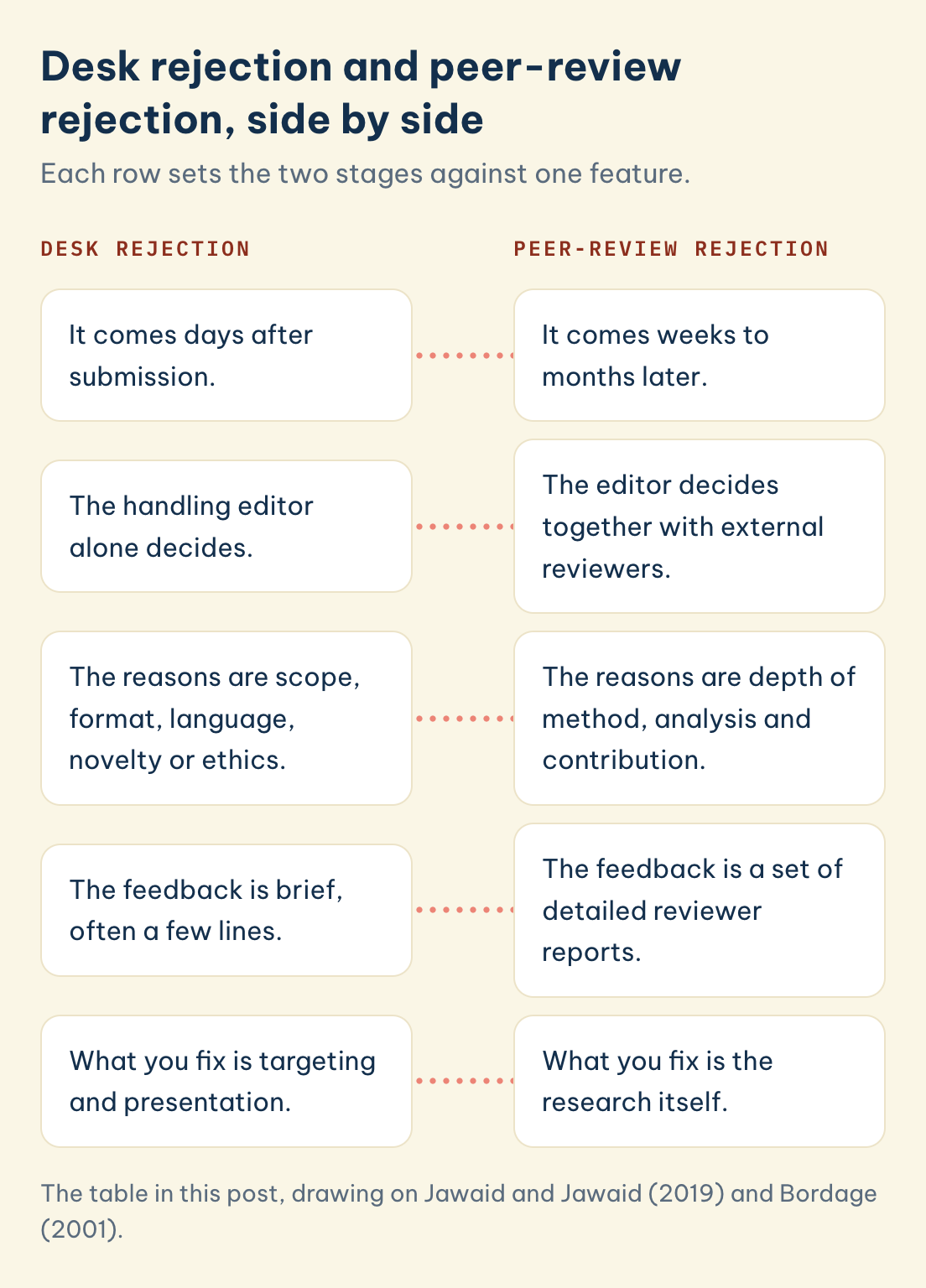
Evidence: Jawaid and Jawaid (2019) document that editors of high-submission journals screen every manuscript first and reject a large share under names such as desk rejection, sudden-death rejection, and editor's triage. Bordage (2001) shows that deeper, science-level objections, statistics, sample size, overinterpretation, surface only once reviewers are involved.
Example: A MAAS client received a one-paragraph rejection 2 days after submitting to a Q2 journal and read it as a verdict on her research. In fact the editor had flagged a scope mismatch: the study fit a clinical journal, not the methods journal she chose. The science was never questioned; the target was wrong.
The two stages ask very different things of an author:
| Feature | Desk rejection | Peer-review rejection |
|---|---|---|
| When | Days after submission | Weeks to months later |
| Who decides | Handling editor alone | Editor plus external reviewers |
| Why | Scope, format, language, novelty, ethics | Depth of method, analysis, contribution |
| Feedback given | Brief, often a few lines | Detailed reviewer reports |
| What to fix | Targeting and presentation | The research itself |
◆ Question 2 / 7 · How common
Direct answer: At selective, high-submission journals, most rejections happen at the desk stage, before any reviewer is contacted. Editors use triage to protect reviewer time: with far more submissions than qualified reviewers, screening out unsuitable papers early keeps the review system functioning and shortens decisions for everyone.
Rejected after initial screening
70 to 80%
is roughly the share of manuscripts rejected at journals with high submission rates and high impact factors (Jawaid & Jawaid, 2019)
Manuscripts with a text-similarity rate above roughly 15% were frequently rejected without review, and duplicate submissions were screened out outright (Wu et al., 2024).
Wu et al. (2024) analysed data from over 5,000 rejected transport papers and found that desk decisions are driven by measurable, avoidable factors rather than subjective taste.
Geoderma (n.d.) advises keeping the cover letter under 1 page and clearly stating the study's aim and main findings.
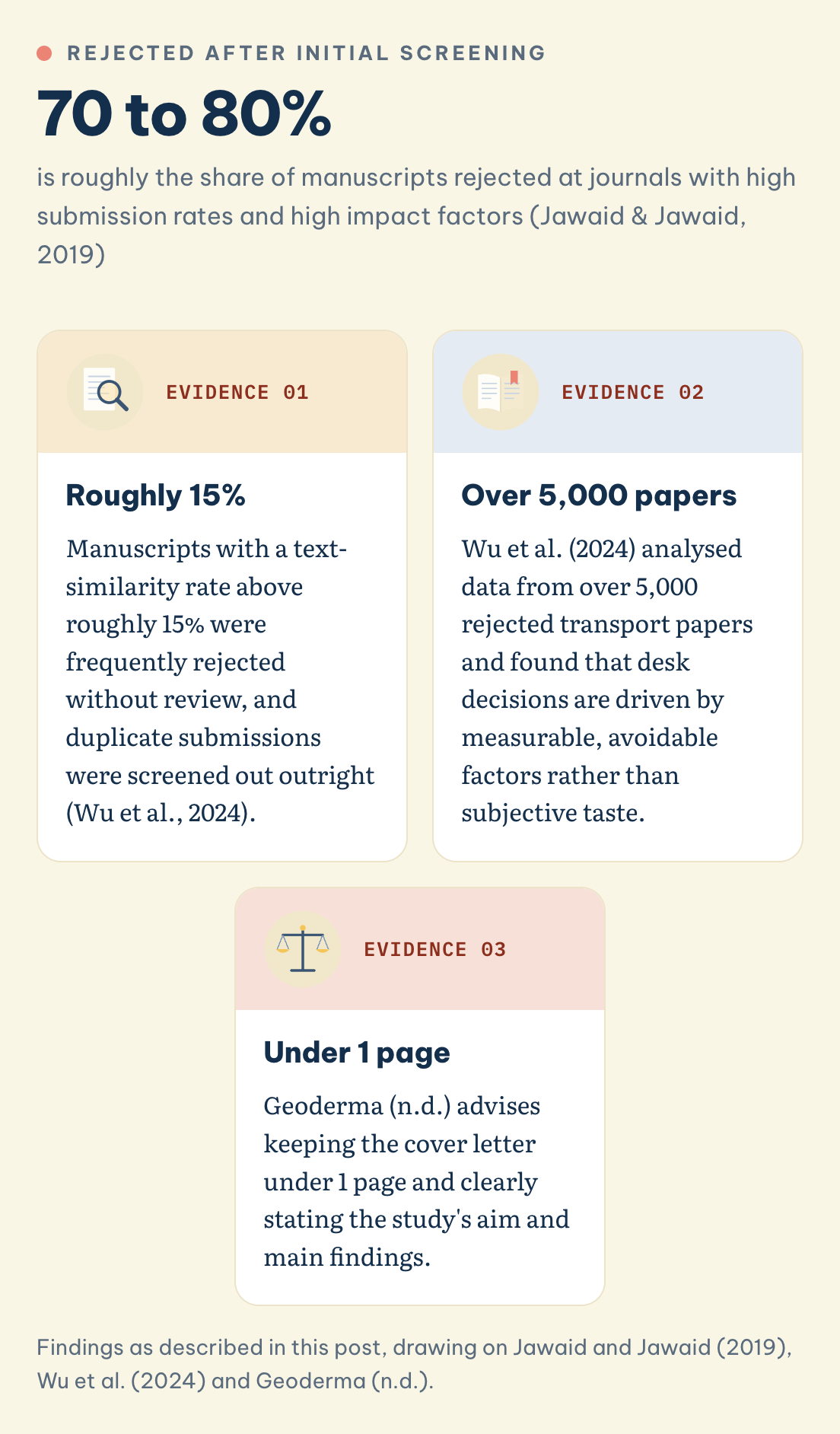
Evidence: Jawaid and Jawaid (2019) report that journals with high submission rates and high impact factors reject roughly 70–80% of manuscripts after initial screening. Wu et al. (2024), analysing data from over 5,000 rejected transport papers, confirm that a large proportion of submissions never reach review and that desk decisions are driven by measurable, avoidable factors rather than subjective taste.
Example: A Vietnamese PhD candidate coached by MAAS assumed a fast rejection meant a weak study. Her mentor reframed it: at her target journal, four in five papers are screened out at the desk, so her task was to re-target, not defend the science.
◆ Question 3 / 7 · Common reasons
Direct answer: Five reasons account for most desk rejections: the paper is out of the journal's scope; the language or structure is hard to follow; the submission ignores the guide for authors; the contribution lacks clear novelty; or there is an ethical flag such as high text similarity. Each is visible to an editor without reading the full results.
The five triggers, and how to prevent each
Tap a trigger to see what the editor checks and what you can do.
Out of scope
The editor checks the aims and scope page and recent issues, so read the scope and cite 2 to 3 papers the journal published.
Language or structure
The editor checks the abstract, the first page and the section flow, so edit for clarity, follow IMRaD and get a professional language check.
Guide ignored
The editor checks word limits, abstract type and references, so build a submission checklist from the guide for authors.
Weak novelty
The editor checks the introduction and the stated contribution, so state the gap and the "so what" in the abstract.
Ethical flag
The editor checks the similarity report and the disclosures, so keep similarity low and declare funding and conflicts.
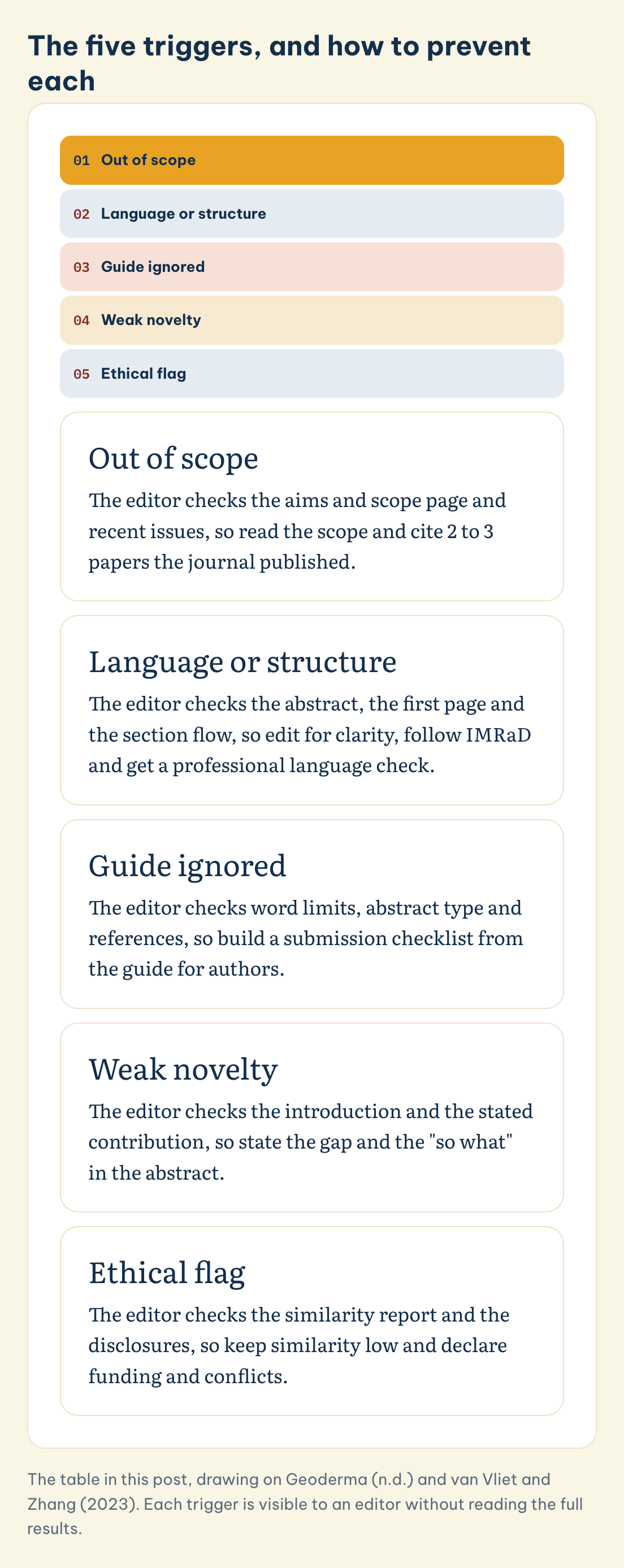
Evidence: Geoderma's editorial guidance lists scope mismatch, language and structure problems, failure to follow the guide for authors, weak novelty, and ethical issues as recurring causes of desk rejection (Geoderma, n.d.). Writing for Elsevier Connect, van Vliet and Zhang (2023) name the same cluster: common reasons for desk rejection "are usually related to the paper being out of scope; problems with the manuscript's language or structure; failure to adhere to the guide for authors; lack of perceived novelty or impact; and/or ethical issues" (van Vliet & Zhang, 2023). Wu et al. (2024) add a measurable trigger: manuscripts with a text-similarity rate above roughly 15% were frequently rejected without review, and duplicate submissions were screened out outright.
Example: A MAAS mentor auditing a client's submission found three desk-rejection risks: a similarity score near 20% from an unparaphrased methods section, a missing structured abstract, and an introduction that never stated the research gap. Fixing all three took a week and removed the likeliest reasons for an instant return.
Journal fit is the hardest of these to judge from inside your own project, and it is where Publishing Advisory spends most of its time: an advisor who has published in your target tier reads the manuscript and tells you which journals it can realistically survive.
The five triggers and the concrete preventive step for each, map cleanly:
| Desk-rejection trigger | What the editor checks | How to prevent it |
|---|---|---|
| Out of scope | Aims and scope page, recent issues | Read scope; cite 2–3 papers the journal published |
| Language or structure | Abstract, first page, section flow | Edit for clarity; follow IMRaD; professional language check |
| Guide for authors ignored | Word limits, abstract type, references | Build a submission checklist from the guide |
| Weak novelty or significance | Introduction, stated contribution | State the gap and the "so what" in the abstract |
| Ethical flag | Similarity report, disclosures | Keep similarity low; declare funding and conflicts |
◆ Question 4 / 7 · Scope fit
Direct answer: Scope mismatch is the leading cause of desk rejection, so confirm fit before writing the cover letter. Read the aims-and-scope statement, scan the last two or three issues for comparable studies, and check that your topic, method, and readership match. If you cannot point to recent papers like yours in that journal, it is probably the wrong target.
Evidence: Geoderma names being out of scope as a primary reason editors decline papers before review (Geoderma, n.d.), and Springer Nature advises verifying aims and scope as a first step in journal selection (Springer Nature, n.d.). Jawaid and Jawaid (2019) note that many rejected authors had not read the scope or instructions before submitting.
Example: A MAAS client targeting a top general-medicine journal found no study using her qualitative method in its recent issues. Her mentor shortlisted three field-specific Q2 journals that published such work; she submitted to the best-matched one, cleared triage, and reached full peer review, the same paper, a better-fitted home.
◆ Question 5 / 7 · Language and format
Direct answer: Editors read the abstract and first page before anything else, so unclear English or a messy structure creates an immediate negative impression. Ignoring the guide for authors, wrong word count, missing structured abstract, incorrect reference style, absent ethics statement, signals carelessness and gives the editor an easy reason to decline. Both are fully within your control, and Jawaid and Jawaid (2019) list them among the most frequent triage failures they recorded.
Evidence: Jawaid and Jawaid (2019) identify manuscripts needing a complete rewrite for English and grammar, and submissions that ignore the instructions for authors, as frequent triage failures. Geoderma (n.d.) lists language, structure, and non-compliance with the guide for authors among its top desk-rejection causes.
Example: An ESL researcher coached by MAAS had strong data but an abstract that buried the finding and exceeded the word limit. Her mentor restructured it to lead with the result, trimmed it to length, and ran a clarity pass, and the resubmission reached review with no comment on the writing.
◆ Question 6 / 7 · Novelty
Direct answer: Even a well-targeted, well-formatted paper is desk rejected if the editor cannot quickly see why it matters. State your novelty and contribution explicitly in the abstract, the introduction, and a short cover letter rather than leaving the editor to infer them. A focused cover letter of about 1 page, naming the gap and main finding, helps the editor say yes to review.
Evidence: Geoderma (n.d.) advises keeping the cover letter under 1 page and clearly stating the study's aim and main findings, and lists weak novelty or impact as a desk-rejection cause. Bordage (2001) found the importance and timeliness of the problem among the strongest predictors of a positive response, underlining that significance must be visible early.
Example: A MAAS client had a solid replication study returned twice at the desk. Her mentor reframed the contribution as the first validation of a model in a Vietnamese clinical setting and wrote a tight cover letter saying so. The study then passed triage on the next submission.
◆ Question 7 / 7 · After rejection
Direct answer: Treat a desk rejection as routing information, not a verdict. Read any reason the editor gave, fix the fixable issues, identify a better-matched journal, and resubmit promptly. Because there are no detailed reviewer reports, you usually lose only days, not the months a full review costs so a fast, considered re-target is the right response.
Four moves after a desk rejection
Tap a move to see what to do.
Move 1 of 4
Read the reason
Read any reason the editor gave, and treat the rejection as routing information, not a verdict.
Move 2 of 4
Fix what you can
Fix the fixable issues.
Move 3 of 4
Find a better match
Identify a better-matched journal.
Move 4 of 4
Resubmit promptly
Resubmit promptly, and never submit the same manuscript to two journals at once.
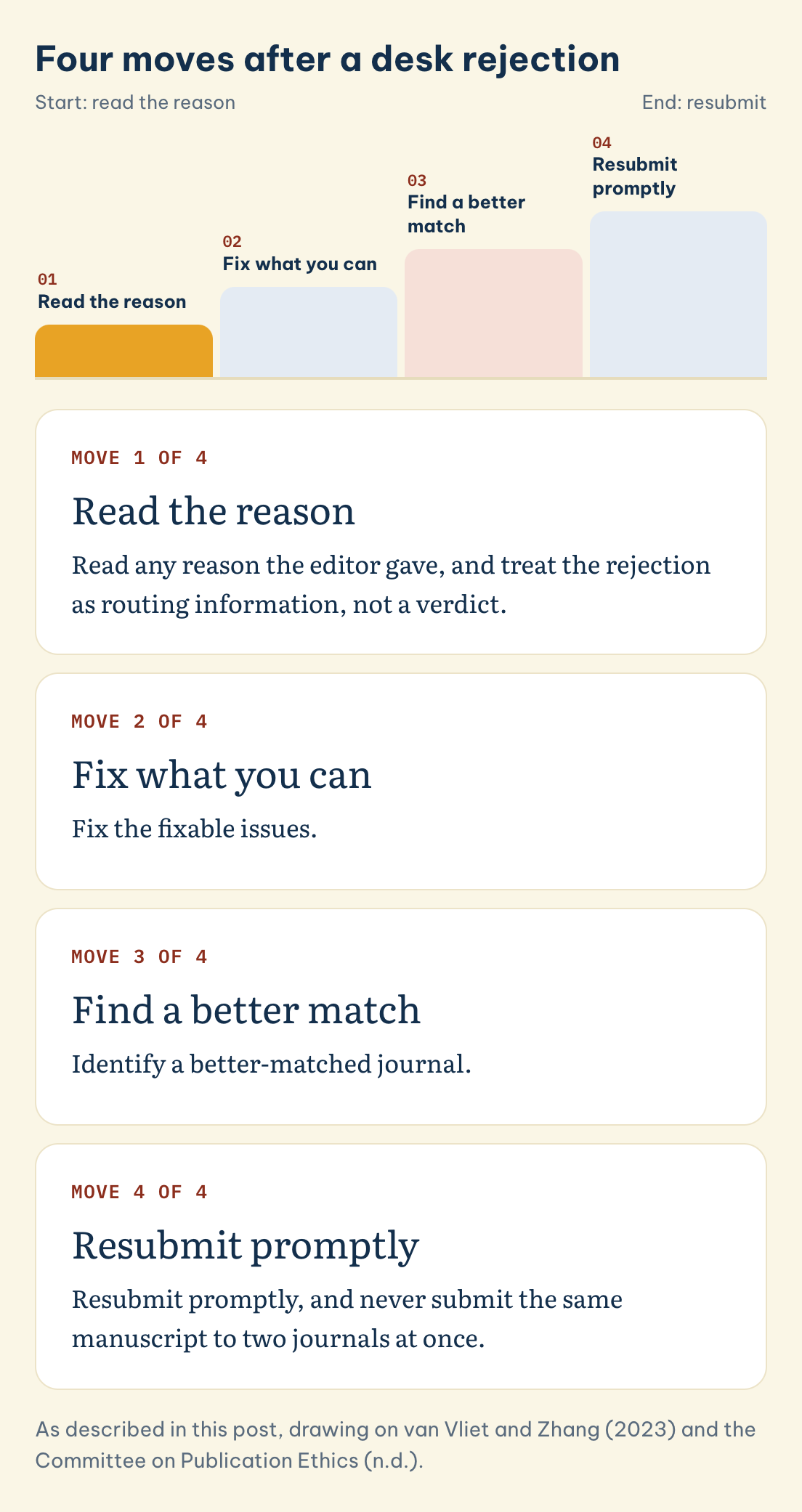
Evidence: van Vliet and Zhang's editorial advice frames rejection as a normal, recoverable step and urges authors to learn from it and resubmit to a more appropriate journal (van Vliet & Zhang, 2023). The Committee on Publication Ethics (n.d.) cautions that resubmission must be ethical: address any integrity issues raised, and never submit the same manuscript to two journals at once.
Example: A Vietnamese researcher mentored by MAAS was desk rejected for scope, spent 2 days re-targeting, and resubmitted to a journal that had recently published two similar studies. It cleared triage within a week and was accepted after one major revision, the early redirect saved a submission cycle.
The evidence behind this guide, in brief:
It means the handling editor returned your manuscript before sending it to external reviewers, a step also called editor triage or initial screening. The decision is fast, usually within days to 2 weeks, and it is about fit and presentation, such as scope, formatting, language, novelty or ethics, rather than the depth of your science, which only reviewers assess later.
No. A desk rejection is usually about fit and presentation, scope, formatting, language, or unclear novelty, not the quality of your data. Most desk-rejected papers are accepted elsewhere after re-targeting and tightening.
Often a few days to 2 weeks. Because the editor decides without sending the paper to reviewers, desk decisions are far faster than the weeks or months a full peer review takes.
Only if the editor invites it or you have substantially changed the paper to address the stated reason. In most cases it is faster and wiser to choose a better-matched journal and resubmit there.
Scope mismatch, the paper does not fit the journal's aims and scope, a cause Geoderma (n.d.) and Springer Nature (n.d.) both name as the leading one. Reading the scope statement and checking recent issues for similar studies prevents most of these rejections.
Yes. Many editors screen submissions for similarity and decline papers above their threshold before review; Wu et al. (2024) found manuscripts above roughly 15% text similarity were frequently rejected without review. Proper paraphrasing and full citation of sources keep your originality score within acceptable limits.
Yes. MAAS Publishing Advisory coaches Vietnamese researchers through journal selection, scope fit, structure, and the cover letter using a phase-by-phase model, so your submission clears editor triage and reaches review, with the manuscript remaining entirely your own work.
A desk rejection is the cheapest rejection to prevent, because almost every cause is visible before you submit. With a mentor who has sat on both sides of the editor's desk, journal fit and framing stop being guesswork.
MAAS Publishing Advisory matches you with a discipline-matched adviser within 48 hours when our network already covers that field. If it does not, MAAS opens a dedicated recruitment round for your case, which usually takes about two weeks. Your submission package is then reviewed by an adviser who holds multiple Q1 or Q2 papers under their own name, drawn from 100+ experts of whom 23% hold a PhD, and the work runs from a shortlist of 3–5 fit journals through to the cover letter. Whether a journal accepts the paper is the editor's decision, so that is not something MAAS promises. Start with a free 20-minute consultation, and the project kick-off that follows is also free and does not count as a paid session.
Book a Publishing Advisory consultation with MAAS →
This article is part of the MAAS Journal series for Vietnamese international postgraduate students and researchers. MAAS Publishing Advisory is an advisory partner; we coach authors through a phase-by-phase delivery model with developmental feedback from PhD-level, Scopus-published mentors. We do not write, submit, or guarantee acceptance of work on an author's behalf.
A free 20-minute consultation with a MAAS publishing mentor, to talk through your target journal, your scope fit and your cover letter.
Book Free Discovery ▸