
◆ Publishing advisory
How do you submit a paper to an academic journal for publication?
To submit a paper to an academic journal, you choose a journal, format the manuscript to its guidelines, assemble a cover letter and declarations, submit through an editorial system, then manage the decision. For Vietnamese researchers, getting that order right often decides acceptance, because it is not simply attaching a file to an email.
Get the sequence right and you avoid the desk rejections that stop nearly half of all submissions before a reviewer reads them. This guide answers the seven questions Vietnamese researchers most often ask MAAS mentors when submitting a first international paper.

◆ Question 1 / 7 · What it involves
What does submitting a paper to a journal actually involve?
Direct answer: Submission is a pipeline, not a single action. You select a target journal, format the manuscript to its author guidelines, prepare supporting files (title page, cover letter, figures, declarations), submit through an online editorial system, and then respond to the editor's decision, with the corresponding author managing every stage.
The six stages of submitting a paper
Tap a stage to see what you do and the pitfall to avoid.
Stage 1 of 6
Choose
Choose the journal. What you do: match scope, indexing and audience. Common pitfall: sending to a mismatched or predatory journal.
Stage 2 of 6
Format
Format the manuscript. What you do: follow the author guidelines exactly. Common pitfall: ignoring word limits and reference style.
Stage 3 of 6
Files
Prepare supporting files. What you do: title page, figures, declarations. Common pitfall: missing ethics or data statements.
Stage 4 of 6
Letter
Write the cover letter. What you do: state significance and fit. Common pitfall: a generic, one-size-fits-all letter.
Stage 5 of 6
Submit
Submit through the system. What you do: upload files, confirm authorship. Common pitfall: wrong file types or incomplete metadata.
Stage 6 of 6
Decision
Manage the decision. What you do: respond to review or resubmit. Common pitfall: giving up after a first rejection.
Save this figure
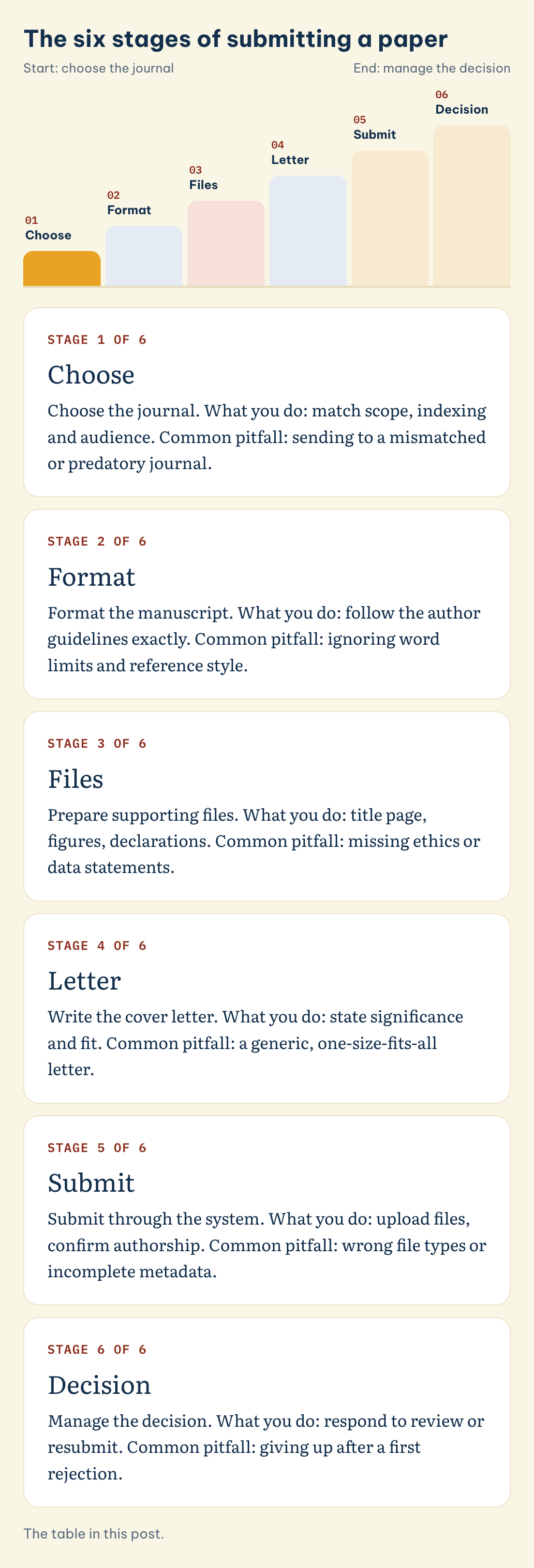
Evidence: The International Committee of Medical Journal Editors (ICMJE, n.d.-a) defines the corresponding author as the person responsible for communication with the journal through submission, peer review, and publication, and for completing all administrative requirements. Springer Nature (n.d.) describes the same flow: choose the journal, follow its guidelines, submit files through the editorial system, and track the outcome.
Example: A MAAS-mentored PhD candidate treated submission as one task and tried to upload immediately. Her mentor mapped the pipeline below and found four missing items, title page, data-availability statement, ethics line, and cover letter.
The process has six predictable stages:
| Stage | What you do | Common pitfall |
|---|---|---|
| 1. Choose the journal | Match scope, indexing, and audience | Sending to a mismatched or predatory journal |
| 2. Format the manuscript | Follow the author guidelines exactly | Ignoring word limits and reference style |
| 3. Prepare supporting files | Title page, figures, declarations | Missing ethics or data statements |
| 4. Write the cover letter | State significance and fit | A generic, one-size-fits-all letter |
| 5. Submit through the system | Upload files, confirm authorship | Wrong file types or incomplete metadata |
| 6. Manage the decision | Respond to review or resubmit | Giving up after a first rejection |
◆ Question 2 / 7 · Choosing the journal
How do you choose the right journal to submit to?
Direct answer: Choose a journal whose scope, readership, and indexing match your paper before you write a single formatting line. Confirm it is indexed where your institution counts (Scopus or Web of Science), listed in trusted directories, and free of predatory warning signs. A strong paper sent to the wrong journal is still rejected.
Evidence: ICMJE (n.d.-a) states that authors must evaluate the integrity, history, and reputation of the journals they submit to, and avoid predatory titles that publish almost anything for a fee. The Directory of Open Access Journals is one verification tool, alongside database indexing and Committee on Publication Ethics (COPE) membership.
Example: A MAAS client in public health had a paper of clear regional value but aimed at a broad global journal wanting only wide-interest findings. Her mentor moved the target to a well-indexed regional Scopus journal and it reached review rather than a desk rejection.
◆ Question 3 / 7 · Documents
What documents do you need to prepare before you submit?
Direct answer: Most journals require a manuscript file, a separate title page, a cover letter, figures at print quality, and declarations covering ethics, conflicts of interest, author contributions, and data availability. The exact list lives in the journal's author guidelines, and following it precisely is the cheapest way to avoid a desk rejection.
Evidence: ICMJE (n.d.-b) specifies that the title page carries the article title, author details, disclaimers, sources of support, and word count, and that submissions often need a statement confirming all authors approved the manuscript. Dantas-Torres (2022) lists incomplete methods, missing data-availability statements, and unresolved ethics approvals among the top reasons manuscripts are rejected without review.
Example: A MAAS-mentored team wrote "data available on request." Their mentor flagged it, many journals now reject that phrasing and helped them deposit the dataset in a public repository with an accession number.
A typical package includes the manuscript (within word and reference limits), a separate title page (authors, affiliations, ORCID, funding), the cover letter, figures at 300 dpi, and declarations for ethics, conflicts of interest, contributions, and data availability, each worded to match the journal. Who counts as an author is worth settling before submission, and who qualifies as an author on a research paper explains the criteria.
◆ Question 4 / 7 · Cover letter
How do you write a cover letter for your submission?
Direct answer: Keep the cover letter to one page and make it specific to the journal. Address the handling editor, name the journal, state what the study found and why its readers will care, and confirm the work is original and not under review elsewhere. It is your argument for why this paper belongs here.
Evidence: Elsevier (n.d.) advises authors to articulate the significance of the research, show how it aligns with the journal's scope, and confirm the manuscript is not published or under review elsewhere and that all authors approved it. Elsevier states that "A cover letter is often the first thing an editor reads when reviewing your submission" (Elsevier, n.d.). Springer Nature (n.d.) recommends a concise, journal-specific letter of no more than one page.
Example: A MAAS client reused one cover letter across three journals, changing only the title. Her mentor rebuilt it for the actual target, two sentences on the gap the study fills, one on why that readership needs it, plus the originality statement.
◆ Question 5 / 7 · After you submit
What happens after you click submit?
Direct answer: Your manuscript enters an editorial pipeline. Staff first check it is complete and in scope; an editor then decides whether to reject it at the desk or send it to reviewers. Reviewers assess rigour and novelty, and the editor makes the final call, usually accept, minor or major revision, or reject.
The four decisions you can receive
Tap a decision to see what it means and your next move.
Accept
What it means: rare on first submission. Your next move: complete production steps.
Minor revision
What it means: small fixes needed. Your next move: address quickly, resubmit.
Major revision
What it means: substantial work required. Your next move: plan a point-by-point response.
Reject
What it means: not for this journal, or not yet. Your next move: improve, then submit elsewhere.
Save this figure
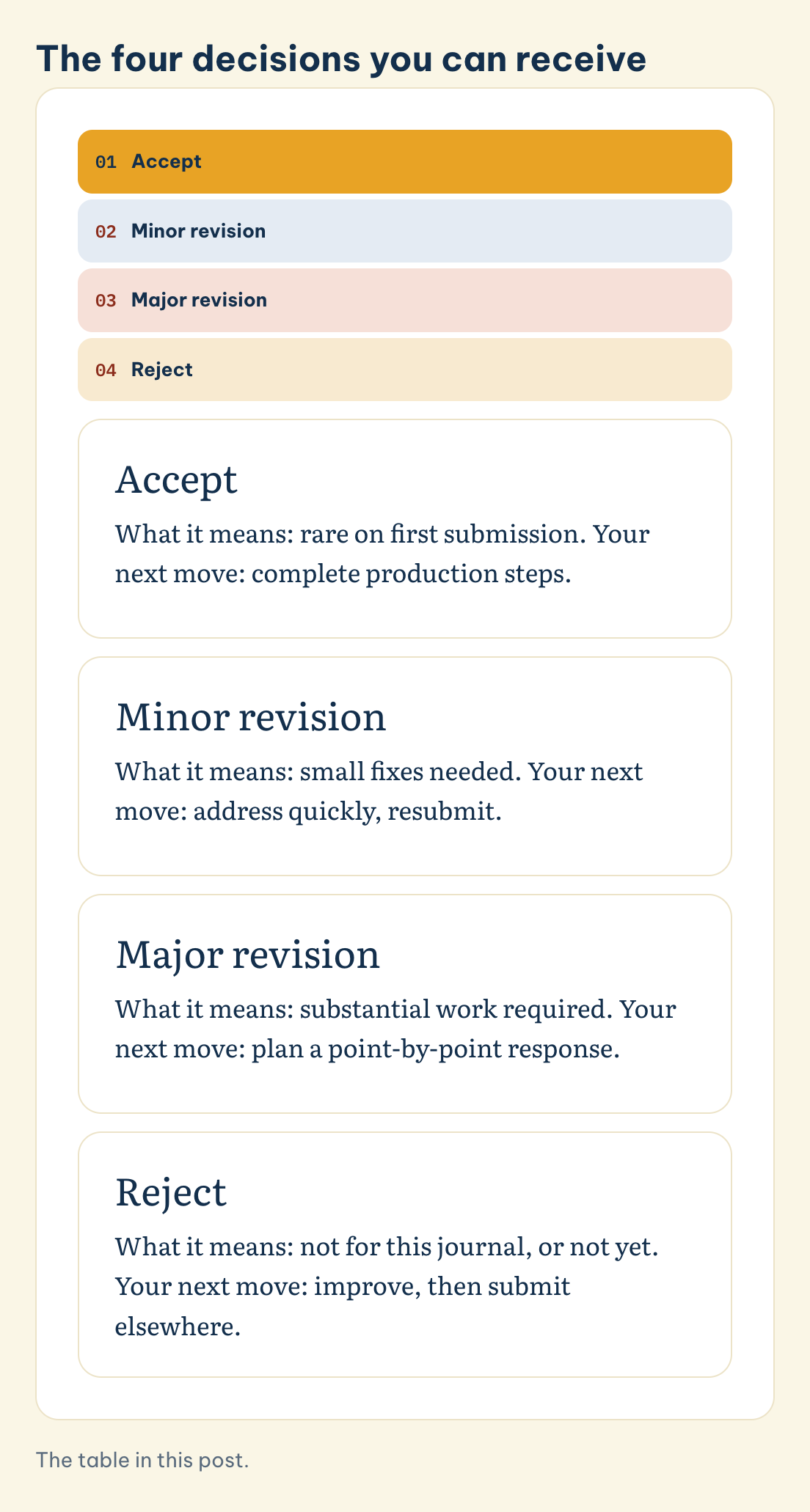
Evidence: Dantas-Torres (2022), writing as editor-in-chief of Parasites & Vectors, reports a pre-review rejection rate of 39% at his own journal, and cites JAMA Internal Medicine's reported rate of 78% of manuscripts received in 2017, showing how much the desk-check stage filters out before review begins. ICMJE (n.d.-a) frames peer review as the critical evaluation that follows this screening.
Example: A MAAS-mentored author panicked when her status stayed on "with editor" for three weeks. Her mentor explained the desk-check and reviewer stages and advised waiting, the paper moved to review in week four.
The decision you receive falls into one of four categories:
| Decision | What it means | Your next move |
|---|---|---|
| Accept | Rare on first submission | Complete production steps |
| Minor revision | Small fixes needed | Address quickly, resubmit |
| Major revision | Substantial work required | Plan a point-by-point response |
| Reject | Not for this journal, or not yet | Improve, then submit elsewhere |
◆ Question 6 / 7 · Desk rejection
Why do so many papers get rejected before review, and how do you avoid it?
Direct answer: Most early rejections are avoidable and have nothing to do with the quality of your science. Papers are desk-rejected for being out of scope, of only local interest, lacking novelty, missing methods or ethics detail, poorly formatted, or written in unclear English. Fixing these before you submit sharply raises your odds of review.
Common desk-rejection triggers and their fixes
Each row sets one trigger beside the fix to make before you submit.
Trigger
Fix before submitting
Out of scope
Read recent issues and send a pre-submission inquiry.
Local interest only
Reframe toward a broader question, or pick a regional journal.
No clear novelty
State the research gap explicitly in the introduction.
Incomplete methods or data
Follow a reporting guideline (EQUATOR Network).
Ethics not documented
Add approval numbers and consent statements.
Poor English
Revise with a mentor before, not after, rejection.
Save this figure
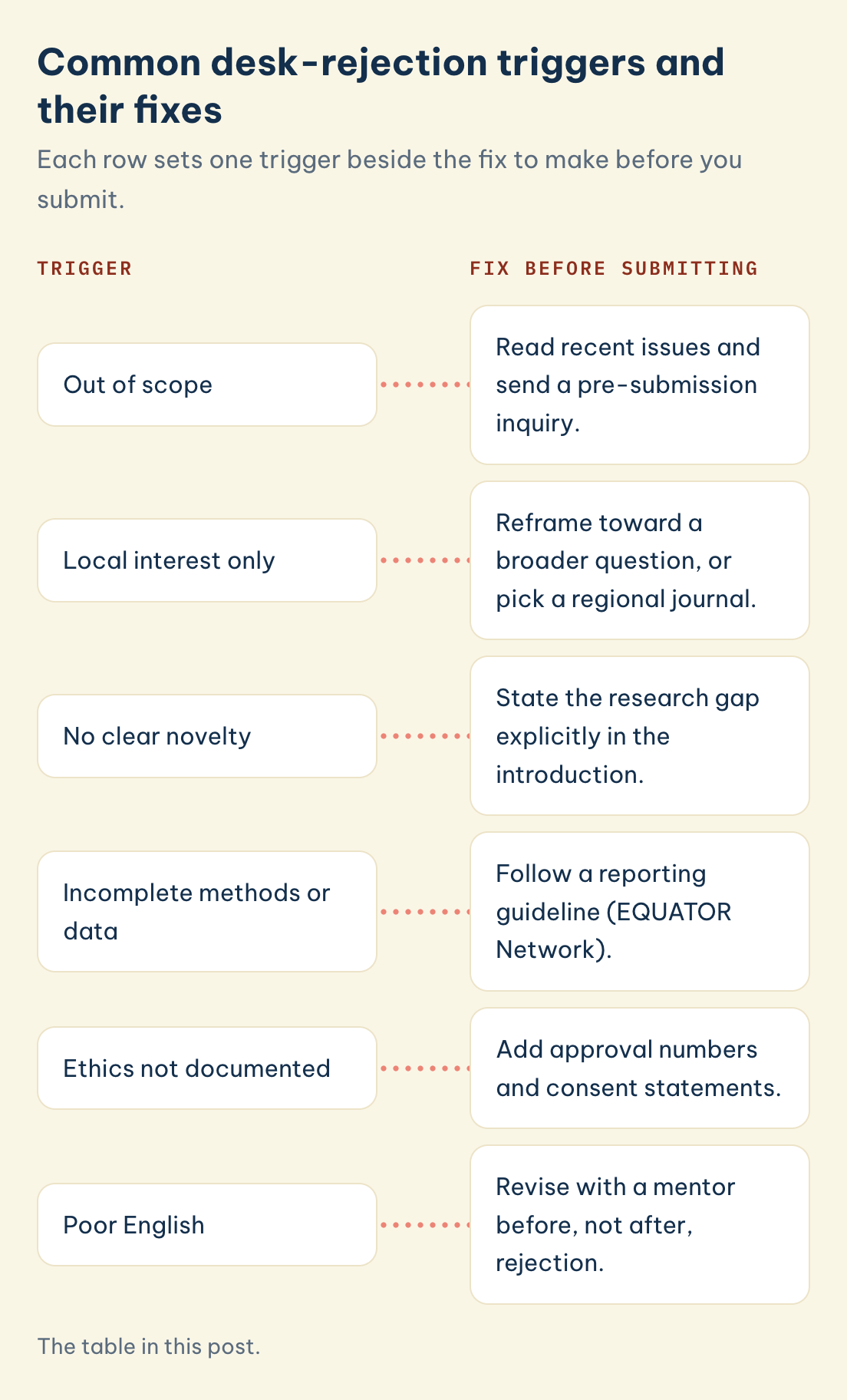
Evidence: Dantas-Torres (2022) lists ten recurring desk-rejection triggers: out of scope, local interest only, no novelty, inadequate study design, incomplete methodological detail, data availability issues, ethical issues, poor presentation, poor English, and plagiarism. Simera et al. (2010), writing in BMC Medicine, show that transparent, guideline-based reporting increases the reliability and impact of research, and following reporting guidelines catalogued by the EQUATOR Network helps manuscripts pass editorial screening.
Example: A MAAS client wrote strong science in unclear English, and two journals rejected it without review. Her mentor coached her through the Outline → Draft → Final model, restructuring the argument and sharpening the language while she kept full authorship and the next submission reached review.
The most common desk-rejection triggers, and their fixes:
| Trigger | Fix before submitting |
|---|---|
| Out of scope | Read recent issues; send a pre-submission inquiry |
| Local interest only | Reframe toward a broader question, or pick a regional journal |
| No clear novelty | State the research gap explicitly in the introduction |
| Incomplete methods/data | Follow a reporting guideline (EQUATOR Network) |
| Ethics not documented | Add approval numbers and consent statements |
| Poor English | Revise with a mentor before, not after, rejection |
◆ Question 7 / 7 · The decision
How do you handle the decision and what comes next?
Direct answer: Read every decision as information, not a verdict. Minor and major revisions are invitations to improve, answer each reviewer point by point in a respectful letter. If the paper is rejected, use the feedback to strengthen it, choose a better-matched journal, and submit again. Persistence, done properly, is how most papers publish.
Evidence: COPE (n.d.) sets out the ethical framework editors and authors follow through revisions and appeals, emphasising honest, documented responses. ICMJE (n.d.-a) reinforces that authors must not submit the same manuscript to two journals at once, so a genuine rejection frees you to submit elsewhere.
Example: A MAAS-mentored researcher received a rejection and assumed her project had failed. Her mentor read the reviews, identified three fixable weaknesses, matched her to a better-fitting Q2 journal, and guided the resubmission, accepted after one round of minor revision.
Frequently asked questions
How do I submit a paper for publication in a journal, step by step?
Submission is a pipeline of six stages: choose a target journal, format the manuscript to its author guidelines, prepare the supporting files (title page, cover letter, figures, declarations), submit through the journal's online editorial system, wait through the editor's desk check and peer review, and respond to the decision, which is usually accept, minor or major revision, or reject. The corresponding author manages every stage (ICMJE, n.d.-a).
Is submitting a paper to a journal the same as getting it published?
No. Submission only starts the editorial pipeline. Many manuscripts are rejected at the desk before review, for example a pre-review rejection rate of 39% at one journal and a reported 78% at JAMA Internal Medicine in 2017 (Dantas-Torres, 2022), so choosing the right journal and preparing every file before you submit matters as much as the upload itself.
How long does it take to hear back after submitting?
It varies by field and journal. A desk decision can arrive within days to a few weeks, while full peer review commonly takes six to twelve weeks or longer. Check the journal's stated timelines before emailing the editor.
Can I submit my paper to more than one journal at once?
No. Submitting the same manuscript to two journals at once breaches publication ethics and can lead to rejection or retraction. Wait for a decision, or formally withdraw, before submitting elsewhere.
Do I need a cover letter if the system does not ask for one?
Yes, unless the journal explicitly says otherwise. A concise, journal-specific cover letter helps the editor understand your paper's fit and significance, and many journals still expect one.
What is a desk rejection?
A desk rejection is when an editor declines a manuscript without peer review, usually for scope, novelty, formatting, ethics, or language reasons. It is fast, common, and largely preventable by preparing carefully.
Should Vietnamese and other ESL researchers get language help before submitting?
Yes. Unclear English is a frequent cause of rejection without review. Revising with a mentor before submission, while you keep full authorship, is far more effective than fixing it after a rejection.
Can MAAS help me submit my paper to a journal?
Yes. MAAS Publishing Advisory coaches Vietnamese researchers through journal selection, manuscript preparation, the cover letter, and the full submission and revision process using a phase-by-phase model, with the manuscript remaining entirely your own work.
Ready to submit your paper with confidence?
Submission is where good research quietly wins or loses, the difference between a desk rejection and review is usually preparation.
MAAS Publishing Advisory matches you with a discipline-matched adviser within 48 hours when our network already covers that field. If it does not, MAAS opens a dedicated recruitment round for your case, which usually takes about two weeks. The final phase covers shortlisting journals that genuinely fit, the cover letter and the submission steps, and once a paper is accepted the final manuscript is formatted to the journal's requirements. With 100+ experts, 23% holding a PhD, your submission is shaped with an adviser who holds multiple Q1 or Q2 papers under their own name, while you remain the sole author and the one who submits. Start with a free 20-minute consultation.
Book a Publishing Advisory consultation with MAAS →
Where this guidance comes from
The pipeline described above is drawn from primary editorial guidance, not secondary study-skills advice: the International Committee of Medical Journal Editors' recommendations, Elsevier's and Springer Nature's own author guidance, the Committee on Publication Ethics's editor guidance, a 2022 desk-rejection analysis in Parasites & Vectors (Dantas-Torres, 2022), and a 2010 reporting-guidelines study in BMC Medicine (Simera et al., 2010). Where a claim is unique to one journal or field, the evidence paragraphs above say so explicitly.
Related guides
- How do you choose the right Scopus journal for your paper?
- How do you write a journal cover letter?
- What is a desk rejection, and how do you avoid one?
- How long does peer review take?
- How do you respond to a major revision from a Scopus journal?
- Your first international paper as a Vietnamese researcher
- Do you have to pay to publish open access?: weighing open-access fees and APC waivers before you pick a target journal
- How do you get your published research read and cited?: the visibility work that begins the moment your paper is accepted
- Publishing Advisory service: service tiers for Scopus Q1/Q2 support
- Scopus Publishing resource hub: selection and submission checklists
- Meet the MAAS expert network: the PhD-level mentors behind every submission
Tools & resources
- Directory of Open Access Journals (DOAJ), verify a journal: https://doaj.org
- EQUATOR Network, reporting guidelines by study type: https://www.equator-network.org
- ORCID, a persistent author identifier: https://orcid.org
References
- Committee on Publication Ethics [COPE]. (n.d.). Guidance for editors and authors. Retrieved July 5, 2026, from https://publicationethics.org/guidance
- Dantas-Torres, F. (2022). Top 10 reasons your manuscript may be rejected without review. Parasites & Vectors, 15, Article 418. https://doi.org/10.1186/s13071-022-05543-w
- Elsevier. (n.d.). How to write a cover letter for your manuscript. Retrieved July 5, 2026, from https://scientific-publishing.webshop.elsevier.com/publication-process/how-to-write-a-cover-letter-for-a-manuscript/
- International Committee of Medical Journal Editors [ICMJE]. (n.d.-a). Responsibilities in the submission and peer-review process. Retrieved July 5, 2026, from https://www.icmje.org/recommendations/browse/roles-and-responsibilities/responsibilities-in-the-submission-and-peer-peview-process.html
- International Committee of Medical Journal Editors [ICMJE]. (n.d.-b). Preparing a manuscript for submission to a medical journal. Retrieved July 5, 2026, from https://www.icmje.org/recommendations/browse/manuscript-preparation/preparing-for-submission.html
- Simera, I., Moher, D., Hoey, J., Schulz, K. F., & Altman, D. G. (2010). Transparent and accurate reporting increases reliability, utility, and impact of your research: Reporting guidelines and the EQUATOR Network. BMC Medicine, 8, Article 24. https://doi.org/10.1186/1741-7015-8-24
- Springer Nature. (n.d.). Cover letters. Retrieved July 5, 2026, from https://www.springer.com/gp/authors-editors/authorandreviewertutorials/submitting-to-a-journal-and-peer-review/cover-letters/10285574
This article is part of the MAAS Journal series for Vietnamese postgraduate students and researchers. MAAS Publishing Advisory is an advisory partner; we coach authors through a phase-by-phase model with developmental feedback from PhD-level, Scopus-published mentors. We do not write, submit, or guarantee acceptance of work on an author's behalf.
A free 20-minute consultation with a MAAS publishing adviser, to talk through your submission plan.
Book Free Discovery ▸