
◆ Publishing advisory
How do you get your published research read and cited?
A paper's reach depends on more than the journal: preprints, a researcher profile, self-archiving, and sharing decide how many people read and cite it. For Vietnamese researchers, where a citation record shapes graduation, promotion, and funding, visibility is not vanity; it is part of the job. The good news is that the highest-impact visibility steps are free, ethical, and largely within your control.
This guide explains how to make your work discoverable and citable after acceptance, preprints, ORCID and Google Scholar profiles, green open access, and altmetrics, in the plain terms MAAS publishing mentors use with first-time authors.

◆ Question 1 / 6 · Why visibility matters
Why does visibility matter as much as the journal?
Direct answer: Two papers of equal quality can have very different impact depending on how discoverable they are. Making your work openly available and easy to find measurably increases how often it is read and cited: open-access papers receive about 18% more citations on average, and papers with a preprint receive roughly 36% more.
Evidence: Piwowar et al. (2018), analysing millions of articles, found that open-access papers receive about 18% more citations than average after accounting for age and discipline. Fu and Hughey (2019) found that articles with an associated preprint had, on average, 36% more citations and a 49% higher Altmetric Attention Score than those without. Their own words: "we found that articles with a preprint had, on average, a 49% higher Altmetric Attention Score and 36% more citations than articles without a preprint" (Fu & Hughey, 2019). Visibility compounds: more readers lead to more citations, which lead to more readers.
Example: A Vietnamese author published two solid papers; the one she shared via a preprint and an updated researcher profile accumulated citations far faster, same quality, more reach.
◆ Question 2 / 6 · Preprints
What is a preprint, and should you post one?
Direct answer: A preprint is a complete manuscript you post to a public server (such as arXiv, bioRxiv, medRxiv, or SSRN) before or during peer review. It timestamps your work, invites early feedback, and increases attention and for most journals, posting one does not count as prior publication. Always check your target journal's preprint policy first.
Evidence: Berg et al. (2016) describe a preprint as a complete manuscript uploaded to a public server without formal review, and argue it accelerates discovery and feedback. Fu and Hughey (2019) quantified the benefit: a measurable citation and attention advantage for papers with preprints. Most major journals now explicitly permit preprints, but policies vary, so confirm before posting.
Example: A researcher worried a preprint would "use up" her novelty. Her mentor showed that her target journal welcomed preprints, and the early version drew two helpful comments that strengthened the paper before formal review.
◆ Question 3 / 6 · Researcher profiles
How do you set up a researcher profile (ORCID and Google Scholar)?
Direct answer: Create an ORCID iD as your permanent identity and a Google Scholar profile as your public citation showcase. Together they consolidate your work under one verified identity and make your full output easy to find, especially important when your name is romanised inconsistently across databases.
Evidence: Haak et al. (2012) introduced ORCID specifically to solve author name ambiguity, a frequent problem for Vietnamese authors whose names appear in several forms. Linking every paper to your ORCID, and maintaining a Google Scholar profile, ensures citations accrue to you rather than fragmenting across mistaken identities.
Example: An author publishing as "Tran, V. A." and "Van Anh Tran" found her citations split across profiles right before a promotion review. Consolidating everything under one ORCID and a single Google Scholar profile restored an accurate, complete record.
◆ Question 4 / 6 · Green open access
How do you make your paper free to read (green open access)?
Direct answer: Even if you publish in a subscription journal, you can usually make a version free by self-archiving it in a repository, green open access, at no cost. This widens your readership and contributes to the open-access citation advantage.
Evidence: Suber (2012) describes green OA as depositing a version in a repository, which carries no fee, while Piwowar et al. (2018) attribute much of the open-access citation advantage to green and hybrid routes. Respect the publisher's permitted version and any embargo period when you self-archive.
Example: A budget-limited author published in a strong subscription journal, then deposited his accepted manuscript in his university repository after the embargo, free to readers worldwide, with no APC paid.
◆ Question 5 / 6 · Altmetrics
What are altmetrics, and should you track them?
Direct answer: Altmetrics measure the online attention a paper receives, mentions in news, policy documents, social media, and reference managers, as a faster, broader complement to citation counts. Use them to understand reach, not as a goal to chase or inflate.
Evidence: Priem et al. (2010), in the altmetrics manifesto, proposed these indicators to capture impact that traditional citation counts miss, given the speed and breadth of modern scholarly communication. They are a complement to citations, not a replacement and, like citations, they must never be manipulated.
Example: An author saw her paper cited in a government health brief through its altmetrics, real-world impact that would not show up in citation counts for years, and useful evidence for her next funding application.
◆ Question 6 / 6 · Promoting ethically
How do you promote your paper ethically?
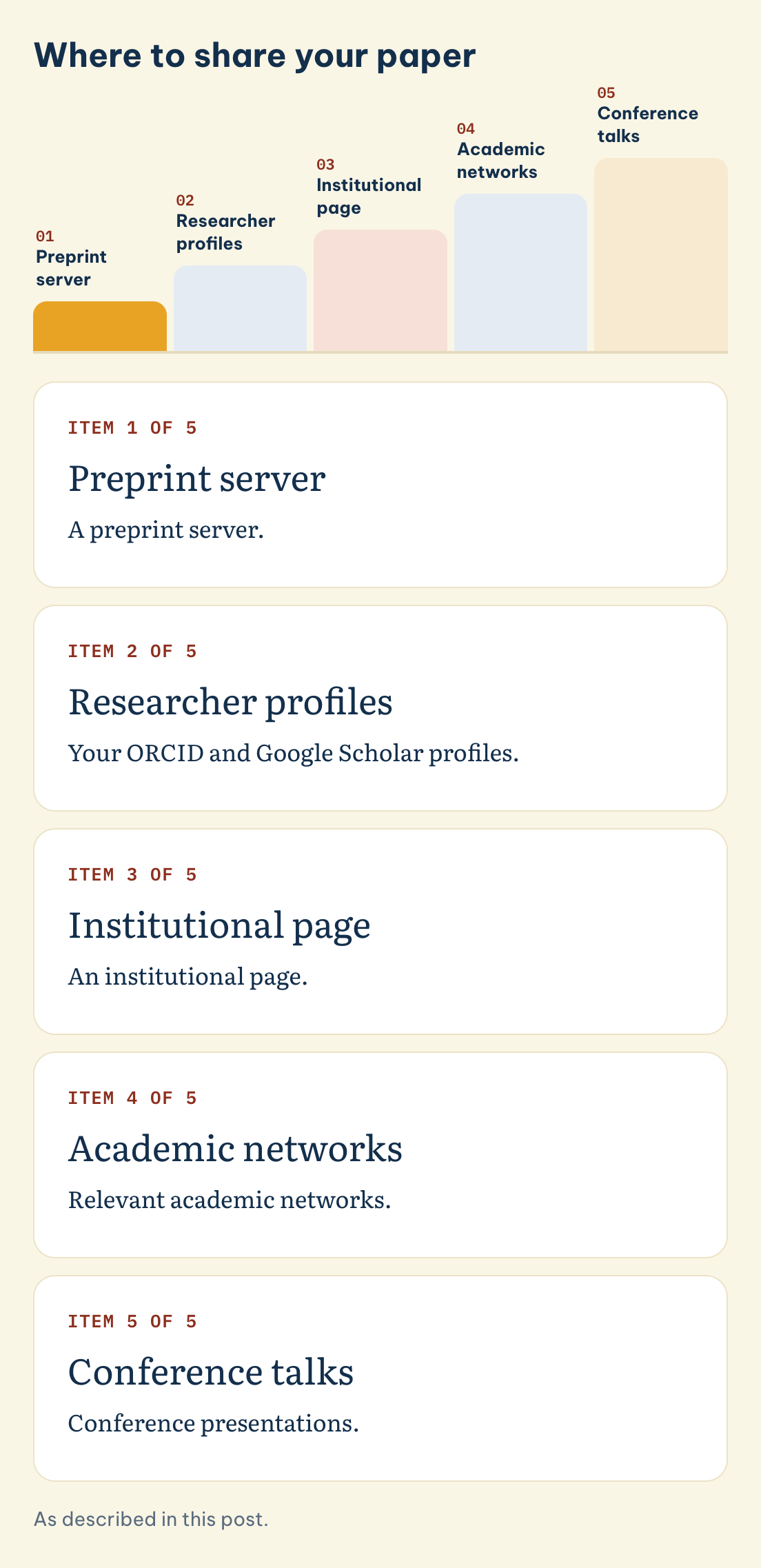
Direct answer: Share your work where your peers actually are, a preprint server, your ORCID and Google Scholar profiles, an institutional page, relevant academic networks, and conference presentations. Promotion means helping the right readers find genuine work; it never means buying citations, trading citations, or gaming metrics.
Where to share your paper
The post says to share your work where your peers actually are. Tap a place to read it as the post puts it. They are options to choose from, not steps.
Item 1 of 5
Preprint server
A preprint server.
Item 2 of 5
Researcher profiles
Your ORCID and Google Scholar profiles.
Item 3 of 5
Institutional page
An institutional page.
Item 4 of 5
Academic networks
Relevant academic networks.
Item 5 of 5
Conference talks
Conference presentations.
Save this figure
Evidence: Because visibility drives citations (Piwowar et al. 2018; Fu & Hughey, 2019), legitimate sharing is one of the highest-return things you can do after publication. But citation manipulation is a research-integrity breach that can lead to correction or retraction, so keep promotion honest.
Example: A MAAS mentor helps each Publishing Advisory author build a simple post-publication plan, preprint, profiles, repository deposit, and a short list of where to share, during a phase-by-phase model. The author does the sharing; the mentor advises, and never games metrics on anyone's behalf.
Frequently asked questions
Will posting a preprint stop a journal from accepting my paper?
Usually not, most major journals permit preprints and do not treat them as prior publication. A minority do not, so always check the specific journal's preprint policy before you post.
Is green open-access self-archiving free?
Yes. Depositing a permitted version in a repository carries no fee. Respect the publisher's allowed version and any embargo period.
Do altmetrics matter for promotion in Vietnam?
Promotion still centres on indexed publications and citations, but altmetrics can be supporting evidence of real-world impact (for example, policy or media uptake). Treat them as a complement, not a substitute.
Can I just buy citations to boost my profile faster?
No. Buying or trading citations is research misconduct and is increasingly detected; it can trigger correction or retraction and damage your record permanently. Build citations through visibility and quality.
Does MAAS run my profiles or promote my paper for me?
No. MAAS mentors coach you to set up profiles and a sharing plan, but you own and run them, and you do the sharing. You are the author and researcher throughout.
Book a Publishing Advisory consultation with MAAS Academic Mentoring →
Related guides
- Do you have to pay to publish open access?: OA routes that boost readership and citations
- Who qualifies as an author on a research paper?: ORCID and authorship done right from the start
- How do you keep your research paper from being retracted?: why citation manipulation is never worth it
- How do you choose the right Scopus journal for your paper?: the venue decision that visibility builds on
- Scopus Publishing Advisory: the full pillar on legitimate Q1/Q2 publishing
- Meet the MAAS experts: the postgraduate-qualified mentors behind our publishing advisory
References
- Berg, J. M., Bhalla, N., Bourne, P. E., Chalfie, M., Drubin, D. G., Fraser, J. S., Greider, C. W., Hendricks, M., Jones, C., Kiley, R., King, S., Kirschner, M. W., Krumholz, H. M., Lehmann, R., Leptin, M., Pulverer, B., Rosenzweig, B., Spiro, J. E., Stebbins, M. ... Wolberger, C. (2016). Preprints for the life sciences. Science, 352(6288), 899–901. https://doi.org/10.1126/science.aaf9133
- Fu, D. Y., & Hughey, J. J. (2019). Releasing a preprint is associated with more attention and citations for the peer-reviewed article. eLife, 8, Article e52646. https://doi.org/10.7554/eLife.52646
- Haak, L. L., Fenner, M., Paglione, L., Pentz, E., & Ratner, H. (2012). ORCID: A system to uniquely identify researchers. Learned Publishing, 25(4), 259–264. https://doi.org/10.1087/20120404
- Piwowar, H., Priem, J., Larivière, V., Alperin, J. P., Matthias, L., Norlander, B., Farley, A., West, J., & Haustein, S. (2018). The state of OA: A large-scale analysis of the prevalence and impact of Open Access articles. PeerJ, 6, Article e4375. https://doi.org/10.7717/peerj.4375
- Priem, J., Taraborelli, D., Groth, P., & Neylon, C. (2010). Altmetrics: A manifesto. https://altmetrics.org/manifesto/
- Suber, P. (2012). Open access. MIT Press.
This article is part of the MAAS Journal series for Vietnamese international postgraduate students and researchers. MAAS Publishing Advisory is an advisory partner; we coach authors through a phase-by-phase delivery model with developmental feedback from postgraduate-qualified, Scopus-published mentors. We do not write, submit, or guarantee acceptance of work on an author's behalf.
A free 20-minute consultation with MAAS Publishing Advisory, to talk through a simple post-publication plan for your paper.
Book Free Discovery ▸