
◆ Publishing advisory
Do you have to pay to publish open access?
No; you do not have to pay to publish in a reputable journal: many charge no fee at all, and waivers exist for researchers in lower-income countries. For Vietnamese researchers on a limited budget, the fear that "publishing costs thousands of dollars" stops many strong papers before they start. The truth is more flexible: open access has several routes, only some involve a fee, and the fee is often waivable.
This guide explains open access, what an article processing charge (APC) really is, when you have to pay, how to get a waiver, and which licence to choose, in the plain terms MAAS publishing mentors use with first-time authors.

◆ Question 1 / 7 · What it means
What does "open access" actually mean?
Direct answer: Open access (OA) means a paper is free for anyone to read online, without a subscription or paywall. The Budapest Open Access Initiative (2002) defined it as free availability on the public internet, permitting readers to read, download and reuse the work with attribution. It is about reader access, not quality: reputable OA papers are peer-reviewed like subscription papers.
Evidence: The Budapest Open Access Initiative gave the first formal definition of open access, describing it as "its free availability on the public internet, permitting any users to read, download, copy, distribute, print, search, or link to the full texts of these articles" (Budapest Open Access Initiative, 2002). Open access changes who can read your work, not whether it was reviewed.
Example: A Vietnamese author assumed "open access" meant lower quality. Her mentor clarified that many of the highest-impact journals in her field are fully OA and rigorously peer-reviewed, access and quality are separate questions.
◆ Question 2 / 7 · The routes
Gold, green, diamond, hybrid, what are the open-access routes?
Direct answer: There are several ways a paper becomes open access, and only some involve a fee. The main routes:
Five routes to a paper readers can find
Tap a route to see what it is and who pays. In the post's table every route is peer-reviewed, and for green OA that means the journal version.
Gold OA
The article is free in a fully open-access journal. The author or funder pays an APC, though some journals charge nothing.
Diamond / Platinum OA
An open-access journal that charges no APC. A society or an institution funds it.
Hybrid OA
A subscription journal opens your single article for a fee. The author or funder pays an APC.
Green OA
You self-archive a version in a repository. It is free, with no APC.
Subscription (non-OA)
Readers or libraries pay to access the journal. The author pays no fee.
Save this figure
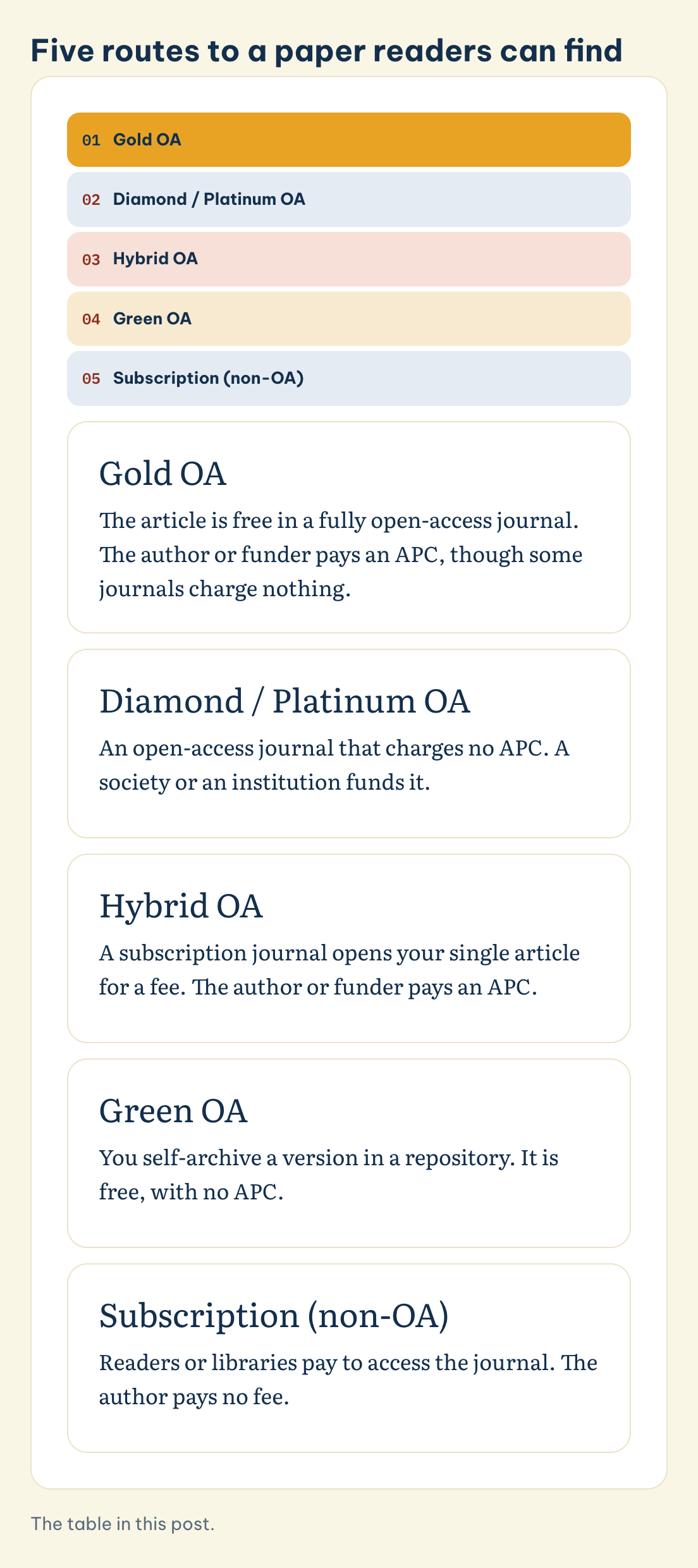
| Route | What it is | Who pays | Peer-reviewed? |
|---|---|---|---|
| Gold OA | Article is free in a fully OA journal | Author/funder pays an APC (some charge nothing) | Yes |
| Diamond / Platinum OA | OA journal that charges no APC | Funded by a society/institution | Yes |
| Hybrid OA | A subscription journal opens your single article for a fee | Author/funder pays an APC | Yes |
| Green OA | You self-archive a version in a repository | Free (no APC) | Yes (the journal version) |
| Subscription (non-OA) | Readers/libraries pay to access | No author fee | Yes |
Evidence: Suber (2012) distinguishes the two primary vehicles: OA journals ("gold") and OA repositories ("green"), the key difference being that journals conduct peer review while repositories do not. Green OA lets you make a version free by depositing it in a repository, often after a publisher embargo.
Example: A budget-conscious author published in a strong subscription journal (no APC) and then deposited his accepted manuscript in his university repository (green OA), making the work freely readable without paying a cent.
◆ Question 3 / 7 · What an APC is
What is an APC, and how much does it cost?
Direct answer: An article processing charge (APC) is the fee that gold and hybrid OA journals charge to make your article free to read. Most journals worldwide charge no APC at all; among those that do, fees commonly range from a few hundred to several thousand US dollars, and a few prestige journals exceed US$10,000.
Evidence: Borrego (2023) reviews the APC landscape and confirms wide variation, many journals levy no charge, while APCs at selective journals have risen substantially over the past decade. Price does not equal prestige: a high APC is not a quality signal, and a zero APC does not mean low quality.
Example: An author targeting a Q1 journal panicked at a US$3,500 APC. Her mentor showed her two alternatives in the same quartile, one subscription (no APC) and one offering a waiver so the cost did not dictate where she could publish.
◆ Question 4 / 7 · Do you have to pay
Do you have to pay an APC to publish?
Direct answer: No. You only pay an APC if you choose a gold or hybrid OA option and the journal charges one. You can publish for free by choosing a subscription journal, a diamond OA journal, or by making your work open via green OA (self-archiving).
Evidence: Suber (2012) notes that green OA carries no fee, and a large share of journals charge no APC (Borrego, 2023). Paying is a choice tied to the OA route and any funder mandate, not a universal requirement to be published.
Example: A researcher with no grant assumed she was locked out of publishing. Her mentor mapped three no-cost paths, a subscription journal, a diamond OA journal in her field, and green self-archiving and she published without paying.
◆ Question 5 / 7 · Waivers
Can you get an APC waiver or discount?
Direct answer: Often, yes. Many publishers waive or discount APCs for authors based in low- and middle-income countries, and most journals consider individual waiver requests. Check the journal's waiver policy before you submit, and ask the editor, do not assume you must pay full price.
Evidence: Research4Life (n.d.) documents that authors at institutions in eligible lower-income countries can receive automatic APC waivers or discounts, typically a full waiver for the lowest-income group and a partial discount for the next, through publisher partnerships. Eligibility is set by recognised economic indicators and changes over time, so verify your institution's current status.
Example: Before submitting, a Vietnamese author checked the journal's APC waiver page and emailed the editorial office. She qualified for a substantial discount she would never have received had she not asked.
◆ Question 6 / 7 · Choosing a licence
Which licence should you choose (CC BY and others)?
Direct answer: Gold OA articles are published under a Creative Commons (CC) licence that sets how others may reuse your work. CC BY (attribution only) is the most open and is required by many funders; more restrictive options (e.g. CC BY-NC, non-commercial) limit reuse. Choose the licence your funder requires, or the most open one you are comfortable with.
Evidence: Creative Commons (n.d.) defines the licence suite, with CC BY allowing reuse with attribution. cOAlition S (n.d.), the funders behind Plan S, requires CC BY for the research it funds, reflecting a broad push toward maximally reusable open access. Always confirm the licence your specific funder or institution mandates.
Example: An author unsure which licence to pick checked her scholarship's open-access policy, found it required CC BY, and selected that at submission, avoiding a compliance problem at acceptance.
◆ Question 7 / 7 · How to decide
How do you decide: pay, go green, or go subscription?
Direct answer: Start from three questions, does a funder require open access; what is your budget; and where does your target journal sit? If OA is mandated and funded, use gold/hybrid and claim any waiver. If money is tight and OA is not mandated, choose a strong subscription or diamond journal and self-archive (green). Never let a high APC push you toward a weaker or predatory journal.
Evidence: Because most journals charge no APC (Borrego, 2023) and green OA is free (Suber, 2012), a limited budget rarely needs to lower your publishing ambition. Predatory journals exploit exactly this anxiety by charging fees for fake review, verify any journal first against a curated open-access whitelist such as the Directory of Open Access Journals (n.d.) (see the predatory-journals guide).
Example: A MAAS mentor walks each Publishing Advisory author through this decision during a phase-by-phase model, funder mandate, budget, waiver eligibility, and licence so the OA choice is deliberate, not panic-driven. The author decides and submits; the mentor advises, never submits on their behalf.
Frequently asked questions
Is a journal with no APC lower quality?
No. Most journals charge no APC, including many rigorous subscription and diamond OA journals. APC and quality are unrelated, judge a journal by its indexing, peer review, and reputation, not its fee.
Is paying an APC the same as paying for acceptance?
No. A legitimate APC is charged only after independent peer review accepts your paper, to fund open publication. A journal that guarantees acceptance for a fee, or charges before review, is a predatory red flag.
Can I make my paper free without paying anything?
Yes, publish in a subscription or diamond OA journal and self-archive your accepted manuscript in a repository (green OA), respecting any publisher embargo.
Do APC waivers apply to authors in Vietnam?
Many publishers offer waivers or discounts based on country income level, and eligibility changes over time. Check the specific journal's waiver policy and your institution's status, and ask the editorial office before submitting.
Does MAAS pay APCs or submit for me?
No. MAAS mentors coach you to choose the right OA route, licence, and waiver, but you make the decision, you pay any fee directly, and you submit. You are the author throughout.
Book a Publishing Advisory consultation with MAAS Academic Mentoring →
Related guides
- How do you avoid predatory journals when publishing your research?: telling a legitimate APC from a predatory one
- How do you choose the right Scopus journal for your paper?: weighing OA status alongside scope and quartile
- Who qualifies as an author on a research paper?: getting authorship right before you submit
- How do you keep your research paper from being retracted?: the integrity rules that protect your record
- Scopus Publishing Advisory: the full pillar on legitimate Q1/Q2 publishing
- Meet the MAAS experts: the PhD-level mentors behind our publishing advisory
References
- Borrego, Á. (2023). Article processing charges for open access journal publishing: A review. Learned Publishing. https://doi.org/10.1002/leap.1558
- Budapest Open Access Initiative. (2002). Budapest Open Access Initiative. https://www.budapestopenaccessinitiative.org/read/
- cOAlition S. (n.d.). Plan S: Making full and immediate open access a reality. Retrieved June 23, 2026, from https://www.coalition-s.org/
- Creative Commons. (n.d.). About CC licenses. Retrieved June 23, 2026, from https://creativecommons.org/share-your-work/cclicenses/
- Directory of Open Access Journals. (n.d.). About DOAJ. Retrieved June 23, 2026, from https://doaj.org/about/
- Research4Life. (n.d.). Best practices for APC waivers. Retrieved June 23, 2026, from https://www.research4life.org/apc-waivers/
- Suber, P. (2012). Open access. MIT Press.
This article is part of the MAAS Journal series for Vietnamese international postgraduate students and researchers. MAAS Publishing Advisory is an advisory partner; we coach authors through a phase-by-phase delivery model with developmental feedback from PhD-level, Scopus-published mentors. We do not write, submit, or guarantee acceptance of work on an author's behalf.
A free 20-minute consultation with a MAAS publishing adviser, to talk through which open-access route fits your paper and your budget.
Book Free Discovery ▸