
◆ Publishing advisory
Should you publish in a conference or a journal first?
A conference paper and a journal article are different tools, not competing goals, and the right first venue depends on your research field and your aim. For Vietnamese researchers weighing a fast conference deadline against a slower Scopus Q1 or Q2 submission, this is strategic, not a formality, the wrong order can cost a year, split one study into two weak outputs, or raise a self-plagiarism flag.
The decision follows a few predictable rules once you know how the two venues differ and what your discipline expects. This guide answers the seven questions Vietnamese researchers ask MAAS publishing mentors most often when deciding where to send their first paper.

◆ Question 1 / 7 · Difference
What is the difference between a conference paper and a journal article?
Direct answer: A conference paper is a short, deadline-driven work presented at a meeting and published in proceedings; a journal article is a longer, archival work reviewed on a rolling basis. Conferences favour timely, focused contributions and faster decisions. Journals favour depth, complete methodology, and a permanent record of validated findings.
Conference paper and journal article, side by side
Each row sets the two venues against one practical feature.
Conference paper
Journal article
The deadline is a fixed submission date.
The deadline is rolling, so you can submit anytime.
Peer review is usually one round and fast.
Peer review runs to multiple rounds and is slower.
The length is short, often 4 to 10 pages.
The length is long, with full detail.
Decisions take weeks to a few months.
Decisions take several months to over a year.
The main value is timely feedback and networking.
The main value is depth, permanence and credit.
Revisions are limited or none after acceptance.
Revisions are expected, and sometimes major.
Save this figure
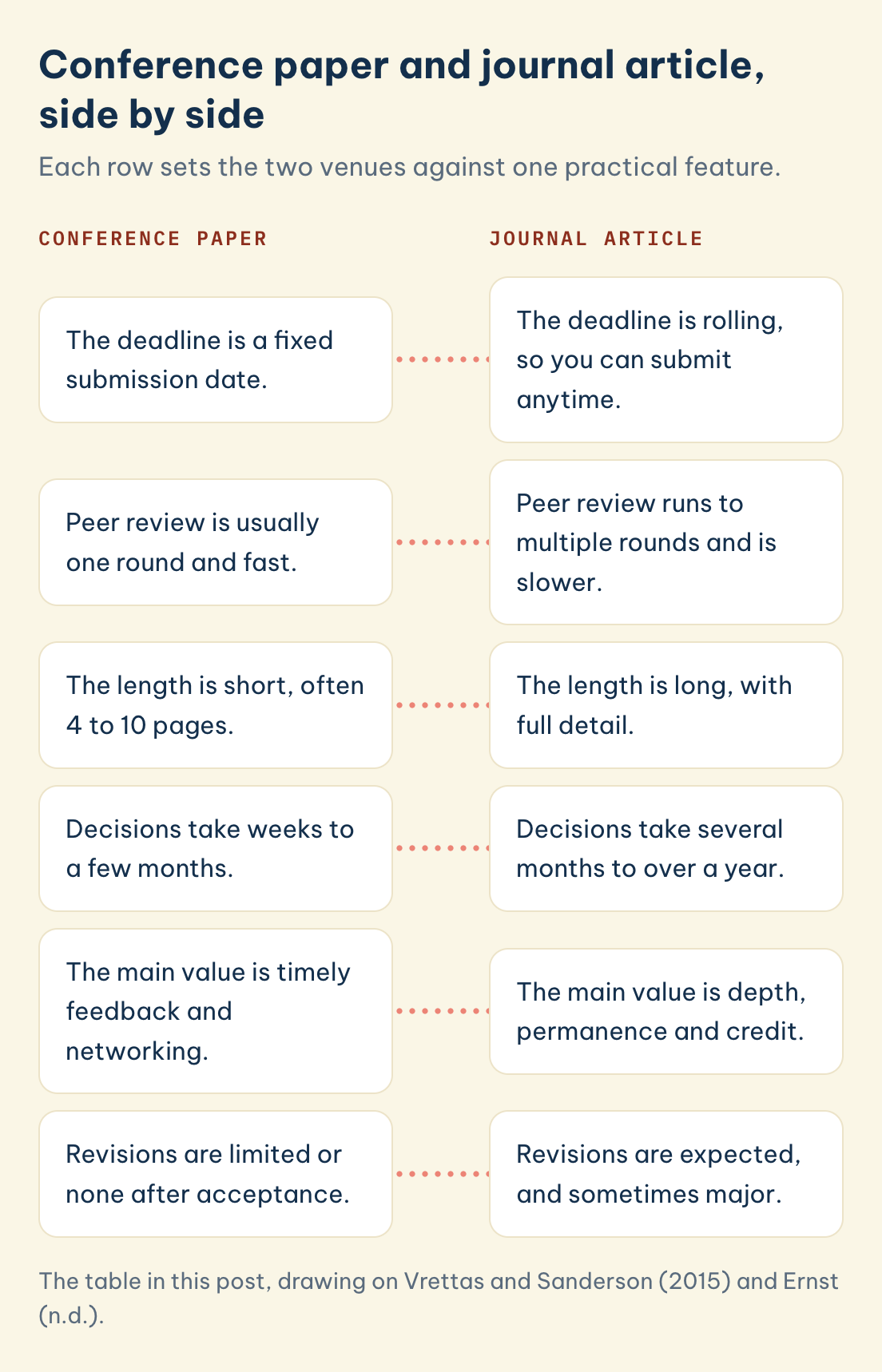
Evidence: Vrettas and Sanderson (2015), publishing across pages 2674 to 2684 of the Journal of the Association for Information Science and Technology, describe conference peer review as typically a single round tied to a fixed submission date, while journal review usually runs across multiple rounds of revision with no deadline. Ernst (n.d.) adds that conference page limits force concision, whereas journals allow the full detail needed for others to reproduce the work.
Example: A MAAS client in engineering assumed her conference paper, 8 pages long, could be relabelled as a journal article. Her mentor showed the gap: the journal wanted a full related-work review, expanded methods, and extra experiments, roughly double the content.
The two venues differ on almost every practical axis:
| Feature | Conference paper | Journal article |
|---|---|---|
| Deadline | Fixed submission date | Rolling, submit anytime |
| Peer review | Usually one round, fast | Multiple rounds, slower |
| Length | Short (often 4–10 pages) | Long, full detail |
| Decision speed | Weeks to a few months | Several months to over a year |
| Main value | Timely feedback, networking | Depth, permanence, credit |
| Revisions | Limited or none after acceptance | Expected, sometimes major |
◆ Question 2 / 7 · Your field
Does the right choice depend on your research field?
Direct answer: Yes, field norms matter more than personal preference. In computer science and parts of engineering, top conferences are a primary, prestigious venue in their own right. In medicine, the health and social sciences, and most other disciplines, the journal article is the archival record, and conferences serve mainly for early feedback through abstracts and posters.
Evidence: Vrettas and Sanderson (2015), analysing over 195,000 conference papers and 108,000 journal papers, found that computer science values conferences more highly than any other discipline, and that top-ranked CS conference papers are cited more than journal papers, while medium- and lower-ranked ones attract citations similar to journals. Ernst (n.d.) puts a number on that prestige from the inside: good software-engineering conferences accept only about 10% of submissions, a rejection rate closer to a strong journal than to a typical workshop. Outside computing, conferences typically publish abstracts expected to mature into full journal articles (Scherer et al. 2018). Ernst states that "In computer science, your preference should be for conference publication" (Ernst, n.d.).
Example: Two MAAS clients asked this in the same week. For a computer-science student targeting a CORE A* conference, the mentor recommended the conference as the main output. For a clinical-pharmacy researcher, the same mentor advised a conference abstract for feedback but a Q2 journal as the real destination, because in her field, only the journal counts toward graduation.
◆ Question 3 / 7 · Conference first
When does it make sense to publish in a conference first?
Direct answer: Choose a conference first when you need timely feedback, a firm deadline to finish, visibility with peers, or a credible milestone for a scholarship or transfer application. Conferences suit early-stage or fast-moving work, and in computing they can be the definitive venue and a realistic first win for undergraduates and master's students building a research profile.
Evidence: Ernst (n.d.) notes that conference deadlines impose useful discipline and that presenting brings direct, in-person feedback that can strengthen a later journal version. In fields where conferences are secondary, an abstract still signals priority but Scherer et al. (2018) caution it is only a first step.
Example: A MAAS-mentored undergraduate aiming to transfer needed a research credential quickly. Her mentor targeted a regional Scopus-indexed conference with a clear deadline, scoped a study she could finish in time, and used the accepted paper on her application, with a journal extension planned for later.
◆ Question 4 / 7 · Journal first
When should you go straight to a journal?
Direct answer: Go straight to a journal when the work is complete and you need a permanent, citable record, for a degree requirement, a promotion, or a competitive Q1 or Q2 line on your CV. Journals give the depth to report full methods and results, the credibility of multi-round review, and a durable archival version that graduation and promotion committees usually require.
Studies first shown as abstracts
52.6%
is about the share published in full within 9 years
Randomised trials
63.1%
were published in full within 9 years
How many abstracts become full papers
Share published in full within 9 years, in percent.
Save this figure
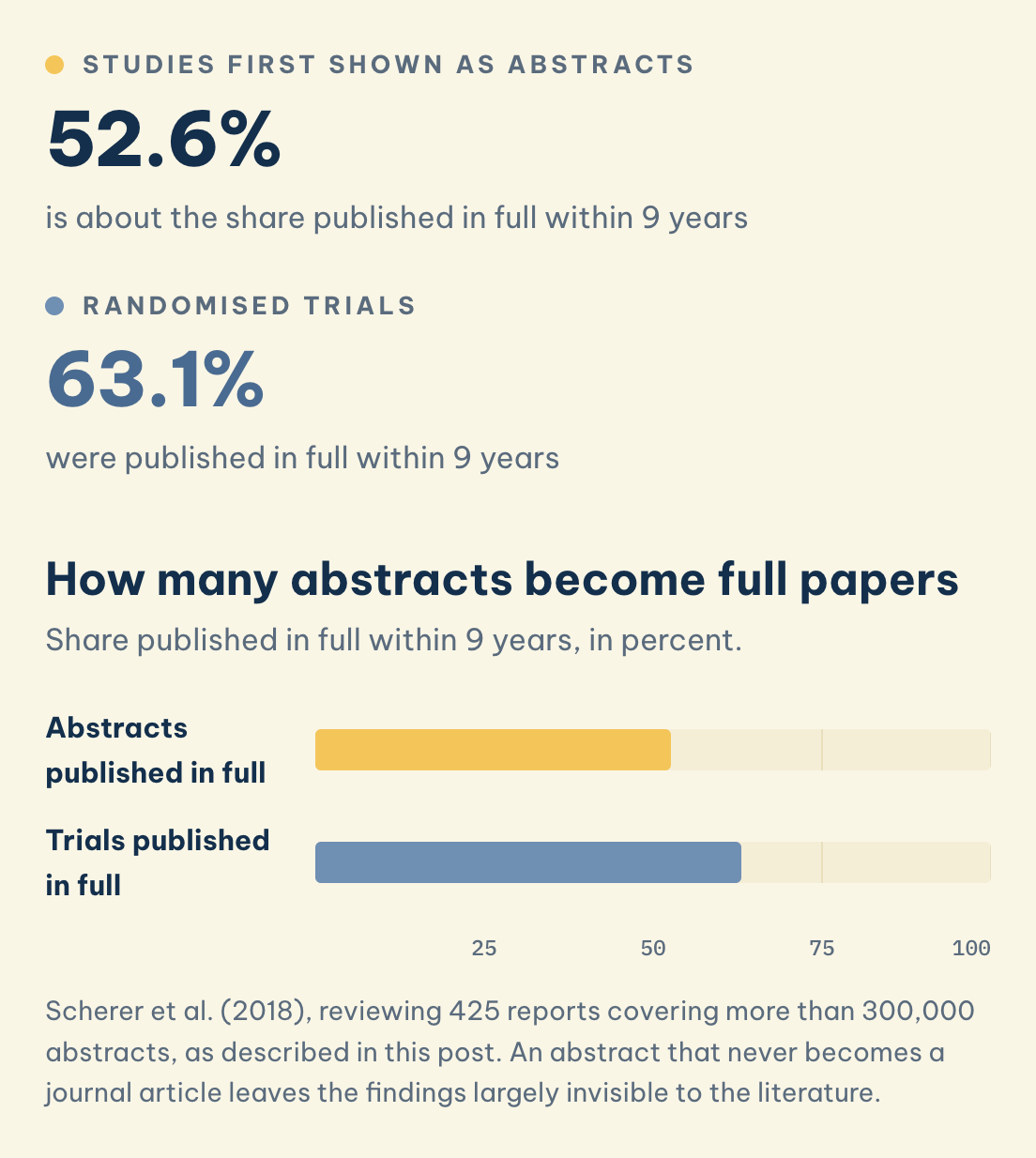
Evidence: Scherer et al. (2018), reviewing 425 reports covering more than 300,000 abstracts, found that only about 52.6% of studies first presented as abstracts, and 63.1% of randomised trials, were published in full within 9 years. A conference abstract that never becomes a journal article leaves the findings largely invisible to the literature, a strong reason to prioritise the journal when the study is ready.
Example: A Vietnamese PhD candidate had presented her results at two conferences but never written the full paper, and her programme required a journal publication to defend. A MAAS mentor helped her consolidate the material into one manuscript, target a well-matched Q2 journal, and reach acceptance, turning stalled abstracts into the output her degree needed.
◆ Question 5 / 7 · Both venues
Can you publish the same study as both a conference paper and a journal article?
Direct answer: Often yes, but only through an honest extension, never a copy. You may develop a conference paper into a journal article if the journal version adds substantial new material, cites the earlier paper, and discloses it to the editor. Publishing the same content twice without disclosure is redundant publication and self-plagiarism, which can trigger rejection or retraction.
Four ways to reuse a conference paper
Tap a practice to see its ethical status and what to do.
Verbatim resubmission
Submitting a verbatim conference paper to a journal is not allowed, so never do it, because it is duplicate publication.
Substantial extension
A journal version with substantial new results and analysis is allowed, so cite the conference paper and disclose it to the editor.
Two venues at once
Submitting to two venues at the same time is not allowed, so wait for one decision before submitting elsewhere.
Reusing your own text
Reusing your own figures or text without citation is risky, so cite your prior work and check the venue's policy.
Save this figure
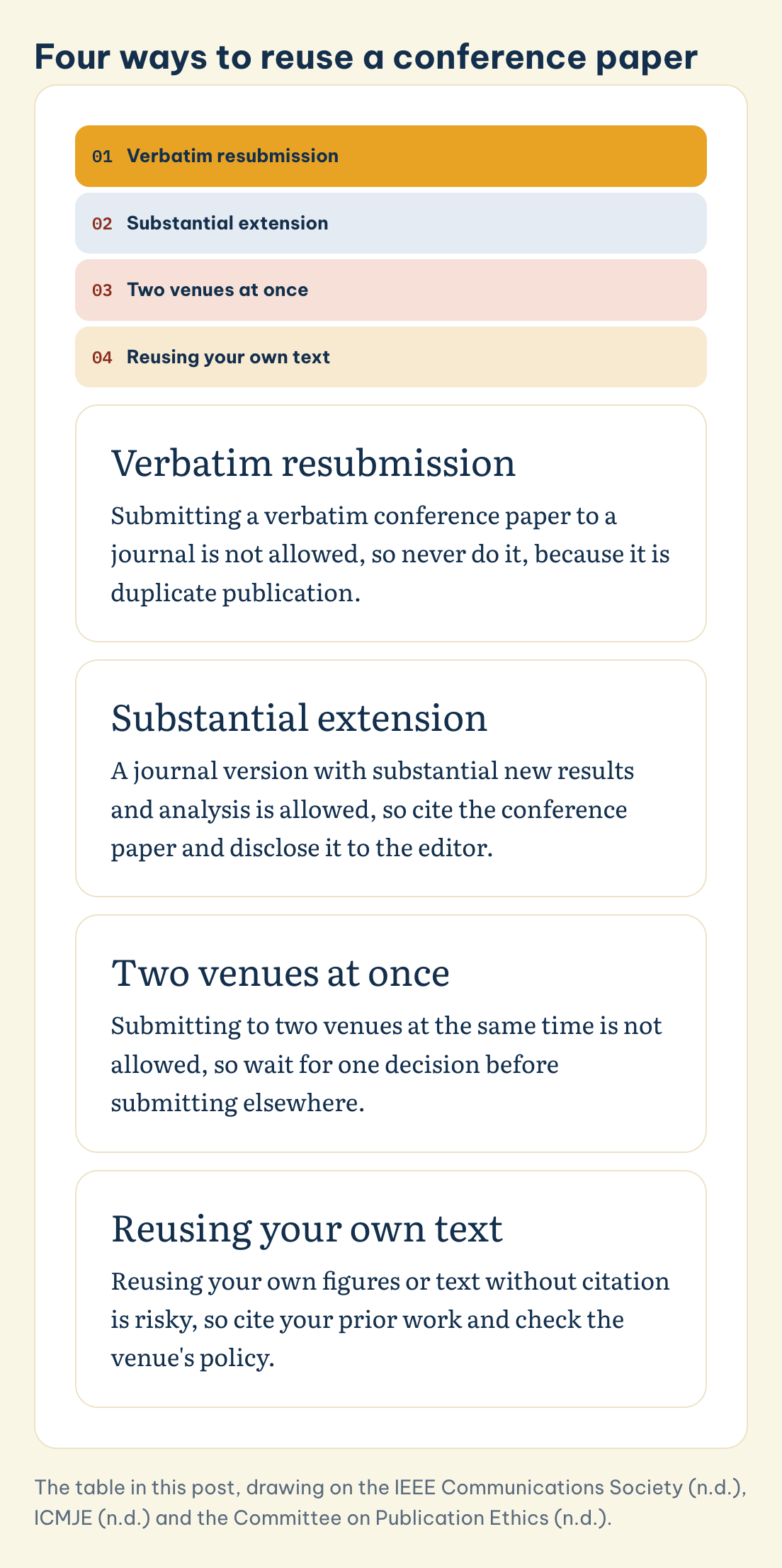
Evidence: The IEEE Communications Society (n.d.) recognises "evolutionary publishing", workshop to conference to journal but requires that each new version contain sufficient original material beyond the previous one and that prior versions be cited and disclosed. Different venues quantify "sufficient" differently. Ernst (n.d.) notes that many journals require at least 20 to 30% new material compared with the earlier conference version, a rough benchmark for how much extra work an honest extension actually takes. The ICMJE (n.d.) treats undisclosed overlapping publication as a breach of ethics, and the Committee on Publication Ethics (n.d.) advises editors to act on redundant submissions.
Example: A MAAS client wanted to reuse her conference paper verbatim to hit a journal target faster. Her mentor flagged the risk, then helped her add a new dataset, deeper analysis, and a fuller discussion so the journal version was genuinely new, with a cover letter citing the conference paper. It cleared with no integrity concern.
The safe path is a clearly signposted extension:
| Practice | Ethical status | What to do |
|---|---|---|
| Verbatim conference paper resubmitted to a journal | Not allowed | Never, this is duplicate publication |
| Journal version with substantial new results and analysis | Allowed | Cite the conference paper; disclose it to the editor |
| Concurrent submission to two venues | Not allowed | Wait for one decision before submitting elsewhere |
| Reusing your own figures or text without citation | Risky | Cite your prior work; check the venue's policy |
◆ Question 6 / 7 · Indexing and credit
How do conference proceedings and journals compare for Scopus indexing and career credit?
Direct answer: Scimago's SJR system, the basis for Scopus quartile rankings, splits the journals in each subject category into four quartiles by citation-weighted rank: Q1 is the top 25% of titles in that category, Q2 the next 25%, and so on down to Q4. Scopus indexes both selected conference proceedings and journals, so either can be a Scopus-indexed line.
But for most Vietnamese degree and promotion frameworks, a Scopus-indexed journal article, especially Q1 or Q2, carries more weight than a proceedings paper. Vietnam's own 2025 to 2030 basic-science program targets a 15 to 20% annual increase in WoS or Scopus Q1 to Q2 publications, with a national benchmark of at least 1.5 international publications per PhD graduate per year by 2030 (Vietnam.vn, 2025), which is exactly the kind of target a conference proceedings line does not reliably move. Check whether your target is indexed and how your institution counts each type.
Evidence: Vrettas and Sanderson (2015) show that citation impact varies sharply by venue rank, so "conference" and "journal" are not uniform categories, a top conference can outperform a mid-tier journal, and vice versa. Ernst (n.d.) similarly stresses judging the venue's standing, not the format alone.
Example: A MAAS-mentored researcher counted a conference paper toward her promotion dossier, only to learn her university recognised only Scopus-indexed journal articles for that step. Her mentor rebuilt the plan around a Q2 journal extension, producing the credential her committee accepted.
◆ Question 7 / 7 · Deciding
How do you decide which venue is right for your paper?
Direct answer: Work through four questions in order: What does your field treat as the primary venue? What is your goal, feedback, a deadline milestone, or an archival credential? How complete is the work right now? And what will your degree or promotion committee actually count? The answers usually point clearly to conference-first, journal-first, or conference-then-journal.
Four questions to ask in order
Tap a question to see what it asks.
Question 1 of 4
Your field
Ask what your field treats as the primary venue.
Question 2 of 4
Your goal
Ask what your goal is, whether feedback, a deadline milestone or an archival credential.
Question 3 of 4
Your work
Ask how complete the work is right now.
Question 4 of 4
Your committee
Ask what your degree or promotion committee will actually count.
Save this figure
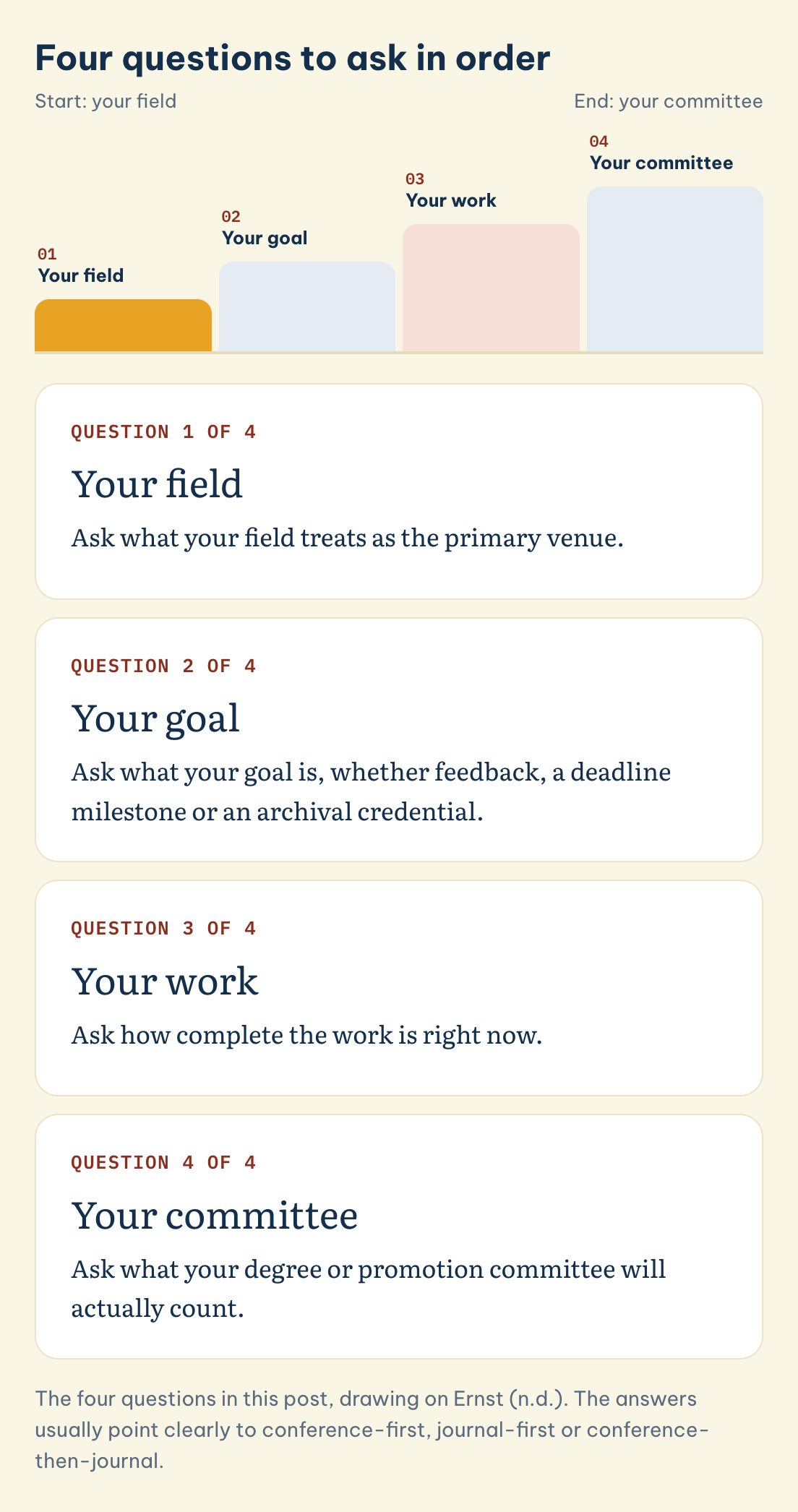
Evidence: Ernst (n.d.) recommends choosing a venue by matching the work's stage and audience to the venue's norms, not defaulting to one format. Vrettas and Sanderson (2015) reinforce that the decision is venue- and discipline-specific, not a blanket rule that one format is always better.
Example: A MAAS mentor uses this sequence with every researcher weighing venues. For a finished clinical study needed for graduation, the four questions pointed straight to a Q2 journal. For a novel machine-learning method with a looming conference deadline, they pointed to the conference first, with a journal extension mapped for the next year.
Frequently asked questions
Is a journal article always better than a conference paper?
No. In computer science and some engineering fields, top conferences are as prestigious as strong journals. In most other disciplines the journal is the archival record. The best venue depends on your field, your goal, and the specific venue's standing, not the format alone.
Can I turn my conference paper into a journal article?
Yes, if the journal version adds substantial new material, cites the conference paper, and is disclosed to the editor. This "evolutionary publishing" is accepted practice. Republishing the same content without changes or disclosure is redundant publication and is not allowed.
Do conferences count for my degree or promotion in Vietnam?
Sometimes, but many Vietnamese degree and promotion frameworks give more weight to Scopus-indexed journal articles, especially Q1 and Q2. Confirm how your institution counts conference proceedings before you rely on one.
Which is faster, a conference or a journal?
A conference is usually faster to a decision because review is a single round tied to a fixed deadline. Journals review on a rolling basis across multiple rounds, so acceptance can take months to over a year.
Is a conference abstract the same as a conference paper?
No. An abstract is a short summary presented as a poster or talk; a full conference paper is a peer-reviewed contribution published in proceedings. Many abstracts are never developed into full papers, so treat an abstract as a starting point, not a final output.
Can MAAS help me choose between a conference and a journal?
Yes. MAAS Publishing Advisory helps Vietnamese researchers match their work to the right venue, plan an ethical conference-to-journal extension, and prepare each submission using a phase-by-phase model, with the manuscript remaining entirely your own work.
Ready to choose the right venue for your research?
Picking between a conference and a journal is not a coin toss, your field, your goal, and your target committee have already half-answered it. A mentor who has published in both turns that into a clear, sequenced plan instead of a guess.
MAAS Publishing Advisory runs two tracks, so the venue question comes with real timelines attached. An indexed international journal usually takes 4 to 12 or more months from submission to publication, while a Vietnamese ISSN journal usually takes 1 to 3 months. Both tracks move through the same five phases, and your venue strategy is shaped by an adviser who holds multiple Q1 or Q2 papers under their own name, drawn from 100+ experts of whom 23% hold a PhD. MAAS matches you within 48 hours when our network already covers that field. If it does not, MAAS opens a dedicated recruitment round for your case, which usually takes about two weeks. Start with a free 20-minute consultation.
Book a Publishing Advisory consultation with MAAS →
Related guides
- How do you choose the right Scopus journal for your paper?
- Q1 vs Q2 journals: what is the difference?
- How long does peer review take?: timelines that shape the decision
- How do you write a cover letter to a journal editor?: the one-page letter that discloses a prior conference version and frames the journal submission
- How do you avoid predatory journals?: vetting journals and conferences
- Your first international paper as a Vietnamese researcher: the whole publication journey
- Publishing Advisory service: service tiers for Scopus Q1/Q2 support
- Scopus Publishing resource hub: selection and submission checklists
- Meet the MAAS expert network: the postgraduate-qualified mentors behind every submission
References
- Committee on Publication Ethics. (n.d.). Guidance for editors and authors. Retrieved July 4, 2026, from https://publicationethics.org/guidance
- Ernst, M. D. (n.d.). Choosing a venue: Conference or journal? University of Washington. Retrieved July 4, 2026, from https://homes.cs.washington.edu/~mernst/advice/conferences-vs-journals.html
- International Committee of Medical Journal Editors [ICMJE]. (n.d.). Overlapping publications. Retrieved July 4, 2026, from https://www.icmje.org/recommendations/browse/publishing-and-editorial-issues/overlapping-publications.html
- IEEE Communications Society. (n.d.). Policy on self-plagiarism. Retrieved July 4, 2026, from https://www.comsoc.org/publications/magazines/policy-self-plagiarism
- Scherer, R. W., Meerpohl, J. J., Pfeifer, N., Schmucker, C., Schwarzer, G., & von Elm, E. (2018). Full publication of results initially presented in abstracts. Cochrane Database of Systematic Reviews, 2018(11), Article MR000005. https://doi.org/10.1002/14651858.MR000005.pub4
- Vietnam.vn. (2025). Vietnam aims to have multiple world-class research centers by 2030. https://www.vietnam.vn/en/viet-nam-dat-muc-tieu-co-nhieu-trung-tam-nghien-cuu-tam-the-gioi-vao-nam-2030
- Vrettas, G., & Sanderson, M. (2015). Conferences versus journals in computer science. Journal of the Association for Information Science and Technology, 66(12), 2674–2684. https://doi.org/10.1002/asi.23349
This article is part of the MAAS Journal series for Vietnamese international postgraduate students and researchers. MAAS Publishing Advisory is an advisory partner; we coach authors through a phase-by-phase delivery model with developmental feedback from postgraduate-qualified, Scopus-published mentors. We do not write, submit, or guarantee acceptance of work on an author's behalf.
A free 20-minute consultation with a MAAS publishing mentor, to talk through your field, your goal and your target venue.
Book Free Discovery ▸