
Hidden segment 01
Journal shopping
Journal shopping after a rejection takes real months, and those months fall disproportionately on first-time and second-language authors who have not yet been through the cycle.
◆ Publishing advisory
Expect a first Scopus paper to take about 9 to 18 months end to end, so count backwards from your deadline. Ask a first-time Vietnamese author how long a Scopus Q1 or Q2 paper takes, and you get the wrong question. What actually matters, once a defence date, scholarship milestone, or promotion dossier is fixed, is not how long publishing takes in the abstract, but how many months you need to count backwards from that deadline before you can safely start. Confusing the two questions is the most common planning mistake first-time authors make, and it is entirely avoidable.
This guide sets out the realistic ranges stage by stage, explains why first-time authors consistently underestimate them, and shows how to build a backward-planned calendar from a fixed deadline so the wait becomes a schedule rather than a source of anxiety.

◆ Question 1 / 7 · End to end
Direct answer: For a first international submission, plan for roughly 9 to 18 months from a completed study to an indexed article. Peer review is only one segment of that span; journal selection, formatting, revision rounds, and production each add their own weeks, and a single desk rejection can cost a month before review even begins.
First paper
9 to 18 months
is roughly what to plan for from a completed study to an indexed article, for a first international submission
Business and economics
Around 18 months
is the average from submission to publication, roughly twice the 9-month average in chemistry (Björk & Solomon, 2013)
How long publishing takes, in months
The yellow bar is the span the post says to plan for. The blue marks are the two field averages it cites, which measure submission to publication.
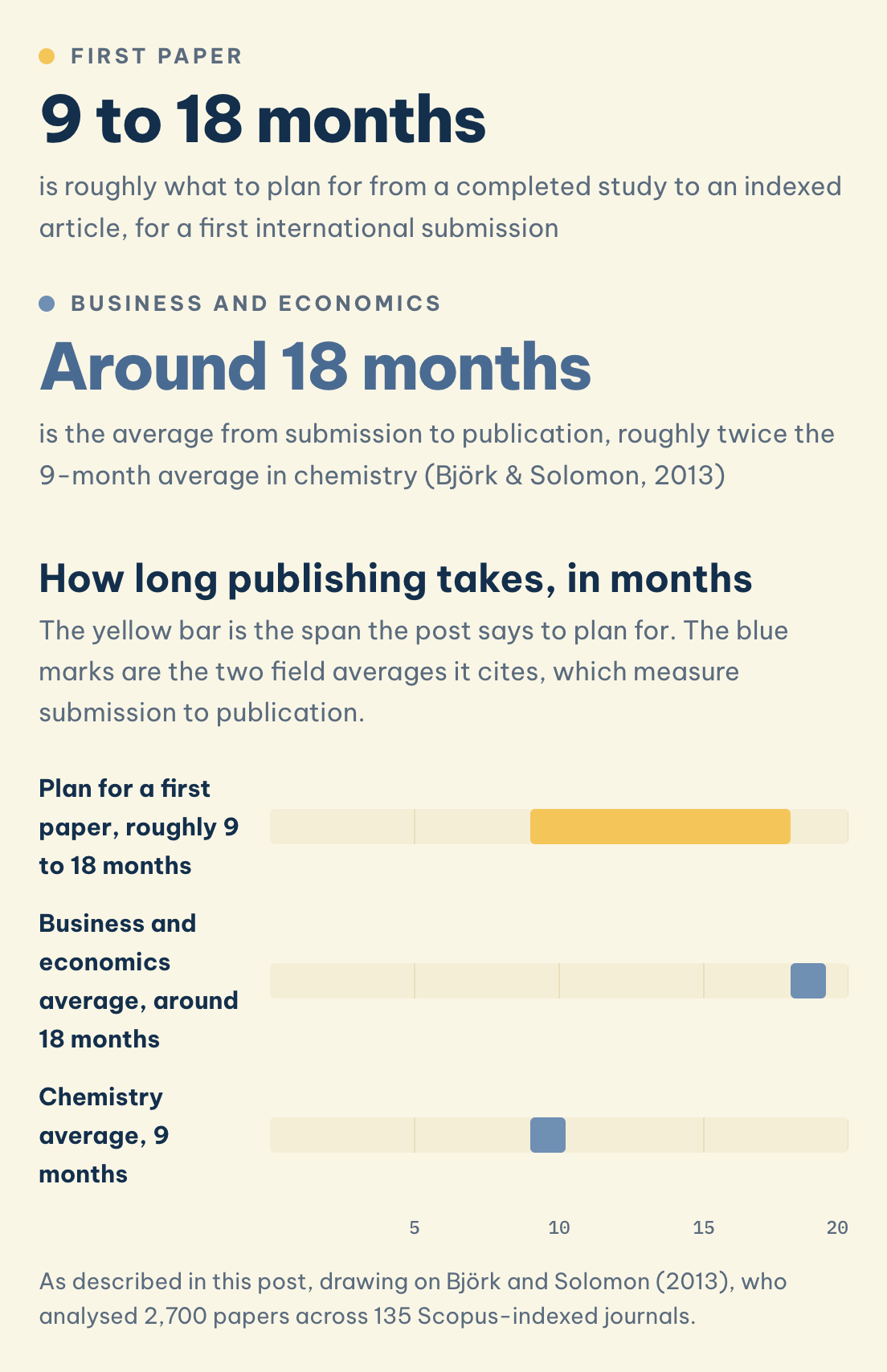
Evidence: Björk and Solomon (2013), analysing 2,700 papers across 135 Scopus-indexed journals, found that publishing delays vary sharply by field: business and economics averaged around 18 months from submission to publication, roughly twice the 9-month average in chemistry. Powell (2016), writing in Nature, opens with the complaint that drives this entire timeline problem: "Scientists are becoming increasingly frustrated by how long it seems to take to publish papers" (Powell, 2016, p. 148), and reported that the median review time, submission to acceptance, has hovered near 100 days for decades, while production time has fallen to a median of about 25 days. Because these segments run in sequence rather than in parallel, the totals accumulate, which is why a realistic end-to-end estimate sits well above the peer-review figure alone.
Example: A MAAS Publishing Advisory client in the social sciences assumed her paper would be "out" within 6 months because she had read that review takes 3. Her mentor mapped the full sequence with her, 6 weeks of formatting, 4 months to a first decision, a major revision, then production and reset the expectation to 12 to 14 months. The paper was accepted at month 11, comfortably inside the plan, precisely because the plan had been honest from the start.
◆ Question 2 / 7 · Why it is underestimated
Direct answer: The underestimate almost always comes from counting only the visible stage, peer review and ignoring the segments that surround it. Journal shopping after a rejection, the time it takes to prepare a revision, and the extra care an English-language manuscript needs are real months, and they fall disproportionately on first-time and second-language authors who have not yet been through the cycle.
Preparing a revision
39 days
is the average time authors take to prepare a revision, rising to 64 days in economics and business (Huisman & Smits, 2017)
Journal shopping after a rejection takes real months, and those months fall disproportionately on first-time and second-language authors who have not yet been through the cycle.
The time it takes to prepare a revision is one of the segments that first-time authors leave out when they count only peer review.
The extra care an English-language manuscript needs takes real months too.
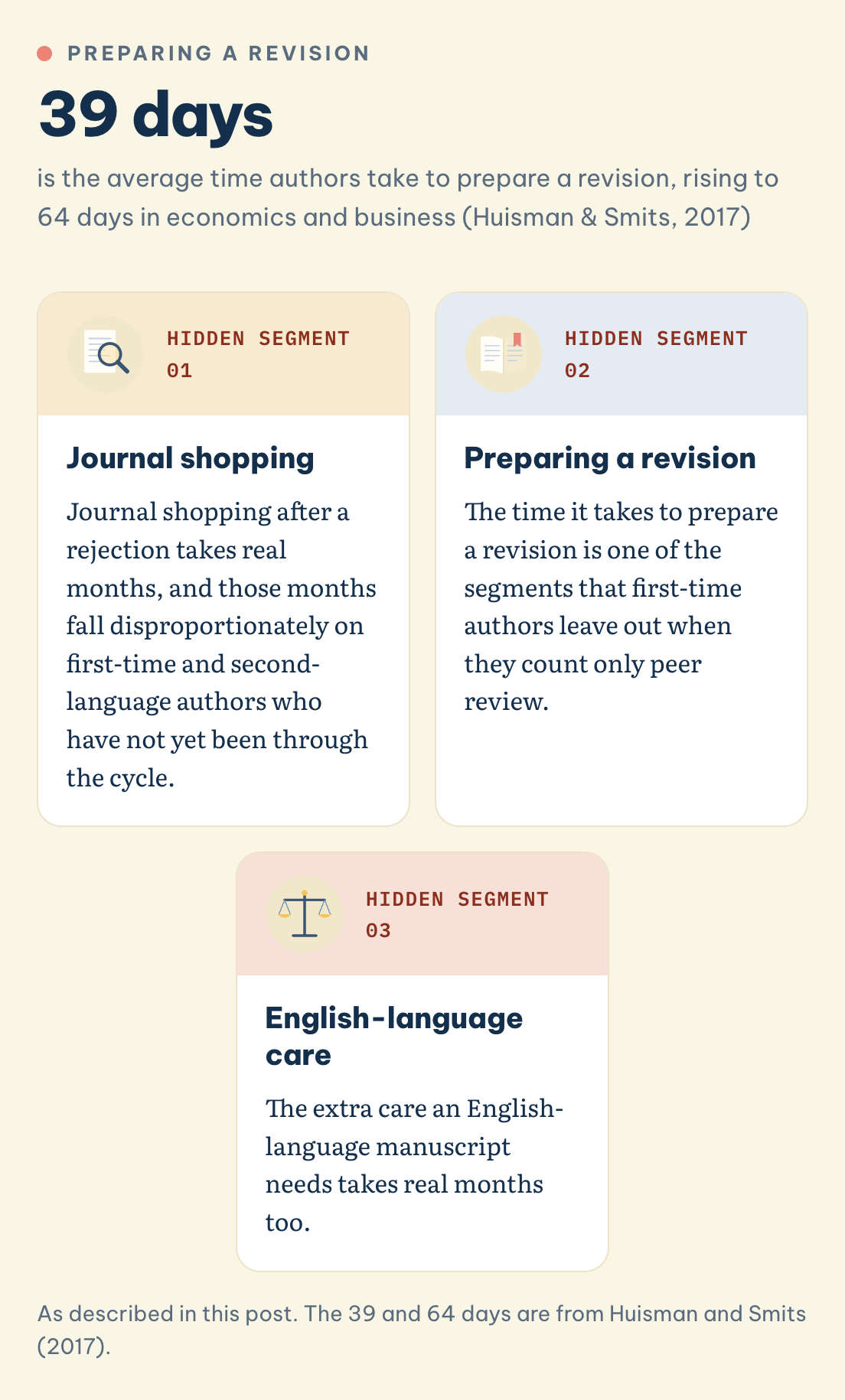
Evidence: Taşkın et al. (2022) found that papers by authors from central, high-income countries move through to publication faster than comparable work from elsewhere, and that a larger author team tends to lengthen rather than shorten the process, structural frictions a first-time Vietnamese author cannot simply write their way past. Huisman and Smits (2017) reported that authors take an average of 39 days to prepare a revision, rising to 64 days in economics and business, and that even a desk rejection takes more than 2 weeks at a third of journals and more than 4 weeks at a sixth. Pham-Duc et al. (2020) documented that Vietnamese social-science output has grown quickly since 2000 but still concentrates in lower-ranked outlets, which suggests that first-time authors aiming at Q1 or Q2 are often attempting an unfamiliar level of competition where rejection, and the re-submission it triggers, is more likely.
Example: A doctoral candidate brought us a timeline that budgeted zero time for rejection, on the assumption that a careful manuscript would be accepted at the first journal. Her mentor gently reframed this: a strong paper is not the same as a well-matched one, and building in a single "shop to a second journal" contingency, rather than treating it as failure, is what keeps a real deadline safe.
◆ Question 3 / 7 · Month by month
Direct answer: A realistic month-by-month timeline helps most when you see the journey as a chain of dated segments rather than one long wait. The table below sets out realistic durations for a first Scopus Q1 or Q2 submission; the ranges are deliberately wide because field, journal, and revision depth all move the numbers.
The six segments of a first Scopus Q1 or Q2 submission
Tap a segment to see what happens and the realistic duration. The ranges are deliberately wide.
Realistic duration: 2 to 4 weeks
Readiness check
Confirm the claim is clear and defensible before submitting.
Realistic duration: 2 to 3 weeks
Journal selection
Build a three-tier shortlist by scope and citation fit.
Realistic duration: 4 to 8 weeks
Formatting
Reformat to the exact author guidelines of the chosen journal.
Realistic duration: 2 to 5 months
First decision
Desk screen, reviewer search, review, and the editor's decision.
Realistic duration: 1 to 3 months
Revision and re-review
Point-by-point response, revise, and reviewers re-check.
Realistic duration: 1 to 3 months
Production and indexing
Proofs, copyright, publication, and Scopus indexing.
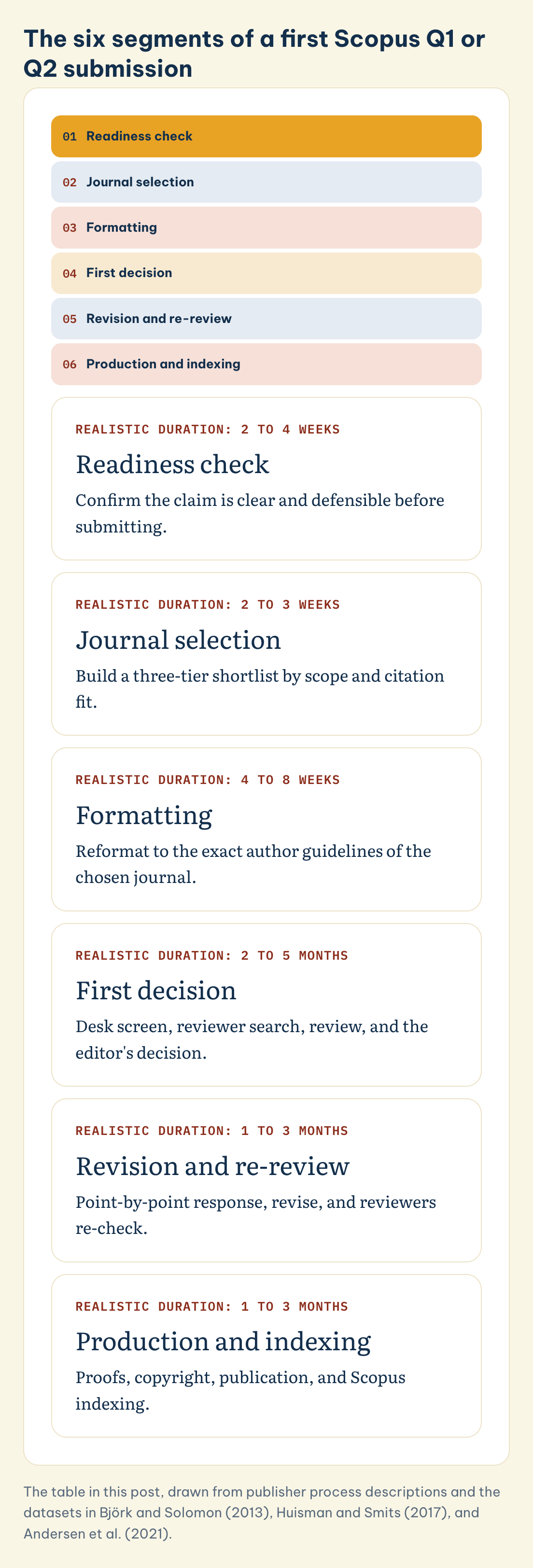
Evidence: The stages and durations below are drawn from publisher process descriptions and the datasets in Björk and Solomon (2013), Huisman and Smits (2017), and Andersen et al. (2021), whose systematic review confirmed that submission-to-publication times vary widely even within a single discipline.
| Segment | What happens | Realistic duration |
|---|---|---|
| Readiness + contribution check | Confirm the claim is clear and defensible before submitting | 2–4 weeks |
| Journal selection | Build a three-tier shortlist by scope and citation fit | 2–3 weeks |
| Manuscript formatting | Reformat to the exact author guidelines of the chosen journal | 4–8 weeks |
| First decision | Desk screen, reviewer search, review, editor's decision | 2–5 months |
| Revision + re-review | Point-by-point response, revise, reviewers re-check | 1–3 months |
| Production + indexing | Proofs, copyright, publication, Scopus indexing | 1–3 months |
Example: A MAAS-coached author kept this table on her desk and marked each segment as she cleared it. When her manuscript sat in "first decision" for 4 months, she checked the row, saw the range was 2 to 5, and waited calmly instead of emailing the editor prematurely, the schedule told her the silence was normal.
◆ Question 4 / 7 · Working backwards
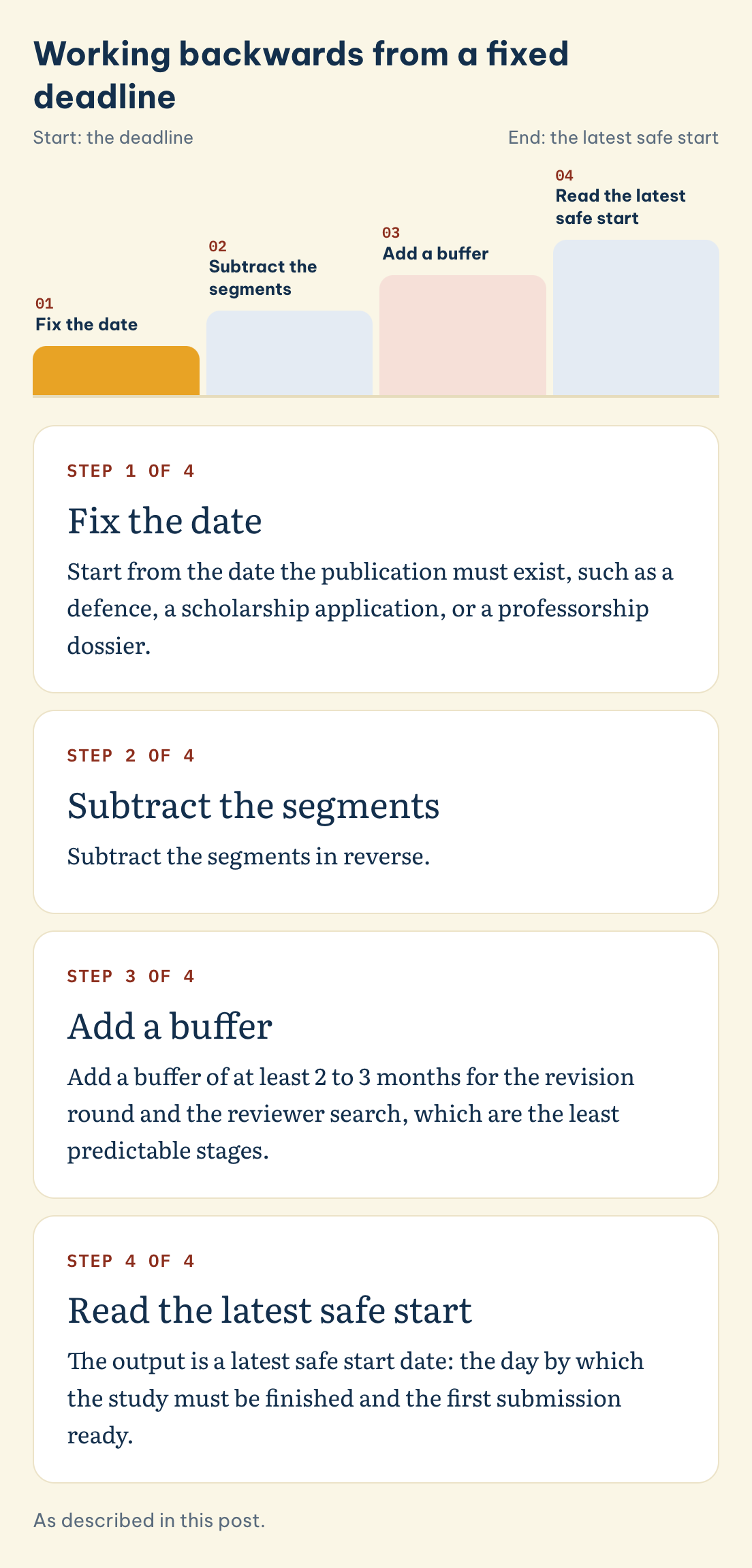
Direct answer: Start from the date the publication must exist, a defence, a scholarship application, or a professorship dossier and subtract the segments in reverse. Add a buffer of at least 2 to 3 months for the revision round and the reviewer search, which are the least predictable stages. The output is a "latest safe start date": the day by which the study must be finished and the first submission ready.
Working backwards from a fixed deadline
Tap a step to see what to do.
Step 1 of 4
Fix the date
Start from the date the publication must exist, such as a defence, a scholarship application, or a professorship dossier.
Step 2 of 4
Subtract the segments
Subtract the segments in reverse.
Step 3 of 4
Add a buffer
Add a buffer of at least 2 to 3 months for the revision round and the reviewer search, which are the least predictable stages.
Step 4 of 4
Read the latest safe start
The output is a latest safe start date: the day by which the study must be finished and the first submission ready.
Evidence: Vietnam's Ministry of Education and Training requires doctoral candidates to publish in indexed journals before defending, under Circular 08/2017/TT-BGDĐT, which makes the defence date a genuine hard constraint rather than a preference. Because Björk and Solomon (2013) showed that within-journal variation between individual papers is larger than the variation between journals or fields, no single average is safe to plan against; the buffer, not the average, is what protects the deadline.
Example: A candidate needed one indexed publication 14 months before her defence. Working backwards, her mentor allotted 3 months of production, 2 months of revision, 4 months to a first decision, 2 months of formatting, and a 2-month buffer, placing the latest safe start at 11 months out. She started immediately, chose a Q2 with a documented fast turnaround, and her acceptance arrived 4 months before the paperwork was due.
◆ Question 5 / 7 · Q1 or Q2
Direct answer: Yes, and the difference is often larger than the difference in prestige. A borderline Q1 submission carries a higher chance of desk rejection and a longer, more demanding review, so gambling on it can add an entire rejection-and-resubmission cycle, several months, to the calendar. For a first-time author under a real deadline, a well-matched Q2 is frequently the faster route to an indexed paper that still satisfies the requirement.
Evidence: Powell (2016) noted that journals with the very highest impact factors showed longer review times than mid-range titles, and that journal shopping alone added anywhere from a few days to more than 8 months to publication. Björk and Solomon (2013) found the widest delays concentrated in the most competitive social-science and business outlets, exactly the category many first-time authors over-reach for.
Example: Two MAAS clients submitted in the same month. The author who targeted a fitting Q2 was accepted after one revision at month 9; the author who insisted on a stretch Q1 was desk-rejected, re-submitted elsewhere, and reached acceptance at month 16. Same quality of work, 7 months separated them, and the gap was the journal choice, not the writing.
◆ Question 6 / 7 · What you control
Direct answer: You cannot compress the peer-review clock, reviewer availability and editorial pace are out of your hands. What you can control sits on either side of it: how quickly you produce a review-ready, well-matched first submission, and how fast and how completely you turn a revision around. Those two levers are where a disciplined author saves months.
Evidence: Andersen et al. (2021) found the spread in submission-to-publication times so wide that the journal and the author's own responsiveness, rather than the field average, largely determined the outcome. Huisman and Smits (2017) showed that revision time is substantial and highly variable, which means a fast, thorough point-by-point response is one of the few genuine accelerators available to an author.
Example: A MAAS client received a major revision with 11 comments and, instead of stalling, returned a structured response within 3 weeks using the Outline → Draft → Final model with her mentor. The paper was accepted on the next round. The author sitting on an identical decision for 3 months would have added that delay to her own timeline for no gain.
◆ Question 7 / 7 · When to start
Direct answer: If your deadline is inside 12 months, start now and choose deliberately for speed, a well-matched Q2 with a documented fast first decision, rather than gambling on a slow, prestigious title. If your deadline is 18 months or more away, you have room to attempt a stronger journal with a rejection contingency built in. The safest start date is always earlier than it feels, because the buffer, not the best-case average, is what carries a real deadline.
Evidence: The combined picture from Björk and Solomon (2013), Powell (2016), and Andersen et al. (2021) is consistent: totals are long, variance is high, and the tail is heavy. Planning to the average leaves roughly half of all papers running late; planning to a realistic range with a buffer is what keeps the defence, the scholarship, or the dossier on schedule.
Example: A lecturer needed a Scopus paper for an Associate Professor application 18 months out. Because the runway was generous, her mentor supported a Q2-primary, Q1-stretch plan with a clear switch point: if the Q1 had not returned a first decision by a set date, she would move to the Q2 without hesitation. She never needed the fallback but knowing it existed let her aim high without risking the deadline.
Plan for roughly 9 to 18 months from a finished study to an indexed article. Peer review is only part of that; journal selection, formatting, revision, and production each add weeks, and a rejection can reset the clock.
Often, yes. Borderline Q1 submissions face higher desk-rejection rates and longer reviews, so for a first-time author under a deadline, a well-matched Q2 is frequently the faster route to an indexed paper that still meets the requirement.
Work backwards from the defence date, subtract the segments, and add a 2- to 3-month buffer for revision and the reviewer search. For most first-time authors that places the latest safe start at 11 to 14 months before the deadline.
No. An article processing charge is an open-access publication fee paid only after acceptance; it does not buy faster review. Any journal promising guaranteed fast acceptance for a fee is a warning sign of a predatory outlet.
The review itself is not slower, but avoidable delays, a desk rejection for scope or language, or a slower revision round, are more common on a first submission. A well-matched, well-edited first submission is the main defence against them.
Yes. MAAS Publishing Advisory helps Vietnamese researchers build a backward-planned calendar, shortlist journals by realistic speed, and prepare a review-ready submission through a phase-by-phase model. Book a consultation through our contact page.
The publishing clock is long and uneven, and most of it is genuinely out of your control but the two segments that decide whether you make your deadline, a well-matched first submission and a fast, complete revision, are entirely within it. A mentor who has published and reviewed on the other side of the desk turns a vague "9 to 18 months" into a dated plan with a latest safe start.
MAAS pairs you with a publishing adviser who holds multiple Q1 or Q2 papers under their own name (23% of our experts hold a PhD) within 48 hours when our network already covers that field. If it does not, MAAS opens a dedicated recruitment round for your case, which usually takes about two weeks. The international track runs 26 one-to-one sessions over typically 4 to 10 months, and the domestic track runs 14 sessions over typically 2 to 4 months, so the backward-planned calendar you build has real numbers behind it. Your first 20-minute consultation is free. You stay the author, with a MAAS expert alongside you.
Book a Publishing Advisory consultation with MAAS Academic Mentoring →
This article is part of the MAAS Journal series for Vietnamese international postgraduate students and researchers. MAAS Publishing Advisory is an advisory partner; we coach authors through a phase-by-phase delivery model with developmental feedback from PhD-level, Scopus-published mentors. We do not write, submit, or guarantee acceptance of work on an author's behalf.
A free 20-minute consultation with a MAAS publishing mentor, to talk through your deadline and a backward-planned calendar.
Book Free Discovery ▸