
To conduct a meta-analysis, frame one question with PICO, register a protocol, extract data and choose an effect size, pick a model, measure heterogeneity, then check publication bias and report. A meta-analysis statistically combines results from multiple studies on one question into a single pooled estimate more precise than any single study. For Vietnamese researchers building an early publication, it is one of the most realistic routes into a Scopus-indexed journal, provided the method is rigorous from the protocol stage rather than improvised once the data are in.
This guide answers the seven questions first-time Vietnamese researchers ask MAAS publishing mentors most often before starting a meta-analysis.
Author: MAAS Research Methods Publishing Desk · Reviewed by a MAAS subject mentor
Last updated: 2026-06-07
Category: research-methods

What is a meta-analysis, and when is it the right choice?
Direct answer: A meta-analysis is a statistical method that pools the quantitative results of several studies addressing the same question to produce one combined effect estimate. It is the right choice when multiple comparable studies report a measurable outcome, such as a treatment effect or correlation but individually are too small or inconsistent to be conclusive on their own.
Evidence: The Cochrane Handbook for Systematic Reviews of Interventions defines meta-analysis as the statistical combination of results from two or more separate studies, and stresses that it should sit inside a systematic review rather than stand alone (Higgins et al. 2024). Borenstein and colleagues note that pooling increases statistical power and precision over any single study (Borenstein et al. 2021).
Example: A first-year Vietnamese student preparing a scholarship application wanted to "do research from zero" but had no laboratory access. Her MAAS mentor steered her toward a meta-analysis of existing studies in her field, a feasible, data-light design that let her produce a publishable quantitative paper without running a single new experiment.
How is a meta-analysis different from a systematic review?
Direct answer: A systematic review is the full, reproducible process of finding, appraising, and synthesising every relevant study on a question. A meta-analysis is the optional statistical step that pools numerical results within that review. Every sound meta-analysis is built on a systematic review; not every systematic review ends in a meta-analysis.
Evidence: PRISMA 2020, the reporting standard for both, treats the systematic search and selection as the foundation and meta-analytic synthesis as one possible result (Page et al. 2021). When studies are too clinically or methodologically diverse to combine, the Cochrane Handbook advises a narrative synthesis instead of forcing a pooled number.
Example: A MAAS-coached author assumed she could skip the search protocol and jump straight to "the statistics." Her mentor walked her through the order of operations: a registered protocol and systematic search first, then, only if the studies were similar enough, the meta-analysis. The detour of a few days protected the credibility of months of work. The companion guide on how to design a systematic review in the health sciences covers that foundation in detail.
How do you frame the question and register a protocol before you start?
Direct answer: Turn your topic into one focused, answerable question using a structured framework such as PICO (Population, Intervention, Comparison, Outcome), then write and register a full protocol, usually on PROSPERO for health-related work, before you screen a single study. Registration time-stamps your method and stops the question quietly shifting to fit the results.
Evidence: The Cochrane Handbook specifies PICO for developing review questions, and PROSPERO requires a completed protocol submitted before data extraction begins, issuing a registration number that links to the eventual publication (University of York, Centre for Reviews and Dissemination, n.d.). PRISMA 2020 lists that registration number as a required reporting item.
Example: A Vietnamese doctoral candidate began with "AI in diagnosis", far too broad to pool. Her MAAS mentor used PICO to fix the population, comparison, and one measurable outcome, producing a question precise enough that the eligible studies actually reported the same effect, which is what makes pooling valid in the first place.
How do you extract data and choose the right effect size?
Direct answer: Decide on a single common effect measure that every included study can be converted to, for example a risk ratio or odds ratio for binary outcomes, or a standardised mean difference (Cohen's d / Hedges' g) for continuous ones, then extract the numbers needed to compute it from each study using a piloted, duplicated form.
Evidence: The Cochrane Handbook requires data extraction by at least two independent reviewers to reduce error, and matches effect-size choice to outcome type (Higgins et al. 2024). Borenstein et al. emphasise that all studies must be expressed on one effect-size scale before they can be combined (Borenstein et al. 2021).
Example: A MAAS-mentored pharmacy researcher had studies reporting outcomes three different ways, means, medians, and percentages. Her mentor built a single extraction sheet, converted each study to a standardised mean difference where possible, and flagged the two studies that could not be converted for separate narrative treatment rather than distorting the pool.
Should you use a fixed-effect or a random-effects model?
Direct answer: Use a fixed-effect model only when you can assume every study estimates the same single true effect; use a random-effects model when true effects plausibly vary across studies because of differences in populations, settings, or methods. For most real-world reviews, including beginner ones, random-effects is the safer and more defensible default.
Evidence: Borenstein and colleagues explain that the two models answer different questions and should be chosen on conceptual grounds before seeing the data, not by picking whichever gives a tidier result (Borenstein et al. 2021). The Cochrane Handbook notes random-effects models incorporate between-study variation into the confidence interval.
Example: A Vietnamese researcher pooling studies from different countries and age groups initially chose fixed-effect because the interval looked narrower. Her MAAS mentor explained that the populations clearly differed, so a random-effects model was the honest choice and that defending the model choice is exactly what a Q1 reviewer probes.
| Question to ask | Fixed-effect model | Random-effects model |
|---|---|---|
| What does it assume? | One single true effect across all studies | True effects vary between studies |
| When is it appropriate? | Near-identical studies, same population | Studies differ in population, setting, or method |
| How does it weight studies? | Mainly by study size (precision) | More balanced; small studies count more |
| Confidence interval | Narrower | Wider (accounts for between-study variance) |
| Best default for beginners? | Rarely | Usually |
How do you measure and interpret heterogeneity?
Direct answer: Heterogeneity is the variation in true effects across studies beyond chance. Quantify it with Cochran's Q (a significance test) and the I² statistic, which expresses the percentage of total variation due to genuine differences rather than sampling error. High heterogeneity is a signal to investigate causes, not necessarily to abandon the pool.
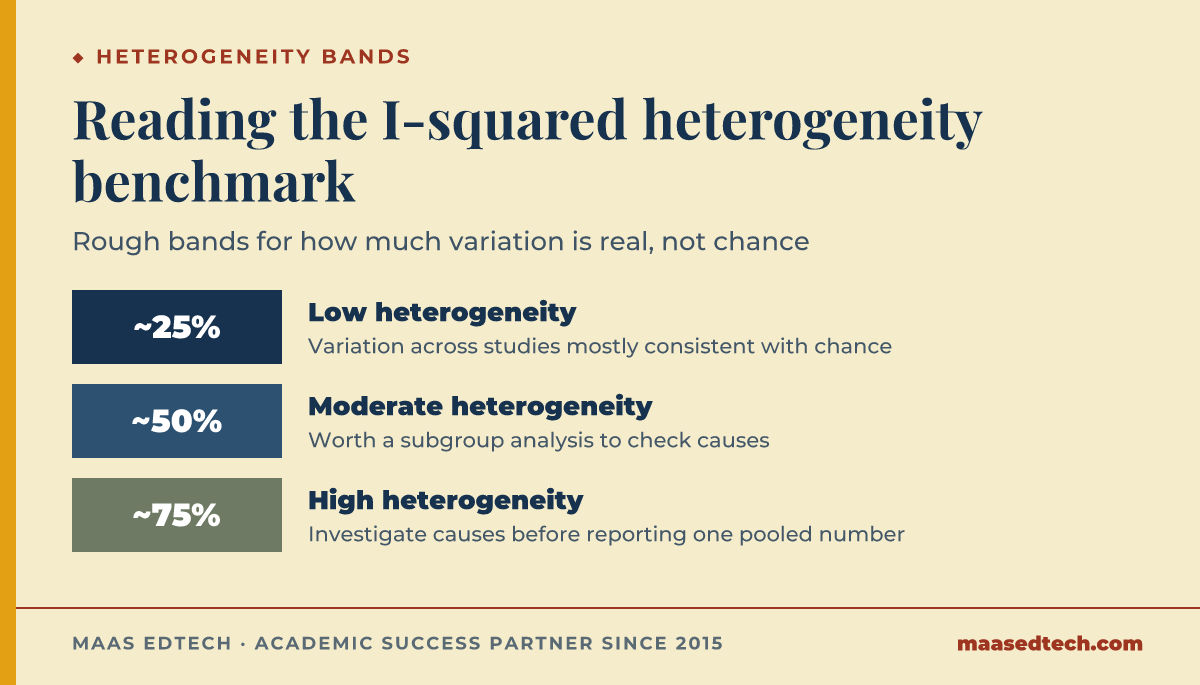
Evidence: Higgins and colleagues introduced I² as a measure of inconsistency that, unlike Q, does not depend on the number of studies, with rough benchmarks of around 25%, 50%, and 75% for low, moderate, and high heterogeneity (Higgins et al. 2003). Their own definition is direct: "the quantity, which we call I², describes the percentage of total variation across studies that is due to heterogeneity rather than chance" (Higgins et al., 2003). The Cochrane Handbook recommends exploring substantial heterogeneity through subgroup analysis or meta-regression rather than ignoring it.
Example: A MAAS client's first pool returned an I² of 82%. Rather than report a misleading single number, her mentor guided a subgroup analysis by study design, which revealed that observational and randomised studies pulled in opposite directions, a finding that became the most interesting part of her paper.
How do you check for publication bias and report the meta-analysis?
Direct answer: Assess publication bias, the tendency for positive results to be published more readily, using a funnel plot and, when you have roughly ten or more studies, a statistical test such as Egger's test. Then report every step against PRISMA 2020 and grade the certainty of your overall evidence, typically with GRADE, so readers can judge how much to trust the pooled result.
Evidence: Egger and colleagues proposed the funnel-plot asymmetry test for detecting bias in meta-analyses (Egger et al. 1997), and PRISMA 2020 provides the 27-item checklist and flow diagram that journals expect (Page et al. 2021). The GRADE approach rates certainty across domains including risk of bias, inconsistency, and imprecision (GRADE Working Group, n.d.).
Example: A Vietnamese researcher's funnel plot looked asymmetric, suggesting small negative studies were missing. Her MAAS mentor helped her report this transparently as a limitation and downgrade her GRADE certainty, a move that strengthened, rather than weakened, the reviewers' trust in the paper, which was accepted into a Q2 journal after one revision.
Frequently asked questions
What are the steps in the meta-analysis process?
The process begins with a focused question and a registered protocol, then a systematic search and data extraction with an effect size chosen up front. Next you pick a fixed-effect or random-effects model, quantify heterogeneity, and finish by testing for publication bias and reporting to PRISMA 2020 (Higgins et al. 2024; Page et al. 2021).
Do I need to run new experiments to publish a meta-analysis?
No. A meta-analysis synthesises data from already-published studies, so it requires no new laboratory or fieldwork. This makes it a realistic first paper for students and early-career researchers who lack access to a lab but can search, appraise, and analyse existing evidence rigorously.
What software do first-time researchers use for meta-analysis?
Common choices include R with the metafor or meta packages, Stata, Comprehensive Meta-Analysis (CMA), and RevMan for Cochrane-style reviews. R is free and widely taught, while RevMan is purpose-built for systematic reviews. The right tool depends on your comfort with coding and your target journal's norms.
How many studies do I need for a meta-analysis?
There is no fixed minimum; a pool of two studies is technically possible, but more studies give a more stable estimate and allow tests like Egger's, which usually need around ten. Quality and comparability of studies matter far more than raw count.
Is a meta-analysis good enough for a Q1 or Q2 journal?
Yes. A well-conducted meta-analysis on an important, under-synthesised question is frequently published in Q1 and Q2 journals, because it produces high-evidence conclusions. Acceptance depends on the rigour of the method and the novelty of the question, not on the design label alone.
Can I use AI tools in my meta-analysis?
You can use AI to support tasks like initial screening or text extraction, but you must verify every output, keep a human reviewer in control, and disclose any AI use in line with your target journal's policy. Transparency keeps the work aligned with academic integrity standards.
Can MAAS help me run my first meta-analysis?
Yes. MAAS publishing mentors guide you through a phase-by-phase process, framing the question, registering the protocol, choosing effect sizes and models, and interpreting heterogeneity, alongside a mentor with Q1 or Q2 papers under their own name while you remain the sole author of your work. You can book a free 15-minute consultation to map your project before you commit.
Work on your meta-analysis alongside a Q1 mentor
MAAS Academic Publishing Advisory pairs you with a discipline-matched mentor, 23% of our experts hold a PhD, to plan and refine your first meta-analysis through a clear phase-by-phase process, with you keeping full authorship throughout.
Every engagement opens with a project kick-off that is free and not counted as a paid session, and we match you with a suitable adviser within 48 hours when our network already covers that field. If it does not, MAAS opens a dedicated recruitment round for your case, which usually takes about two weeks.
Start with a free 15-minute consultation through our Academic Publishing Advisory service, explore the Scopus publishing resource hub for the full research-to-submission roadmap, or meet the team behind the work on the our experts page. If you are choosing your analysis approach, the guide on choosing the right statistical test for a Q1 paper is a useful next read, and the guide on how to use AI to screen studies for a systematic review covers the screening stage that feeds a meta-analysis.
References
- Borenstein, M., Hedges, L. V., Higgins, J. P. T., & Rothstein, H. R. (2021). Introduction to meta-analysis (2nd ed.). Wiley.
- Egger, M., Davey Smith, G., Schneider, M., & Minder, C. (1997). Bias in meta-analysis detected by a simple, graphical test. BMJ, 315(7109), 629–634. https://doi.org/10.1136/bmj.315.7109.629
- GRADE Working Group. (n.d.). GRADE handbook for grading quality of evidence and strength of recommendations. Retrieved June 8, 2026, from https://gdt.gradepro.org/app/handbook/handbook.html
- Higgins, J. P. T., Thompson, S. G., Deeks, J. J., & Altman, D. G. (2003). Measuring inconsistency in meta-analyses. BMJ, 327(7414), 557–560. https://doi.org/10.1136/bmj.327.7414.557
- Higgins, J. P. T., Thomas, J., Chandler, J., Cumpston, M., Li, T., Page, M. J., & Welch, V. A. (Eds.). (2024). Cochrane handbook for systematic reviews of interventions (Version 6.5). Cochrane. https://www.cochrane.org/authors/handbooks-and-manuals/handbook
- Page, M. J., McKenzie, J. E., Bossuyt, P. M., Boutron, I., Hoffmann, T. C., Mulrow, C. D., Shamseer, L., Tetzlaff, J. M., Akl, E. A., Brennan, S. E., Chou, R., Glanville, J., Grimshaw, J. M., Hróbjartsson, A., Lalu, M. M., Li, T., Loder, E. W., Mayo-Wilson, E., McDonald, S. ... Moher, D. (2021). The PRISMA 2020 statement: An updated guideline for reporting systematic reviews. BMJ, 372, Article n71. https://doi.org/10.1136/bmj.n71
- University of York, Centre for Reviews and Dissemination. (n.d.). PROSPERO: International prospective register of systematic reviews. Retrieved June 8, 2026, from https://www.crd.york.ac.uk/prospero/
Tools & resources
- Scimago Lab. (n.d.). Scimago Journal & Country Rank. Retrieved June 8, 2026, from https://www.scimagojr.com/
Disclaimer: MAAS EdTech is an academic success partner. Our mentors provide advisory and coaching support through an Outline → Draft → Final process; you remain the author of your own research and manuscript. We do not guarantee journal acceptance. Guidance reflects published methodological standards current at the last-updated date; always follow your target journal's specific instructions.