
◆ Literature review
How do you write an undergraduate literature review?
An undergraduate literature review surveys published work on a topic, grouped by theme, so a reader sees what a field agrees on, disputes, and has not settled (Queensland University of Technology, n.d.; University of North Carolina at Chapel Hill Writing Center, n.d.). It can be set as a stand-alone undergraduate project, and when it is, analysing published work is the whole task, because a review adds no new arguments and no unpublished primary research of your own (Kennesaw State University Writing Center, n.d.).
Snyder (2019) states the underlying problem bluntly: "Traditional literature reviews often lack thoroughness and rigor and are conducted ad hoc, rather than following a specific methodology" (p. 333). That paper appears in the Journal of Business Research, volume 104, pages 333 to 339. This guide covers source counts, organising patterns, and the move markers grade hardest: synthesis rather than summary. The MAAS guide to writing a university assignment sets this genre beside the others.

◆ Section 1 / 7 · What it is and is not
What a literature review is, and what it is not
Direct answer: A literature review analyses published research and organises it into themes, showing patterns, disagreements and gaps (Queensland University of Technology, n.d.). It is not a list of source summaries. An annotated bibliography records each source separately, one entry at a time, while a literature review puts sources into conversation with one another.
That distinction decides structure. An annotated bibliography simply lists sources and summaries one by one (Kennesaw State University Writing Center, n.d.), so each entry stands alone for a reader who has read no other entry. In a review the opposite holds: a paragraph discussing one study is usually still summary, and no paragraph should survive being lifted out, because each exists to carry a comparison. If your brief says critical review rather than literature review, see how to write a critical review. To see what synthesis looks like on the page, read an annotated literature review example, which breaks down a four-paragraph model paragraph by paragraph.
Review writing is a genre family. Grant and Booth (2009), writing in Health Information and Libraries Journal, catalogued 14 review types, from rapid reviews to systematic reviews, each with its own method. Undergraduate coursework almost always means the narrative thematic review, so check your brief before importing rules belonging to a systematic review (Grant & Booth, 2009).
◆ Section 2 / 7 · How many sources
How many sources an undergraduate review needs
Direct answer: Counts scale with level. Queensland University of Technology (n.d.) puts the range at about 5 sources for a first-year undergraduate review, rising to more than 50 sources for a thesis. Your brief overrides any general figure, so confirm the expected number and source types against your criteria before reading.
Quality decides more than quantity. Use a variety of academic or scholarly sources that are relevant, current and authoritative, and search for them through the library rather than a general web search (Queensland University of Technology, n.d.). Reports, theses and working papers sit outside journals, so see our guide to grey literature for where to find them. The reference list of 1 strong recent article is an excellent entry point into your own research (University of North Carolina at Chapel Hill Writing Center, n.d.). A review resting mostly on blogs and news items reads as under-researched whatever its length.
◆ Section 3 / 7 · One organising pattern
Choose one organising pattern before you write
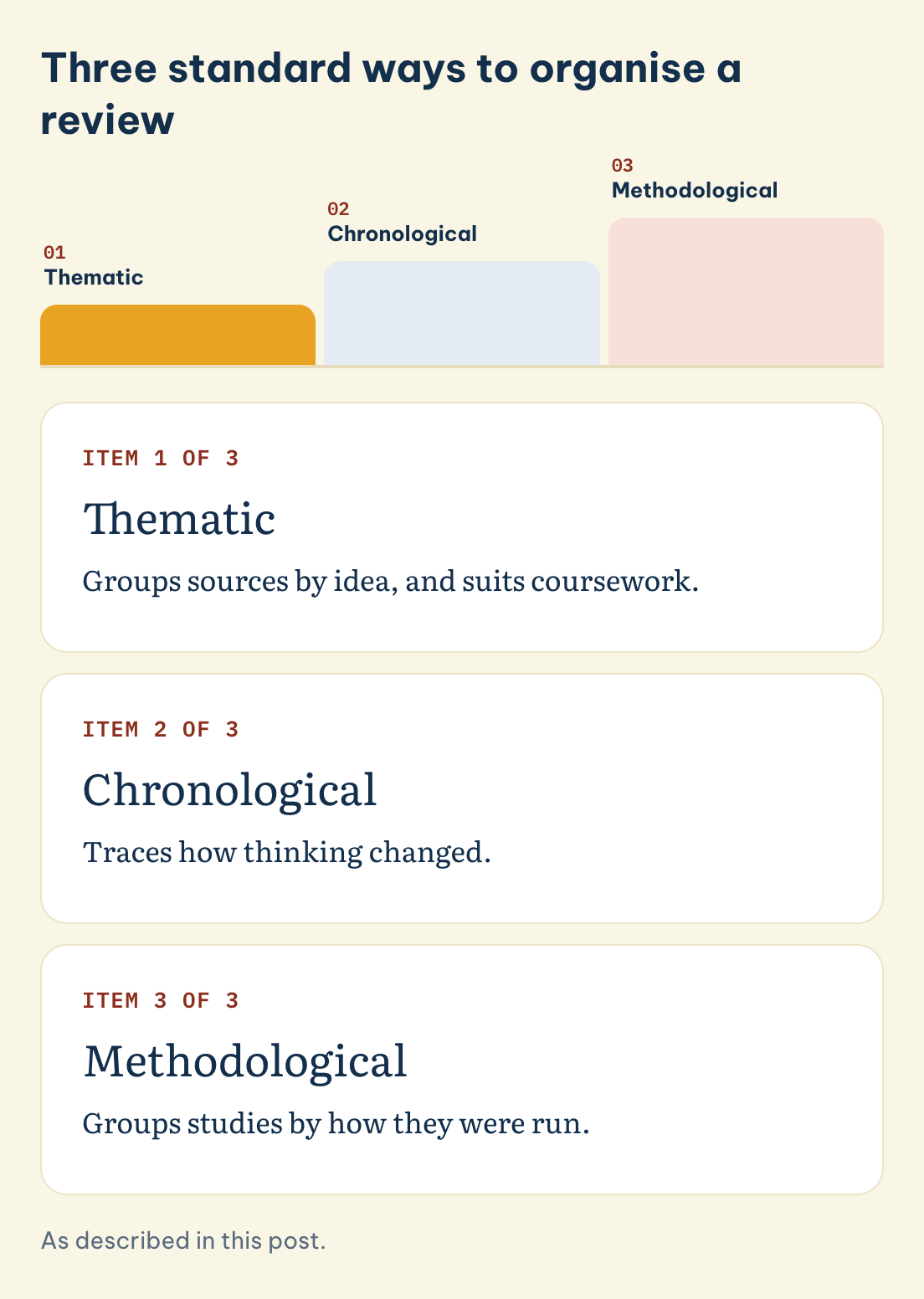
Direct answer: Decide your organising principle before drafting, then state it in the introduction (University of North Carolina at Chapel Hill Writing Center, n.d.). The 3 standard patterns are thematic, which groups sources by idea and suits coursework, chronological, which traces how thinking changed, and methodological, which groups studies by how they were run.
Three standard ways to organise a review
Tap a pattern to read what it groups and when it suits, as the post puts it. Pick one before you draft and state it in the introduction.
Item 1 of 3
Thematic
Groups sources by idea, and suits coursework.
Item 2 of 3
Chronological
Traces how thinking changed.
Item 3 of 3
Methodological
Groups studies by how they were run.
Save this figure
A review rarely carries a thesis statement in the essay sense, but always needs a stated focus (University of North Carolina at Chapel Hill Writing Center, n.d.). Drafting without a chosen pattern is why so many reviews read as a pile of facts: sources arrive in the order they were read. Choosing the pattern is part of the assignment, not preparation for it.
◆ Section 4 / 7 · Synthesis, not summary
Synthesis, not summary: the move your marker is grading
Direct answer: Synthesis means pulling sources together, grouping them, and discussing how they agree, differ, and what remains unstudied (University of North Carolina at Chapel Hill Writing Center, n.d.). Summary reports what each source said in turn. The UNC test is structural: organise around ideas rather than around individual sources.
A practical version is countable. Count the studies cited in each body paragraph. A paragraph citing 1 author is probably still summary. A synthesised paragraph opens with a claim about the field, brings 2 or more studies alongside each other as evidence, then closes by saying what the comparison establishes (University of North Carolina at Chapel Hill Writing Center, n.d.).
Disagreement is your most useful material. A review presenting only agreeing sources looks incomplete, because real fields contain contested findings (Snyder, 2019). Naming a contradiction between 2 studies, then giving a reason such as different samples or different measures, demonstrates the critical reading the task exists to test. For the questions to ask of each source, and sentence rewrites that turn description into evaluation, see how to make a literature review critical.
◆ Section 5 / 7 · The synthesis matrix
The synthesis matrix, and how to build one
Direct answer: Queensland University of Technology (n.d.) suggests a table, matrix or concept map to show how sources relate to each other. In practice that means 1 row per source and 1 column per theme, each cell holding what that source says, so reading down a column supplies one synthesised paragraph.
Build it while reading, not afterwards. Add a column when a theme appears in more than 1 source, and leave a cell blank where a source is silent. For a step-by-step build with a worked example, see how to synthesise literature with a synthesis matrix. Blank cells carry information: a column holding 1 entry is usually too narrow to become a section, and a theme nearly every source addresses is usually a section you cannot omit.
◆ Section 6 / 7 · Introduction, body, conclusion
Structure: introduction, body, conclusion
Direct answer: A review uses 3 parts. The introduction names topic, scope and organising principle, and explains deliberate exclusions. The body groups sources by theme and discusses what they collectively show. The conclusion states what the literature reveals and what remains unresolved (Queensland University of Technology, n.d.), and then it stops.
Scope statements do real work. Where necessary, state why certain sources are, or are not, included (Kennesaw State University Writing Center, n.d.), for example if you excluded everything published before a particular reform. Without that sentence a marker cannot distinguish a deliberate boundary from an incomplete search, and will assume the second.
◆ Section 7 / 7 · Mistakes that cost marks
The mistakes that cost undergraduates marks
Direct answer: The failures that recur are serial summary, organising by source instead of idea, drafting with no organising principle chosen, leaning on non-scholarly sources, over-quoting instead of paraphrasing, and presenting only studies that agree while leaving a field's real disagreements out (Snyder, 2019).
- Serial summary. One paragraph per author, in reading order. This is a frequent failure, and it converts a review into an annotated bibliography (University of North Carolina at Chapel Hill Writing Center, n.d.).
- Subheadings named after studies. If headings are author surnames and years rather than "Barriers to access", the structure is source-led (University of North Carolina at Chapel Hill Writing Center, n.d.).
- Sources from a general search engine. The library is the best place to search for academic or scholarly sources (Queensland University of Technology, n.d.).
- Quote stacking. Paraphrase the finding, then explain what it does for your argument.
- A field with no disagreement. If every source agrees, you have a settled question or an incomplete search, and markers assume the second (Snyder, 2019).
When you want a second pair of eyes on your review
Most students write their literature review unaided, and the genre rewards that. An expert reader adds speed and certainty: someone who knows the field can say within 1 reading whether your themes are the right themes, whether a paragraph is synthesis or still summary, and whether your claimed gap is genuinely a gap. Through academic support at MAAS, a discipline-matched expert reads alongside you at Outline, Draft and Final, measuring each against the rubric you were given. The review stays yours from first note to final page.
Frequently asked questions
Is a literature review the same as an annotated bibliography?
No. An annotated bibliography lists sources one at a time, each with its own summary and evaluation. A literature review organises the discussion of sources around a common characteristic such as the authors' purposes, findings or conclusions, the research methodologies, or chronology, and discusses them together (Kennesaw State University Writing Center, n.d.).
How many sources does a literature review need?
Follow your brief first. As a general scale, Queensland University of Technology (n.d.) describes about 5 sources at first-year undergraduate level, rising to more than 50 sources at thesis level.
Should I organise by theme or by date?
Thematic organisation suits coursework. Chronological organisation suits a topic where the point is how thinking changed, and methodological organisation suits a field split by how studies were run (University of North Carolina at Chapel Hill Writing Center, n.d.).
Do I need a thesis statement?
Not in the essay sense, but you need a stated focus and organising principle in the introduction, so a reader knows why sections appear in the order they do (University of North Carolina at Chapel Hill Writing Center, n.d.).
Can I include sources that contradict each other?
Yes, and you should. Naming a contradiction and explaining it is stronger evidence of critical reading than a review in which every source agrees (Snyder, 2019).
References
Grant, M. J., & Booth, A. (2009). A typology of reviews: An analysis of 14 review types and associated methodologies. Health Information & Libraries Journal, 26(2), 91–108. https://doi.org/10.1111/j.1471-1842.2009.00848.x
Kennesaw State University Writing Center. (n.d.). Literature review assignment. Open Educational Resources. https://campus.kennesaw.edu/current-students/academics/writing-center/open-educational-resources/literature-review/assignment.php
Queensland University of Technology. (n.d.). How to write a literature review. QUT cite|write. https://www.citewrite.qut.edu.au/write/writing-well/litreview.html
Snyder, H. (2019). Literature review as a research methodology: An overview and guidelines. Journal of Business Research, 104, 333–339. https://doi.org/10.1016/j.jbusres.2019.07.039
University of North Carolina at Chapel Hill Writing Center. (n.d.). Literature reviews. https://writingcenter.unc.edu/tips-and-tools/literature-reviews/
A free consultation with MAAS Academic Support, to talk through your themes, your organising pattern and your synthesis.
Book Free Discovery ▸