
◆ Research Methods
What does a good literature review example look like, annotated?
A good literature review example groups published studies under ideas, compares them, judges their quality and ends by showing what is still unknown. Reading a model is the fastest way to see how that works, so this guide gives you an original four-paragraph example and annotates what each paragraph is doing.
Library and writing-centre guides in the UK, Australia and the United States agree that a review is not a list of summaries (Niada, 2026; UNSW Sydney, n.d.). The example below uses invented placeholder studies, labelled Study A to Study F, so you can copy the technique without copying anyone's research. The concept-centric idea comes from Webster and Watson (2002) in MIS Quarterly. We also cover format, a short version for a research proposal, and a concept matrix. For the step-by-step process, start with our guide to writing a literature review, and see the MAAS guide to writing a university assignment for the wider genre.
◆ Question 1 / 7 · Short example
What does a short literature review example look like?
Direct answer: A short literature review example, like the one below, runs 3 to 4 paragraphs, each built around one idea rather than one author. Each paragraph names the idea, weaves 2 to 3 sources together (Balos, 2026), judges their quality, and points to what is missing (Deakin University, n.d.). The example below follows that shape.
The topic is remote work and employee wellbeing. Every study named is a hypothetical placeholder written for this guide, not a real publication, so do not cite them. Real reviews cite real sources, with a full reference entry for each.
Paragraph 1. Remote work has moved from an occasional arrangement to a standing feature of many workplaces, and research on its effect on wellbeing now clusters around three concepts: autonomy, social connection and the boundary between work and home. Study A and Study B both report that employees who control where and when they work describe lower stress, and Study C reports the same pattern in a sample of managers. The shared mechanism in these studies is autonomy, because workers who decide how to organise their day appear to recover from demands more easily. This review therefore treats autonomy as the first organising concept, then turns to connection and boundaries, and it reads every finding in light of how wellbeing was measured.
Paragraph 2. Social connection is where the evidence divides. Study D finds that fully remote staff report more isolation than office-based colleagues, whereas Study E finds no difference once team size is held constant. The disagreement may rest on measurement, since Study D asked about loneliness in general and Study E asked only about contact with colleagues. Study F, a small interview study, suggests a third explanation: isolation depends on whether the employee chose to work remotely. Taken together, the three studies suggest that connection is not a fixed cost of remote work but depends on team design and personal choice, although none of them tests that claim directly.
Paragraph 3. A methodological pattern limits all of these findings. Studies A to E rely on self-reported surveys collected at a single point in time, so they cannot show whether remote work changes wellbeing or whether people who are already doing well choose remote work. Study F's interviews add depth but cover a single organisation. Sample composition narrows what can be claimed as well, because most participants are office-based professionals, which leaves manual, caring and frontline roles largely absent. Until longitudinal designs and wider samples appear, the safest reading is that remote work is associated with differences in wellbeing, not that it causes them.
Paragraph 4. Two gaps follow from this evidence. First, no study in this review follows the same employees from office work to remote work, so change over time remains unexamined. Second, the boundary between work and home is measured in only one study, which leaves it the least developed of the three concepts (Study E also measures the work-home boundary). The present project addresses the first gap by collecting wellbeing measures from the same employees before and after a move to remote work, and the next section explains how that design answers the weaknesses of the single-time-point surveys discussed above.
◆ Question 2 / 7 · What each paragraph does
What makes each paragraph in the example work?
Direct answer: Each paragraph does one job. Paragraph 1 sets the frame and shows a pattern, paragraph 2 reveals a debate, paragraph 3 critiques the method, and paragraph 4 names the gap and links forward. Deakin University (n.d.) describes 4 paragraph parts, namely topic, elaboration, analysis and link, and the example uses all 4 across its paragraphs.
Paragraph 1: the pattern and the organising concept
The annotations draw on 6 sources: Balos (2026) for synthesis moves, Niada (2026) for structure, Deakin University (n.d.) for paragraph parts, UNSW Sydney (n.d.) for critique, Link (n.d.) for pivots and Webster and Watson (2002) for concepts. Balos (2026) advises 2 to 3 sources per paragraph, a range the example keeps in paragraphs 1 and 2.
The topic sentence names concepts, not authors, which is the pattern Balos (2026) recommends in a Tulane University Libraries guide, and the paragraph covers 3 sources in 4 sentences. Three sources sit together in one sentence group because they agree, and the paragraph says why they agree (autonomy) before moving on. The last sentence tells the reader how the rest of the review is organised. Paragraph 1 cites 3 sources, paragraph 2 cites 3 and paragraph 3 draws on all 6 placeholders, while paragraph 4 names none and speaks in its own voice. Westminster's guide explains the logic: sources "will be put together when agreeing, contrasted when disagreeing" (Niada, 2026).
Paragraph 2: the debate, with an explanation
Contrast is the signal here (Niada, 2026): "whereas", "since" and "although" mark where sources part. The paragraph does not stop at "they disagree". It offers 2 possible reasons, measurement and choice, which is the analysis step in Deakin's structure. The paragraph weighs 3 sources and 2 explanations, and its closing sentence is hedged ("suggest", "none of them tests") because a review should not claim more than the sources show.
Paragraph 3: critique of strengths, weaknesses and omissions
UNSW Sydney (n.d.) advises that you "highlight the strengths, weaknesses and omissions of the literature, providing a critique of the research". Paragraph 3 does exactly that in 5 sentences: it names the survey design, the single-organisation sample and the missing job types. Link (n.d.) describes the pivot sentence that introduces a limitation, often starting with "However" or "Despite these advances". Here the pivot is the first sentence, "A methodological pattern limits all of these findings".
Paragraph 4: the gap and the link
UNSW Sydney (n.d.) gives the purpose of a review as identifying the gap that your work addresses and creating a space for your work. Link (n.d.) puts it this way: "A strong literature review does not just celebrate what is known; it uses integrated understanding to expose what is missing." The final sentence is the link in Deakin University (n.d.) terms, joining the review to the next section of the project.
◆ Question 3 / 7 · Weak vs strong
How does a weak paragraph differ from a strong one?
Direct answer: A weak paragraph summarises sources one after another, each in its own sentence, and the writer's voice disappears. A strong paragraph synthesises: it opens with an idea, compares sources, judges them and links onward. Webster and Watson (2002) call the weak pattern author-centric and say it "fails to synthesize the literature" (p. xvi).
Here is a weak version of paragraph 2, using the same placeholder studies: "Study D found that remote staff reported more isolation. Study E found no difference between remote and office staff. Study F interviewed workers about isolation." The weak version uses 3 sentences for 3 studies and makes 0 comparisons, so every sentence is accurate and none connects to another. The table sets the two versions side by side.
| Feature | Weak (summary) | Strong (synthesis) |
|---|---|---|
| Topic sentence | Names an author: "Study D found..." | Names an idea: "Social connection is where the evidence divides" |
| Structure | One source per sentence, in turn | 2 to 3 sources woven together by idea |
| Relationship between sources | Not stated | Agreement, contrast or explanation stated |
| Evaluation | Absent | Method, sample and measurement judged |
| Writer's voice | Hidden | Visible in the analysis and the hedged conclusion |
| Ending | Stops after the last source | Links to the gap or the next section |
Summary and synthesis compared
How a weak literature review paragraph differs from a strong one
Weak (summary)
Strong (synthesis)
Topic sentence names an author
Topic sentence names an idea
One source per sentence, in turn
2 to 3 sources woven together by idea
Relationship between sources not stated
Agreement, contrast or explanation stated
No evaluation of method or sample
Method, sample and measurement judged
Stops after the last source
Links to the gap or the next section
Save this figure
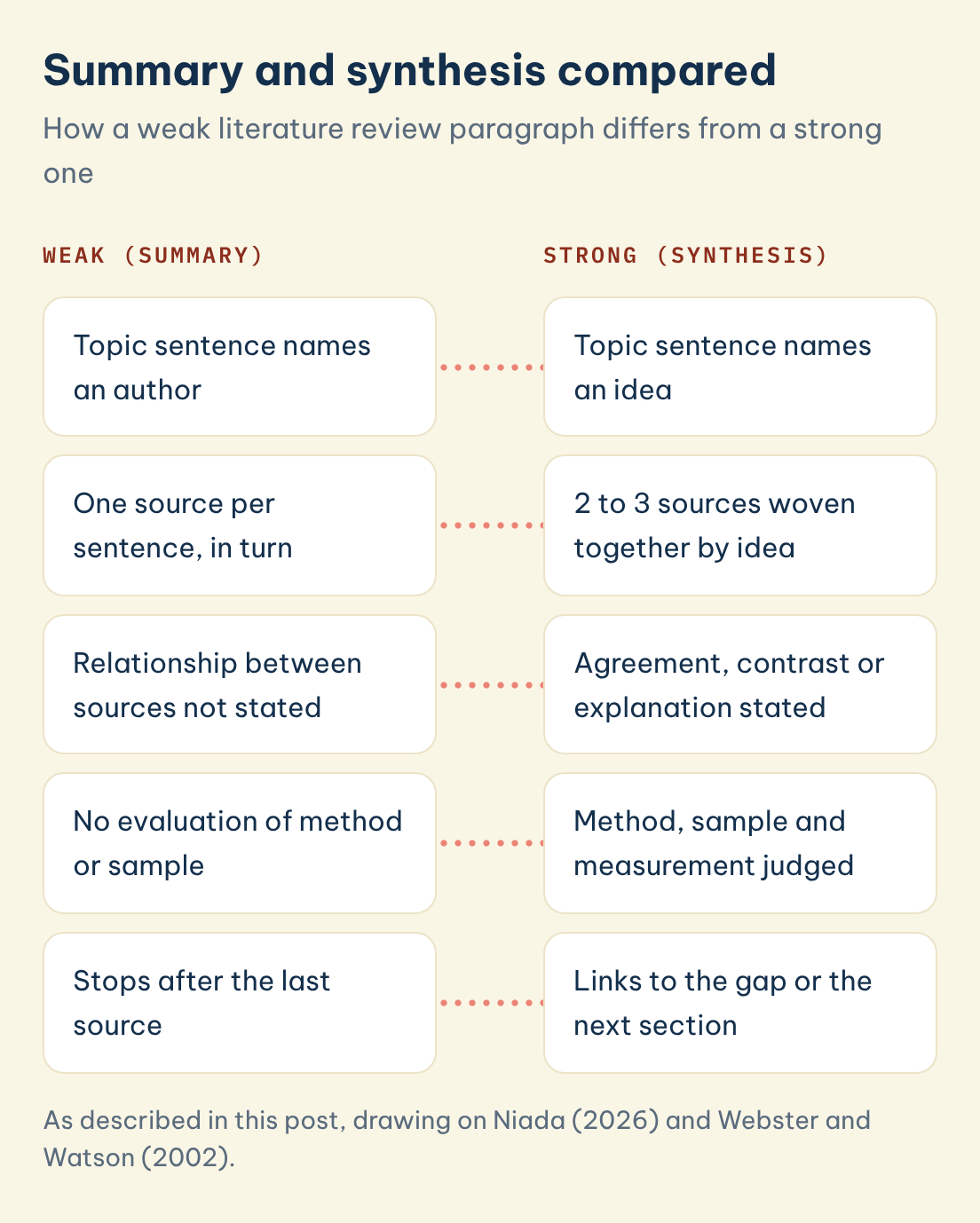
Niada (2026) puts the difference in structural terms, in a guide for University of Westminster students: paraphrase and summary keep the structure of the source, while with synthesis you create a new structure. If your draft paragraphs each contain one study and you could reorder them without changing the meaning, they are probably summaries.
◆ Question 4 / 7 · Concept or author
Should a literature review be organised by concept or by author?
Direct answer: Organise by concept. Webster and Watson (2002) state that "A literature review is concept-centric. Thus, concepts determine the organizing framework of a review" (p. xvi). UNSW Sydney (n.d.) lists thematic, inverted pyramid, chronological and classic-studies structures as options, and thematic is the one the example uses.
A concept matrix keeps you organised while you read. Webster and Watson recommend compiling one as you read each article. The matrix below uses the placeholder studies and shows how the example's three concepts map onto them. A tick means the study speaks to that concept.
| Study (placeholder) | Autonomy | Social connection | Work-home boundary | Method |
|---|---|---|---|---|
| Study A | ✓ | Survey | ||
| Study B | ✓ | Survey | ||
| Study C | ✓ | Survey of managers | ||
| Study D | ✓ | Survey | ||
| Study E | ✓ | ✓ | Survey | |
| Study F | ✓ | Interviews |
Of the 6 studies, 3 speak to autonomy, 3 to social connection and 1 to the work-home boundary. Reading down a column shows which concept is well covered. Balos (2026) names 4 moves a synthesis paragraph can make: showing a pattern, revealing a debate, tracking development and identifying a gap, and this example uses 3 of them. Reading across a row shows how much one study can contribute. Here the matrix makes the gap visible: only one study touches the work-home boundary, which is exactly what paragraph 4 says. Link (n.d.), writing for Oklahoma State University students, gives the same advice in other words, saying paragraphs should be organised around sub-claims, not researchers' names.
◆ Question 5 / 7 · For a proposal
What does a literature review example look like for a research proposal?
Direct answer: A research proposal needs a shorter review, often a single section of 1 to 2 paragraphs, because its job is to justify your question and design, not to survey a whole field. Check the length in your brief or with your supervisor. The pattern stays the same: concept, comparison, critique, gap.
The example below compresses the four paragraphs above into one, still using the placeholder studies. It ends with the gap and a sentence linking to the proposed design.
Research on remote work and wellbeing clusters around autonomy, social connection and the work-home boundary. Studies A to C associate autonomy with lower stress, but Studies D and E disagree on whether remote staff are more isolated, a difference that may reflect how connection was measured. Most of this evidence comes from single-time-point surveys of office-based professionals, so it cannot show whether remote work changes wellbeing or whether better-off employees choose it. No study follows the same employees across the move to remote work. The proposed project fills that gap by measuring the same employees before and after the move.
Treat the length as a starting point, not a rule, and compare it with the 4 paragraphs of the full example. Paul and Criado (2020) note that review articles identify and synthesise relevant literature to compare and contrast the findings of prior studies in a domain, and a proposal does this in miniature. Their percentage guidance for a research agenda applies to journal review articles, not to student proposals, so do not apply it to your own work.
◆ Question 6 / 7 · Format and field
What format, field and country conventions affect a literature review example?
Direct answer: Format varies with your brief, so confirm the word count, citation style and heading rules with your lecturer. The paragraph technique transfers across fields, including medicine and the UK or Australian systems, but required structure differs: a medical or systematic review often follows a formal search protocol that a standard coursework review does not.
Searches for a literature review example pdf, an example for students, a UK example or a medical example all lead to the same core skill, which is synthesis. What changes is the wrapper. A thesis chapter, a journal article, a research proposal and a short assignment are 4 different wrappers, and each can ask for a different length and a different amount of method detail. Snyder (2019) writes that "Traditional literature reviews often lack thoroughness and rigor and are conducted ad hoc, rather than following a specific methodology" (p. 333), which is why many fields now expect you to state how you searched.
Three practical checks apply wherever you study. Read your marking criteria first and match their wording in your headings. Use the referencing style your department names, and keep it consistent. Finally, treat any example you find online, including this one, as a model of technique, not a template to copy, because your lecturer is marking your sources and your argument.
◆ Question 7 / 7 · Mentor help
Can a mentor help you write and annotate a literature review?
Most students draft a literature review alone, and learning to synthesise is part of the degree. A mentor can still help with the parts that are hard to judge from inside the draft: whether your paragraphs are synthesis or still summary, whether your concepts are the right ones, and whether the gap you claim is genuinely a gap. Through thesis and dissertation mentoring at MAAS, the student reads, writes and decides, and a mentor guides the approach and reviews the work you produce. The mentor does not write for you, and there is no promise about results, because your supervisor and your institution decide those. If the mentor is not a fit, you can ask to change mentor. Share your brief, your marking criteria and your current draft in the first session so the mentor can respond to your actual assignment.
Frequently asked questions
What is a good literature review example?
A good example groups sources by idea, compares them, judges their methods and ends with a gap. The four-paragraph example above shows a pattern, a debate, a critique and a gap in turn, adapting the moves in Balos (2026) and the paragraph parts in Deakin University (n.d.).
Where can I find a literature review example pdf?
Start with your university library or academic skills pages, which often host annotated models, and ask your lecturer for an approved example. Use any example you find to learn technique, not to copy wording.
How long is a short literature review example?
There is no single length. The short example here runs 4 paragraphs and the proposal version runs 1 paragraph. Your brief and your supervisor set the real word count, and UNSW Sydney (n.d.) lists 4 structures to choose from (thematic, inverted pyramid, chronological and classic studies).
What is the difference between summary and synthesis in a literature review?
Summary reports what each source says in turn. Synthesis creates a new structure around ideas, putting sources together when they agree and contrasting them when they disagree (Niada, 2026).
How do I write a literature review for a research proposal?
Keep it short, organise it by concept, and end with the gap your project fills. Check the expected length in your brief before you write, and keep the same shape: concept, comparison, critique and gap. Balos (2026) describes related moves, such as showing a pattern, revealing a debate and identifying a gap.
Should I organise my literature review by author or by concept?
By concept. Webster and Watson (2002) call the review concept-centric and say author-centric summaries fail to synthesise the literature (p. xvi).
References
Balos, M. (2026). How to synthesize literature: Summary vs. synthesis. Tulane University Libraries. https://libguides.tulane.edu/c.php?g=1514806&p=11363290
Deakin University. (n.d.). Paragraph structure. https://www.deakin.edu.au/students/study-support/study-resources/study-support-guides/paragraph-structure
Link, S. (n.d.). Section 4 of research argument. In Scientific writing for publication. Oklahoma State University. https://open.library.okstate.edu/writingforpublication/part/section-4-of-research-argument/
Niada, L. (2026). Synthesis. In Literature reviews. University of Westminster. https://libguides.westminster.ac.uk/literature-reviews/synthesis
Paul, J., & Criado, A. R. (2020). The art of writing literature review: What do we know and what do we need to know? International Business Review, 29(4), Article 101717. https://doi.org/10.1016/j.ibusrev.2020.101717
Snyder, H. (2019). Literature review as a research methodology: An overview and guidelines. Journal of Business Research, 104, 333–339. https://doi.org/10.1016/j.jbusres.2019.07.039
UNSW Sydney. (n.d.). Literature review. Academic Skills Support toolkit. https://www.unsw.edu.au/student/managing-your-studies/academic-skills-support/toolkit/honours-postgraduate/literature-review
Webster, J., & Watson, R. T. (2002). Analyzing the past to prepare for the future: Writing a literature review. MIS Quarterly, 26(2), xiii–xxiii. https://doi.org/10.2307/4132319
Tools & resources
Not sure how this guide applies to your own case? Talk it through with MAAS in a free 20-minute consultation.
Book a free consultation ▸