
◆ Research Methods
How do you make a literature review critical, not descriptive?
You make a literature review critical by judging each source instead of reporting it: ask where its evidence comes from, whether its method fits its claim, and what it leaves out, then explain what the pattern across sources means for your question. A descriptive review says what authors found. A critical review says how far those findings can be trusted and why that matters.
Many students get a "too descriptive" comment without a clear fix. This guide turns that comment into a set of questions you can ask of every source, shows descriptive sentences rewritten as critical ones, and explains why "critical" does not mean "negative". We also cover how a critical literature review differs from a systematic review, and how to structure one. It builds on two earlier guides, our step-by-step guide to writing a literature review and the annotated literature review example, which already cover the move from summary to synthesis. Here we go deeper on evaluation. For the wider genre, see the MAAS guide to writing a university assignment.
◆ Question 1 / 9 · What critical means
What does it mean for a literature review to be critical?
Direct answer: Critical means you evaluate the literature, not just report it. University of Westminster guidance describes a commonly used model in which critical writing involves three elements: description, analysis and evaluation, and says evaluation "is what makes critical thinking critical, rather than just analytical" (Niada, n.d.). In a review, that means judging the quality and value of what you read.
Description is not banned. Niada (n.d.) says some description is necessary because it clarifies key terms, gives background and introduces the topic, and adds that "Description explains what something is." The problem arises when description is all there is. The University of Sydney (n.d.) lists 4 main types of academic writing, namely descriptive, analytical, persuasive and critical, calls descriptive writing the simplest type and gives a summary of an article as an example. It also says that critical writing "requires you to consider at least two points of view, including your own."
UCL's Academic Writing Centre explains what a "not critical enough" comment usually means. In the words of UCL Institute of Education (n.d.), it "probably means that your writing treats the knowledge claims as if they are true, well-supported, and applicable in the context you are writing about. This may not always be the case." In other words, your reader wants to see that you tested the claims before repeating them.
UNSW Sydney (n.d.) puts the expectation plainly: the review "needs to critically examine the texts that relate to your research question, rather than just list what you have located." It adds that your own voice, meaning your perspective or standpoint, "should be clearly identifiable in the literature review" and warns that because you are writing about other people's work "it is easy for your own 'voice' to be lost."
| Writing type | What it does | Typical sign in a review |
|---|---|---|
| Descriptive | Reports what a source says | "Smith found that..." with no comment |
| Analytical | Shows how parts relate | Groups sources under shared ideas |
| Critical | Judges quality, strength or value | Names strengths, weaknesses and omissions |
◆ Question 2 / 9 · Questions to ask
What questions make each source critical?
Direct answer: Ask the same questions of every source and note the answers as you read. UCL Institute of Education (n.d.) suggests asking where the author's data and evidence come from and whether they are appropriate and sufficient, whether the text is balanced or biased, whether the author contradicts herself, and how it relates to other literature on the topic.
Those 4 questions are a good start, and Niada (n.d.) adds prompts that move from analysis to evaluation: what can be grouped together and what that reveals, how a source compares and contrasts with another, what other perspectives should be considered and what alternatives are possible. Niada (n.d.) also says that when you evaluate you identify strengths and weaknesses and assess the quality of evidence, methods or arguments. Combined, these give you a checklist you can paste into your reading notes.
- Evidence: Where do the data come from, and are they appropriate and sufficient for the claim being made?
- Method: Does the design fit the question, or does the author claim more than the design can show?
- Balance: Is the treatment fair, or does the author ignore evidence that points the other way?
- Consistency: Does the author contradict herself between sections?
- Relationship: How does this source agree with, extend or challenge the others you have read?
- Significance: So what? Why does this strength or weakness matter for your own research question?
The last question comes from Sheffield Hallam University. Hemsworth (n.d.) describes the discussion part of a paragraph as "Your critical voice, offering one interpretation of the evidence", and says you could discuss the strengths or weaknesses of the studies, highlight their significance for your study, or think about a possible consequence of their agreement. She also tells students to try to answer the question "so what?" UCL Institute of Education (n.d.) frames the same habit as considering questions such as "why", "what if" and "so what".
You will not write all 6 answers into the final review. Keep the notes short, and expect most answers to stay in your notes; only those that explain a pattern or gap reach the page. The notes are what stop you from reaching for a safe, descriptive sentence when you are tired.
◆ Question 3 / 9 · Rewrite sentences
How do you turn a descriptive sentence into a critical one?
Direct answer: Keep the finding, then add what the reader needs to judge it: the method, the sample or the relationship to other studies, and what follows. Sheffield Hallam University recommends words such as "therefore", "consequently" and "as a result" because they prompt you to explain your interpretation of the source explicitly (Hemsworth, n.d.).
The three rewrites below use invented placeholder studies on remote work and wellbeing, labelled Study A to Study F as in our annotated example. They are not real publications, so do not cite them.
| Descriptive sentence | Critical rewrite |
|---|---|
| Study A found that remote workers reported lower stress. | Study A reports lower stress among remote workers, but it relies on a single self-reported survey, so it shows an association and cannot show that remote work caused the difference. |
| Study D found more isolation among remote staff, and Study E found no difference. | Study D and Study E disagree on isolation, and the disagreement may come from measurement, since Study D asked about loneliness in general and Study E asked only about contact with colleagues, so neither can settle whether remote work increases isolation. |
| Study F interviewed workers in one organisation. | Study F adds depth through interviews, yet it covers a single organisation, which limits how far its explanation of isolation can be applied elsewhere. |
Descriptive and critical writing compared
How a descriptive literature review sentence differs from a critical one
Descriptive
Critical
Reports what a source found
Reports the finding and judges the method
No comment on the sample
Notes the sample and what it limits
Sources listed one after another
Sources compared, with agreement or contrast stated
Stops at the finding
Ends with a consequence: so what?
Save this figure
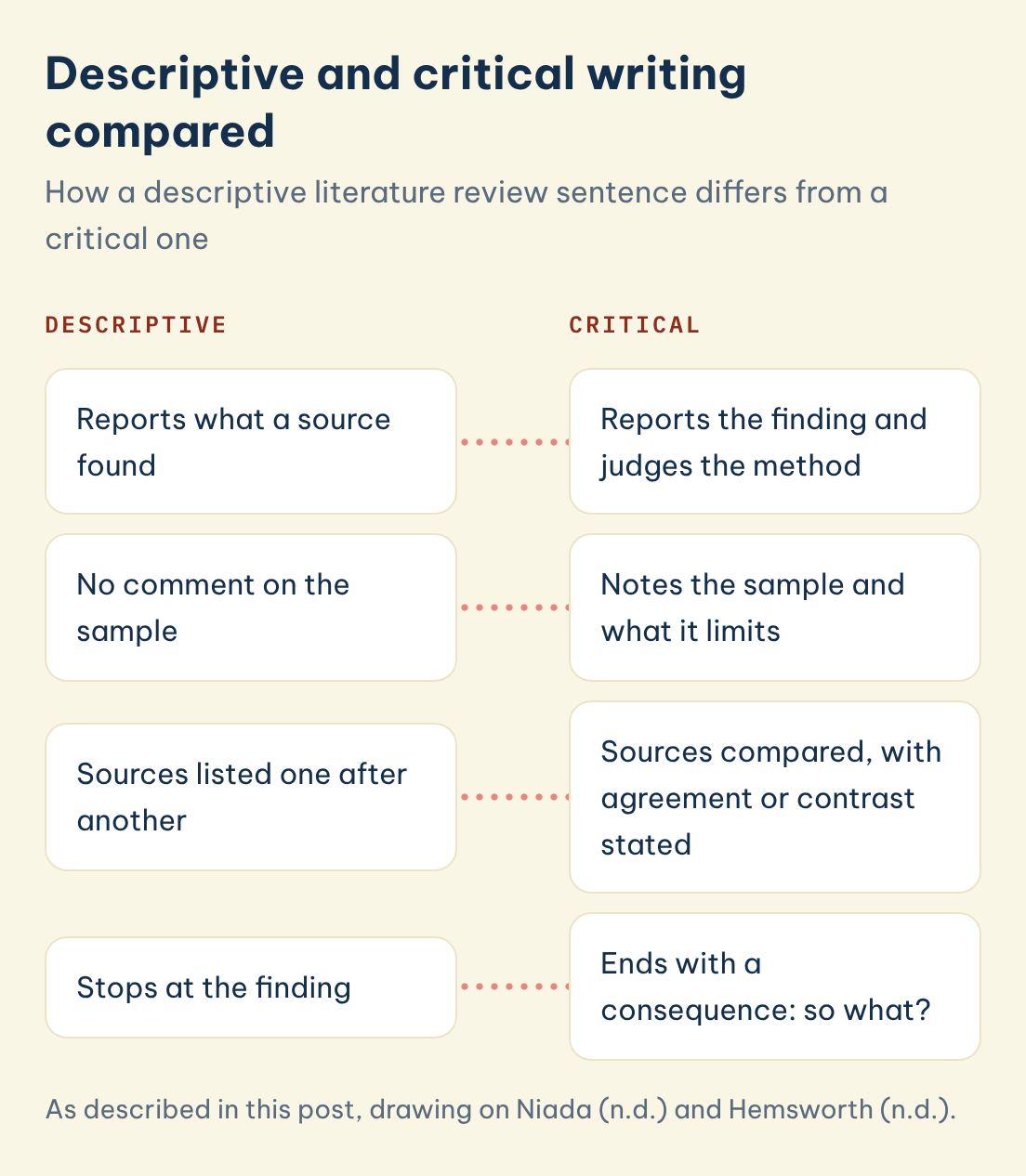
Each of the 3 rewrites does 3 things. It keeps the original finding, so nothing is lost. It adds a judgment about method or sample, and it states a consequence for how the finding can be used. Sheffield Hallam's guide shows the same contrast on a longer scale. Hemsworth (n.d.) says paragraph A "summarises and describes the research papers, rather than giving an evaluation or clear comparison of the different sources", while the critical version ends by saying what future research might therefore do.
Sheffield Hallam also gives a rule for paragraph shape. Hemsworth (n.d.) says each paragraph "should bring together or synthesise two or more pieces of reading", so a critical sentence usually sits inside a paragraph that already compares sources. If you want to see how that comparison works across a whole paragraph, the annotated example annotates four paragraphs one by one.
◆ Question 4 / 9 · Does critical mean negative
Does critical mean negative?
Direct answer: No. Webster and Watson (2002) warn against being overly critical: "A successful literature review constructively informs the reader about what has been learned" (p. xviii). Critical evaluation is a judgment of strength and limits, which includes saying what a source does well, and it is not a hunt for faults.
Webster and Watson (2002) go on to contrast a review of the whole literature with a critique of single papers: "In contrast to specific and critical reviews of individual papers, tell the reader what patterns you are seeing in the literature" (p. xviii). They quote Daft's warning that "Criticizing is easy, and of little value; it is more important to explain how research builds upon previous findings rather than to claim previous research is inadequate and incompetent" (Daft, 1985, as cited in Webster & Watson, 2002, p. xviii).
This matches what university guides say about weaknesses. UNSW Sydney (n.d.) asks you to highlight "the strengths, weaknesses and omissions of the literature". A fair critical sentence therefore often has 2 halves, a credit and a limit, and pure fault-finding should be rare. "Study A uses a large sample, but it measures wellbeing only once" is critical, accurate and respectful. "Study A is weak" is negative, and it does not tell the reader anything they can check.
Webster and Watson (2002) also give the purpose that criticism serves: "A review should identify critical knowledge gaps and thus motivate researchers to close this breach" (p. xix). Criticism is the route to the gap, and the gap is what justifies your own project. The University of Sydney (n.d.) agrees, saying you will use critical writing in the literature review to show where there is a gap or opportunity in the existing research.
◆ Question 5 / 9 · Versus systematic
What is a critical literature review, and how does it differ from a systematic review?
Direct answer: A "critical review" differs from a systematic review mainly in method. A critical review "goes beyond mere description of identified articles and includes a degree of analysis and conceptual innovation" (Grant & Booth, 2009, p. 93), while a systematic review follows a formal, explicit search and appraisal process.
Three different things share the word "critical", and it helps to separate them. UCL Institute of Education (n.d.) says "A critique (or critical review) is not to be mistaken for a literature review". A critical review, it explains, is a complete type of text discussing one particular article or book in detail, whereas a literature review, which also needs to be critical, is part of a larger text such as a dissertation chapter. So the literature review chapter in your thesis should be critical, but it is not a critique of one paper.
Grant and Booth (2009) are describing a third usage, a standalone review type. Their typology sets out what a critical review looks like and what it lacks.
| Feature | Critical review | Systematic review |
|---|---|---|
| Aim | Demonstrates extensive reading and critical evaluation of quality | Appraises and synthesises research evidence |
| Typical product | A hypothesis or a model, not an answer (Grant & Booth, 2009, p. 93) | A synthesis of the evidence that meets the question |
| Search and methods | No formal requirement to present methods of search, synthesis and analysis explicitly | Often follows guidelines on how the review is conducted |
| Quality appraisal | No formal quality assessment; attempts to evaluate according to contribution | Appraises research evidence (Grant & Booth, 2009, p. 95) |
The comparison draws on Grant and Booth (2009, pp. 93-95), a typology that covers 14 review types in 18 pages. It appeared in volume 26 of Health Information and Libraries Journal in 2009, and Webster and Watson (2002) published their guidance in volume 26 of MIS Quarterly, on pages xiii to xxiii, 7 years earlier. The 2009 paper also names a perceived strength: a critical review "provides an opportunity to 'take stock' and evaluate what is of value from the previous body of work" and "may also attempt to resolve competing schools of thought" (p. 93). Among the weaknesses, they note that critical reviews "do not typically demonstrate the systematicity of other more structured approaches to the literature". The authors place a systematized review, an attempt to include elements of the systematic review process while stopping short of a full systematic review, and note that it is typically conducted as a postgraduate student assignment (p. 95). If your department asks for a systematic or systematized approach, follow the method instructions in your brief, because a critical literature review does not replace them.
◆ Question 6 / 9 · Methodology
What methodology does a critical literature review use?
Direct answer: A critical or integrative review goes beyond summary. Snyder (2019) writes that it aims "to assess, critique, and synthesize the literature on a research topic" (p. 335), and that it "should not be descriptive or historical but should preferably generate a new conceptual framework or theory" (p. 336).
Snyder (2019) places that definition on p. 335 of the article, and also gives a warning that many students will recognise: "Frequently, reviews labeled as integrative are simply summaries of studies and not truly integrative" (p. 336). In practice, the method for coursework is modest and can be stated in 4 steps.
- Define the question. Snyder (2019) says the research question and the specific purpose of the review determine the right strategy to use, so write your question before you search.
- Read with the evaluation questions. Use the 6 questions above and log the answers for each source.
- Compile a concept matrix. Webster and Watson (2002) advise: "To make the transition from author- to concept-centric, we recommend that you compile a concept matrix as you read each article" (p. xvi).
- Synthesise by concept. Webster and Watson (2002) add: "When your reading is complete, synthesize the literature by discussing each identified concept" (p. xvi).
Although a critical review has no formal requirement to present its search method (Grant & Booth, 2009), your department may still ask you to say how you searched. Check your marking criteria. A short sentence naming the databases, search terms and inclusion limits you used costs little and shows the reader how you chose your sources.
◆ Question 7 / 9 · Structure
How should a critical literature review be structured?
Direct answer: Structure it by concept, not by author. Webster and Watson (2002) state that "A literature review is concept-centric. Thus, concepts determine the organizing framework of a review" and say the author-centric alternative "fails to synthesize the literature" (p. xvi). Inside each concept section, every paragraph follows the same critical pattern.
A workable structure for a coursework chapter or a dissertation review looks like this.
- Introduction: state the topic, the question and the concepts you will use to organise the review.
- One section per concept: in each, compare 2 or more sources, evaluate their evidence and method, and say what the pattern means.
- Cross-cutting critique: a section or paragraph on weaknesses shared across the studies, such as design, sample or measurement.
- Gap and link: name what remains unknown and link to your own project.
The University of Sydney (n.d.) notes that a literature review that identifies the strengths and weaknesses of existing research is one of its examples of critical writing, and UNSW Sydney (n.d.) gives the purpose of the review as identifying the gap that your work is attempting to address and creating a space for your work. The end of the review should therefore feel like the start of your project, and the closing sentences should say so.
For each paragraph inside a concept section, a simple 4-part pattern keeps you critical. Open with the idea, not an author. Bring in 2 or more sources and say how they relate. Evaluate their evidence or method, and finish with the "so what?" that Hemsworth (n.d.) describes. If a paragraph has no evaluation, it is description. If it has evaluation but no link to your question, it is a detour.
◆ Question 8 / 9 · Examples and samples
Is there a critical literature review example or sample PDF to follow?
Direct answer: Yes, and the most reliable ones come from your own university's library or academic skills pages, plus the example in our guide. Use any sample to learn technique, not wording. Check which type your brief wants, because a sample that is a standalone critical review, a systematic review or a thesis chapter will follow different conventions.
Searches for a critical literature review sample PDF often return journal articles titled "critical review". Those follow the standalone review type described by Grant and Booth (2009), which is not the same as a literature review chapter inside a dissertation (UCL Institute of Education, n.d.). Look at your marking criteria and your supervisor's guidance first, then pick a sample of the same type and length as yours.
When you read a sample, annotate it with 3 colours, one each for evaluation, comparison and gap. Mark each place where the author evaluates a method, compares sources or names a gap, and count how often it happens. If a paragraph contains no such moves, it is likely descriptive, even in a published example. Our annotated literature review example does this for an original four-paragraph review built on placeholder studies, so you can see the moves labelled.
◆ Question 9 / 9 · Mentor help
Can a mentor help you make a literature review critical?
Many students draft a literature review alone, and learning to evaluate sources is part of the degree. A mentor can still help with the parts that are hard to judge from inside the draft: whether a paragraph evaluates or still describes, whether your concepts are the right ones, and whether the gap you claim is genuinely a gap. Through thesis and dissertation mentoring at MAAS, you read, write and decide, and a mentor guides the approach and reviews the work you produce. The mentor does not write for you, and there is no promise about results, because your supervisor and your institution decide those. If the mentor is not a fit, you can ask to change mentor. Share your brief, your marking criteria and your current draft in the first session so the mentor can respond to your actual assignment.
Frequently asked questions
How do I make my literature review more critical?
Judge each source on its evidence, method, balance and relationship to other work, then explain what the pattern means for your question. UCL Institute of Education (n.d.) suggests asking where the data come from, whether they are sufficient and whether the text is balanced, and Hemsworth (n.d.) adds the "so what?" question.
Does critical mean I have to criticise every study?
No. Webster and Watson (2002) warn against being overly critical and say a review should constructively inform the reader (p. xviii). Name strengths as well as limits, and focus on patterns across the literature.
What is the difference between description, analysis and evaluation?
In a commonly used model that Niada (n.d.) outlines, critical writing has three parts. Description explains what something is, analysis explores how it works, and evaluation judges its quality, strength or value.
Is a critical review the same as a literature review?
Not exactly. UCL Institute of Education (n.d.) describes a critical review as a complete text that discusses one article or book in detail, while a literature review is part of a larger text and also needs to be critical. Grant and Booth (2009) treat the critical review as a review type of its own.
How is a critical literature review different from a systematic review?
A critical review demonstrates extensive reading and critical evaluation without a formal requirement to present its search methods, while a systematic review seeks to systematically search for, appraise and synthesise evidence (Grant & Booth, 2009, pp. 93-95).
Should a critical literature review be organised by author or by concept?
By concept. Webster and Watson (2002) call a review concept-centric and say the author-centric approach fails to synthesize the literature (p. xvi).
References
Grant, M. J., & Booth, A. (2009). A typology of reviews: An analysis of 14 review types and associated methodologies. Health Information and Libraries Journal, 26(2), 91–108. https://doi.org/10.1111/j.1471-1842.2009.00848.x
Hemsworth, K. (n.d.). Critical writing. In Literature reviews. Sheffield Hallam University Library. https://libguides.shu.ac.uk/literaturereviews/critical-writing
Niada, L. (n.d.). Critical writing and argumentation. In Critical thinking and writing. University of Westminster Library. https://libguides.westminster.ac.uk/critical-thinking-and-writing/critical-writing
Snyder, H. (2019). Literature review as a research methodology: An overview and guidelines. Journal of Business Research, 104, 333–339. https://doi.org/10.1016/j.jbusres.2019.07.039
The University of Sydney. (n.d.). Types of academic writing. https://www.sydney.edu.au/students/study-skills/writing/types-of-academic-writing.html
UCL Institute of Education. (n.d.). Academic writing: Writing critically. UCL Academic Writing Centre. https://www.ucl.ac.uk/ioe/departments-and-centres/academic-writing-centre/resources-academic-reading-and-writing/academic-writing-writing-critically
UNSW Sydney. (n.d.). Literature review. Academic Skills Support toolkit. https://www.unsw.edu.au/student/managing-your-studies/academic-skills-support/toolkit/honours-postgraduate/literature-review
Webster, J., & Watson, R. T. (2002). Analyzing the past to prepare for the future: Writing a literature review. MIS Quarterly, 26(2), xiii–xxiii. https://doi.org/10.2307/4132319
Tools & resources
Not sure how this guide applies to your own case? Talk it through with MAAS in a free 20-minute consultation.
Book a free consultation ▸