
◆ Writing Tips
How do you write a critical review instead of a summary?
Category: writing-tips
Last updated: 2026-09-04
A student hands in a careful, accurate account of a research article and gets it back marked "too descriptive". Every claim in the piece is correct. The problem is that most of it explains what the article said, and the marker was looking for what the student thought about it and why.
Direct answer: A critical review summarises briefly and evaluates at length. UNSW Sydney (n.d.) states that the summary "should occupy about one-third of the review". The rest carries your judgement of the work, supported by criteria and evidence rather than by preference.
The word that misleads most students. Being critical is not being negative. UNSW Sydney (n.d.) says plainly that "at university, being critical does not mean criticising negatively", and a review finding a study convincing is exactly as critical as one finding it flawed, provided it says why against stated criteria.
This guide covers how much summary is allowed, what research says students actually get wrong, the structure universities publish, the criteria you evaluate against, where the marks sit, and how to disagree politely.
◆ Question 1 / 6 · How much of a critical
How much of a critical review should be summary?
Direct answer: There is no single answer, and that is the finding rather than a gap in this guide. Published guidance runs from a paragraph or two up to half the piece, so the ratio in your own brief overrides anything you read online, including this article.
Three institutions land near a third. UNSW Sydney (n.d.) gives "about one-quarter to one-third of the entire review", Ontario Tech University (n.d.) states "the summary should only make up about a third of the critical review", and Zabin (2003), writing for Carleton College, instructs students to "do NOT spend more than one-third or so of the paper summarizing the book".
Others sit far from a third. Purdue Online Writing Lab (n.d.) tells reviewers to "determine what kind of balance to strike between your summary information and your evaluation" and adds that "often the ratio is half and half", though the same page also says to ensure the summary is brief and to ask your instructor first. Federation University Australia (2025) likewise sets the weighting of summary and critique as approximately equal.
At the strict end, a journal caps the retelling outright. The Intergenerational Justice Review instructs reviewers that "a review is not re-narration. The second part of a review should not make up more than 60% of the review", and proposes a split of roughly 10%, 60% and 30% across context, content and evaluation (Intergenerational Justice Review, 2025). The same guidance calls those figures "merely indicators for orientation".
Some guides drop percentages and count paragraphs instead. Trent University (n.d.) advises "keep the summary of the work short! A paragraph or two should be sufficient", while UNSW Sydney (n.d.) sets 1 paragraph of introduction for an article review and 2 or 3 for a book review. None of these sources is wrong, and the practical lesson is that the ratio is a local rule.
◆ Question 2 / 6 · What does the evidence say
What does the evidence say students actually get wrong?
Direct answer: They substitute opinion for evaluation. Wingate (2012) analysed 60 first-year essays with comments from 5 tutors and found that most low-achieving writers "had not developed a position, rather they had presented lists of facts from the literature, or stated their personal opinions". That is the exact failure a critical review exposes.
The same study, published in the Journal of English for Academic Purposes, surveyed what students believed criticality meant, reporting that "there seems to be little awareness of the need to evaluate and analyse sources: less than half of the respondents mentioned the need for evidence, and only eight the need for analysis" (Wingate, 2012). Tutors saw it too, with 14 comments on low-achieving essays accusing writers of lacking criticality.
The corrective matters as much as the diagnosis. Woodward-Kron (2002), analysing 20 successful essays by trainee teachers in the same journal, found that "forms of descriptive writing such as naming, taxonomising, and reporting are intrinsic to students' attempts at critical analysis". Description in the wrong place is the error, not description itself.
Evaluation is also a language problem rather than only a thinking problem. Aull and Lancaster (2014), in Written Communication, compared "over 4,000 argumentative essays written by incoming first-year university students" against advanced and published writing. Lam and Crosthwaite (2018) examined 60 sampled essays, 20 by native speakers and 40 by Hong Kong second-language writers, and found first-language writers used significantly more engagement devices. If your evaluation reads flat, the missing piece is often hedging and attribution rather than ideas.
The genre itself is real and named. Gardner and Nesi (2013), in Applied Linguistics, classified "all 2858 BAWE (British Academic Written English) corpus texts actually produced by undergraduate and taught postgraduate university students in England for assessment purposes", and the critique family sits among them. Your tutor is not inventing a private format.
◆ Question 3 / 6 · What is the standard
What is the standard structure of a critical review?
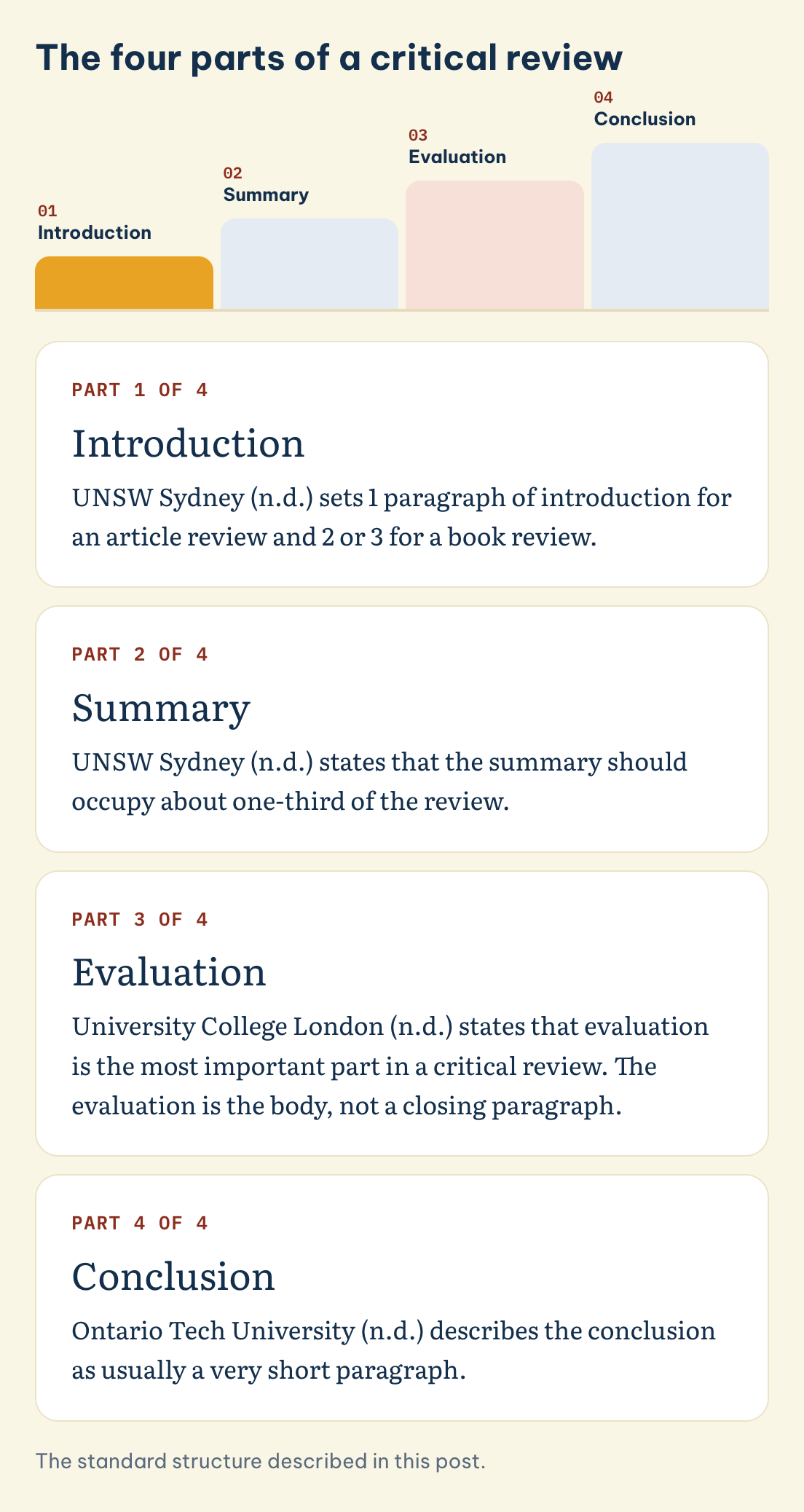
Direct answer: Four parts, namely an introduction, a short summary, an evaluation section, and a conclusion. University College London (n.d.) puts the weight where it belongs, stating that "evaluation is the most important part in a critical review". The evaluation is the body, not a closing paragraph.
The four parts of a critical review
Tap a part to see what the post says about it.
Part 1 of 4
Introduction
UNSW Sydney (n.d.) sets 1 paragraph of introduction for an article review and 2 or 3 for a book review.
Part 2 of 4
Summary
UNSW Sydney (n.d.) states that the summary should occupy about one-third of the review.
Part 3 of 4
Evaluation
University College London (n.d.) states that evaluation is the most important part in a critical review. The evaluation is the body, not a closing paragraph.
Part 4 of 4
Conclusion
Ontario Tech University (n.d.) describes the conclusion as usually a very short paragraph.
Save this figure
The University of Kent (n.d.) sets out the same shape for short pieces, describing "a simple structure for a short review of a book or journal article (c. 500-1000 words)" running from introduction through summary, strengths, weaknesses and conclusion. Above roughly 1000 words, Kent recommends working through the source section by section instead.
Keep the number of evaluated points small. The Australian National University (n.d.) instructs students to "critically discuss 2-3 key issues raised in the text. This section is the core of your review", and a review raising 8 minor points reads as a list while one developing 3 reads as an argument.
The conclusion is the part you may be able to cut. Federation University Australia (2025) notes that "in a critical review of 800 words, a conclusion might not even be necessary", and Ontario Tech University (n.d.) describes the conclusion as "usually a very short paragraph". Trent University (n.d.) instead asks you to front-load the verdict in "a clear 1-2 sentence thesis statement".
Length itself varies by outlet. The University of North Carolina Writing Center (n.d.) observes that in newspapers and academic journals reviews "rarely exceed 1000 words", Massey University (n.d.) gives 100 to 500 words for a general book review and up to 1,500 for an academic one, and Purdue Online Writing Lab (n.d.) puts the typical range at 500 to 750 words.
◆ Question 4 / 6 · What exactly are you
What exactly are you evaluating?
Direct answer: Four things, namely the significance of the contribution, the methodology, the argument and its evidence, and the writing and structure. UNSW Sydney (n.d.) publishes these as its criteria with focus questions attached, which turns a vague instruction to evaluate into a set of answerable questions.
Significance asks what the author set out to do and how far they got there. The Australian National University (n.d.) adds a caution that saves students from a common trap, noting that "it is seldom useful to criticise a writer for not doing something they never intended to do". Read the stated aim before judging the scope.
Methodology asks whether the approach fits the question and whether the results can bear the weight placed on them. Argument and evidence ask whether a clear position is stated and whether the evidence supports the conclusion rather than merely accompanying it. The University of North Carolina Writing Center (n.d.) frames the whole task in 1 line, noting that "the most important element of a review is that it is a commentary, not merely a summary".
Reading is where the evaluation is actually produced. The University of Melbourne (n.d.) observes that "asking critical questions helps you to read actively and avoid getting carried away by the details of a text because these questions often require synthesis and interpretation of the whole text". The Australian National University (n.d.) publishes 11 such questions covering objectives, theory, concepts, argument, method, evidence, values, literature, contribution, style and conclusion.
The University of Sydney (2026) offers the cleanest test of whether a piece has crossed into critical writing, stating that "while persuasive writing requires you to have your own point of view on an issue or topic, critical writing requires you to consider at least two points of view, including your own".
◆ Question 5 / 6 · Where do the marks
Where do the marks and the hours actually sit?
Direct answer: Analysis carries more marks than summary, and most of your hours go before you write. One published rubric splits a critical review into 5 categories worth 20% each, of which 2 concern analysis and only 1 is summary, so evaluation is worth double what retelling is worth.
That rubric comes from a computer science module at the University of Toronto (n.d.), which weights Summary, Overall Quality of Analysis, Support of Analysis, Organization and Content, and Mechanics at 20% each. Oxford Brookes University (n.d.) states the same principle without numbers, noting that "the evaluation and judgement parts normally count for more marks".
The time budget is more surprising than the mark budget. Queen's University (n.d.) publishes a 12-step plan with a percentage against each step, allocating 20% to careful reading, 15% to drafting the analysis and 7% to developing evaluation criteria, against 20% for writing the first draft. Adding those 3 preparatory steps gives 42% of the total spent before the first sentence is written.
The planning consequence is concrete. If a critical review is due in 10 days, roughly 4 of those belong to reading and building criteria, which is exactly the stage students compress when a deadline tightens. Queen's University (n.d.) also notes that "the number of criteria will depend on the length of your review", so a 1-page review needs fewer criteria rather than shallower ones.
◆ Question 6 / 6 · How do you disagree without
How do you disagree without sounding rude?
Direct answer: Use tentative verbs, concede what the work does well before naming a limitation, and phrase problems as improvements rather than failures. The University of Leeds Library (n.d.) frames the underlying move as writing that does "not only describe what happened, but also identify the significance of what happened".
The Academic Phrasebank at the University of Manchester (n.d.) supplies ready patterns for the constructive form, including "the study would have been more interesting if it had included …", which names a gap without attacking the author. The same source offers direct forms such as "the main weakness of the study is the failure to address how …" for cases where the problem is central.
Sequence matters as much as vocabulary. The Australian National University (n.d.) instructs students to "make clear the author's own argument before you criticise and evaluate it", because a criticism landing before the reader understands the position reads as a misreading rather than as an objection.
The failure mode is documented. University College London (n.d.) prints a sample passage that paraphrases a source and stops there, commenting that "this is not a good example of critical writing, as the writer has not made any critical comment". Adding a source without adding a judgement leaves the paragraph descriptive, which returns to what Wingate (2012) found across 60 essays.
Frequently asked questions
Can I use the first person in a critical review?
Usually yes, and many disciplines expect it, because the review is your judgement. Check your unit guide, and if first person is discouraged, phrase evaluation through the evidence instead, as in "the sample size limits the claim" rather than "I think the sample was too small".
How many sources should a critical review cite?
Fewer than an essay, because the reviewed text is your main source. You still cite the works you use to judge it, such as a methods reference or a competing study. Our guide to referencing in university assignments covers placement.
Is a critical review the same as a peer review?
No. A peer review advises an editor on whether to publish and is confidential. A critical review is an assessed piece of student writing about work already published. The evaluative criteria overlap, but the audience and the purpose differ.
What if I agree with everything in the article?
Then say so and justify it against criteria. Agreement supported by reasons is critical writing, while agreement stated as preference is not. Name what the study does well, note the limits the authors acknowledge, and say what would strengthen the claim further.
Related resources
- How to write a university essay: the general structure this specialises
- Assignment command words explained: what "evaluate" and "critically discuss" actually require
- How to do a university assignment: reading a brief before you start
- Literature review guide: the related but different genre
- Academic Support service: coaching through Outline, Draft and Final with a discipline-matched expert
Ready to start? Book a free 20-minute consultation. Bring the article you are reviewing and your marking rubric, and we will match you to a mentor in your discipline within 48 hours.
References
- Aull, L. L., & Lancaster, Z. (2014). Linguistic markers of stance in early and advanced academic writing: A corpus-based comparison. Written Communication, 31(2), 151-183. https://doi.org/10.1177/0741088314527055
- Australian National University. (n.d.). Writing a critical review. Retrieved September 4, 2026, from https://www.anu.edu.au/students/academic-skills/writing-assessment/other-assessments/writing-a-critical-review
- Federation University Australia. (2025). Critical reviews [Helpsheet]. https://www.federation.edu.au/siteassets/files/students/study-skills/critical_reviews_helpsheet-2025.pdf
- Gardner, S., & Nesi, H. (2013). A classification of genre families in university student writing. Applied Linguistics, 34(1), 25-52. https://doi.org/10.1093/applin/ams024
- Intergenerational Justice Review. (2025). Guidelines for book reviewers. https://intergenerationaljustice.org/wp-content/uploads/2025/04/Guidelines-for-Book-Reviewers_IGJR_Jan-2025.pdf
- Lam, S. L., & Crosthwaite, P. (2018). APPRAISAL resources in L1 and L2 argumentative essays: A contrastive learner corpus-informed study of evaluative stance. Journal of Corpora and Discourse Studies, 1(1), 8-35. https://doi.org/10.18573/jcads.1
- Massey University. (n.d.). Book review. Retrieved September 4, 2026, from https://www.massey.ac.nz/study/postgraduate-study/postgraduate-support-and-resources/types-of-assignments/book-review/
- Ontario Tech University. (n.d.). Writing a critical review. Student Learning Centre. Retrieved September 4, 2026, from https://shared.ontariotechu.ca/shared/department/student-learning-centre/handouts/critical-review-updated-20222.pdf
- Oxford Brookes University. (n.d.). Critical review. Retrieved September 4, 2026, from https://www.brookes.ac.uk/students/academic-development/online-resources/critical-review
- Purdue Online Writing Lab. (n.d.). Writing a book review. Purdue University. Retrieved September 4, 2026, from https://owl.purdue.edu/owl/general_writing/common_writing_assignments/book_reviews.html
- Queen's University. (n.d.). Critical review. Student Academic Success Services. Retrieved September 4, 2026, from https://sass.queensu.ca/assignments/critical-review
- The University of Manchester. (n.d.). Being critical. Academic Phrasebank. Retrieved September 4, 2026, from https://www.phrasebank.manchester.ac.uk/being-critical/
- The University of Melbourne. (n.d.). Reading critically. Retrieved September 4, 2026, from https://students.unimelb.edu.au/academic-skills/reading-writing-and-referencing/reading-and-note-taking/how-to-read-effectively-and-critically
- The University of Sydney. (2026, May 6). Types of academic writing. https://www.sydney.edu.au/students/study-skills/writing/types-of-academic-writing.html
- Trent University. (n.d.). How to write academic reviews. Academic Skills. Retrieved September 4, 2026, from https://www.trentu.ca/academicskills/how-guides/how-write-university/how-approach-any-assignment/how-write-academic-reviews
- University College London, Institute of Education. (n.d.). Academic writing: Writing critically. Retrieved September 4, 2026, from https://www.ucl.ac.uk/ioe/departments-and-centres/academic-writing-centre/resources-academic-reading-and-writing/academic-writing-writing-critically
- University of Kent. (n.d.). Critical book and article reviews. Retrieved September 4, 2026, from https://www.student.kent.ac.uk/studies/literature-reviews/critical-book-and-article-reviews
- University of Leeds Library. (n.d.). Critical writing. Retrieved September 4, 2026, from https://library.leeds.ac.uk/info/1401/academic_skills/105/critical_thinking/5
- University of North Carolina Writing Center. (n.d.). Book reviews. Retrieved September 4, 2026, from https://writingcenter.unc.edu/tips-and-tools/book-reviews/
- University of Toronto, Department of Computer Science. (n.d.). CSC290 critical review grading rubric [PDF]. Retrieved September 4, 2026, from https://www.cs.toronto.edu/~lczhang/290/files/cr_rubric.pdf
- UNSW Sydney. (n.d.). Critical review. Retrieved September 4, 2026, from https://www.unsw.edu.au/student/managing-your-studies/academic-skills-support/toolkit/writing/critical-review
- Wingate, U. (2012). 'Argument!' helping students understand what essay writing is about. Journal of English for Academic Purposes, 11(2), 145-154. https://doi.org/10.1016/j.jeap.2011.11.001
- Woodward-Kron, R. (2002). Critical analysis versus description? Examining the relationship in successful student writing. Journal of English for Academic Purposes, 1(2), 121-143. https://doi.org/10.1016/S1475-1585(02)00013-9
- Zabin, S. (2003). How to write a critical book review. Carleton College, Department of History. https://www.carleton.edu/history/resources/history-study-guides/criticalbookreview/
This article is part of the MAAS Journal series for Vietnamese international students. We guide students through worked examples, drafts and feedback so they build their own evaluation of a text, and we do not write reviews on students' behalf.
A free 20-minute consultation is a conversation about your situation, with the article you are reviewing and your marking rubric in hand.
Book a free consultation ▸