
◆ Study skills
What are command words? Discuss, analyse and evaluate explained
Command words are the instruction verbs that set your answer type: describe reports, analyse breaks material apart, and discuss weighs viewpoints with evidence and concludes. Reading them together with the content words and limiting words around them tells you what to write about and where the boundaries of your answer sit.
Most misread questions do not fail on the topic; they fail because one of those three groups of words was skimmed over, or because a familiar word like discuss was assumed to carry its everyday meaning rather than its academic one. It is also worth saying early that no glossary is absolute, since the University of Portsmouth (n.d.) cautions that these words do not hold a fixed meaning in every subject. This guide gives you a glossary of 16 command words defined by university writing centres, a three-step method for decoding any question before you start researching, and the habits that keep a finished answer inside the question the marker actually set.
Last updated: 2026-07-02
Category: writing-tips

◆ Part 1 / 6 · Type of answer
Command words tell you the type of answer, not the topic
Direct answer: Command words are the instruction verbs in an assignment question, such as discuss, analyse and evaluate, that tell you what type of response the marker expects, per RMIT University. Together with the content words that state the topic and the limiting words that set boundaries, they tell you what to write about and where your answer should stop.
RMIT University (n.d.-b) describes instruction words as the verbs in an assignment question that specify the type of response required: they are what separates a question asking you to report from a question asking you to judge. A university library guide states the mechanism plainly: "Task words are usually verbs and they tell you what to do to complete your assignment" (James Cook University Library, 2026). If your brief comes from a UK university you may meet a different name for the same idea; The Open University (n.d.) calls them "process words", instructions "expressed as imperatives" that tell you what to do with the subject matter.
Two questions can share every content word and still be entirely different assignments. "Describe the recruitment process at firm X" and "Evaluate the recruitment process at firm X" cover identical territory, yet the first asks for an account while the second asks for a defended judgement, each marked against that expectation. The command word also points toward a shape: our guides to structuring a university essay and structuring a university report pick up where this glossary ends.
◆ Part 2 / 6 · Three parts
The three parts of every assignment question
Direct answer: Every assignment question is built from three groups of words, per RMIT University: instruction words that state what to do, content words that name the topic, and limiting words that set boundaries such as time, place or population. James Cook University Library also names a fourth category, context words, background phrasing that frames the question without adding new instructions.
The three groups of words in every assignment question
Tap a group to see what it does.
Instruction words
The verbs in an assignment question that specify the type of response required, and so state what to do.
Content words
The words that carry the topics, theories and concepts the answer must cover. They are also your search vocabulary.
Limiting words
The words that narrow the scope to a specific time period, place or population, such as in the last ten years.
RMIT University (n.d.-b) breaks an assignment question into three groups: content words, instruction words and limiting words. James Cook University Library (2026) works with the same anatomy under slightly different names (task words, content words and limiting words) and adds a fourth category of context words: background phrasing that frames the question without adding new instructions. This anatomy sits behind Step 1 of the six-step assignment guide; here we take it further and turn it into a repeatable method. The broader sequence from reading the brief to submitting is laid out in how to do a university assignment. If your brief is a case study, the case study assignment guide applies the same reading of the question to that format.
Task words: what to do
Task words are the command verbs themselves. They determine the type of thinking you must show and, in most cases, the shape of the answer: a describe question can be organised around features, while a discuss question needs viewpoints, evidence on each side and a conclusion. When you are unsure how to structure a response, the task word is the first place to look. A describe question typically sits at the comprehension level Bloom (1956) placed near the base of his taxonomy, while a discuss or evaluate question sits at the analysis or evaluation level Anderson and Krathwohl (2001) placed well above it in their revision, which is one reason the second kind of question expects more than an accurate recap of what you found.
Content words: what to write about
Content words carry the topics, theories and concepts the answer must cover. They are also your search vocabulary: the terms you will put into the library catalogue and databases come from here, together with their synonyms. An answer can execute the task word perfectly and still fall short if it quietly swaps the set content for adjacent material you happened to know better. RMIT University (n.d.-b) separates content from task for exactly this reason, and Lea and Street (1998) would frame the swap as a discipline problem rather than a carelessness problem: the content that counts as relevant in one subject is not automatically the content that counts as relevant in another, even when the surface topic looks the same.
Limiting words: the boundaries the marker will hold you to
Limiting words narrow the scope, restricting the question to a specific time period, place or population, such as "in the last ten years", "in Melbourne" or "students in year seven" (RMIT University, n.d.-b). They look minor on the page, yet they are commitments; a marker reading an answer about the wrong decade or the wrong population is reading an answer to a different question. The University of Reading (n.d.) treats them the same way, listing them among the terms worth underlining before you plan, on the reasoning that a boundary you did not notice while planning is a boundary you will not respect while writing.
◆ Part 3 / 6 · The glossary
A 16-word glossary, defined by university writing centres
Direct answer: The glossary below groups 16 command words into three tiers of increasing independent judgement, an ordering Bloom (1956) established in his taxonomy of cognitive objectives: words that ask you to report accurately, such as describe or summarise; words that ask you to break material apart, such as analyse or compare; and words that ask for a defended judgement, such as discuss or evaluate.
Command words
16
are defined in the post's glossary, each from a university writing centre or library guide
Groups
3
of increasing independent judgement make up the glossary, an editorial arrangement to make the list easier to hold in mind
Three groups of command words
Tap a group to see the words in it and what they ask for.
Group 1 / 3
Report
Describe, outline, summarise and explain. These words ask you to convey material accurately, and precision and coverage carry the marks.
Group 2 / 3
Break apart
Analyse, examine, compare, contrast and interpret. These words ask you to work on the material rather than reproduce it, by separating parts, tracing relationships and drawing out meaning.
Group 3 / 3
Judge
Discuss, evaluate, critically evaluate, critique, review, justify and to what extent. These words ask you to take a position and defend it with evidence, and an answer that stops at accurate reporting has not yet answered the question.
Every definition below comes from a university writing centre or library guide, cited beside it. The three groups are an editorial arrangement to make the list easier to hold in mind: each group asks for progressively more independent judgement from you, moving from reporting what is known, to taking material apart, to defending a verdict.
That ordering is not an editorial invention. Bloom (1956) placed knowledge and comprehension, the territory of describe, outline and summarise, below analysis and evaluation in his taxonomy of cognitive objectives, and Anderson and Krathwohl (2001) kept that same ordering when they revised the taxonomy decades later, ranking analysing above understanding and evaluating above analysing. Biggs and Collis (1982) describe a parallel progression through their SOLO taxonomy: an answer that only lists points sits below one that shows how the parts relate, which in turn sits below an answer that generalises beyond the material it was given, a climb that tracks the move from reporting to breaking apart to judging almost exactly. Command words are therefore not a vocabulary list to memorise; they are markers for where a question sits on that same climb, and misreading one usually means answering at the wrong altitude rather than the wrong topic.
Words that ask you to report: describe, outline, summarise, explain
These words ask you to convey material accurately. Interpretation stays in the background; precision and coverage carry the marks.
| Command word | What it asks for | Defined by |
|---|---|---|
| Describe | Give a detailed account of the features, qualities or characteristics of the subject, without arguing a position | RMIT University (n.d.-a); University of Portsmouth (n.d.) |
| Outline | Give the main points or general principles, leaving out fine detail | RMIT University (n.d.-a); University of New South Wales (n.d.) |
| Summarise | State the key points briefly, omitting details, examples and side issues | RMIT University (n.d.-a); University of New South Wales (n.d.) |
| Explain | Show how or why something happens, giving the reasons or causes behind it | Massey University (n.d.); University of Sheffield (n.d.) |
Set side by side, the four reporting words separate cleanly by what they leave out. Describe asks for features, qualities and characteristics with no verdict attached (RMIT University, n.d.-a; University of Portsmouth, n.d.). Outline compresses that to main points and general principles, dropping the fine detail describe would keep (RMIT University, n.d.-a; University of New South Wales, n.d.). Summarise compresses further again, cutting details, examples and side issues that outline might retain, on the same authority. Explain alone asks for a mechanism rather than a shape, tying the answer to how or why something happens rather than to what it looks like (Massey University, n.d.; University of Sheffield, n.d.).
Words that ask you to break things apart: analyse, examine, compare, contrast, interpret
These words ask you to work on the material rather than reproduce it: separating parts, tracing relationships and drawing out meaning.
| Command word | What it asks for | Defined by |
|---|---|---|
| Analyse | Break the issue into its component parts, examine each part and show how the parts relate to one another | RMIT University (n.d.-a); University of Sheffield (n.d.) |
| Examine | Look closely at the subject, inspecting its details and questioning the assumptions behind it | University of Portsmouth (n.d.); University of Sheffield (n.d.) |
| Compare | Identify the similarities between two or more things, noting differences where they are relevant | Massey University (n.d.) |
| Contrast | Set two or more things against each other to bring out their differences | Massey University (n.d.); University of New South Wales (n.d.) |
| Interpret | Explain the meaning or significance of information or results, showing what they imply | RMIT University (n.d.-a); University of Sheffield (n.d.) |
The five words in this middle group divide by what they do to the material once it is in front of you. Analyse takes the issue apart, examines each component and shows how the parts relate to one another (RMIT University, n.d.-a; University of Sheffield, n.d.). Examine asks for a closer inspection of the same material, questioning the assumptions behind it rather than only its structure (University of Portsmouth, n.d.; University of Sheffield, n.d.). Compare and contrast are often taught as a pair, but they are not identical: compare identifies similarities and notes differences only where they are relevant (Massey University, n.d.), while contrast sets two or more things against each other specifically to bring out their differences (Massey University, n.d.; University of New South Wales, n.d.). Interpret closes the group by explaining the significance of information or results rather than only their content (RMIT University, n.d.-a; University of Sheffield, n.d.).
Words that ask for a judgement: discuss, evaluate, critically evaluate, critique, review, justify, to what extent
These words ask you to take a position and defend it with evidence. An answer that stops at accurate reporting has not yet answered the question.
| Command word | What it asks for | Defined by |
|---|---|---|
| Discuss | Explore the topic in detail, present the different viewpoints with the evidence for and against each, and reach a conclusion | RMIT University (n.d.-a); University of New South Wales (n.d.) |
| Evaluate | Weigh the strengths and weaknesses and deliver an overall judgement of worth or usefulness, supported by evidence | RMIT University (n.d.-a); Massey University (n.d.) |
| Critically evaluate | Show how judgements vary from different perspectives, argue why some judgements are stronger than others, and support your verdict with sources on both sides | University of Portsmouth (n.d.); University of Sheffield (n.d.) |
| Critique | Assess the value of a theory, argument or piece of work by weighing both its merits and its faults | RMIT University (n.d.-a) |
| Review | Survey the topic and examine it critically, commenting on the main points and their significance | RMIT University (n.d.-a); University of Sheffield (n.d.) |
| Justify | Give the evidence and reasoning that support a position or conclusion, answering the main objections that could be raised against it | RMIT University (n.d.-a); University of Sheffield (n.d.) |
| To what extent | Make a thorough assessment of the evidence in presenting your argument, exploring alternative explanations where they exist | University of Sheffield (n.d.) |
The judgement words are where most marks are lost, because each one asks for a different kind of verdict. Discuss wants the different viewpoints explored with evidence for and against each, closing on a conclusion (RMIT University, n.d.-a; University of New South Wales, n.d.). Evaluate wants the strengths and weaknesses weighed into an overall judgement of worth or usefulness (RMIT University, n.d.-a; Massey University, n.d.). Critically evaluate goes one step further again, asking you to show how judgements vary across perspectives and to argue why some are stronger than others, using sources on both sides of the question (University of Portsmouth, n.d.; University of Sheffield, n.d.). Critique asks specifically for both merits and faults to be weighed against each other (RMIT University, n.d.-a); review asks for the main points and their significance to be surveyed and commented on (RMIT University, n.d.-a; University of Sheffield, n.d.); justify asks you to answer the objections a sceptical reader would raise against your position (RMIT University, n.d.-a; University of Sheffield, n.d.). To what extent, finally, is a phrase rather than a single verb, framed as a demand for a thorough assessment of the evidence that still ends in a clear position (University of Sheffield, n.d.).
◆ Part 4 / 6 · Same word, different subject
Same word, different subject: why no glossary outranks your course handbook
Direct answer: No glossary, including this one, is absolute, because the same command word can ask for different work depending on the subject and the lecturer who set the question, a finding Lea and Street (1998) trace to differences between disciplines. The reliable hierarchy is your course handbook and assignment brief first, the marking criteria second, a general glossary third, and the lecturer last when the expectation is still unclear.
A glossary like the one above is genuinely useful, and for most assignments it will point you in the right direction. It should not, however, be treated as absolute. The University of Portsmouth (n.d.) states that none of these words have a fixed meaning, and that lecturers may attach specific definitions to a word within a particular subject or task. "Discuss" in a philosophy essay, a law problem question and a nursing case study can ask for noticeably different intellectual work, even though the verb is identical.
Lea and Street (1998) trace this instability to a deeper cause. Their academic literacies research, drawn from a study of undergraduate writing across UK universities, found that staff and students frequently held contrasting interpretations of the same assignment instructions, which they read as evidence that academic writing conventions are practices tied to a discipline rather than a single transferable skill. Chanock (2000) showed how costly that gap can be in practice: when students and tutors in humanities subjects were separately asked what the comment "too much description, not enough analysis" meant, almost half of the students did not read it the way their tutors intended, a mismatch centred on exactly the describe-versus-analyse distinction this glossary exists to close. Norton (1990) found a related mismatch a decade earlier: surveying first-year students and the tutors who marked their essays, she found students weighted content most heavily while tutors weighted argument, the two groups prizing different things under the same instruction word.
The reliable hierarchy is therefore your course handbook and assignment brief first, the marking criteria second, a general glossary third, and when the expectation is still unclear after all three, the lecturer or tutor who set the question. Asking what a command word means in this unit counts as exactly the kind of clarification writing centres encourage, and it is far cheaper than committing weeks of work to an interpretation. Across these sources the same conclusion holds from three different angles: a command word's demand depends on where it sits in a cognitive taxonomy (Bloom, 1956; Anderson & Krathwohl, 2001), in a discipline's own conventions (Lea & Street, 1998), and in the mind of the person marking your answer (Chanock, 2000; Norton, 1990), which is why the glossary above is a starting point rather than a substitute for asking.
In brief, the research above and the writing-centre guides below converge on the same warning from several directions:
- Bloom (1956) ranks comprehension below analysis and evaluation in his taxonomy of cognitive objectives.
- Anderson and Krathwohl (2001) kept that ranking when they revised the taxonomy, placing evaluating above analysing.
- Biggs and Collis (1982) describe the same climb through their SOLO taxonomy, from unconnected points to a generalised judgement.
- Lea and Street (1998) found that staff and students often read the same assignment instructions differently across disciplines.
- Chanock (2000) found that almost half of the students they studied misread the comment "too much description, not enough analysis."
- Norton (1990) found that students weighted essay content most heavily while the tutors marking those essays weighted the argument built on it.
- RMIT University (n.d.-b) and James Cook University Library (2026) independently break every assignment question into the same three parts, task, content and limiting words, a structure this guide follows throughout.
- The University of Reading (n.d.) and the University of Hull (2026) both recommend marking up a question before researching it, on the same reasoning Step 1 below builds on.
◆ Part 5 / 6 · Three-step method
How to decode a question before you research: a three-step method
Direct answer: Decode a question in three steps before you research, a method the University of Reading recommends. First, mark the task, content and limiting words separately. Second, restate the question in one plain sentence of your own, which exposes any gap in understanding early. Third, split questions that carry more than one command into separate jobs, each planned against its own command word.
Three steps to decode a question before you research
Tap a step to see what to do.
Step 1 of 3
Mark the words
Work through the question three times with a pen, one group per pass: circle the task words, underline the content words, box the limiting words.
Step 2 of 3
Restate the question
Rebuild the marked elements into one plain sentence of your own. If you cannot restate the question without looking back at it, you have found a gap in understanding at the cheapest possible moment.
Step 3 of 3
Split the jobs
Many questions carry more than one command. Each job needs its own section of the answer, planned against its own command word.
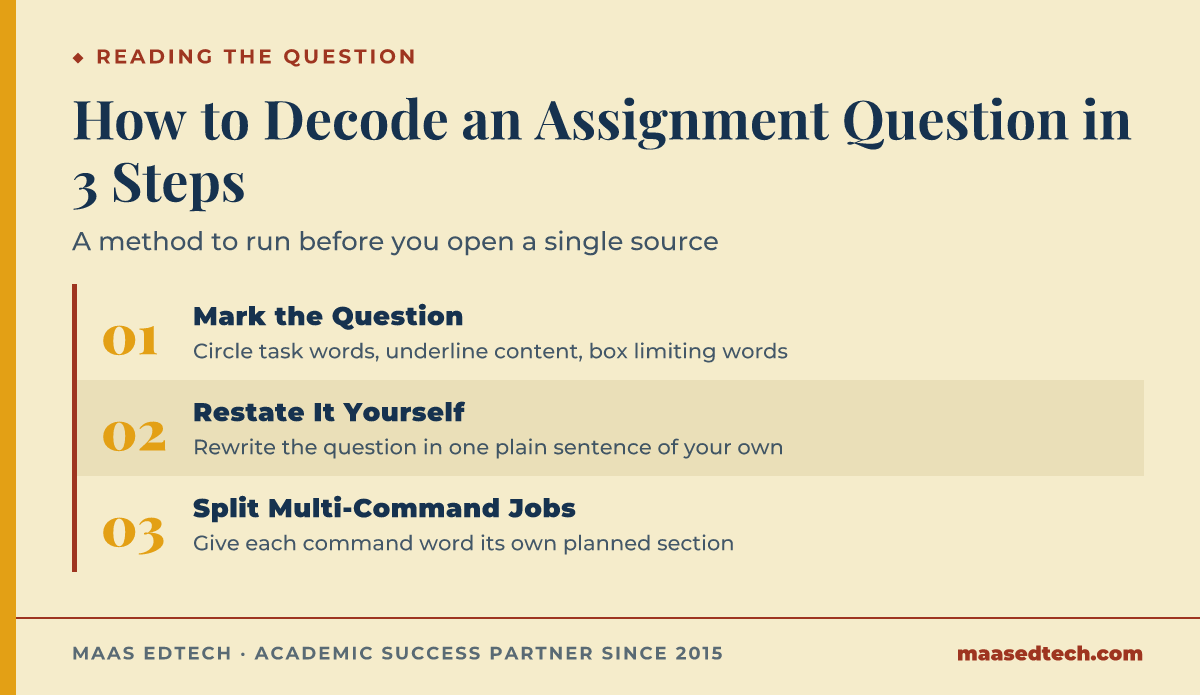
Step 1: mark the task, content and limiting words
Work through the question three times with a pen, one group per pass: circle the task words, underline the content words, box the limiting words. The University of Reading (n.d.) recommends underlining or highlighting the key terms of a question for exactly this reason: marking them helps you identify the crucial information in the question and clarify what it is asking you to do. Three passes sounds slow; in practice it takes a minute and surfaces words that a single reading glides over.
Step 2: restate the question in your own words
McMillan and Weyers (2013, as cited in University of Hull, 2026) advise students to "break down the question into its different elements" as a way into understanding what it requires. Once the elements are marked, rebuild them into one plain sentence of your own, for instance "using evidence from the last ten years, judge how well this policy has worked for this group, and say so with reasons." If you cannot restate the question without looking back at it, you have found a gap in understanding at the cheapest possible moment, before it has cost you any research or writing time.
Step 3: split multi-command questions into their separate jobs
Many questions carry more than one command. Take "Describe the main features of X and critically evaluate its usefulness for Y." That sentence contains two different jobs: the first command asks for an accurate report of features, while the second asks for a defended judgement that weighs perspectives and evidence on both sides. Each job needs its own section of the answer, planned against its own command word. James Cook University Library (2026) makes the same point about compound questions: each command inside one carries its own share of the marks, and a marker working through a rubric checks for evidence against each in turn, not only the one that was easiest to answer. The common failure with questions like this comes from letting the more comfortable command absorb the whole answer, producing a long description with a thin verdict attached; a marker reading against both commands will find only one of them served.
◆ Part 6 / 6 · Where answers drift
Where answers drift: responding to the topic instead of the question
Direct answer: Most answers drift in one of two ways: ignoring the limiting words, which turns the research into a bigger and vaguer question than the one set, or answering with the wrong response type, such as describing when the question asked for evaluation, the failure Chanock (2000) documented from the marking side. The remedy is cheap: keep the marked-up question beside you while you plan and draft.
Two drifts account for most answers that miss. The first ignores the limiting words. James Cook University Library (2026) notes that limiting words are what "stop you from trying to research everything in the history of mankind"; skip them and you end up researching, and eventually answering, a bigger and vaguer question than the one that was set. The second drift responds to the topic with the wrong response type, most often describing when the question asked you to evaluate: the answer reports faithfully what the sources say, yet never arrives at the judgement the command word demanded. This is close to the failure Chanock (2000) documented from the marking side: a description-heavy answer to an evaluate question is not a wrong topic, it is the right topic delivered at the wrong altitude, and Norton (1990) found that students and tutors do not always notice the mismatch the same way, since students tend to weight content while tutors weight the argument built on top of it. When the same mismatch repeats across a semester it stops being a grade problem and starts touching the university's academic progress rules, which run on their own thresholds and deadlines.
Both drifts share a cheap remedy. Keep the marked-up question from Step 1 beside you while you plan and while you draft, and check each section against it; a section that does not serve a marked word is either padding or drift, however well written it is.
WHEN YOU WANT A SECOND PAIR OF EYES ON THE QUESTION ITSELF
A MAAS academic mentor can work through your brief before you commit to a structure, unpacking the task, content and limiting words, checking your restatement of the question against the marking criteria, and pressure-testing your planned outline against each command word, while the interpretation and the writing stay yours.
Most feedback on an assignment arrives after the writing, when a misread command word has already shaped the structure, the sources and the argument. If you would rather catch that risk earlier, a MAAS academic mentor can work through the brief with you before you commit to a structure: unpacking the task, content and limiting words, checking your restatement of the question against the marking criteria, and pressure-testing your planned outline against each command word, while the interpretation and the writing remain yours. Explore academic support at MAAS
Frequently asked questions
What is the difference between analyse and discuss in an assignment question?
Analyse asks you to break the issue into its component parts, examine each part and show how they connect (RMIT University, n.d.-a). Discuss asks you to explore the topic in detail, present different viewpoints with the evidence for and against each, and reach a conclusion (RMIT University, n.d.-a; University of New South Wales, n.d.). An analyse answer is judged on the depth of the breakdown; a discuss answer is judged on the balance of viewpoints and the quality of the conclusion. The gap also tracks the taxonomy Anderson and Krathwohl (2001) built on Bloom (1956): analyse sits at the analysis level, discuss closer to evaluation, which is one reason a discuss answer is expected to go further along the judgement continuum than an analyse answer.
What is the difference between evaluate and critically evaluate?
Evaluate places the emphasis on an overall judgement, critically assessing the strengths and weaknesses of an argument, theme or study (RMIT University, n.d.-a; University of Portsmouth, n.d.). Critically evaluate goes further, asking you to show how judgements vary from different perspectives, argue why some judgements are stronger than others, and support your verdict with sources that both agree with and contradict the argument (University of Portsmouth, n.d.; University of Sheffield, n.d.). In the terms Biggs and Collis (1982) use for the SOLO taxonomy, evaluate is answerable at a relational level, while critically evaluate is not complete until the answer reaches the extended abstract level their model describes.
Do command words mean the same thing in every subject?
No. The University of Portsmouth (n.d.) states that none of these words have a fixed meaning and that lecturers may attach specific definitions to them within a subject or task. Before relying on any glossary, check your course handbook and the marking criteria, and ask the lecturer if the expectation is still unclear. Lea and Street (1998) would frame this as a feature of academic writing rather than a flaw in any glossary: what counts as an adequate "discussion" is a discipline-specific practice, not a rule that transfers unchanged from one subject to the next.
How do I break down an assignment question before I start researching?
Separate the question into three groups of words: task words that tell you what to do, content words that carry the topics and concepts you must cover, and limiting words that set boundaries such as a time period, place or population (James Cook University Library, 2026; RMIT University, n.d.-b). Underlining each group before you plan helps you identify the crucial information in the question and clarify exactly what it asks you to do (University of Reading, n.d.), the same restating habit McMillan and Weyers (2013, as cited in University of Hull, 2026) recommend once the groups are marked.
What are limiting words and why do they matter?
Limiting words narrow the scope of an assignment by setting boundaries such as specific time periods, locations or populations, for example "in the last ten years" or "students in year seven" (RMIT University, n.d.-b). They matter because they keep the research focused; James Cook University Library (2026) notes that they stop you from trying to research everything around the topic, and an answer that ignores them drifts wider than the question the marker set.
What if the question has no obvious command word, such as a "to what extent" question?
Treat the phrase itself as the instruction. A "to what extent" question calls for a thorough assessment of the evidence in presenting your argument, including alternative explanations where they exist (University of Sheffield, n.d.). In practice, that assessment is most convincing when it ends with a clear position on how far the statement holds.
References
Anderson, L. W., & Krathwohl, D. R. (Eds.). (2001). A taxonomy for learning, teaching, and assessing: A revision of Bloom's taxonomy of educational objectives. Longman.
Biggs, J. B., & Collis, K. F. (1982). Evaluating the quality of learning: The SOLO taxonomy. Academic Press.
Bloom, B. S. (Ed.). (1956). Taxonomy of educational objectives: The classification of educational goals. Handbook I: Cognitive domain. David McKay Company.
Chanock, K. (2000). Comments on essays: Do students understand what tutors write? Teaching in Higher Education, 5(1), 95–105. https://doi.org/10.1080/135625100114984
James Cook University Library. (2026). The writing guide: Step 1. Understanding the essay question. https://libguides.jcu.edu.au/writing/writing1
Lea, M. R., & Street, B. V. (1998). Student writing in higher education: An academic literacies approach. Studies in Higher Education, 23(2), 157–172. https://doi.org/10.1080/03075079812331380364
Massey University. (n.d.). Assignment planning. Retrieved July 2, 2026, from https://www.massey.ac.nz/study/study-and-assignment-support-and-guides/your-assignment/planning-your-assignment/
Norton, L. S. (1990). Essay-writing: What really counts? Higher Education, 20(4), 411–442. https://doi.org/10.1007/BF00136221
The Open University. (n.d.). Understanding the question. Help Centre. Retrieved July 2, 2026, from https://help.open.ac.uk/understanding-the-question
RMIT University. (n.d.-a). Meanings of instructional words. Learning Lab. Retrieved July 2, 2026, from https://learninglab.rmit.edu.au/assessments/getting-started-with-assignments/understanding-your-assignment/meanings-instructional-words/
RMIT University. (n.d.-b). Understanding your assignment. Learning Lab. Retrieved July 2, 2026, from https://learninglab.rmit.edu.au/assessments/getting-started-with-assignments/understanding-your-assignment/
University of Hull. (2026). Analysing questions. Essay Writing SkillsGuide. https://libguides.hull.ac.uk/essays/questions
University of New South Wales. (n.d.). Answering assignment & essay questions. Current Students. Retrieved July 2, 2026, from https://www.unsw.edu.au/student/managing-your-studies/academic-skills-support/toolkit/writing/essay/answering-essay-questions
University of Portsmouth. (n.d.). Essays: Task words. MyPort for Students. Retrieved July 2, 2026, from https://myport.port.ac.uk/study-skills/written-assignments/essays-task-words
University of Reading. (n.d.). Planning and structuring your essay. Essay Writing LibGuide. Retrieved July 2, 2026, from https://libguides.reading.ac.uk/essays/planning
University of Sheffield. (n.d.). Essay question instruction words: Glossary [PDF]. 301 Academic Skills Centre. https://sheffield.ac.uk/media/31085/download?attachment=
A free 20-minute consultation with a MAAS mentor, to talk through your brief and the command words in your question.
Book Free Discovery ▸