
◆ University essay
University essay structure: how do you write one, step by step?
University essay structure has three parts, an introduction, a body of linked paragraphs and a conclusion, and each body paragraph works as a mini essay defending one point of your overall argument. To write one, decode what the question's directive word is asking, plan the argument before you draft, build every paragraph around a topic sentence supported by evidence and explanation, then revise in two separate passes, editing first and proofreading last.
This guide walks that process in seven steps, from reading the question properly through planning, structure and paragraph craft to the final two-pass revision. The three-stage shape, planning, then translating a plan into sentences, then reviewing what was written, is not a MAAS invention; it is the cognitive process Flower and Hayes (1981) described across a paper of 23 pages that is still assigned in composition courses today. Every claim below traces to a university study-skills guide or an official style body, listed in full at the end, the same kind of source Purdue's own Online Writing Lab, founded in 1976 and moved onto the web in 1994, has built its reputation on since long before search engines existed.
◆ Section 1 / 9 · Three parts, one argument
What a university essay is: three parts, one argument
Direct answer: A university essay has three parts, an introduction, a sequence of body paragraphs, and a conclusion, built around a single argument, per RMIT University and The University of Sydney. The introduction promises a position, each body paragraph defends one piece of that position with evidence, and the conclusion states what the body has earned.
University study-skills guides in both the UK and Australia describe the same skeleton: an essay opens with an introduction, develops its case through a sequence of body paragraphs, and closes with a conclusion (RMIT University, n.d.; The University of Sydney, n.d.). The single argument running through all three parts is what makes the result an essay rather than a stack of notes: the introduction promises a position, each body paragraph defends one piece of it, and the conclusion states what the body has earned. Learning how to write a university essay is therefore mostly learning to hold one argument steady across three parts.
Naming what an essay is helps before going further. University of Wollongong (n.d.) defines an essay as a coherent text that presents an argument in response to a question. The University of Nottingham (n.d.) sets out the features common to essays, among them an argument that reaches a conclusion, resting on evidence, requiring critical thinking, and working within a set word limit. Essays also come in several types depending on the discipline, including descriptive, explanatory, discussion-based, reflective, critical review and argumentative essays (University of Wollongong, n.d.), and this guide covers the argumentative essay, which defends a position rather than only describing or reflecting on one.
The definition also tells you what this guide does not cover. If your brief asks for a report instead, the university report guide covers that genre, and if it asks for a reflection essay built on your own experience, the reflection essay guide is the better starting point. If it asks you to find and evaluate your own sources rather than argue from the set reading, that is a different genre again, and the research paper guide covers it. The steps below assume the classic argumentative essay that most humanities, business and social science modules set.
◆ Section 2 / 9 · Essay and tiểu luận
Is an essay the same as the tiểu luận that Vietnamese universities assign?
Direct answer: Often only partly. Two Vietnamese faculties describe the course-level tiểu luận as a small research paper whose opening states an object and a method, while University of Portsmouth (2019) says an essay usually does not mention methods and carries no recommendations. The brief and rubric for your module decide which one you are writing, not the name.
Tiểu luận is the familiar word at Vietnamese universities for the piece of work that closes a course module. Trường Đại học Công Thương Thành phố Hồ Chí Minh, Khoa Chính trị - Luật (2023) requires the opening of a tiểu luận to cover urgency, purpose, object and scope, method, theoretical and practical significance, and structure. Trường Đại học Sư phạm Kỹ thuật Thành phố Hồ Chí Minh, Khoa Chính trị và Luật (2024) likewise asks the opening to state a reason, an object, an aim and a method, then requires the body to include a theoretical chapter and a chapter applying it to practice. That shape is close to a small research paper, and Nguyễn Tấn Đại (n.d.), citing Vũ Cao Đàm, also places the tiểu luận among the types of scientific thesis, which belong to the family of research reports. Each school and faculty sets its own template, so these two documents are examples rather than a universal standard.
On the UK and Australian side, UTS Library (2015) describes an essay as presenting an argument and a report as presenting information. University of Portsmouth (2019) adds that an essay has three parts, usually does not mention the methods used, does not include recommendations, and rarely carries tables or charts. The table below sets the two descriptions side by side.
| Point of comparison | Course tiểu luận at two Vietnamese faculties | Essay per UK and Australian guidance |
|---|---|---|
| Nature of the piece | A small research paper tied to a course module | An argument that answers the question in the brief |
| Opening | States the object, the aim or purpose, and the method | Introduces a thesis, then develops it through argument |
| Method | Stated from the opening | Usually not mentioned |
| Application | Includes a link to practice | May apply theory to practice in practice-based fields, but makes no recommendations |
If your brief and rubric are written in English but your school still calls the piece a tiểu luận, check whether the rubric has criteria for method or recommendations, because that is a sign the piece sits closer to a research paper or a report than to an argumentative essay.
◆ Section 3 / 9 · Decode the question
Step 1: Decode the question before you open a blank document
Direct answer: Decoding the question means reading the directive word carefully, because analyse, discuss and evaluate ask for different kinds of thinking, then splitting the question into topic, focus and limits before you plan. Flower and Hayes (1981) treat this step as the basis of their whole writing model, since the directive word and the plan set the ceiling the essay can reach.
The seven steps of the essay process
Tap a step to read it as the post puts it, in the order the post gives them.
Step 1 of 7
Decode
Read the directive word carefully, then split the question into topic, focus and limits before you plan.
Step 2 of 7
Plan
Choose a mind map or a linear plan and commit to one, then compress the plan into a single working sentence that answers the question directly.
Step 3 of 7
Shape
The introduction moves from the general topic to your position to a route map of the body, each body paragraph carries one idea, and the conclusion mirrors the introduction.
Step 4 of 7
Write
Each body paragraph works as a mini essay: a topic sentence, supporting sentences, and a closing sentence that ties it back to the argument.
Step 5 of 7
Analyse
Description sets an argument up, yet it cannot advance one, so ask of any paragraph what claim it defends.
Step 6 of 7
Tone
Write in a formal, precise register, mostly in the third person unless your module guide says otherwise.
Step 7 of 7
Revise
Editing deals with content, structure and clarity, and proofreading is the final pass for surface errors.
A surprising share of lost marks has nothing to do with writing quality: the essay answers a question the assignment never asked. An essay is largely decided before you draft a word, a claim Flower and Hayes (1981) made the basis of their whole model, because the directive word and the plan set the ceiling the writing can reach.
Analyse, discuss and evaluate ask for different essays
Directive words, sometimes called command or task words, tell you what kind of thinking the marker wants, and they carry distinct instructions rather than interchangeable flavours. According to University of Hull (2026), analyse means to "examine critically so as to bring out the essential elements," a different job from discussing a debate between positions or evaluating a claim against evidence. The ranking is not arbitrary: analyse and evaluate sit near the top of the six levels Bloom (1956) set out for cognitive skill, above the merely descriptive levels of knowledge and comprehension, which is why a marker treats "evaluate" as a demand for a harder kind of thinking than "describe". Anderson and Krathwohl (2001), across a volume of 352 pages, later revised the same six levels into verbs, remember, understand, apply, analyse, evaluate, and create, and moved evaluate to the second-highest level, below only create, which is why evaluate essays are usually harder to score well on than analyse essays. Reading the directive word slowly, and then re-reading it after the first draft, is the cheapest quality check available; the full glossary of command words works through the common ones with examples.
Break the question into topic, focus and limits
Once the directive word is clear, take the rest of the question apart. University of Hull (2026) separates the subject of the question, meaning its general topic, from the focus or constraint that sets the scope, which in practice leaves you three things to name: the topic, the broad subject area; the focus, the specific aspect the question targets; and the limits, any boundaries of time, place, theory or case the wording sets. A question about remote work policies in European firms since 2020 does not invite everything you know about remote work; an essay that respects its limits reads as controlled rather than thin. When any component stays ambiguous, ask the module convenor before you plan; a clarification costs one email while a misreading can cost the essay.
◆ Section 4 / 9 · Plan the argument
Step 2: Plan the argument before you draft
Direct answer: Plan the argument before drafting by choosing a mind map, the format Buzan (1974) popularised, or a linear plan, per the University of Reading, and commit to one format, since an unplanned draft usually needs structural surgery later. Then compress the plan into a single working sentence that answers the question directly.
Mind map or linear plan: pick one and commit
The University of Reading's guidance is direct about sequence: planning comes before drafting, because the plan is what turns a pile of reading into a coherent argument rather than a summary of sources (University of Reading, 2026a). The same guidance describes two workable formats: a mind map, the technique Buzan (1974) popularised and radiating ideas around the central question, or a linear plan listing points in the order they will appear (University of Reading, 2026a). Which format you choose matters less than choosing one and committing to it, since a plan held only in your head tends to reveal its gaps at paragraph six, when repairs are expensive.
Skipping the plan can feel efficient, and for a short discussion post it sometimes is. For a graded essay, however, the cost only moves downstream: an unplanned draft tends to need structural surgery at exactly the point when there is only time left for proofreading.
Turn the plan into a one-sentence working answer
Before drafting, compress the plan into a single sentence that answers the question directly. This working answer, often called a thesis, does not need to be elegant, and it will usually be rewritten once the body paragraphs exist; its job at this stage is diagnostic. Booth et al. (2024), a text first published in 1995 and now in its 5th edition, build an entire research-methods book around exactly this move, from a topic, to a question, to a claim that a reader could disagree with. If you cannot state your answer in one sentence, the argument is not yet decided, and drafting will only postpone the decision.
What an outline contains and how to order it
An outline, whether it takes the shape of a mind map or a linear plan, is an organisational pattern that lets you plan your composition before you write it, and it helps you spot gaps in the argument early, draft faster because you are not stopping to remember the next point, and avoid straying off topic (Duncan, n.d.). There are two workable formats: a topic outline, which uses short phrases for each heading and is quick to write but light on detail, and a sentence outline, which uses full sentences for each heading and is slower but suits ideas complex enough to need working out at the planning stage (Duncan, n.d.). Four principles keep an outline from turning into a mess once ideas start filling it in: headings at the same level should share the same grammatical form, ideas of equal weight should sit at the same level rather than mixing a main point with its own example, ideas should move from general to specific in a consistent hierarchy, and each round of grouping should use only one criterion at a time (Duncan, n.d.).
A minimal outline for an essay might look like this: the introduction states the working thesis, the body splits into three main points matching three arguments, each main point carries two pieces of supporting evidence with analysis, and the conclusion returns to the working thesis. Once the outline has that shape, writing paragraphs in Step 4 becomes a matter of filling in a structure that already exists.
◆ Section 5 / 9 · Build the structure
Step 3: Build the three-part structure
Direct answer: The introduction takes roughly 10 to 20 percent of the essay and moves from the general topic to your position to a route map of the body. Each body paragraph carries one idea, the discipline Bain (1866) first defined for a paragraph. The conclusion mirrors the introduction, travelling from the specific answer back out to why it matters.
The introduction: 10 to 20 percent, from topic to route map
The University of Sydney's guidance sizes the introduction at roughly 10 to 20 percent of the essay's length and gives it three jobs: telling the reader the topic, the purpose and the structure of the paper (The University of Sydney, n.d.). In practice that means moving from the general subject, to your position on the question, to a short map of the order in which the body will defend it.
Writing centres are unusually concrete about the first sentence itself. UNC's handout invites writers to "open with something that will draw readers in", then lists 5 options: an intriguing example, a provocative quotation, a puzzling scenario, "a vivid and perhaps unexpected anecdote", and a thought-provoking question (University of North Carolina at Chapel Hill, n.d.-c). The same handout names 5 openings that do not work, among them the placeholder sentence written only to get started, the restated essay question, the dictionary definition, and the sweeping historical opening it calls the "dawn of man" move.
One popular piece of advice is absent from every one of those sources. Not one writing centre at UNC, Harvard, Purdue, Leeds, Sydney, Manchester or RMIT teaches opening with a shocking statistic, and Harvard College Writing Center (n.d.-b) argues the opposite case: "You don't have to 'hook' your readers with a dramatic promise". That same Harvard guidance tells writers to "avoid writing a 'funnel' introduction" moving from a broad generalisation inward, while RMIT University (n.d.) teaches precisely that broad-to-narrow movement. Conventions differ between disciplines and between universities rather than one side being wrong, which is why UNC closes with the only instruction that travels: "If you are uncertain what kind of introduction is expected, ask your instructor."
Length advice varies too, and only some sources put a number on it. Guidance from University of Leeds Library states that an introduction usually makes up 5 to 10% of an assignment, "although there is no absolute rule" (University of Leeds, n.d.-c), against the 10 to 20 percent Sydney gives, and Harvard College Writing Center (n.d.-b) accepts "a two paragraph (or longer) introduction" in some fields. Treat any of these as a planning ratio rather than a marking criterion.
The body: one idea per paragraph, in the order the introduction promised
Each body paragraph carries exactly one idea, a rule that goes back further than any modern style guide: Bain (1866) defined a paragraph as a collection of sentences with unity of purpose, handling and exhausting a single topic, and specified that the opening sentence should announce that topic, the earliest formal statement of what a course guide now calls the topic sentence. The paragraphs appear in the order the introduction announced. That discipline lets a marker, who is often reading quickly, follow the whole argument through the first sentence of each paragraph; when two ideas share a paragraph or the promised order silently changes, the thread breaks even if every sentence is sound.
The conclusion: the mirror image of your introduction
Sydney's guidance describes the conclusion as the mirror image of the introduction (The University of Sydney, n.d.), which in practice means travelling the opening route in reverse: from the specific answer the body has established back out to why it matters for the wider topic. Write it from the body you actually produced rather than from the plan you started with, since arguments often sharpen during drafting, exactly the recursive movement between planning and reviewing that Flower and Hayes (1981) documented rather than a sign the original plan failed.
The ban on new material is stated more strictly than most students expect. Newcastle University in the United Kingdom puts it as an absolute: "You cannot include any new material as conclusions should close a discussion down, not open up new avenues or leave points unresolved", adding that "if a point is important, it should be dealt with in the main body rather than as an afterthought" (Newcastle University, n.d.). Oxford states the same rule in a single clause, that you "shouldn't use the conclusion to introduce new information" (University of Oxford, n.d.), and University of Leeds Library extends it from ideas to evidence: "You must not include any new information or evidence in your conclusion" (University of Leeds, n.d.-b).
Where institutions differ is on how far the word "new" reaches. Newcastle University (n.d.) allows a shift of framing rather than of content, noting that "although you cannot include new information in your conclusion, you can show your thinking in a new light". Harvard College Writing Center (n.d.-a) blocks only the large move, warning against ending on "a whole new argument you don't have space to refute". The University of Newcastle (2016) in Australia pushes in a stricter direction again, advising that "as a general rule, avoid using in-text references in a conclusion", while UNC still encourages closing on a provocative insight or quotation (University of North Carolina at Chapel Hill, n.d.-a). Leeds gives the test that reconciles them: "your conclusion should not be a surprise to your reader" (University of Leeds, n.d.-b).
What a conclusion should carry instead is well documented. University of Leeds Library asks writers to "highlight any gaps or limitations you have identified in your assignment, and indicate a direction for future study", and to describe "the implications or consequences of your findings or recommendations" (University of Leeds, n.d.-b). UNC compresses the underlying instruction into 2 words, "synthesize, don't summarize", and warns that a conclusion assembled from leftovers, "extra information that the writer found or thought of but couldn't integrate into the main paper", only creates confusion (University of North Carolina at Chapel Hill, n.d.-a). Newcastle University (n.d.) supplies a figure to plan against, putting the conclusion at "usually about 10% of your total word count".
◆ Section 6 / 9 · Write the paragraphs
Step 4: Write paragraphs that carry the argument
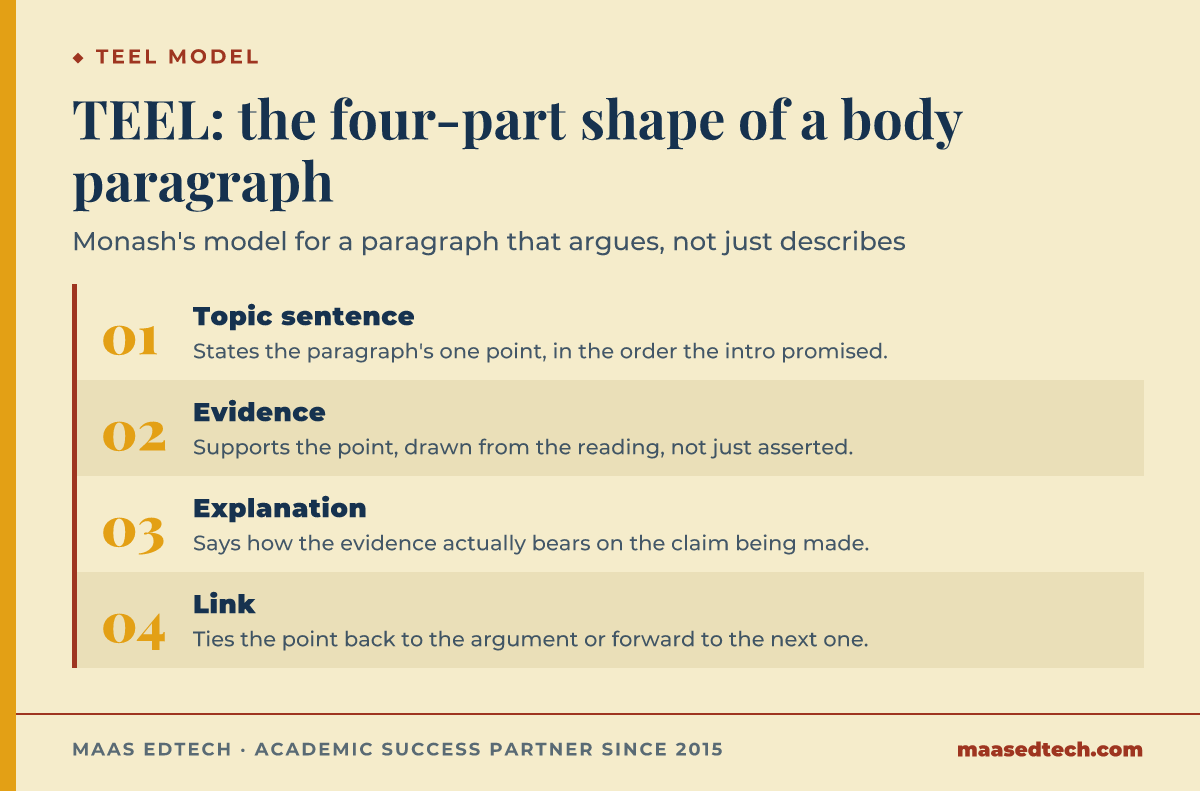
Direct answer: Each body paragraph works as a mini essay, opening with a topic sentence, developing the point through supporting sentences, and closing with a sentence that ties it back to the argument. Monash teaches the same structure as TEEL, topic, evidence, explanation, link, a compressed version of the six elements Toulmin (1958) set out for any sound argument.
Each paragraph is a mini essay
The University of Sydney frames a body paragraph as a mini essay: it opens with a topic sentence stating the paragraph's point, develops that point through supporting sentences, and closes with a concluding sentence that ties the point back to the argument (The University of Sydney, n.d.). The frame converts a vague instruction, write good paragraphs, into a checkable one: read the topic sentences alone, and the essay's spine should still make sense.
TEEL: the model Australian universities teach
Monash University teaches the same anatomy under the name TEEL: a Topic sentence stating the point, Evidence supporting it, Explanation of how the evidence bears on the point, and a Link back to the question or forward to the next paragraph (Monash University, n.d.). The Evidence-Explanation pair is a compressed version of the six elements Toulmin (1958) set out for any sound argument, claim, data, warrant, backing, qualifier, and rebuttal, and the two most often missing from a weak paragraph are the warrant, why the evidence actually supports the claim, and the qualifier, how far the claim can be pushed. Formula-style models sometimes attract the criticism that they produce mechanical writing, and an essay in which every paragraph shows its TEEL joints can indeed read as boxy. The criticism is worth conceding and then weighing: the model is scaffolding, and markers penalise a missing explanation far more often than visible structure. Master the pattern first, then vary it once the argument holds without it.
◆ Section 7 / 9 · Describe, analyse, evaluate
Step 5: Move from describing to analysing to evaluating
Direct answer: The University of Reading sorts the registers by the question each answers, what, when and who for description against why, how and so what for analysis, with the evaluative register weighing angles and limitations. Leeds separately rules that description stay minimal so analysis and evaluation get the space. Ennis (1962) split critical thinking into 3 dimensions and 12 aspects.
What, when and who versus why, how and so what
The University of Reading distinguishes styles of academic writing by the questions they answer: descriptive writing answers what, when and who, while analytical writing answers why, how and so what (University of Reading, 2026b). The same guidance associates the evaluative register with weighing different angles and acknowledging limitations (University of Reading, 2026b). Much first-year feedback that says too descriptive is pointing at exactly this line: the essay reports what the sources say without ever asking so what.
Keep description to a minimum
The University of Leeds turns the distinction into a proportion rule: keep descriptive statements to a minimum and give the space to analysis and evaluation (University of Leeds, n.d.-a). "Critical" is doing real work in that instruction: across a paper of 31 pages, Ennis (1962) broke critical thinking down into 3 dimensions and 12 separate aspects, and a marker's comment "not critical enough" is usually pointing at one specific missing aspect, not a vague personality trait the essay lacks. Description sets an argument up, yet it cannot advance one, so a practical test is to take any paragraph and ask what claim it defends. If the honest answer is that it summarises a source, the analysis that should sit on top of it still needs writing.
◆ Section 8 / 9 · Tone and referencing
Step 6: Get tone and referencing right as you draft
Direct answer: Academic tone should be formal, precise and mostly third person, per the University of Southern California (2026). Paraphrases need citations just as much as direct quotes do. APA Style's 7th edition, published in 2019, states that restating another author's idea in your own words must still be cited, in narrative or parenthetical form.
Formal, precise, mostly third person
The University of Southern California's academic writing guidance describes the expected register: formal and precise, predominantly third person, and free of contractions (University of Southern California, 2026). The instinct behind that guidance is old: Strunk's rule to "omit needless words" dates to a privately printed 1918 pamphlet, later revised and published by Macmillan in 1959 as The Elements of Style (Strunk & White, 1959), and formal academic register is largely that same instinct for precision applied to a discipline's own vocabulary. Zinsser (1976), whose On Writing Well has sold more than 1.5 million copies since its first printing, called the same problem clutter and named it the disease of professional writing generally, not only student writing. Conventions do vary by discipline, and some practice-based or reflective modules explicitly invite the first person, so the sensible reading is a default rather than a ban: write in the third person unless your module guide says otherwise.
Paraphrases need citations too, not just quotes
APA Style defines a paraphrase as restating another author's idea in your own words, and states that paraphrases must be cited, in either narrative or parenthetical form (American Psychological Association, 2022). This is current 7th-edition guidance, published in 2019 after a gap of 10 years since the 6th edition in 2009, so material written for the older edition can quote different formatting rules even when the underlying citation logic has not changed. The point deserves emphasis because the opposite belief, that only direct quotes need citing, remains one of the most expensive misunderstandings in early university work. The full decision rule for when a sentence needs a citation has its own guide, and if your course uses APA, the APA 7th referencing guide works through the entry formats one source type at a time.
◆ Section 9 / 9 · Revise in two passes
Step 7: Revise in two passes: edit first, proofread last
Direct answer: Editing deals with content, structure and clarity, while proofreading is the final pass for surface errors, and the order matters: Sommers (1980) found experienced writers revise structure first and leave surface correction until last. UNC's techniques for tired eyes include putting distance between drafting and proofreading, reading aloud, reading backwards sentence by sentence, and hunting one error type at a time.
Editing and proofreading are different jobs
The Writing Center at the University of North Carolina at Chapel Hill separates revision into two distinct stages: editing, which deals with content, structure and clarity, and proofreading, which is the final pass for surface errors (University of North Carolina at Chapel Hill, n.d.-b). The order matters, and the reason has research behind it: across a study of 11 pages comparing first-year students against experienced writers, Sommers (1980) found that inexperienced writers mostly proofread, hunting for word-level errors, while experienced writers revised at the level of structure and argument first and left surface correction until last. Proofreading a paragraph that editing may later delete is wasted work, so resist polishing sentences while the structure is still moving.
Proofreading techniques that work when you are tired
Proofreading your own writing is genuinely hard, because you know what you meant to say and your eyes quietly supply the missing word. UNC's countermeasures are practical: put distance between drafting and proofreading, read the text aloud so the ear catches what the eye skips, read backwards sentence by sentence to break the flow of meaning, and hunt for one error type at a time rather than everything at once (University of North Carolina at Chapel Hill, n.d.-b). None of these techniques requires brilliance, which is what makes them dependable the night before a deadline.
Frequently asked questions
How long should the introduction of a university essay be?
Roughly 10 to 20 percent of the whole essay, per the University of Sydney's guidance; its job is to tell the reader the topic, purpose and structure of the paper. For a 2,000-word essay that works out to 200 to 400 words, enough to move from the general topic to a specific, arguable position.
What is the difference between analyse, discuss and evaluate in an essay question?
Each directive word asks for different thinking: the University of Hull's guidance defines analyse as examining critically to bring out the essential elements and explain how the parts work together, which is not the same task as discussing or evaluating. Bloom (1956) and the Anderson and Krathwohl (2001) revision both rank evaluate above analyse on the scale of cognitive difficulty, which is one reason evaluate questions tend to be marked more strictly.
What is TEEL and do I have to use it?
TEEL stands for Topic sentence, Evidence, Explanation, Link, a paragraph model Monash University teaches; it is one widely taught structure, not a universal rule, and Sydney frames the same idea as the paragraph being a mini essay. The underlying logic goes back to Bain (1866) for the topic sentence and Toulmin (1958) for the evidence-explanation pairing.
What is the difference between describing and analysing in an essay?
Descriptive writing answers what, when and who; analytical writing answers why, how and so what, per the University of Reading (2026b), and Leeds advises keeping descriptive statements to a minimum and moving to interpretation. In Toulmin's (1958) terms, description supplies the data; analysis supplies the warrant that connects the data to your claim, and a marker who calls a paragraph "too descriptive" is really saying the warrant is missing.
Does this structure change by discipline?
The seven steps hold, but each discipline adds its own standard of what counts as analysis. A sociology essay, for instance, is judged on whether it connects individual outcomes to social structures rather than on its topic, which our sociology essay guide sets out in full.
How is a critical review different from an essay?
A review evaluates one named text rather than building an argument across sources, and universities cap the summary at roughly a third of the piece. The evaluative moves overlap with essay writing, and our critical review guide sets out the structure.
Do I need to cite a paraphrase, or only direct quotes?
Both: APA Style (American Psychological Association, 2022) states that a paraphrase restates another's idea in your own words and must be cited using narrative or parenthetical format, guidance that has sat in every edition of the manual since the 6th in 2009.
Can I use "I" in a university essay?
Academic writing predominantly uses the third person, per USC's academic writing style guidance, but conventions vary by discipline, so check your module guide rather than treating first person as universally banned. Strunk and White's (1959) advice to omit needless words applies to pronouns too: "I think" rarely adds anything a confident claim does not already carry.
What is the difference between editing and proofreading an essay?
They are two different stages of revision, per the UNC Writing Center: edit first for content, structure and clarity, then proofread last for surface errors, one error type at a time. Sommers (1980) found this order is exactly what separates practised writers from first-year students, who tend to reverse it.
What is an essay, and how is it different from a report?
An essay is a piece of academic writing that presents an argument in response to a question, resting on evidence and requiring critical thinking (University of Wollongong, n.d.; The University of Nottingham, n.d.). Unlike a report, which typically uses headings and data, an essay develops a continuous argument through connected paragraphs, though some departments still encourage sub-headings (The University of Nottingham, n.d.). It is marked first on the strength of the argument, so fluent prose without a central argument still scores poorly.
Should an outline use short phrases or full sentences?
Either works. A topic outline using short phrases is faster but less detailed, while a sentence outline using full sentences is slower but suits ideas complex enough to need working out at the planning stage (Duncan, n.d.). Whichever format you pick, commit to it rather than switching midway.
Is a tiểu luận at a Vietnamese university the same as an essay?
Only partly. The course-level tiểu luận at the two faculties compared in this guide has an opening that states an object and a method, and one of the two also requires a chapter applying theory to practice, while an essay in University of Portsmouth (2019) guidance usually does not mention methods and carries no recommendations. Read the brief and your school's rules for the module to see which one yours resembles.
WHEN YOU WANT A MENTOR'S EYES ON YOUR DRAFT
A postgraduate-qualified mentor from MAAS academic support reads your draft closely and gives structured feedback on question fit, structure and paragraph logic, catching where the argument thread drops or a paragraph describes when it should analyse. The writing and the final academic decisions remain yours.
Most of the steps above sharpen fastest with feedback from a reader who marks where the argument thread drops, which paragraphs describe when they should analyse in Ennis's (1962) sense, and whether the essay still answers the directive word Bloom (1956) would rank it under. If you would rather have that conversation before the deadline than after the grade, academic support at MAAS pairs you with a postgraduate-qualified mentor who reads your draft closely and gives structured feedback on question fit, structure and paragraph logic; the writing and the final academic decisions remain yours.
References
- American Psychological Association. (2022). Paraphrases. APA Style. https://apastyle.apa.org/style-grammar-guidelines/citations/paraphrasing
- Anderson, L. W., & Krathwohl, D. R. (Eds.). (2001). A taxonomy for learning, teaching, and assessing: A revision of Bloom's taxonomy of educational objectives. Longman.
- Bain, A. (1866). English composition and rhetoric. Longmans, Green.
- Bloom, B. S. (Ed.). (1956). Taxonomy of educational objectives: The classification of educational goals, handbook I: Cognitive domain. Longmans, Green.
- Booth, W. C., Colomb, G. G., Williams, J. M., Bizup, J., & FitzGerald, W. T. (2024). The craft of research (5th ed.). University of Chicago Press.
- Buzan, T. (1974). Use your head. BBC Books.
- Ennis, R. H. (1962). A concept of critical thinking. Harvard Educational Review, 32(1), 81-111.
- Harvard College Writing Center. (n.d.-a). Conclusions. Harvard University. Retrieved September 4, 2026, from https://writingcenter.fas.harvard.edu/ending-essay-conclusions
- Harvard College Writing Center. (n.d.-b). Introductions [PDF]. Harvard University. Retrieved September 4, 2026, from https://writingcenter.fas.harvard.edu/sites/g/files/omnuum451/files/writingcenter/files/introductions.pdf
- Newcastle University. (n.d.). Writing introductions and conclusions. Academic Skills Kit. Retrieved September 4, 2026, from https://www.ncl.ac.uk/academic-skills-kit/writing/academic-writing/writing-introductions-and-conclusions/
- The University of Newcastle. (2016). Writing a conclusion [PDF]. Learning Development, Centre for Teaching and Learning. https://www.newcastle.edu.au/__data/assets/pdf_file/0009/333765/LD-Conclusions-LH.pdf
- Flower, L., & Hayes, J. R. (1981). A cognitive process theory of writing. College Composition and Communication, 32(4), 365-387. https://doi.org/10.2307/356600
- Sommers, N. (1980). Revision strategies of student writers and experienced adult writers. College Composition and Communication, 31(4), 378-388. https://doi.org/10.2307/356588
- Strunk, W., & White, E. B. (1959). The elements of style. Macmillan.
- Monash University. (n.d.). How to build an essay: Writing body paragraphs. Student Academic Success. Retrieved July 2, 2026, from https://www.monash.edu/rlo/assignment-samples/assignment-types/writing-an-essay/writing-body-paragraphs
- RMIT University. (n.d.). Structure of an essay. Learning Lab. Retrieved July 2, 2026, from https://learninglab.rmit.edu.au/assessments/essays/write/
- Duncan, J. (n.d.). Developing an outline [PDF]. The Writing Centre, University of Toronto Scarborough. Retrieved September 13, 2026, from https://www.sgs.utoronto.ca/wp-content/uploads/2023/10/Developing-an-Outline.pdf
- University of Hull. (2026). Essay writing: Analysing questions. Library SkillsGuides. https://libguides.hull.ac.uk/essays/questions
- University of Leeds. (n.d.-a). Critical writing. Library. Retrieved July 2, 2026, from https://library.leeds.ac.uk/info/1401/academic_skills/105/critical_thinking/5
- University of Leeds. (n.d.-b). The conclusion. Library. Retrieved September 4, 2026, from https://library.leeds.ac.uk/info/14011/writing/220/structure-your-writing/5
- University of Leeds. (n.d.-c). The introduction. Library. Retrieved September 4, 2026, from https://library.leeds.ac.uk/info/14011/writing/220/structure-your-writing/2
- University of North Carolina at Chapel Hill. (n.d.-a). Conclusions. The Writing Center. Retrieved September 4, 2026, from https://writingcenter.unc.edu/tips-and-tools/conclusions/
- University of North Carolina at Chapel Hill. (n.d.-b). Editing and proofreading. The Writing Center. https://writingcenter.unc.edu/tips-and-tools/editing-and-proofreading/
- University of North Carolina at Chapel Hill. (n.d.-c). Introductions. The Writing Center. Retrieved September 4, 2026, from https://writingcenter.unc.edu/tips-and-tools/introductions/
- University of Oxford. (n.d.). Essay and dissertation writing skills. Retrieved September 4, 2026, from https://www.ox.ac.uk/students/academic/guidance/skills/essay
- University of Reading. (2026a). Planning and structuring your essay. Library Guides. https://libguides.reading.ac.uk/essays/planning
- University of Reading. (2026b). Descriptive, analytical and reflective writing. Library Guides. https://libguides.reading.ac.uk/writing/stylesofwriting
- University of Wollongong. (n.d.). Essays. Student Support Services. Retrieved September 13, 2026, from https://www.uow.edu.au/student/support-services/academic-skills/online-resources/assessments/essays/
- The University of Nottingham. (n.d.). Essays. Studying Effectively. Retrieved September 13, 2026, from https://www.nottingham.ac.uk/studyingeffectively/assessment/types/essays.aspx
- Toulmin, S. E. (1958). The uses of argument. Cambridge University Press.
- University of Southern California. (2026). Academic writing style. USC Libraries Research Guides. https://libguides.usc.edu/writingguide/academicwriting
- Zinsser, W. (1976). On writing well. Harper & Row.
- The University of Sydney. (n.d.). Structuring written work. Retrieved July 2, 2026, from https://www.sydney.edu.au/students/study-skills/writing/structuring-writing.html
- University of Portsmouth. (2019). Reports and essays: Key differences [Handout]. https://www.port.ac.uk/sites/default/files/2022-10/Reports%20and%20Essays%20key%20differences.pdf
- Nguyễn Tấn Đại. (n.d.). Meresci, cấu trúc một số loại tài liệu khoa học cơ bản. Retrieved October 1, 2026, from https://khoahocviet.info/meresci/vi/meresci04c2.html
- Trường Đại học Công Thương Thành phố Hồ Chí Minh, Khoa Chính trị - Luật. (2023). Hướng dẫn về hình thức trình bày bài tiểu luận. Retrieved October 1, 2026, from https://law.huit.edu.vn/app_web/Images/Documents/N00CT/huong-dan-hinh-thuc-lam-tieu-luan-2023.pdf
- Trường Đại học Sư phạm Kỹ thuật Thành phố Hồ Chí Minh, Khoa Chính trị và Luật. (2024). Quy định chung về tổ chức kiểm tra, đánh giá học phần bằng hình thức thực hiện tiểu luận (Tờ trình số 53/TTr-CTL). Retrieved October 1, 2026, from https://fpi.hcmute.edu.vn/Resources/Docs/SubDomain/fpi/QUY%20%C4%90%E1%BB%8ANH%20CHUNG%20VE%20HINH%20THUC%20KIEM%20TRA%20DANH%20GIA%20BANG%20TIEU%20LUAN.pdf
- UTS Library. (2015, August). Academic writing guide, part 2: Assignment types. University of Technology Sydney. https://www.uts.edu.au/globalassets/sites/default/files/article/downloads/uts-library-guide-to-assignment-types.pdf
A free consultation with MAAS academic support, to talk through your draft. Through academic support, a postgraduate-qualified mentor reads it closely and gives structured feedback on question fit, structure and paragraph logic. The writing and the final academic decisions remain yours.
Book Free Discovery ▸