
◆ Study skills
How to write a university report: format and structure by section
To write a university report, follow a fixed report structure in which each section does one job, then draft the body first and the executive summary last. Unlike an essay, a report is broken into formal sections and sub-sections with their own headings, so the structure is decided before the first paragraph is written (University of Leeds Library, n.d.; University of Reading Libraries, 2026).
This guide walks through that sequence one section at a time: what each part is for, the drafting order that works, and the checks to run before you submit. Every claim traces to a university writing-centre guide or to APA Style, and the full source list sits at the end.

◆ Part 1 / 6 · Report or essay
What a university report is, and how it differs from an essay
Direct answer: A university report presents structured, factual information about an investigation or problem, staying objective, evidence-based and concise, and usually ends in practical outcomes and recommendations. Unlike an essay, which is discursive with structure left largely to the writer, a report is divided into formal sections and sub-sections, each carrying its own heading.
A report presents structured, factual information, narrates an investigation or problem-solving process, and responds to a specific need, issue or question, usually ending in practical outcomes and recommendations (RMIT University, n.d.-b). It is one of the most common assessment genres across university subjects (University of Reading Libraries, 2026), and the University of York (2025) characterises its writing as objective, evidence-based and concise.
The difference from an essay is structural rather than cosmetic. Reports are concise documents divided into formal sections and sub-sections, each with its own heading and paragraphs usually shorter than an essay's; essays, by contrast, are discursive, and much of their structure is left to the writer (University of Leeds Library, n.d.). A report is therefore written for a reader who skims: whoever marks or uses it will often jump straight to the section whose heading promises what they need, so each section has to do its own job completely. If your brief asks for continuous argumentative prose instead, the university essay guide covers that genre.
◆ Part 2 / 6 · Read the brief
Read the brief before you build the structure
Direct answer: No single structure fits every report. Tailor it to the context, and follow any headings or questions your lecturer has already provided. Check whether the type of report you wrote is the type the task actually required, since reading the brief against the marking guide costs minutes while rebuilding around the wrong skeleton costs days.
Executive summary and abstract
Each row sets the executive summary against the abstract.
Executive summary
Abstract
It is more common in business reports.
It is usual for academic and scientific reports.
It typically includes explicit recommendations for the reader to act on.
It generally omits them.
No single structure fits every report. RMIT University (n.d.-a) advises that the structure needs to be tailored to fit the context, and that any headings or questions provided by your lecturer come first; the pre-submission checklist from Queensland University of Technology (2025) likewise asks whether the type of report you wrote is the type the task required. Reading the brief against the marking guide costs minutes; rebuilding around the wrong skeleton costs days.
Settle one distinction at this stage: abstract or executive summary. Abstracts are usual for academic and scientific reports, while executive summaries are more common in business reports (RMIT University, n.d.-a), and an executive summary typically includes explicit recommendations for the reader to act on, which a research abstract generally omits (University of Southern California Libraries, 2026).
◆ Part 3 / 6 · The sections
The sections of a report, one job each
Direct answer: A full formal coursework report moves through a fixed sequence: title page, executive summary or abstract, table of contents, introduction, an optional literature review, methodology, results, discussion, conclusion, recommendations, reference list and appendices. Each section carries its own single job, and your brief may drop or merge some of them depending on what it asks for.
The sequence below suits a full formal coursework report; your brief may drop or merge sections.
Title page
The title page carries a title stating the report's purpose, your name, the person or group the report is for, and the submission date (Queensland University of Technology, 2025). University, school and course details usually sit here too (University of New South Wales, n.d.).
Executive summary or abstract
The University of Reading Libraries (2026) calls this section the shop window for the report, and Queensland University of Technology (2025) is blunter: it may be the only part that gets read, so it must cover purpose, method, findings, conclusions and recommendations. For business reports, Monash University (n.d.) advises no more than one page and stresses that the summary is not an introduction: it must stand alone. For longer research reports, the University of Southern California Libraries (2026) suggests around ten percent of the document's length. Whatever the format, write it last (University of Southern California Libraries, 2026; University of New South Wales, n.d.).
Table of contents
The contents page lists the sections and sub-sections of the report with the page number where each begins (University of New South Wales, n.d.). Its one job is navigation, taking the reader quickly to the sections of interest (University of Kent, 2025). Generate it automatically and refresh it just before submission.
Introduction
The introduction explains the rationale for the work being reported (University of Reading Libraries, 2026) and establishes its aim, scope and background (Australian National University, n.d.). University guides converge on the same three moves: set the context, state the purpose, and preview how the report is organised (University of Kent, 2025; Monash University, n.d.; University of New South Wales, n.d.).
Literature review, when the brief asks for one
Research-style briefs often require a review of the published work already done on the topic: only studies with direct relevance, grouped into themes, each summarised critically rather than listed descriptively (University of Reading Libraries, 2026). Our guide to writing a literature review covers that critical, thematic approach in depth.
Methodology
The methodology states how the research was conducted and, just as importantly, the reasons for choosing those methods (RMIT University, n.d.-a); the University of Kent (2025) frames the section as an account of how the report's objectives were met. Aim for a description precise enough that a reader could replicate the research (University of Reading Libraries, 2026). Our guide to writing a methodology section concentrates on justifying your methods.
Results or findings
This section has only one job: to present the findings of your research as simply as possible, using tables and figures where they help (University of Reading Libraries, 2026). There is no interpretation here; it states the facts and nothing else (RMIT University, n.d.-a). Letting analysis leak into the results is a common and expensive structural slip, because it leaves the discussion with nothing of its own to do.
Discussion
The discussion is where interpretation lives: findings are woven together, major themes are identified, and the results are connected to other research (RMIT University, n.d.-a). It shows how what you found responds to the brief set out in the introduction (University of Reading Libraries, 2026).
Conclusion
The conclusion introduces no new arguments or evidence; its job is closure, summing up how the main findings answer the original brief (University of Reading Libraries, 2026). It draws together the key findings (Queensland University of Technology, 2025) and leaves the reader clear on the work's significance and whether the aims were met (University of New South Wales, n.d.).
Recommendations
Recommendations state what actions should be taken in response to the findings (RMIT University, n.d.-a), and the section can stand alone or be combined with the conclusion, depending on the brief (Australian National University, n.d.). Markers look for a chain: each finding leads to a conclusion, and each conclusion to a recommendation (University of Kent, 2025), and every recommendation must be realistic, achievable and clearly related to its conclusion (Queensland University of Technology, 2025).
Reference list
The reference list gives full publication details for every work referred to in the report, in the referencing style your discipline requires (University of Reading Libraries, 2026). The decision rule for when a source needs citing has its own guide, and if your course uses APA, our guide to referencing correctly in APA 7th covers the entry formats and the most common errors.
Appendices
Appendices hold supporting material that may help the reader but is not essential to the main findings, and the report should stand alone without them (University of Reading Libraries, 2026). Charts, tables and other information too detailed to put in the body belong here (University of New South Wales, n.d.), as does technical information that would otherwise clutter the report (Australian National University, n.d.); raw data, questionnaires and detailed calculations are typical examples.
◆ Part 4 / 6 · Drafting order
A drafting order that works
Direct answer: The reading order is not the writing order. Draft methodology and results first, since they only describe what you did and found, then the discussion, conclusion and recommendations, then the introduction once you know what it introduces, and the executive summary last. Before calling the draft done, trace each finding forward to check the chain holds.
The order to draft a report in
Tap a step to see what to write and why.
Step 1 of 4
Methodology and results
Draft these first, because they only describe what you did and found.
Step 2 of 4
Discussion, conclusion and recommendations
These follow the methodology and results.
Step 3 of 4
Introduction
It is easiest to finalise once you know what it introduces.
Step 4 of 4
Executive summary
It comes last, as an accurate overview of a finished document.
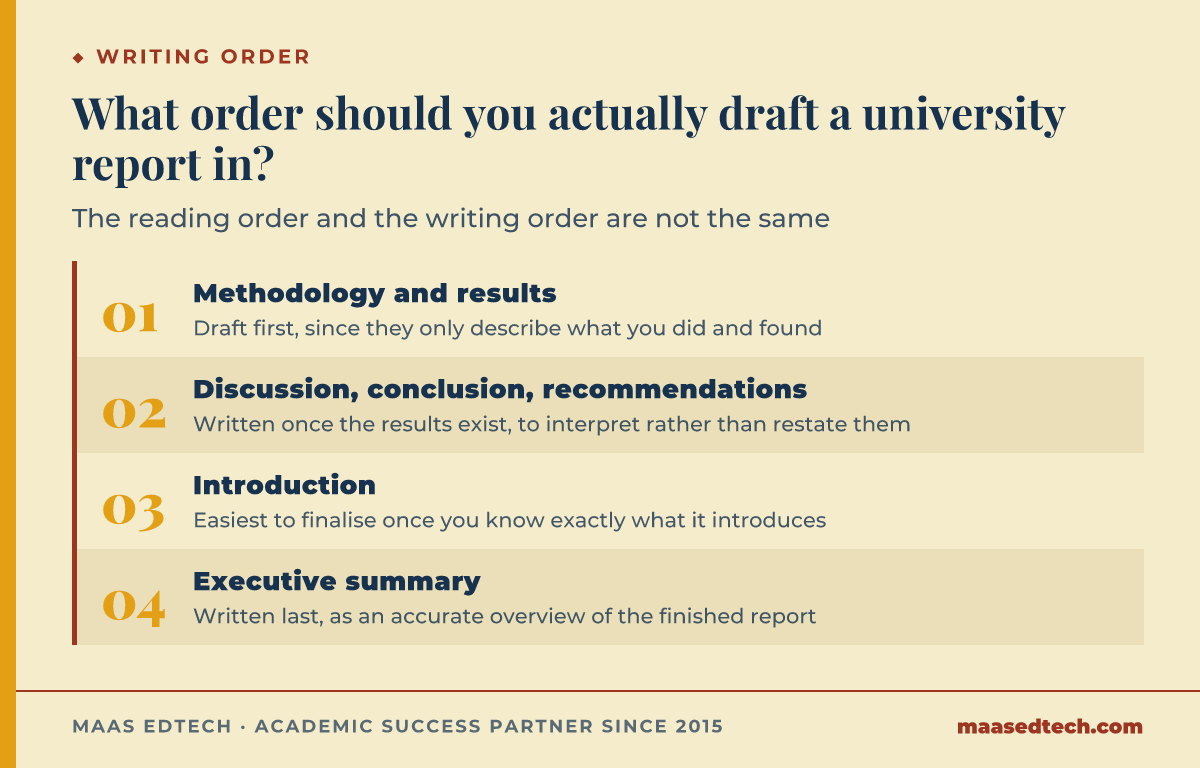
The reading order is not the writing order. Both the University of Southern California Libraries (2026) and the University of New South Wales (n.d.) advise writing the summary or abstract only after the rest of the report is finished, and the same logic orders everything before it. Methodology and results can be drafted earliest, because they describe what you did and found; the discussion, conclusion and recommendations follow; the introduction is easiest to finalise once you know what it introduces; and the executive summary comes last, as an accurate overview of a finished document.
Before you call the draft done, run the University of Kent's chain as a coherence test: pick any finding and trace it forward. The guide distils the check to one line: "Each finding should have a conclusion; each leading to a recommendation" (University of Kent, 2025). If a finding leads to no conclusion, or a recommendation appears that no conclusion supports, the chain is broken, and that is usually where a marker stops.
◆ Part 5 / 6 · Style
Style: how a report should sound
Direct answer: Guidance converges on third person and clear, formal language, without slang, jargon or contractions, and Leeds notes report paragraphs are usually shorter than essay ones. APA, where your course follows it, treats the active voice as the default and keeps the passive for cases such as an experimental setup. Many programmes expect at least 12-point type and consistent heading numbers.
University guidance on register is consistent. Write in the third person, in clear, formal language, avoiding slang, jargon and contractions such as "don't" or "can't" (University of Kent, 2025); the University of Leeds Library (n.d.) gives the same rule on contractions and adds that report paragraphs are usually shorter than essay paragraphs. Monash University (n.d.) models the register with third-person openings such as "This report provides".
Many students take the objectivity rule further and write everything in the passive voice, and the passive does have a place in the genre. APA guidance, however, recommends the active voice as the default for direct, clear and concise sentences, reserving the passive for cases such as describing an experimental setup, where the recipient of the action matters more than the actor (American Psychological Association, n.d.). The thing to check is what your course actually requires. For presentation, many programmes expect a clear font of at least 12 points and consistent heading numbering such as 1.1 and 1.2; confirm the exact formatting requirements in your brief.
◆ Part 6 / 6 · Before you submit
Check before you submit
Direct answer: Submitting without two dedicated read-throughs risks structural gaps and small grammar slips a marker will catch. The first pass confirms every expected section is present and interrogates whether the report meets its aims, reads logically, stays clear and backs each conclusion with evidence. The second hunts for fragments, run-ons, comma splices and subject-verb mismatches at sentence level.
Read-throughs
2
passes before you submit, the first for structure and the second at sentence level
Structure tests
4
tests from the University of Kent are applied in the structure pass
The four structure tests
Tap a test to see what it checks.
Test 1 / 4
Fulfils its objectives
Check that the report fulfils its objectives.
Test 2 / 4
Logical and easy to navigate
Check that the structure is logical and easy to navigate.
Test 3 / 4
Clear and succinct
Check that the writing is clear and succinct.
Test 4 / 4
Evidence behind every conclusion
Check that evidence supports every conclusion made.
Run two passes. First, structure: check completeness against the expected elements, from title page and executive summary through contents, introduction, method, findings, conclusion, recommendations, references and appendices (Queensland University of Technology, 2025), then apply the University of Kent's four tests: the report fulfils its objectives, the structure is logical and easy to navigate, the writing is clear and succinct, and evidence supports every conclusion made (University of Kent, 2025).
The second pass is sentence-level. La Trobe University Library (n.d.) lists the errors markers see most often: sentence fragments, run-on sentences, comma splices, and slips in subject-verb agreement. Each is small on its own and expensive in aggregate.
WHEN YOU WANT A SECOND PAIR OF EYES ON YOUR REPORT
A brief with ten required sections leaves room for structural slips invisible to the writer. A MAAS academic mentor reads your brief and rubric with you, checks the skeleton before you commit days to the wrong structure, and reviews whether each section is doing its own job, while the decisions and the writing stay yours.
A brief with ten required sections leaves room for structural slips, and most of them are invisible to the person who wrote the draft. Through academic support at MAAS, an experienced mentor reads your brief and rubric with you, checks the skeleton before you commit days to the wrong structure, and reviews whether each section is doing its own job. Your mentor questions, advises and gives structured feedback; the decisions and the writing remain your own.
Frequently asked questions
What is the structure of an academic report?
Report structure runs from a title page and executive summary through contents, introduction, optional literature review, methodology, results and discussion, to conclusion, recommendations, references and appendices. Every part has its own purpose, and the brief may merge or drop some, so confirm the required format there.
What is the university report format?
A report uses formal sections and sub-sections under their own headings, unlike an essay, and its structure is settled before any paragraph is drafted (University of Leeds Library, n.d.; University of Reading Libraries, 2026). Follow the order your brief sets, write the body first and the executive summary last.
How long should an executive summary be?
Guidance differs by report type. Monash University (n.d.) advises that a business report's executive summary should not exceed one page, while the University of Southern California Libraries (2026) suggests around 10% of the length of the document for long research reports. Check your brief first, and treat one page as the safe default for coursework.
Should I write the executive summary first or last?
Write it last. Both the University of Southern California Libraries (2026) and the University of New South Wales (n.d.) advise writing the summary after the rest of the report is finished, so it accurately reflects what was done, found and concluded, because it must stand alone as an overview of the whole report.
What is the difference between an executive summary and an abstract?
Abstracts are usual for academic and scientific reports, while executive summaries are more common in business reports (RMIT University, n.d.-a). An executive summary also typically includes explicit recommendations for the reader to act on, which an abstract generally omits (University of Southern California Libraries, 2026).
What is the difference between the results and discussion sections?
The results section has one job: to present the findings as simply as possible, with no interpretation (University of Reading Libraries, 2026; RMIT University, n.d.-a). The discussion then interprets those results and shows how they respond to the purpose set out in the introduction.
Do recommendations go in the conclusion or in their own section?
They can sit in a separate section or be combined with the conclusion, depending on your brief (Australian National University, n.d.). Either way, each finding should lead to a conclusion, and each conclusion to a recommendation that is realistic, achievable and clearly tied to it (University of Kent, 2025; Queensland University of Technology, 2025).
Do I write a university report in first or third person?
Most university guidance recommends formal third-person writing without contractions or slang (University of Kent, 2025; University of Leeds Library, n.d.; Monash University, n.d.). If your report must follow APA Style, note that APA recommends the active voice for direct, concise sentences, reserving the passive for cases such as describing an experimental setup (American Psychological Association, n.d.).
Does a science lab report follow this same structure?
It follows the same logic under different section names. A lab report uses the IMRAD spine, where the method becomes the Experimental section and the same results-versus-discussion boundary still decides most of the marks. Our chemistry lab report guide sets out the discipline-specific conventions, including ACS citations and significant figures.
What should I check before submitting a report?
Check completeness against the structure first: title page, executive summary, contents, introduction, method, findings, conclusion, recommendations, references and appendices (Queensland University of Technology, 2025). Then check the sentence-level errors markers see most often, including sentence fragments, run-on sentences, comma splices and subject-verb agreement (La Trobe University Library, n.d.).
References
- American Psychological Association. (n.d.). Active and passive voice. APA Style. Retrieved July 2, 2026, from https://apastyle.apa.org/style-grammar-guidelines/grammar/active-passive-voice
- Australian National University. (n.d.). Report writing. Retrieved July 2, 2026, from https://www.anu.edu.au/students/academic-skills/writing-and-assessment/report-writing
- La Trobe University Library. (n.d.). Writing: Common mistakes. Retrieved July 2, 2026, from https://latrobe.libguides.com/writing/common-mistakes
- Monash University. (n.d.). BusEco: Report writing. Retrieved July 2, 2026, from https://www.monash.edu/student-academic-success/excel-at-writing/annotated-assessment-samples/business-and-economics/buseco-report-writing
- Queensland University of Technology. (2025). How to write a report. QUT cite|write. https://www.citewrite.qut.edu.au/write/writing-well/report.html
- RMIT University. (n.d.-a). Overall structure of a report. Learning Lab. Retrieved July 2, 2026, from https://learninglab.rmit.edu.au/assessments/reports/overall-structure/
- RMIT University. (n.d.-b). Reports. Learning Lab. Retrieved July 2, 2026, from https://learninglab.rmit.edu.au/assessments/reports/
- University of Kent. (2025). Report structure and tips. https://student.kent.ac.uk/studies/reports/structure-and-tips
- University of Leeds Library. (n.d.). Report writing. Retrieved July 2, 2026, from https://library.leeds.ac.uk/info/14011/writing/114/report-writing
- University of New South Wales. (n.d.). Writing a report. Retrieved July 2, 2026, from https://www.unsw.edu.au/content/dam/pdfs/business/general/resources/2023-07-business-academic-communication-essentials/Writingareport.pdf
- University of Reading Libraries. (2026). Report writing. https://libguides.reading.ac.uk/reports
- University of Southern California Libraries. (2026). Organizing your social sciences research paper: Executive summary. https://libguides.usc.edu/writingguide/executivesummary
- University of York. (2025). Academic writing: A practical guide: Reports. https://subjectguides.york.ac.uk/academic-writing/reports
A free 20-minute consultation with a MAAS mentor, to talk through your brief and the structure of your report.
Book Free Discovery ▸