
◆ Writing Tips
How do you use critical thinking in a university essay?
Direct answer: Critical thinking in an essay means questioning a source before you use it: what it claims, what evidence supports the claim, what it assumes, and how far it applies to your question. You then write your own judgement and the reason for it. Describing what authors said is the starting point, not the finished argument.
The guide below gives you one repeatable framework for doing that, built from the critical thinking pages of the University of Leeds, Monash University and Oxford Brookes, and from the 2006 guide by Richard Paul and Linda Elder at criticalthinking.org. The framework is written for international students in UK and Australian universities who keep seeing "needs more critical analysis" on their feedback.
◆ Question 1 / 6 · Meaning
What does critical thinking mean?
Direct answer: At university, critical thinking means not accepting what you read at face value, but questioning the information, ideas and arguments in your sources and then forming a reasoned view of your own. It does not mean being negative about everything you read.
The Foundation for Critical Thinking offers a compact definition: "Critical thinking is the art of analyzing and evaluating thinking with a view to improving it" (Paul & Elder, 2006, p. 4). The University of Leeds (n.d.) adds the point students most often miss, which is that the word "critical" here does not mean only pointing out faults, and it does not mean only picking out the most important aspects of a topic. In its account, critical thinking is about questioning information and arguments and then using evidence to form your own opinions. Monash University (n.d.) traces the word to the Greek kritikos, "able to judge or discern", and describes good critical thinking as making reliable judgements based on reliable information. Put together, the three sources describe an activity with two halves: you take a source apart carefully, and then you say what you have concluded from it and why.
◆ Question 2 / 6 · Five skills
What are 5 critical thinking skills?
Direct answer: A widely used research definition names five skills: interpretation, analysis, evaluation, inference and explanation. In essay terms, those are understanding a source, breaking down its argument, judging its strength, drawing your own conclusion, and showing the reasoning behind that conclusion to your marker.
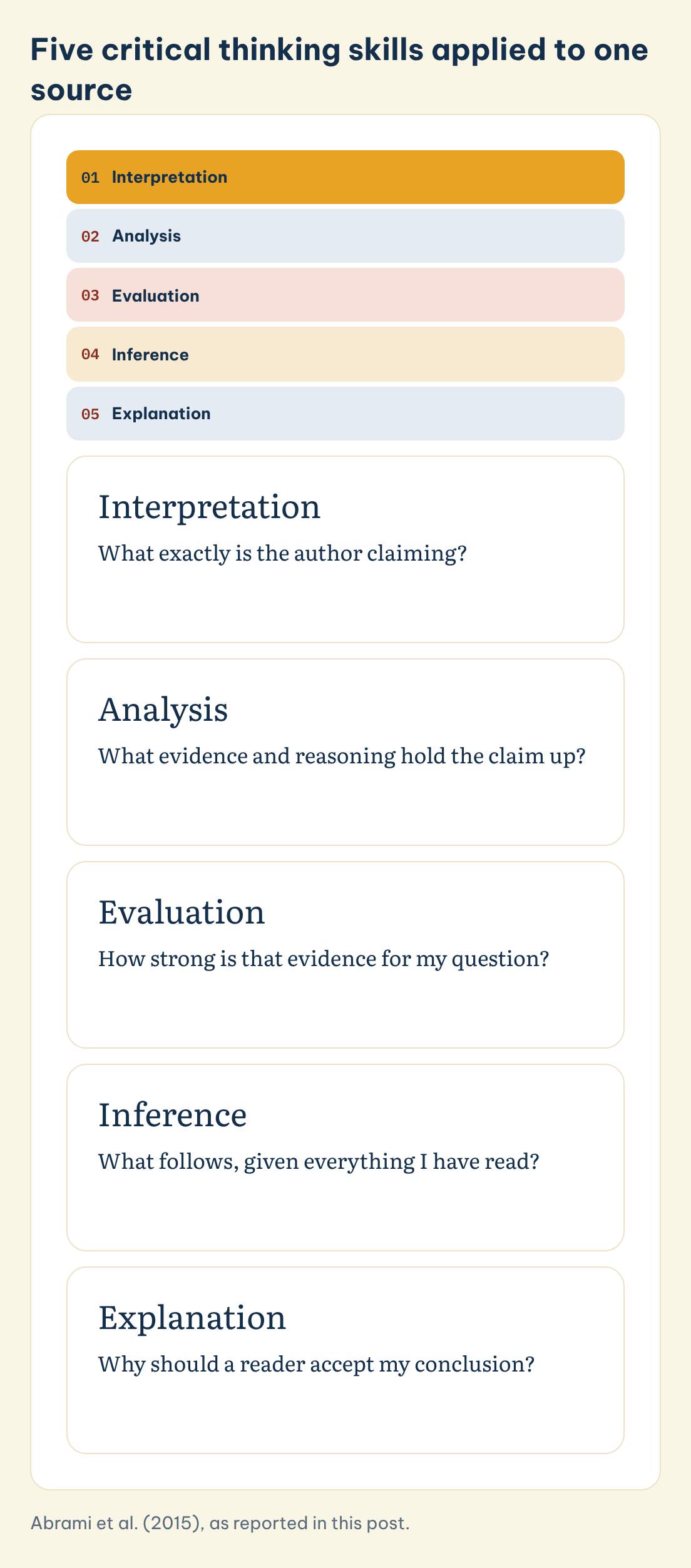
Five critical thinking skills applied to one source
Tap each skill to see the question it asks.
Interpretation
What exactly is the author claiming?
Analysis
What evidence and reasoning hold the claim up?
Evaluation
How strong is that evidence for my question?
Inference
What follows, given everything I have read?
Explanation
Why should a reader accept my conclusion?
Save this figure
The definition traces back to a 1990 Delphi study in which a panel of 46 scholars and educators, sponsored by the American Philosophical Association, worked toward a consensus on what critical thinking is (Facione, 1990). According to the ERIC record of the 112-page report, about half of the 46 panelists were based in philosophy departments, and the rest came from education, the social sciences and the physical sciences. Abrami et al. (2015) open their meta-analysis of 341 effect sizes with a definition built on the same five abilities, describing critical thinking as purposeful, self-regulatory judgement. The table below translates each skill into the question you would ask of a source and the sentence that skill produces in an essay.
| Skill | Question you ask of a source | What it looks like in your essay |
|---|---|---|
| Interpretation | What exactly is the author claiming? | An accurate one-sentence summary of the claim |
| Analysis | What evidence and reasoning hold the claim up? | A sentence naming the study, data or logic behind it |
| Evaluation | How strong is that evidence for my question? | A sentence on a strength or limitation, with a reason |
| Inference | What follows, given everything I have read? | Your own claim, stated plainly |
| Explanation | Why should a reader accept my conclusion? | The link back to the evidence and to the essay question |
Published in the Review of Educational Research, the same review reported a weighted mean effect size of 0.30 for teaching critical thinking, and found that dialogue, authentic problems and mentoring were among the approaches with positive effects (Abrami et al., 2015). For a student, this means the skills improve with deliberate practice on real assignments rather than appearing on their own.
◆ Question 3 / 6 · Five steps
What are 5 steps of critical thinking?
Direct answer: A practical sequence is to clarify your purpose, question your sources, identify each argument, analyse and evaluate it, then build your own argument. Monash University lists these as six steps by separating analysis from evaluation, and the order matters more than the count.
Monash University (n.d.) sets out the steps as clarifying your purpose and context, questioning your sources, identifying arguments, analysing sources and arguments, evaluating the arguments of others, and creating your own arguments. In the steps listed by Monash University (n.d.), the first step is the one essay writers skip. When you start reading without a clear question, every source looks relevant and you end up summarising all of them. Monash University (n.d.) links clarifying purpose to avoiding information overload, which in practice means writing your essay question as one sentence and checking each source against it before you take notes. The last step, which Monash calls synthesis, is where your marks come from: you place the insights from different sources together and state what they mean for your question. Oxford Brookes University (n.d.), which points students to a question-based model from the University of Plymouth, makes the same point from the other direction, warning that thinking critically is more than presenting the pros and cons of a position, because you have to come to your own judgement.
◆ Question 4 / 6 · Five principles
What are the 5 principles of critical thinking?
Direct answer: Paul and Elder's universal intellectual standards are a widely used set. Five of them are clarity, accuracy, precision, relevance and logic, and each one gives you a plain question you can use to test a source and then test your own draft paragraphs before you submit.
Paul and Elder (2006) list nine standards in total, adding depth, breadth, significance and fairness, and on page 12 of the guide they attach two or three plain questions to each one. You can use five of them as a checklist for any paragraph you write.
- Clarity: could I give an example of what I mean here?
- Accuracy: how could I check that this claim is true?
- Precision: could I be more specific about the figure, the group or the date?
- Relevance: how does this point bear on my essay question?
- Logic: does my conclusion actually follow from the evidence I have cited?
In the Paul and Elder (2006) checklist, the relevance and logic questions are the ones that catch descriptive writing. A paragraph that reports a study accurately but never connects it to the question fails the relevance test, and a conclusion that goes further than the evidence fails the logic test. Running your draft through these five questions before submission is a quick way to see where analysis is missing.
◆ Question 5 / 6 · Essay example
What is an example of critical thinking in an essay?
Direct answer: The clearest example is the difference between reporting a finding and judging how far it supports your argument. Critical writing names the evidence, states a limitation or condition, and ends with your own conclusion about what the finding means for the question.
Take an essay on whether remote work raises productivity. A descriptive sentence reads: "One study found that remote workers were more productive." A critical version adds the questions from the framework: "One study found higher output among remote workers, but its sample came from a single software company where output is easy to count, so the finding supports the argument for measurable tasks more than for roles built on collaboration." The second sentence interprets the claim, analyses its evidence, evaluates its reach, and draws an inference, which covers four of the five skills named by Abrami et al. (2015). The study in this example is invented for illustration, so use real sources from your own reading when you practise. The University of Leeds (n.d.) frames the aim the same way: your writing should show that you can weigh up different arguments and use evidence to form your own view. Our guide on writing a critical essay instead of a descriptive one gives paragraph templates for this move.
◆ Question 6 / 6 · Expert guidance
Can expert guidance help you think critically?
Direct answer: Expert guidance can help, when the guidance makes you do the questioning yourself. In the Abrami et al. (2015) meta-analysis, dialogue and mentoring were among the teaching approaches with positive effects on critical thinking skills, so talking through your own reasoning with someone who asks hard questions is worth trying.
MAAS offers essay and assignment support, where a MAAS expert works with you from outline to draft to final version. In practice that means a MAAS expert asks you the five questions above about your own sources, points out where a paragraph describes rather than evaluates, and shows you how the marking rubric rewards analysis. You write and decide your own argument; the expert's role is to sharpen the reasoning you bring. If your feedback mentions a weak literature section, our guide on making a literature review critical applies the same framework to longer projects.
Frequently asked questions
What does critical thinking mean in simple words?
Not taking information at face value, but questioning it and using evidence to reach your own reasoned view (University of Leeds, n.d.).
Is critical thinking the same as criticising?
No. It means judging carefully, which includes recognising strengths as well as weaknesses (Monash University, n.d.).
What are the five critical thinking skills?
Interpretation, analysis, evaluation, inference and explanation, as defined in Abrami et al. (2015).
How do I show critical thinking in an essay?
After presenting a source, state how strong its evidence is for your question and what you conclude from it, with a reason, because listing pros and cons alone is not enough (Oxford Brookes University, n.d.).
Can critical thinking be learned?
Yes. A meta-analysis of 341 effect sizes found that teaching strategies such as dialogue, authentic problems and mentoring had positive effects on critical thinking skills (Abrami et al., 2015).
Why does my feedback say "too descriptive"?
Usually because paragraphs report what sources say without judging them or linking them to the question; Oxford Brookes University (n.d.) notes that being critical goes beyond listing pros and cons.
References
Abrami, P. C., Bernard, R. M., Borokhovski, E., Waddington, D. I., Wade, C. A., & Persson, T. (2015). Strategies for teaching students to think critically: A meta-analysis. Review of Educational Research, 85(2), 275–314. https://doi.org/10.3102/0034654314551063
Facione, P. A. (1990). Critical thinking: A statement of expert consensus for purposes of educational assessment and instruction (ERIC Document No. ED315423). American Philosophical Association. https://eric.ed.gov/?id=ED315423
Monash University. (n.d.). What is critical thinking? Student Academic Success. Retrieved October 23, 2026, from https://www.monash.edu/student-academic-success/enhance-your-thinking/critical-thinking/what-is-critical-thinking
Oxford Brookes University. (n.d.). Critical thinking. Academic Development. Retrieved October 23, 2026, from https://www.brookes.ac.uk/students/academic-development/online-resources/critical-thinking
Paul, R., & Elder, L. (2006). The miniature guide to critical thinking: Concepts and tools (4th ed.). Foundation for Critical Thinking. https://www.criticalthinking.org/files/Concepts_Tools.pdf
University of Leeds. (n.d.). What is critical thinking? Library. Retrieved October 23, 2026, from https://library.leeds.ac.uk/info/1401/academic_skills/105/critical_thinking
Not sure how this guide applies to your own case? Talk it through with MAAS in a free 20-minute consultation.
Book a free consultation ▸