
◆ Writing Tips
How do you write a critical essay, not a descriptive one?
A critical essay is not an essay full of criticism. It is an essay whose every paragraph does something with its material, and the most common reason students lose marks is that a paragraph only reports it. This guide shows how to move from description to analysis in an essay that argues a position, with a before-and-after example you can copy the method from.
Direct answer: A critical essay argues a position. Each paragraph states what the evidence says, then judges it: what it means, how strong it is, and why it matters to your answer. Description is kept to the minimum needed so the reader can follow your judgement (University of Leeds Library, n.d.).
◆ Question 1 / 9 · Why is my essay marked "too
Why is my essay marked "too descriptive"?
Direct answer: Because most of your sentences answer "what", "when", "where" or "who" and few answer "so what". Federation University Australia (2025) notes that descriptive writing tends to answer those questions, and that this is the writing most students have done before starting university study.
The University of Leeds Library (n.d.) describes the feedback students sometimes receive: "your essay is too descriptive" or "you need to show more critical analysis". Federation University Australia (2025) adds that the earlier habit of describing "is not a fault", so the feedback is a sign that the task has changed, not that you cannot write. The task now asks for a position, and a position needs reasons. The University of Leeds Library (n.d.) puts the fix in one instruction: "Give your interpretation of the facts, and explain the significance, consequences and implications of the statements you have made". Federation University Australia (2025) adds that critical writers show a distinctive voice.
Wingate (2012), writing in the Journal of English for Academic Purposes, found that students often arrive at university with partial or incorrect ideas of what an argument is. That fits what markers see: an essay can be accurate, well referenced and tidy, and still contain no claim that a reader could disagree with.
◆ Question 2 / 9 · What is the difference
What is the difference between descriptive and critical writing?
Direct answer: Descriptive writing reports what a source says or what happened. Critical writing identifies the significance of it, evaluates the strengths and weaknesses of the evidence behind it, and connects it to other views and to your overall answer, which is the difference markers look for (University of Technology Sydney, n.d.).
The table below sets out the pairs that the university guides use. The left column is where marks usually stall, and the right column is what to aim for.
| Descriptive move | Critical move | Source |
|---|---|---|
| States what happened | Identifies the significance of what happened | University of Technology Sydney (n.d.) |
| Outlines a theory or argument | Evaluates the strengths and weaknesses of the evidence supporting it | University of Technology Sydney (n.d.) |
| Lists ideas from various experts | Explains how the ideas are connected to each other and to the overall topic | University of Technology Sydney (n.d.) |
| Gives options | Evaluates the options and explains which is best and why | University of Technology Sydney (n.d.) |
| Gives the story so far | Weighs one piece of information against another | The Open University (n.d.) |
| Lists details | Evaluates the relative significance of details | The Open University (n.d.) |
Descriptive and critical moves
Pairs from the University of Technology Sydney and The Open University
Descriptive move
Critical move
States what happened
Identifies the significance of what happened
Outlines a theory or argument
Evaluates the strengths and weaknesses of the evidence supporting it
Gives options
Evaluates the options and explains which is best and why
Lists details
Evaluates the relative significance of details
Save this figure
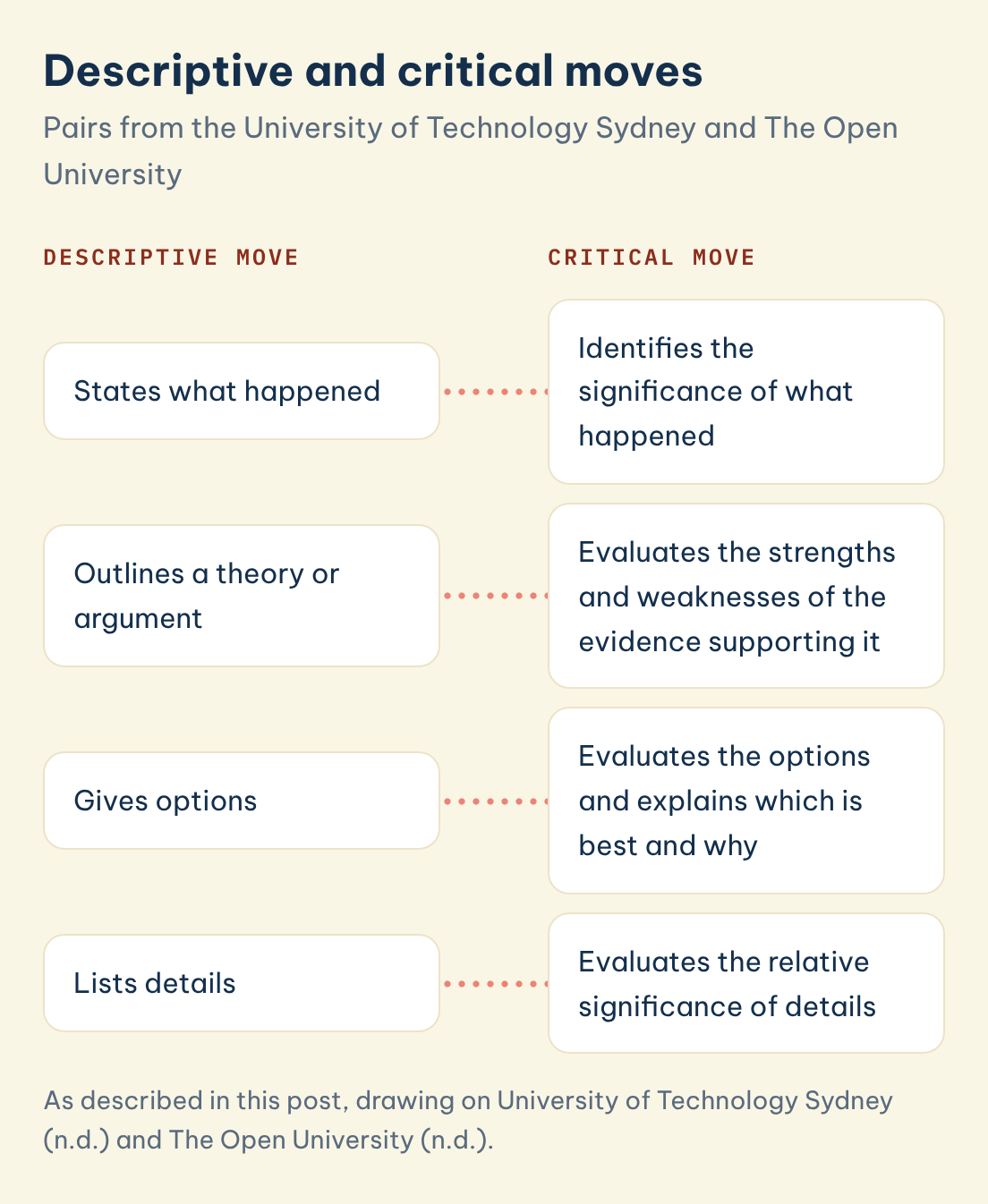
The Open University (n.d.) publishes a fuller list of fifteen such pairs, and the University of Leeds Library (n.d.) gives pairs of the same kind. When several universities publish nearly the same contrast, you can treat it as a stable convention rather than one lecturer's taste.
◆ Question 3 / 9 · How do you move from
How do you move from description to analysis in a paragraph?
Direct answer: Keep the description short, then add your own interpretation and explain the significance, consequences and implications of each statement you have made. The University of Leeds Library (n.d.) tells students to "move from description to analysis and evaluation" and to keep descriptive statements to a minimum.
Here is a before-and-after paragraph on an invented topic, so no real source is misrepresented. The topic is remote working and productivity.
Descriptive version: "Several studies have looked at remote working. One study surveyed employees and found that most reported working more hours. Another study used company records and measured output. Both studies were published in the last decade."
Critical version: "The two main kinds of evidence point in different directions. Self-reported hours suggest that remote staff work more, but company records measure output, and output is the better test of productivity because hours say nothing about what was achieved. The claim that remote working raises productivity is therefore only as strong as the output data behind it, which is thinner."
Notice what changed. The second version still mentions the evidence, but each sentence now compares, weighs or concludes. It also answers the question that the University of Leeds Library (n.d.) pairs with description: it shows the relevance and appropriateness of the evidence, not merely its existence. Both analytical paragraphs are examples written for this guide, not quotations from research.
◆ Question 4 / 9 · What words show that an
What words show that an essay is critical?
Direct answer: Critical writing uses instruction words and phrases that signal judgement, such as evaluate, debate and critique, plus evaluative phrases like "a shortcoming of this argument is". The University of Sydney (n.d.) groups instruction words into descriptive, analytical and critical, and Federation University Australia (2025) lists phrases.
The University of Sydney (n.d.) gives descriptive words as identify, report, record, summarise and define; analytical words as analyse, compare, contrast, relate and examine; and critical words as critique, debate, disagree and evaluate. Read your essay question for these words, because they tell you how far up that ladder the marker expects you to go.
Federation University Australia (2025) offers phrases that carry a judgement: "a difficulty with this position is…", "a shortcoming of this argument is…", "the strength of this stance is…" and "this perspective does not take account of …". It also says that another indicator of writing critically is that the author has a distinctive "voice". Use the phrases as prompts for a thought you actually have, never as filler to decorate a descriptive sentence.
◆ Question 5 / 9 · How do you write a critical
How do you write a critical essay introduction?
Direct answer: Name the topic in a sentence or two, say which position you will argue, and signal the main reasons in order. The University of Sydney (n.d.) says critical writing requires you to consider at least two points of view, including your own, so the introduction should show there is something to weigh.
With two views in play, a weaker opening describes the area ("This essay will discuss remote working"). A stronger one commits to a position ("This essay argues that the evidence for productivity gains is weaker than its popularity suggests, because it relies on self-reported hours"). Wingate (2012) counts the writer's development of a position as part of developing an argument, so the introduction is where that position first appears. Our guide to how to write an essay introduction covers the opening in more detail, and how to make an essay plan shows how to map reasons before you draft.
◆ Question 6 / 9 · What does a critical essay
What does a critical essay template look like?
Direct answer: A critical essay follows the usual introduction, body and conclusion, but each body paragraph makes one claim, gives the evidence briefly, evaluates it, and links back to the question. The overall aim of the structure is to develop an argument (Wingate, 2012).
Wingate's framework "highlights the development of argument as the overarching aim of essay writing" (Wingate, 2012, p. 153). Treat the following as a working pattern rather than a rule, because departments differ and your unit guide has the final say. In each body paragraph, open with the claim in your own words. Then give the evidence in one or two sentences, with the citation. Next, evaluate it: how strong is the method, what does it leave out, and how does it compare with another source. Finish by saying what this means for your overall answer.
The University of Sydney (n.d.) lists three needs of critical writing: you accurately summarise the work, you have an opinion about it, and you provide evidence for your point of view. Keep a short summary at the start of a paragraph, and put the weight of the paragraph after it.
◆ Question 7 / 9 · How is a university critical
How is a university critical essay different from school writing?
Direct answer: At university the marker expects an argument supported by evaluated evidence, not a well-organised account. Federation University Australia (2025) says that the writing most students did before university was descriptive rather than critical, so the main change is the move from reporting to judging.
This guide does not cover school courses such as Nat 5, because none of its sources does, so follow your teacher's and exam board's guidance for those.
A university essay also expects you to weigh sources against each other. Our guide to writing a critical review covers judging a single work, while a critical essay applies that judgement across several works to defend one position.
◆ Question 8 / 9 · Where can I find critical
Where can I find critical essay examples?
Direct answer: Look for examples published by your own university's library or writing centre, and read them for the moves rather than the topic. A model essay from another subject still shows how a paragraph weighs evidence, but check the marking criteria for your discipline.
Ask your tutor which past essays are available, because an example helps most when it matches your discipline and level. Mark every sentence in it as description, analysis or evaluation.
Use the sources in this guide as a marking key. The University of Technology Sydney (n.d.) supplies the descriptive and critical pairs, The Open University (n.d.) lists 15 such comparisons, and the University of Leeds Library (n.d.) adds significance, relevance and appropriateness as three tests to run on a statement. Federation University Australia (2025) gives the evaluative phrases, and the University of Sydney (n.d.) names 3 needs of critical writing: summarise the work accurately, hold an opinion about it, and back that opinion with evidence. Read one example with these sources open beside it, and you will see how much of a good paragraph is judgement.
For a quick check on your own draft, take 3 paragraphs and underline each sentence that matches the left column of the University of Technology Sydney (n.d.) table. Where most of a paragraph is underlined, rewrite it using the right column, and compare your result with the pairs in The Open University (n.d.) before moving on.
◆ Question 9 / 9 · Can expert guidance help
Can expert guidance help with a critical essay?
Expert guidance can help you see where your draft only describes, and how to turn a paragraph into a judgement. Through essay and assignment support at MAAS, a mentor works with you through Outline, Draft and Final, and you stay the author of every argument. Your marker and your institution decide the mark, so there is no promise about a grade.
Frequently asked questions
Does being critical mean criticising?
No. It means judging how strong the evidence and reasoning are, which can lead you to agree or disagree. The University of Sydney (n.d.) asks for your own view alongside at least one other.
How much description should a critical essay contain?
As little as lets the reader follow your judgement. The University of Leeds Library (n.d.) advises keeping descriptive statements to a minimum and moving on to interpretation, significance and implications.
What is the quickest test for a descriptive paragraph?
Check whether it only states what happened or what a source says. The University of Technology Sydney (n.d.) contrasts that with identifying the significance of what happened.
Do I need a different structure for a critical essay?
The shape is usually the same as other essays. What changes is what each paragraph does with its evidence, since the overarching aim of essay writing is the development of argument (Wingate, 2012).
Which words in the question tell me to be critical?
Instruction words such as critique, debate, disagree and evaluate are grouped as critical by the University of Sydney (n.d.). Analytical words like compare and examine sit between description and critique (The University of Sydney, n.d.).
Is a critical essay the same as a critical review?
No. A review judges one work, while an essay argues a position using several works. Both ask for the same habit of evaluating rather than reporting.
References
Federation University Australia. (2025). Reading and writing critically [Helpsheet]. https://www.federation.edu.au/siteassets/files/students/study-skills/reading_writing_critically_helpsheet-2025.pdf
The Open University. (n.d.). Succeeding in postgraduate study: 4 The difference between descriptive and critical writing. OpenLearn. https://www.open.edu/openlearn/mod/oucontent/view.php?id=114381§ion=_unit5.4
The University of Sydney. (n.d.). Types of academic writing. https://www.sydney.edu.au/students/study-skills/writing/types-of-academic-writing.html
University of Leeds Library. (n.d.). Critical writing. https://library.leeds.ac.uk/info/1401/academic-skills/105/critical-thinking/5
University of Technology Sydney. (n.d.). How to write critically. https://www.uts.edu.au/for-students/current-students/support/helps/self-help-resources/academic-skills/how-write-critically
Wingate, U. (2012). 'Argument!' Helping students understand what essay writing is about. Journal of English for Academic Purposes, 11(2), 145–154. https://doi.org/10.1016/j.jeap.2011.11.001
Not sure how this guide applies to your own case? Talk it through with MAAS in a free 20-minute consultation.
Book a free consultation ▸