
An analytical paragraph makes one point, supports it with evidence, then explains what the evidence shows and why it matters. The University of Portsmouth Library (2026) describes the pattern in four moves: introduce the point, provide evidence, analyse it, and link back to the question. The analysis is the part markers look for.
◆ Question 1 / 7 · What does an analytical
What does an analytical paragraph look like?
Direct answer: An analytical paragraph has a topic sentence, evidence, analysis and a closing link, all serving one main point. The University of Portsmouth Library (2026) notes that not every paragraph needs all four parts, but most contain at least the first three, so analysis is rarely the part to leave out.
Picture the paragraph as a small argument with a fixed order. The topic sentence states the point, the evidence gives the reader something to check, the analysis connects the two, and the final sentence ties the paragraph back to the question you were set. Deakin University (n.d.) adds that most paragraphs have only one main idea supported by evidence, and Monash University (n.d.) suggests that a paragraph filling most of an A4 page probably covers more than one key point and should be split.
The order matters because a reader meets your sentences one at a time. If the evidence arrives before the point, the reader has to guess why it is there. If the analysis is missing, the reader has to supply the connection alone, which the University of Portsmouth Library (2026) warns against directly. The sections below take each part in turn, then show a complete paragraph with every part labelled. If you are still working out where paragraphs sit inside a whole essay, our guide to how to write a university essay covers the overall structure.
◆ Question 2 / 7 · How do you start an
How do you start an analytical paragraph?
Direct answer: Start with a topic sentence that states the single point the paragraph will prove. Deakin University (n.d.) says its purpose "is to introduce the main idea or focus of the paragraph" and that it should be clearly stated in a single sentence. A stronger version also signals your position.
The topic sentence is a promise to the reader. Everything after it should deliver on that promise, and anything that does not belongs in a different paragraph. The University of Portsmouth Library (2026) goes a step further for advanced writing: "A strong topic sentence does more than state a point. It signals your position and shows the reader where the paragraph is going."
A weak opening names a subject, such as "Diet and study." A stronger opening makes a claim someone could disagree with. The Portsmouth page gives the example "A poor diet can reduce a student's ability to concentrate during the working day," which names a cause and an effect and invites evidence (University of Portsmouth Library, 2026). Write the topic sentence first, then check that every later sentence could be defended as support for it.
◆ Question 3 / 7 · What is the difference
What is the difference between description and analysis?
Direct answer: Description reports what a source says or what happened. Analysis explains what it means, how reliable it is and why it matters to your point. The University of Leeds Library (n.d.) puts it this way: students must "move from description to analysis and evaluation" and explain significance, consequences and implications.
Feedback such as "too descriptive" is something students "sometimes receive", according to the University of Leeds Library (n.d.), which discusses it on its critical writing page, alongside the advice that most university assignments call for work that is analytical and critical. Some description is acceptable, for instance as background, but Leeds recommends keeping descriptive statements to a minimum.
Monash University (n.d.) shows the contrast with one set of students' behaviour. Its sample paragraphs are annotated as one that "describes the students' behaviour", one that "explains the relevant theory", and one that "analyses the students' behaviour in relation to the theory". Only the third does the job an assessed essay usually asks for. A study of 196 first-year students in Finland points the same way: the writers in one group, 12% of the sample, "stuck to summarizing sources without position-taking" (Kleemola et al., 2022, p. 1). Summary is the natural default, so analysis has to be added on purpose.
| Move | What the sentence does | Typical signal |
|---|---|---|
| Describe | Reports what a source says or found | "The study found that..." |
| Explain | Clarifies a theory, term or process | "This means that..." |
| Analyse | Connects evidence to your point, weighs its reliability or compares sources | "This suggests that...", "However, this assumes..." |
◆ Question 4 / 7 · What does analysis look like
What does analysis look like in an academic paragraph?
Direct answer: Analysis answers the question "so what?" about your evidence. The University of Portsmouth Library (2026) says it shows why the evidence matters and how it supports your topic sentence, and that without it "evidence feels disconnected or descriptive." Analysis can also test the evidence's reliability, assumptions and fit with other sources.
Here is a worked paragraph on a topic taken from this post's own sources, with each part labelled in brackets. The evidence is a real finding from a peer-reviewed study, and the wording of the paragraph is ours.
[Topic sentence] Novice writers often treat summarising sources as if it were the same task as arguing from them. [Evidence] In a study of 196 first-year students in Finland, 12% of the writers "stuck to summarizing sources without position-taking" (Kleemola et al., 2022, p. 1). [Analysis] The habit is hard to break, since Kleemola et al. (2022, p. 3) note that earlier research found writers may fall back on summarising sources "even when explicit requests are made for position-taking". A marker reading such an essay would find accurate content but no answer to the question. [Link] Moving from reporting a source to explaining what it shows for your own point is therefore the change that separates a descriptive paragraph from an analytical one.
Notice that the analysis sentences make judgements ("hard to break", "separates") rather than only reporting what the source says. Deakin University (n.d.) offers prompts for this stage: how will I compare statements that agree or disagree, what conclusions can I draw from this and related sources, and do I need to question the validity of the source or highlight its limitations?
◆ Question 5 / 7 · Which paragraph model
Which paragraph model should you use: PEEL, TEEL, TEAL or MEAL?
Direct answer: Any of them, because they share one logic. The University of Portsmouth Library (2026) lists MEAL, TEAL and PEEL and states that "Although the acronyms differ, they all follow the same logic as the structure described in this guidance." Use the one your department or unit guide names.
Paragraph models compared
Each row sets one paragraph model beside what its letters stand for.
Model
What the letters stand for
MEAL
Main point, Evidence, Analysis, Link
TEAL
Topic sentence, Evidence, Analysis, Link
PEEL
Point, Evidence, Explanation, Link
TEEL
Topic, Expand or Elaborate, Evidence or Examples, Link
Save this figure
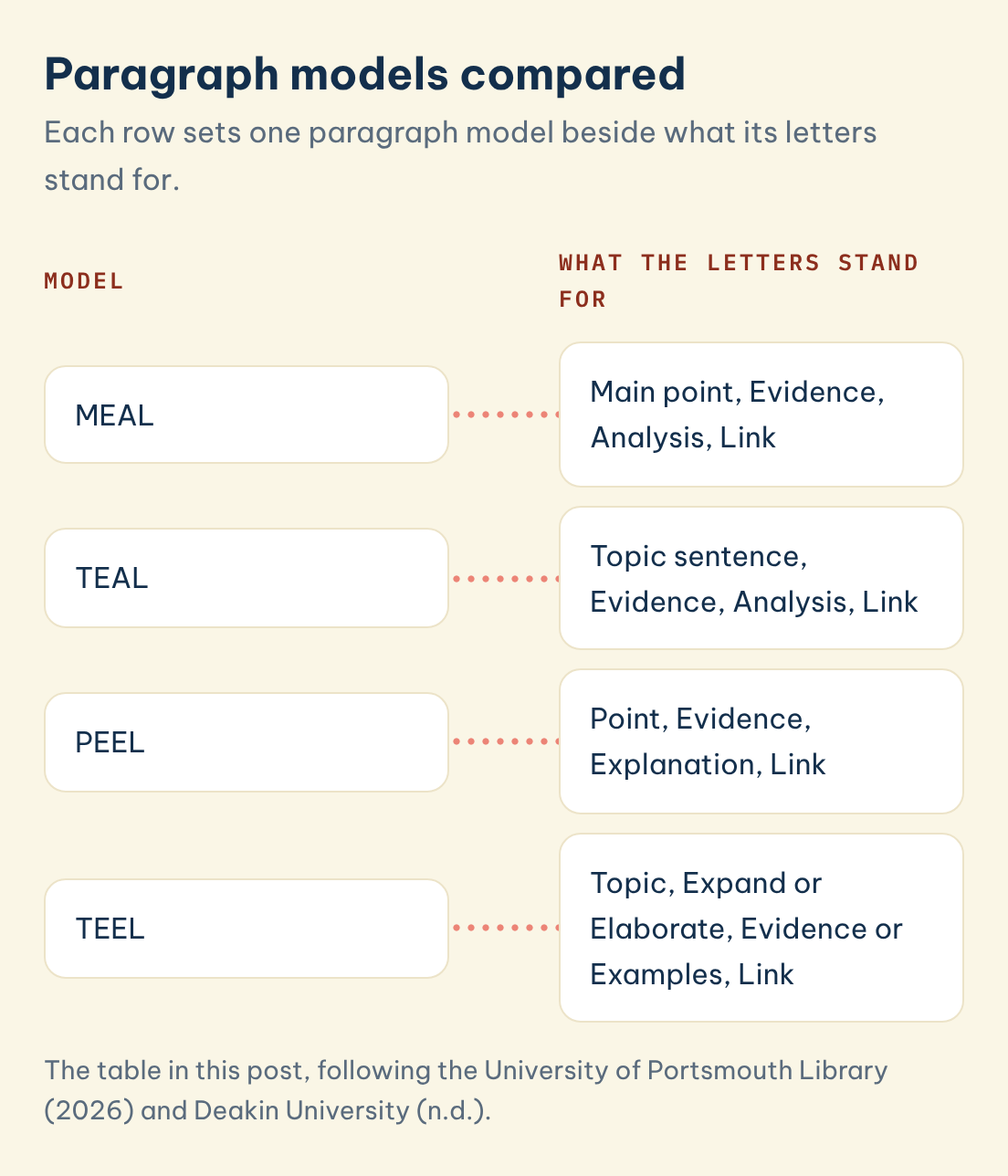
The letters differ mainly in what the second and third slots are called. Deakin University (n.d.) defines TEAL as Topic, Evidence, Analysis, Link, and TEEL as Topic, Expand or Elaborate, Evidence or Examples, Link. Monash University (n.d.) describes the same anatomy as a topic sentence, supporting sentences and a concluding or linking sentence, with the concluding sentence marked optional. Portsmouth's three models are enough for most coursework.
| Model | What the letters stand for | Source |
|---|---|---|
| MEAL | Main point, Evidence, Analysis, Link | University of Portsmouth Library (2026) |
| TEAL | Topic sentence, Evidence, Analysis, Link | University of Portsmouth Library (2026) |
| PEEL | Point, Evidence, Explanation, Link | University of Portsmouth Library (2026) |
| TEEL | Topic, Expand or Elaborate, Evidence or Examples, Link | Deakin University (n.d.) |
A caution applies to all of them. The model is scaffolding for a draft, not a template to stamp on every paragraph. If you have drilled one formula since school, the practical test is simple: does your paragraph contain a point, evidence and an explicit statement of what the evidence shows? If so, the label hardly matters.
◆ Question 6 / 7 · Which words show analysis
Which words show analysis in an essay?
Direct answer: Reporting verbs and evaluative phrases show analysis, because they reveal your stance on a source. Newcastle University (n.d.) says reporting verbs "indicate your stance (agree, disagree, etc) on the scholarship you're describing, highlighting your critical contribution." Choose them with care, because each verb signals a different degree of agreement with the source.
A common mistake is to repeat one neutral verb, usually "states" or "says," in every sentence. That produces a paragraph that lists rather than explains, a fault the University of Portsmouth Library (2026) names directly: "Always explain what your evidence means and why it matters." Newcastle University (n.d.) groups verbs by stance, from argues and contends to demonstrates, shows and confirms, so scanning its list shows how much difference one verb makes.
Verbs are only half the work. The University of Portsmouth Library (2026) lists three analytical moves that go beyond explaining: comparing sources to identify patterns or conflicting results, identifying implications beyond the immediate findings, and evaluating the strength and limitations of the evidence. Phrases that open those moves, such as "This pattern suggests," "A limitation of this finding is," or "In contrast to," give your analysis a visible shape. If you want a longer treatment of evaluating sources, see our guide to how to write a critical review.
◆ Question 7 / 7 · What is the 10% rule
What is the 10% rule in essay writing?
Direct answer: There is no single 10% rule. Some universities allow about 10% over the word limit without penalty, while others penalise it. The University of East Anglia (n.d.) applies no penalty for less than 10% over, but Coventry University London (2026) deducts marks at 10% over or under, so check your own brief.
Students often ask about this rule when they budget words paragraph by paragraph. At the University of East Anglia (n.d.), the policy table reads "Less than 10% over word limit No Penalty / 10% or more over the word limit Deduction of 10 marks off original mark." Coventry University London (2026) states a stricter position: "If your work is 10% over the maximum limit or 10 % under the minimum limit specified, you will lose 10% of your mark for that assessment."
Those two examples are enough to show why a blanket rule is unsafe. Penalty schemes differ by university, by school and sometimes by course. Treat leeway as something your marking criteria must state, not as a habit you may assume. In planning terms, if an essay of 1,500 words has six body paragraphs, each paragraph has roughly 170 to 200 words once the introduction and conclusion are accounted for, which is why a paragraph with one point and tight analysis fits the budget better than one with three points.
Frequently asked questions
What are the parts of an analytical paragraph?
A topic sentence, evidence, analysis and a link. The University of Portsmouth Library (2026) says most paragraphs contain at least the first three parts, and that analysis connects the evidence to your point.
How long should an analytical paragraph be?
Long enough to make one point fully. Monash University (n.d.) warns that a paragraph filling most of an A4 page probably covers more than one key point and should be broken up (Monash University, n.d.).
Is an analytical paragraph the same as a PEEL paragraph?
Largely. PEEL, MEAL and TEAL all follow the same logic (University of Portsmouth Library, 2026). The difference is that an analytical paragraph is defined by what it does, explaining what evidence means, while PEEL names the steps.
Can a paragraph be descriptive in an academic essay?
Yes, briefly. The University of Leeds Library (n.d.) accepts description for background but advises keeping descriptive statements to a minimum and moving on to analysis and evaluation.
How do I start an analytical essay?
Plan the argument first, then write an introduction that moves from the topic to your position. Our guide to how to write a university essay walks through that process in seven steps.
Can a mentor help me check my paragraphs?
Yes. A mentor can read your draft and mark where a paragraph describes when it should analyse, while you write and decide the content. Academic support at MAAS works as tutoring and feedback, and the writing remains yours.
References
Coventry University London. (2026). Coursework assignments. https://www.coventry.ac.uk/student-central/london/handbook/assessment-and-awards/coursework-assignments/
Deakin University. (n.d.). Paragraph structure. https://www.deakin.edu.au/students/study-support/study-resources/study-support-guides/paragraph-structure
Kleemola, K., Hyytinen, H., & Toom, A. (2022). The challenge of position-taking in novice higher education students' argumentative writing. Frontiers in Education, 7, Article 885987. https://doi.org/10.3389/feduc.2022.885987
Monash University. (n.d.). Build clear paragraphs. Student Academic Success. https://www.monash.edu/student-academic-success/excel-at-writing/improve-your-writing/write-clearly/build-clear-paragraphs
Newcastle University. (n.d.). Reporting verbs. Academic Skills Kit. https://www.ncl.ac.uk/academic-skills-kit/writing/academic-writing/reporting-verbs/
University of East Anglia. (n.d.). Submission of work for assessment (taught programmes) [Policy appendix released under a Freedom of Information request]. https://assets.uea.ac.uk/f/185167/x/a73298bf60/foi_25-104-appendix-a.pdf
University of Leeds Library. (n.d.). Critical writing. In Critical thinking. https://library.leeds.ac.uk/info/1401/academic-skills/105/critical-thinking/5
University of Portsmouth Library. (2026). Structuring paragraphs. https://library.port.ac.uk/academic-support/writing-for-assignments/structuring-paragraphs
Not sure how this guide applies to your own case? Talk it through with MAAS in a free 20-minute consultation.
Book a free consultation ▸