
◆ Writing Tips
How do you make an essay plan before you start writing?
To make an essay plan, state your answer to the question in one sentence, pick the main points that support it (UNSW Sydney (n.d.) suggests three or four for a 1,000 to 1,500-word essay, more for longer ones), give each point its own paragraph, and set a rough word count for every section. UNSW Sydney (n.d.) adds a note of the sources you expect to use. In our experience, 20 to 30 minutes is enough for a first version.
◆ Question 1 / 8 · How do you write an essay
How do you write an essay plan for university?
Direct answer: Write your answer to the question in one sentence, list the main points that support it, put them in order, and note the evidence for each. UNSW Sydney (n.d.) says an initial plan should hold a thesis statement, possible main points, a structure and an indication of research.
The 20 to 30 minutes at the top of this post is MAAS advice, not a figure from any university guide, so treat it as a target for a first version rather than a rule. A sensible way to spend that time is to divide it into four short jobs. First, read the question again and mark the task words. Second, write a one-sentence answer, even if you expect to change it. Third, list every point you could make and cross out the ones that do not help the answer. Fourth, put the survivors in an order that lets each point lead into the next one. If you have already read widely and are stuck at this stage, our guide on how to start an essay covers turning a pile of notes into claims, and this post goes further into the plan itself.
Your plan is a working document. UNSW Sydney (n.d.) says to assume you will draft a couple of essay plans, and that the second one, written after your research and reading, will strengthen and clarify your ideas. The first plan tells you what to read, and the second tells you what to write.
◆ Question 2 / 8 · What should an essay plan
What should an essay plan structure look like?
Direct answer: An essay plan structure has an introduction, a body of separate points and a conclusion, with each body paragraph carrying one main point. The University of Queensland (2021) advises addressing one key point per paragraph before moving to the next.
Most university guides agree on the shape and differ only in the numbers. The University of Suffolk (2024) says the introduction usually takes 5 to 15% of an essay, the middle section 70 to 80%, and the conclusion 5 to 10%. Queen Margaret University (n.d.) gives a simpler rule of thumb of roughly 10% each for the introduction and conclusion. The table below applies the Suffolk ranges to a 2,000-word essay. The word counts are our own arithmetic from those percentages, so use them as a planning range and check your assignment brief for anything stricter.
| Section | Share of essay (University of Suffolk, 2024) | Words in a 2,000-word essay |
|---|---|---|
| Introduction | 5 to 15% | 100 to 300 |
| Body | 70 to 80% | 1,400 to 1,600 |
| Conclusion | 5 to 10% | 100 to 200 |
Inside the body, give every paragraph a job. The University of Sheffield (n.d.) describes a five-part paragraph: a topic sentence, an optional explanation or definition, evidence and examples, a comment, and a concluding sentence that links back to your argument and forward to the next paragraph. In the plan you only need the topic sentence and a note of the evidence. The University of Sheffield (n.d.) suggests sketching the structure with paragraph topic sentences as a skeleton for your writing, which is also the quickest way to see whether the argument holds together before you have written a full paragraph.
◆ Question 3 / 8 · How many paragraphs
How many paragraphs and words does each part need?
Direct answer: Start from the total word count, take off the introduction and conclusion, and divide what is left into paragraphs that each make one point. According to the University of Hull (2026), a 2,000-word essay has room for 6 to 8 such paragraphs and a 3,000-word essay for 8 to 12.
Paragraph length is where university guides disagree, and you should not treat any single number as the standard. The University of Hull (2026) says academic paragraphs are usually between 200 and 300 words, while the University of Suffolk (2024) puts them between 150 and 250 or 300 words. The University of Queensland (2021) is similar: "Your essay should be divided into roughly equally sized paragraphs that are between 150-250 words (although your introduction and conclusion can be a bit shorter)" (p. 7). That guide comes from a politics school, so check whether your own department publishes a different range.
The University of Hull (2026) turns this into a lookup table. It takes the introduction and conclusion off the total, then divides what remains into paragraphs, each one carrying a single point.
| Essay length | Introduction + conclusion | Approximate body | Paragraphs (University of Hull, 2026) |
|---|---|---|---|
| 2,000 words | 200 + 200 | 1,600 | 6 to 8 |
| 3,000 words | 300 + 300 | 2,400 | 8 to 12 |
| 4,500 words | 450 + 450 | 3,600 | 12 to 18 |
For shorter pieces, UNSW Sydney (n.d.) says a 1,000 to 1,500-word essay needs 3 to 4 main points. The University of Hull (2026) adds that in the longer essays the paragraphs will probably be grouped into themes, which gives a plan one more level of organisation.
◆ Question 4 / 8 · Can you see an essay plan
Can you see an essay plan example?
Direct answer: Yes. Queen Margaret University (n.d.) shows a 1,500-word plan with a 150-word introduction, four body sections of 250 to 400 words or more, and a conclusion of 100 to 150 words, each section carrying short bullet notes about the points and the evidence.
A 1,500-word essay plan by section
Queen Margaret University (n.d.) worked example, section targets in words.
Introduction
150
words
College study
250
words
University study
250
words
Challenges
400
words
Solutions
300
words
Conclusion
100
words
Save this figure
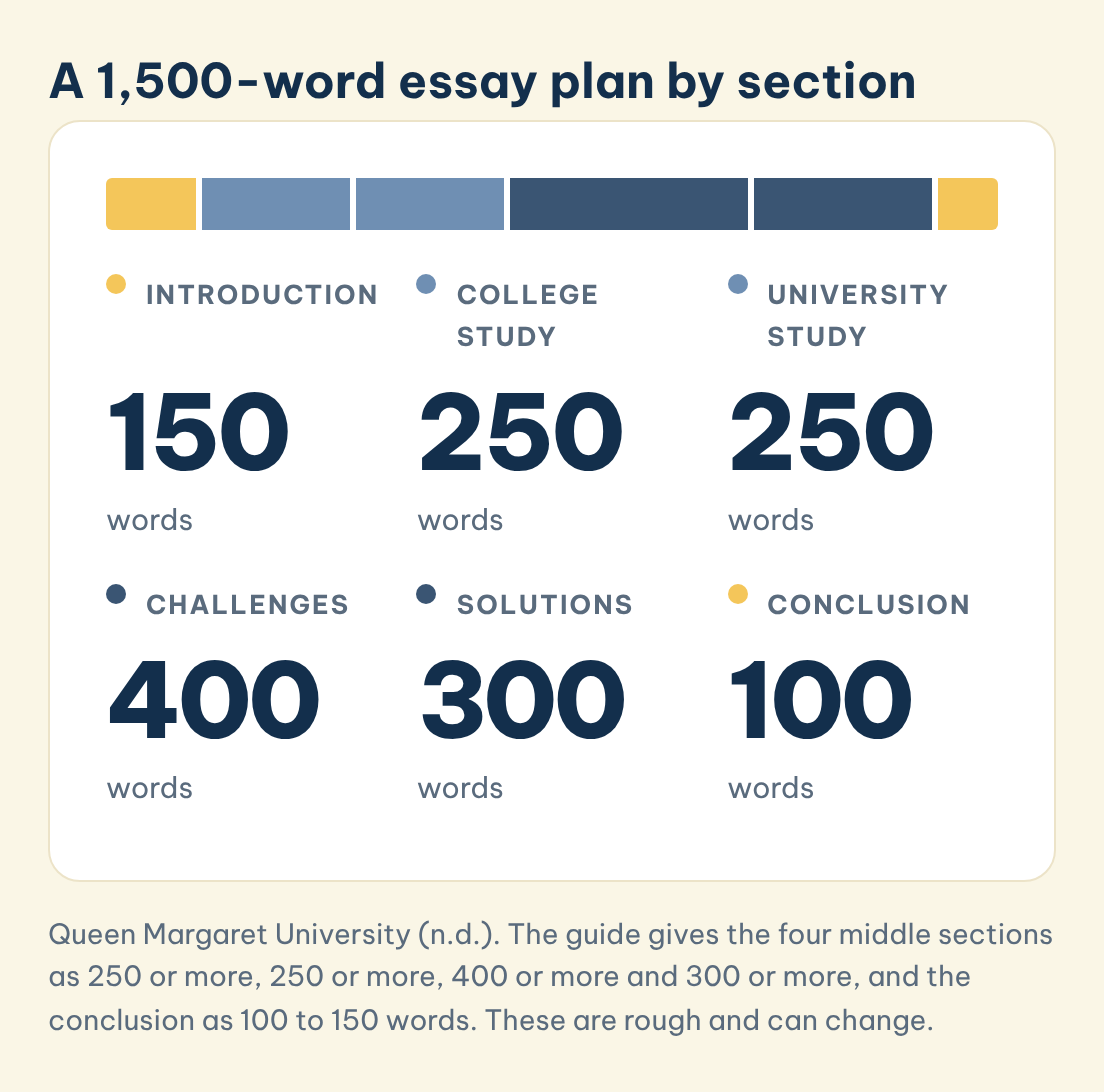
Queen Margaret University (n.d.) works through the question "Discuss the key differences between college and university study". The plan allows roughly 150 words for the introduction, then splits the body into four sections: the key features of college study (250 words or more), the key features of university study (250 or more), the challenges of moving to university (400 or more), and how universities and students can tackle those challenges (300 or more). The conclusion is 100 to 150 words. Within one section it adds paragraph targets, such as 150 words for the first paragraph and 100 for the second, and a note to explain close contact with lecturers and give a reference. The guide itself warns that these numbers are "only rough and can change".
Three features of that example are worth copying. The sections have different lengths, because the student decided which point matters most. The notes are questions and reminders rather than full sentences. The plan also carries a to-do item for evidence. In our experience, a plan that looks like this takes 20 to 30 minutes once you know your answer. That estimate is ours, not the guide's.
◆ Question 5 / 8 · Is there an essay plan
Is there an essay plan template you can copy into Word?
Direct answer: Copy the template below into Word or a notes app and fill each line in turn. It combines the plan contents listed by UNSW Sydney (n.d.) with the one-point-per-paragraph model from the University of Sheffield (n.d.), and it leaves room for a counterargument.
Oxford Brookes University (n.d.) says an assessed essay plan does not have to be in full sentences, and that a linear bullet-point list with some detail on the evidence is often enough. It also says a linear plan is usually best when the plan is set as an assignment because it is the simplest for someone else to read. The template below is linear for that reason. The figures in square brackets are placeholders for a 2,000-word essay, so replace them with your own.
ESSAY PLAN
Question: [paste the exact question]
Task words: [discuss / evaluate / compare ...]
Word count: [2,000]    Deadline: [date]

My answer in one sentence (thesis):
[ ... ]

INTRODUCTION [about 200 words]
- Background and why the question matters
- Scope: what I will and will not cover
- Thesis and route through the essay

BODY (6 to 8 paragraphs, one point each)
Point 1 [about 200 to 250 words]
- Topic sentence:
- Evidence / source:
- Comment: why this supports my answer
- Link to next point:
Point 2 [about 200 to 250 words]
  (same four lines)
Counterargument [about 200 to 250 words]
- Opposing view:
- Source for it:
- My response:
- Restate my position:
Point 3 ... Point 4 ...

CONCLUSION [about 200 words]
- Restate the answer in a new way
- What follows from it

SOURCES STILL TO FIND: [list]
Fill the template in order, but do not be afraid to leave lines blank. Oxford Brookes University (n.d.) notes that people rarely follow essay plans exactly because ideas develop as they write, so a blank line is useful information about what you still have to read.
◆ Question 6 / 8 · How do you structure
How do you structure a counterargument paragraph in your plan?
Direct answer: Name the opposing view, give the best evidence for it, answer it, and then restate your own position. This pattern comes from Sheffield Hallam University (n.d.), whose guide says to explore the arguments that could dismantle your claim, rebuff them, and finally restate your position.
None of the UK or Australian guides we read give a step-by-step formula for a counterargument paragraph, so the four-line version in the template is MAAS's own synthesis of the pattern in Sheffield Hallam University (n.d.), not a rule from a university. The University of Queensland (2021, p. 2) states that "A well-rounded discussion will incorporate various perspectives and counterarguments before coming to an overall conclusion as to which position/s you find more persuasive (and why)." UNSW Sydney (n.d.) agrees: if there are opposing views, they need to be examined too.
In a plan, a counterargument can either take its own paragraph, as in the template, or sit inside each body paragraph as a short rebuttal. In our experience, the first is easier to manage in an essay under 1,500 words, and the second suits longer essays where several points each have an obvious objection. The University of Sheffield (n.d.) adds a useful habit for your notes: make it clear in your plan, and in your final essay, which sources align with your argument and which give alternative viewpoints. That way you do not lose track of who is on which side by the time you start drafting.
◆ Question 7 / 8 · How many sources should an
How many sources should an essay plan include?
Direct answer: No guide gives a fixed number. The University of Sheffield (n.d.) says to estimate how many sources you need to find and add them to your essay plan, and Sheffield Hallam University (n.d.) notes that the more complex the claim, the more sources you may need.
We looked for a figure and did not find one in any UK or Australian guide, so we will not give you one either. What Sheffield Hallam University (n.d.) offers is a method: estimate from your plan, and expect a complex claim to need more sources. Our own rule of thumb at MAAS is that a point supported by a single anecdote needs more evidence, while a well-established fact may need only one reliable source. UNSW Sydney (n.d.) says your plan should include some indication of the sources you might use to research the topic later, and that is enough at this stage.
A practical way to estimate is to count your body points and ask what each one needs: a definition, a statistic, a case study or a scholar's argument. The University of Queensland (2021) lists these as the kinds of support body paragraphs usually use: data, illustrative examples or case studies, and the work of key scholars. Add one line under each point saying which kind of evidence you expect to use, and your source list falls out of the plan. If a point has no evidence line after your first round of reading, either find some or drop the point.
◆ Question 8 / 8 · How can MAAS help with your
How can MAAS help with your essay plan?
Direct answer: MAAS works as a tutor and advisor. You and a MAAS expert agree the structure of your plan, then move through the Outline, Draft and Final stages with the expert explaining what to change at each step, while the thinking and the submission stay with you.
If you are unsure whether your plan answers the question, essay and assignment support from MAAS follows an Outline, Draft, Final sequence in which the work stays yours and a mentor gives feedback at each stage. A mentor can read your plan and tell you whether the structure and the evidence lines match what your marking criteria ask for. Most students begin by sending their plan and the assignment brief, and the first conversation is free.
Frequently asked questions
How long should an essay plan be?
For an assessed plan, Oxford Brookes University (n.d.) says an outline of main points in bullet form, with some detail on the evidence under each point, is often enough. For your own use, MAAS mentors find a page or less is usually enough.
What is the difference between an essay plan and an outline?
The guides we read use the words loosely. Oxford Brookes University (n.d.) describes a plan as a way to identify, select and order the points you want to make, so treat the two terms as the same document at different levels of detail.
Should the plan be a mind map or a list?
Either. UNSW Sydney (n.d.) says a plan can be a list of bullet points, a mind map, a diagram or a few rough paragraphs. Oxford Brookes University (n.d.) says a linear bullet list is usually best when the plan is set as an assignment.
Do I have to follow the plan exactly?
No. Oxford Brookes University (n.d.) says we rarely follow essay plans exactly because our ideas develop as we write. UNSW Sydney (n.d.) expects a second plan after your research.
Should I plan the introduction first?
Not necessarily. The University of Suffolk (2024) says it can help to leave the introduction until the end, after you have explored your topic more fully. Plan its content, then write it last.
How many paragraphs do I need for my word count?
The University of Hull (2026) suggests 6 to 8 body paragraphs for 2,000 words, 8 to 12 for 3,000 words and 12 to 18 for 4,500 words.
References
Sheffield Hallam University. (n.d.). Clearer arguments. Success at Master's Level LibGuide. https://libguides.shu.ac.uk/success-at-masters/clearer-arguments
Oxford Brookes University. (n.d.). Essay plans. Centre for Academic Development, Online resources. https://www.brookes.ac.uk/students/academic-development/online-resources/essay-plans
Queen Margaret University. (n.d.). Planning & writing essays. Effective Learning Service. https://www.qmu.ac.uk/study-here/services-for-students/support-for-learning/effective-learning-service-els/essay-writing
University of Hull. (2026). Planning & drafting. Essay writing LibGuide. https://libguides.hull.ac.uk/essays/planning
University of Queensland. (2021). Essay guide: Political Science and International Studies. School of Political Science and International Studies. https://polsis.uq.edu.au/files/45340/POLSIS%20Essay%20Guide%202021%20Version%281%29.pdf
University of Sheffield. (n.d.). How to structure a paragraph. StudySkills@Sheffield. https://sheffield.ac.uk/study-skills/writing/academic/paragraph
University of Suffolk. (2024). Structuring your assignment. Academic Writing, Learning and Teaching. https://libguides.uos.ac.uk/academic-writing/structuring
UNSW Sydney. (n.d.). How to write a university essay. Current Students, Academic Skills. https://www.unsw.edu.au/student/managing-your-studies/academic-skills-support/toolkit/writing/essay
Not sure how this guide applies to your own case? Talk it through with MAAS in a free 20-minute consultation.
Book a free consultation ▸