
◆ Writing Tips
How to start an essay when you've read everything and written nothing
To start an essay, unpack the question, write a rough answer, group your notes into claims, and draft the easiest body section first. Students who have finished the reading but cannot produce a first sentence are usually stuck on the thinking, not on the wording, and university guides give a sequence for separating the two. This guide walks that sequence with a worked example and explains where freewriting fits, citing university writing centre pages and two journal sources listed under References.
◆ Question 1 / 7 · Why starting is hard
Why is starting so hard when the reading is already done?
Direct answer: Starting is hard because the writer has to decide what they think and find the words in the same moment. A plan separates the two jobs, according to the University of Reading (2026). Delay can also come from avoiding discomfort, a second cause that the next paragraphs describe.
Starting an essay: thinking problem or fear problem
Two causes of the blank page and what to do about each
If the problem is thinking
If the problem is fear
You have notes but no answer yet
You avoid the task to avoid the discomfort
Write a working answer in a sentence or two
Make the first task small and time-limited
Group notes into three or four claims
Set a writing deadline earlier than the due date
Draft the section you understand best
Start anywhere, not at the beginning
Freewrite for ten minutes to find your answer
Reward any writing, even a little piece
Save this figure
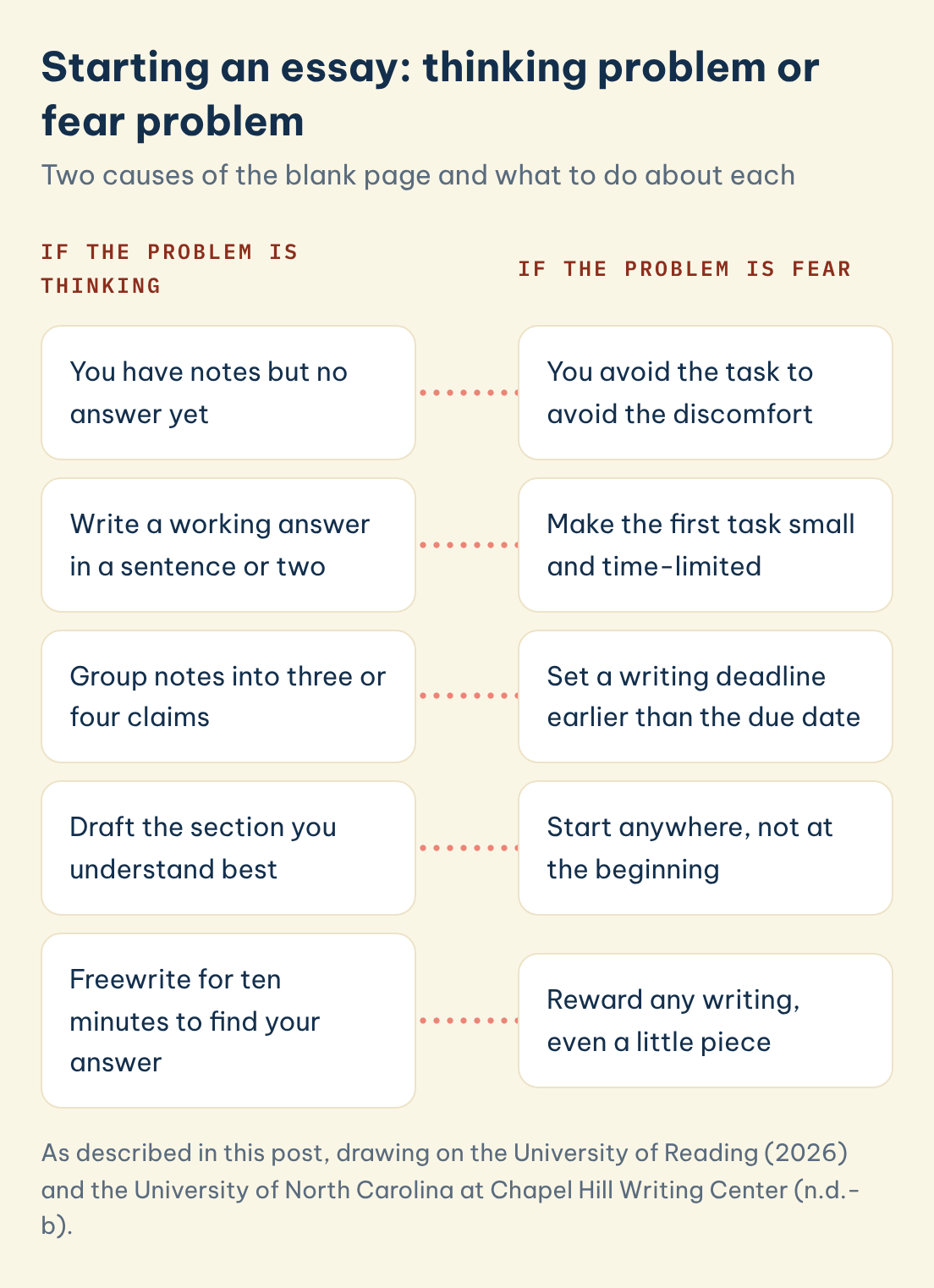
Two different problems tend to hide behind a blank page. The first is a thinking problem: you have notes but no answer to the question yet. The University of Reading (2026) describes planning as the way to work out a logical structure and an end point for your argument before you start writing, so that the writing stage is not also the deciding stage.
The second is an emotional problem. The University of North Carolina at Chapel Hill Writing Center (n.d.-b) says people procrastinate because they do not want to do the task or have too much else to do, that fear of failure can lead you to avoid the work to avoid the fear, and that perfectionists delay because they expect so much of themselves. The same page offers a hopeful point: simply starting to write can help us feel more positive about writing. It also says you do not have to start at the beginning, which matters because the first sentence of an essay is usually the hardest one to write.
Knowing which problem you have changes what you do next, because a thinking problem needs a plan and a fear problem needs a smaller first task, and the rest of this guide covers both.
◆ Question 2 / 7 · Before writing
What should you do before writing a single sentence?
Direct answer: Work out what the question is asking before you gather anything more: find the task words and the limits, read the question as a whole, check what is fixed, and break it into sub-questions. These steps answer a complaint that the University of Reading (2026) reports, that students write a lot but do not answer the question.
Start with the question, because a common complaint from lecturers and examiners, according to the University of Reading (2026), is that students write a lot of information but do not answer the question. Four short steps are enough.
- Mark the task words. The University of North Carolina at Chapel Hill Writing Center (n.d.-c) says words like analyze, summarize or compare direct you to think about your topic in a certain way. If you are unsure what a task word demands, our guide to assignment command words explains the common ones.
- Read it as a whole again. The University of Reading (2026) says underlining key words is a good start, but you should then consider the question as a whole and not as a series of unconnected words.
- Check what is fixed. The University of North Carolina at Chapel Hill Writing Center (n.d.-c) advises finding out whether elements such as page length and citation format are negotiable, and some instructors will deduct large numbers of marks for deviations. Tai Poutini Polytechnic (n.d.) adds that you should read the marking schedule closely and allocate your word count across the sections in line with it.
- Split it into sub-questions. The University of Reading (2026) suggests asking what the question is asking, why it matters, how you will answer it, and what you need to find out first, second and third. It cautions against having too many sub-questions, because that leads to following up minor issues.
If anything is still unclear after these steps, the University of North Carolina at Chapel Hill Writing Center (n.d.-c) says to ask the instructor, who would prefer to set you straight before you hand the paper in.
◆ Question 3 / 7 · Planning from notes
How do you plan when you have notes but no argument yet?
Direct answer: Put your notes on one page, write your current answer to the question in a sentence or two, and group the points that support it into three or four claims. The University of Reading (2026) recommends summarising your findings on a page and brainstorming ideas into three or four groups.
The University of Reading (2026) describes two moments for this. Before reading, note what you already know, what you need to find out and your initial response to the question. After reading, summarise what you found on one page, which helps you see how your first response has changed. If you skipped the first moment, the second still works.
Here is a worked example with an invented question: To what extent has streaming changed how people discover new music? A student with two weeks of notes might proceed like this, and the claims in the table are placeholders to show the method, not research findings.
| Step | What the student writes | Why it helps |
|---|---|---|
| Sub-questions | What does "discover" mean here? Who chooses what people hear? What has changed, and what has stayed the same? | Turns one big question into three answerable ones |
| Working answer | "Streaming has changed who does the recommending more than it has changed what people like." | Gives the plan a direction to test |
| Claim 1 | Recommendation has moved from radio and shops to algorithms and playlists | One point for one body paragraph |
| Claim 2 | Listeners still rely on friends and social media for trust | A counterpoint the answer must handle |
| Claim 3 | The evidence on genre variety is mixed, so the change is smaller than it looks | The qualification that makes the answer honest |
The working answer will probably change, and that is fine. The University of Reading (2026) says no plan is perfect and that you should be prepared for your ideas to change as you write, adding that an initial plan makes it much easier to see where new things fit. What the sentence does at this stage is give you something to test. It is also the starting point for the introduction that our guide on how to write an essay introduction shows you how to finish later.
◆ Question 4 / 7 · Body before introduction
Can you write the body before the introduction?
Direct answer: Yes, and several universities recommend it. Tai Poutini Polytechnic (n.d.) says not to try to write the introduction first and to start with the body, and Monash University (2026) says it is often easier to introduce and sum up information you are familiar with.
Writing the body first follows from the fact that an introduction promises what the body delivers. For a student who has read everything, the simple choice for the first writing session is to pick the claim from your plan that you understand best and write that paragraph. The University of North Carolina at Chapel Hill Writing Center (n.d.-a) tells writers to start with the section that comes together most easily, noting that you do not have to start at the beginning of the draft. State the claim in the first sentence, add the evidence, and explain what it shows. Monash University (2026) offers the same reason in its Faculty of Information Technology guide, and Tai Poutini Polytechnic (n.d.) likewise recommends using your outline and expanding each section, with each paragraph containing one main idea and supporting evidence.
The reasoning for leaving the introduction until later, and the view of the guides that disagree, are set out in our guide on how to write an essay introduction. What a complete body paragraph contains is covered in the step-by-step university essay guide, and the closing paragraph has its own guide on how to write an essay conclusion. If you prefer to begin with an introduction, that is not wrong, but treat it as a draft of your working answer and expect to rewrite it after the body is done.
◆ Question 5 / 7 · Freewriting
What is freewriting, and does it help you start?
Direct answer: Freewriting means writing for a fixed time without pausing to edit or judge what appears. The evidence for it is encouraging but narrow, since Yasuda (2022) found that regular practice raised the written fluency of first-year students, so it works best as a warm-up before you plan.
The University of North Carolina at Chapel Hill Writing Center (n.d.-a) says: "The crucial point is that you keep on writing even if you believe you are saying nothing." Elbow (1989), who championed the technique, argued that freewriting separates producing words from judging them. That suits the stage where you have notes in your head and no sentences on the page, because it lets you find out what you think by writing it down.
The research evidence is encouraging but narrower than the enthusiasm around the technique. Yasuda (2022) followed 39 first-year university students who completed 70 ten-minute freewriting activities over a semester. Their written fluency rose from a mean of 19.5 words per minute to 30.1 words per minute over 15 weeks, and their output and holistic scores on timed essays also rose. That is one study of language learners writing in English, so it supports freewriting as a way to get more words down, and does not prove that it produces better arguments for every writer. Use it as a warm-up, not a replacement for planning.
A practical version for the first session is ten minutes with the question in front of you, writing what you think the answer is and why, without deleting anything. Then underline the one sentence that sounds most like an answer and copy it to the top of your plan as your working answer.
◆ Question 6 / 7 · The first session
How do you break the first session into steps you can actually do?
Direct answer: Keep the first session short and bounded: about an hour of work in small steps that ends with one drafted body paragraph. The steps below combine the planning advice earlier in this guide with the advice on procrastination summarised in the paragraphs that follow.
The same page recommends setting a writing deadline other than the paper's due date and rewarding yourself when you write something, even if it is only a little piece of the whole. It also suggests leaving your work visible as a reminder that you are in the middle of the paper. Combining those points with the steps above gives a first session of roughly this shape.
- Read the question and mark the task words and limits (ten minutes).
- Write sub-questions and a working answer (ten minutes).
- Freewrite on the answer, then pick your best sentence (ten minutes).
- Group your notes into three or four claims (fifteen minutes).
- Draft the body paragraph you understand best (the rest of the hour).
The timings are MAAS's suggestion, not a figure from the sources. Adjust them to your essay and your week, and stop when the hour ends, because stopping on time makes it easier to begin again tomorrow.
◆ Question 7 / 7 · How MAAS helps
How can MAAS help you get started?
Direct answer: A MAAS mentor can go through your question and your notes with you, help you test your working answer, and give feedback on your plan and draft. The thinking and the writing stay yours throughout, and nothing is written or submitted on your behalf.
MAAS's essay and assignment support begins with an outline that you build yourself, and the draft and final version follow from it with a mentor reviewing each step. If you are stuck at the blank page, a free 20-minute discovery with MAAS, a Ho Chi Minh City company, is a conversation about where you are, with no obligation. You can book one here.
Frequently asked questions
How do I start an essay when I don't know what to write?
Begin with the question, not the page. Mark the task words, split the question into sub-questions and write a rough answer, as the University of Reading (2026) suggests. Then freewrite for ten minutes, a method that Elbow (1989) championed because it separates producing words from judging them.
What should my first writing session produce?
A working answer, a plan with three or four claims, and one drafted body paragraph. The plan follows the University of Reading (2026), and starting with the easiest section follows the University of North Carolina at Chapel Hill Writing Center (n.d.-a).
How long should I spend planning before I start writing?
The sources give no fixed time. The University of Reading (2026) says planning makes a coherent argument much more likely, so give it enough time to produce a working answer and three or four claims before you draft.
What if my plan changes while I write?
That is normal. The University of Reading (2026) says no plan is perfect and that you should be prepared for ideas to change, and an initial plan makes it easier to see where new points fit.
How do I stop procrastinating on an essay?
Make the first task small. The University of North Carolina at Chapel Hill Writing Center (n.d.-b) advises breaking the assignment into the smallest possible chunks, working in short blocks, setting an earlier writing deadline and rewarding yourself for any writing.
References
Elbow, P. (1989). Toward a phenomenology of freewriting. Journal of Basic Writing, 8(2), 42–71. https://doi.org/10.37514/JBW-J.1989.8.2.04
Monash University. (2026). Writing an essay. Faculty of Information Technology. https://www.monash.edu/it/current-students/resources/style-guide/writing-an-essay
Tai Poutini Polytechnic. (n.d.). The essay writing process. https://tpp.ac.nz/assets/Explore/Services-and-facilities/Library/The-essay-writing-process.pdf
University of North Carolina at Chapel Hill Writing Center. (n.d.-a). Brainstorming. https://writingcenter.unc.edu/tips-and-tools/brainstorming/
University of North Carolina at Chapel Hill Writing Center. (n.d.-b). Procrastination. https://writingcenter.unc.edu/tips-and-tools/procrastination/
University of North Carolina at Chapel Hill Writing Center. (n.d.-c). Understanding assignments. https://writingcenter.unc.edu/tips-and-tools/understanding-assignments/
University of Reading. (2026). Planning and structuring your essay. Essay writing LibGuide. https://libguides.reading.ac.uk/essays/planning
Yasuda, R. (2022). Fluency development through freewriting and transfer to other more structured tasks. Language Teaching Research, 29(3), 986–1006. https://doi.org/10.1177/13621688221084899
Not sure how this guide applies to your own case? Talk it through with MAAS in a free 20-minute consultation.
Book a free consultation ▸