
◆ Study Hacks
How do you revise for AQA English Language Paper 1?
AQA GCSE English Language Paper 1 is a single 1 hour 45 minute exam worth half of the whole GCSE, and it rewards students who know exactly what each of its five questions is asking. This guide goes through the paper question by question using AQA's own specification and a published mark scheme, then builds a revision routine around practice that has been tested in classrooms. It covers the AQA 8700 specification only, so if your school enters you with a different exam board, check that board's specification before you rely on anything here.
◆ Question 1 / 9 · Paper layout
What is on AQA English Language Paper 1?
Direct answer: Paper 1 is "Explorations in Creative Reading and Writing": 80 marks in 1 hour 45 minutes, worth 50% of the GCSE. Section A has four reading questions on one unseen fiction extract, for 40 marks. Section B is one descriptive or narrative writing task, also for 40 marks.
How the 80 marks on Paper 1 are split
AQA English Language 8700, Paper 1, June 2023 mark scheme.
Q1 list
4
marks
Q2 language
8
marks
Q3 structure
8
marks
Q4 evaluate
20
marks
Q5 writing
40
marks
Save this figure
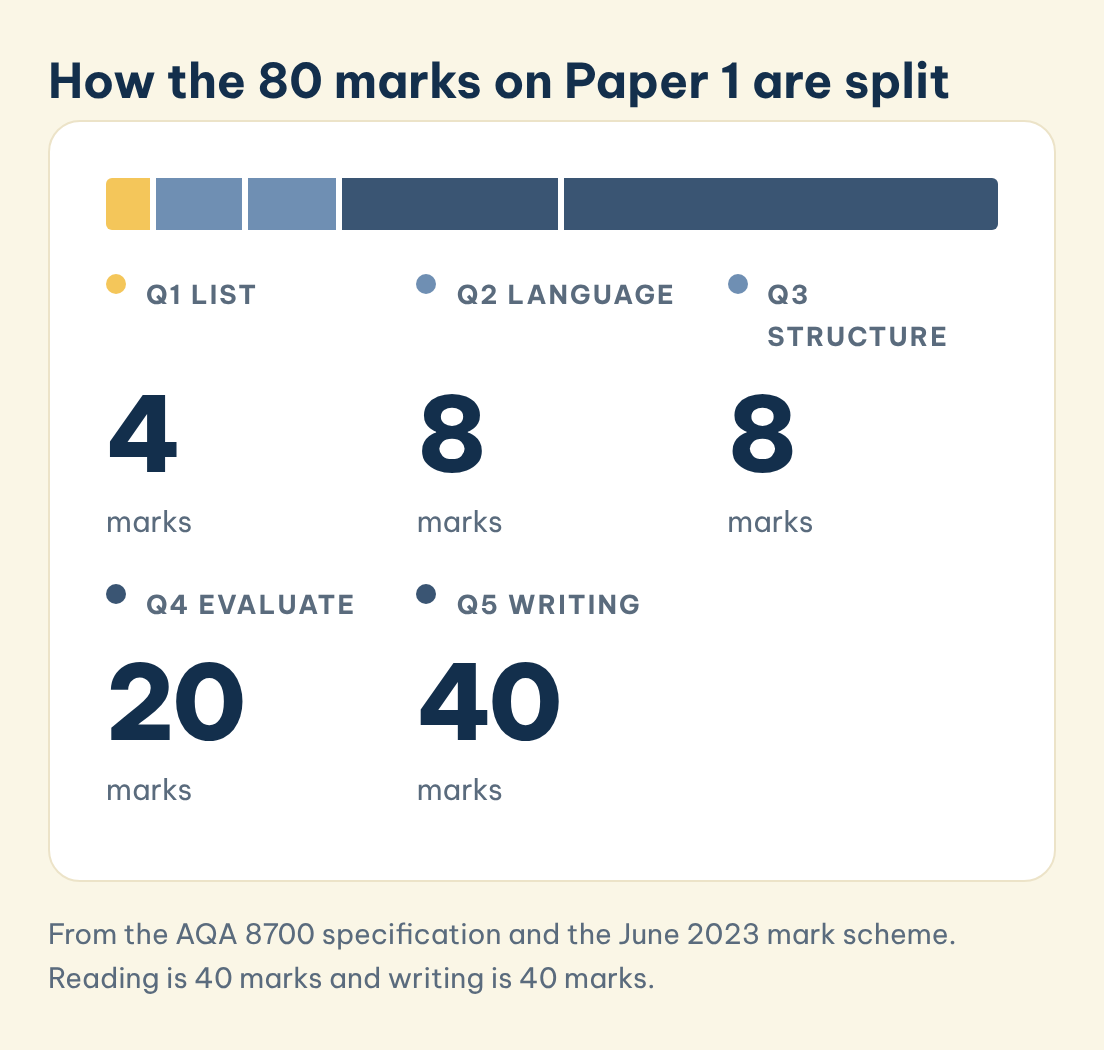
The AQA specification sets out the structure on page 8: Section A is a single literature fiction text, with one short form question of 4 marks, two longer form questions of 8 marks each and one extended question of 20 marks, followed by Section B, where students complete one extended writing question marked as 24 marks for content and 16 marks for technical accuracy (AQA, 2021, p. 8). The text is drawn from the 20th or 21st century and every text on the paper is unseen. Ofqual's conditions say the same thing in regulatory language, that students will not have studied the examination texts during the course (Ofqual, 2015, p. 15). That one fact shapes how you revise, because you cannot memorise the extract in advance; you can only learn the five question types and practise them on fresh passages.
| Question | Marks | Assessment objective | What it asks |
|---|---|---|---|
| Q1 | 4 | AO1 | List four things from a short part of the text |
| Q2 | 8 | AO2 | How the writer uses language in a short part |
| Q3 | 8 | AO2 | How the writer structures the whole text |
| Q4 | 20 | AO4 | To what extent do you agree with a statement |
| Q5 | 40 | AO5 and AO6 | Descriptive or narrative writing |
Marks are the best guide to time: Section B carries as many marks as the whole of Section A, so it deserves about as much of the 1 hour 45 minutes. Follow any timing advice printed on the front of your own question paper. The assessment objectives follow the specification's weighting table, which gives AO1 2.5%, AO2 10%, AO4 12.5%, AO5 15% and AO6 10% of the whole GCSE (AQA, 2021, p. 17).
◆ Question 2 / 9 · Question 1
How do you answer Question 1 on Paper 1?
Direct answer: Question 1 asks you to list four things from a stated range of lines, and each correct point earns 1 mark. Use only the lines you are given, and write short points rather than copying a long section of the text.
The June 2023 paper asked students to list four things about hyenas from lines 1 to 6 of the source. Its mark scheme says to "Give 1 mark for each point" and that responses "must be drawn only from lines 1 to 6 of the text" (AQA, 2023, p. 7). Students may quote or paraphrase, and a response that copies the whole of lines 1 to 4 word for word should not be credited any marks. The practical lesson is that this is the cheapest 4 marks on the paper, and it is easy to lose them by wandering outside the lines or by pasting in a long quotation.
Spend the least time here, and do not turn Question 1 into an analysis question. There is no mark for explaining why the writer chose a word. Find four separate facts in the stated lines, write each one in a short sentence of your own or a brief quotation, and move on. The time you save is worth far more on Question 4 and on the writing task.
◆ Question 3 / 9 · Question 2
How do you answer the language question, Question 2?
Direct answer: Question 2 is worth 8 marks and tests AO2: how the writer uses language to create an effect in a stated part of the text. Choose precise words and phrases, name the technique accurately, and explain the effect on the reader.
The 2023 question asked "How does the writer use language here to describe the hyena's appearance?" and prompted students to think about words and phrases, language features and techniques, and sentence forms (AQA, 2023, p. 8). The top level of the mark scheme describes "Perceptive, detailed analysis", in which the student analyses the effects of the writer's choices of language, selects a range of judicious textual detail and makes sophisticated and accurate use of subject terminology (AQA, 2023, p. 9). The same page cautions that its indicative standard is not a model answer, so treat the descriptor as a description of quality, not a script to imitate.
A reliable pattern is to take one short quotation, name the technique, and then explain what it makes the reader see or feel, before moving to a second quotation that does something different. Two or three well-explained choices will usually give you more to say than six quotations that are merely labelled. Terminology helps only when it is accurate and attached to an effect, because the descriptor rewards analysis of effects and does not reward a list of terms.
◆ Question 4 / 9 · Question 3
How do you answer the structure question, Question 3?
Direct answer: Question 3 is also worth 8 marks, but it asks about the whole source. Describe where the writer places your attention at the start, how and why that focus shifts as the text develops, and any other structural features that you notice.
The question in the 2023 paper began "You now need to think about the whole of the source" and then asked "How has the writer structured the text to interest you as a reader?" (AQA, 2023, p. 11). Its bullet points prompt three things: what the writer focuses your attention on at the beginning, how and why the writer changes this focus as the source develops, and any other structural features. These bullets are a useful skeleton for your answer, because each one points to a stage in the passage that you can name and quote.
The usual trap is to answer Question 2 again by commenting on individual words. Structure is about movement and order: a zoom from a wide setting to a single detail, a shift from description to action, a change of speaker, a final image that echoes the opening. Work through the extract from start to finish, say what changes at each stage and, most importantly, say why that change keeps a reader interested. Because the question covers the whole text, your points should be spread across the beginning, middle and end rather than clustered in one paragraph.
◆ Question 5 / 9 · Question 4
How do you answer the evaluation question, Question 4?
Direct answer: Question 4 is the largest reading question at 20 marks and tests AO4: evaluating the text critically. You respond to a statement about a given section, say to what extent you agree, and support your view with references to the text.
The specification identifies Question 4 on Paper 1 as the extended response question (AQA, 2021, p. 13), and AO4 asks candidates to "Evaluate texts critically and support this with appropriate textual references" (AQA, 2021, p. 16). In the 2023 paper the question focused on line 20 to the end of the source, offered a student's statement and asked "To what extent do you agree?", with prompts to consider your impressions, to evaluate how the writer presents the subject, and to support your response with references to the text (AQA, 2023, p. 13).
Because it carries half of the reading marks, give this answer room. Take a clear position early, even if that position is partial agreement, and then test the statement against the text: where does the writer support it, where do they complicate it, and which methods create that impression? Evaluation means weighing the writer's choices and judging how well they work, so a paragraph that only retells what happens will not do it. Keep to the lines named in the question, and let every point rest on a short, well-chosen quotation.
◆ Question 6 / 9 · Question 5
How do you approach the writing task, Question 5?
Direct answer: Question 5 is worth 40 marks, split into 24 for content and organisation and 16 for technical accuracy. You choose from a scenario, written prompt or visual image related to the reading topic, then write a descriptive or narrative piece.
The specification says the writing stimulus is a choice of scenario, written prompt or visual image related to the topic of the reading text in Section A (AQA, 2021, p. 14), and the 2023 example asked students to "Write a story about a human meeting an animal" (AQA, 2023, p. 16). AO5 asks for clear, effective and imaginative communication, and AO6 asks for a range of vocabulary and sentence structures with accurate spelling and punctuation (AQA, 2021, p. 16). The top band of the content mark scheme describes communication that is "convincing and compelling" with "Extensive and ambitious vocabulary with sustained crafting of linguistic devices" (AQA, 2023, p. 17).
Since this question holds as many marks as all four reading questions together, it deserves the largest block of your time and a short plan before you start. Decide on a narrow moment or a small cast of characters, pick a structure with a clear shape, and keep control of your sentences. Ambitious vocabulary helps only when you can spell and use it correctly, because 16 marks reward technical accuracy on their own. Leave a few minutes at the end to read your writing through for slips.
◆ Question 7 / 9 · Revision plan
What is an effective revision plan for Paper 1?
Direct answer: Practise retrieving what you know rather than rereading it. Attempt questions from memory on unseen extracts, check them against the mark scheme, and space the sessions across several weeks. Dunlosky et al. (2013) rate practice testing and distributed practice as high utility techniques.
Dunlosky and colleagues reviewed ten common learning techniques and rated practice testing and distributed practice as "high utility", while rereading and highlighting did not earn that rating (Dunlosky et al., 2013). Agarwal et al. (2021) reviewed applied research in schools and classrooms and reported that retrieval practice benefits student learning consistently. For Paper 1, retrieval means closing your notes and writing out what each question wants, how the 4, 8, 8, 20 and 40 marks are split, and the pattern you use for each answer, and only then checking what you missed.
A simple weekly rhythm follows from that evidence. Early in the week, do one reading question under timed conditions on a fresh extract. Mid-week, mark it with the published mark scheme and note which descriptor you missed. At the weekend, plan a piece of writing from a prompt and write one section from memory of your best techniques. Because the exam texts are unseen, variety matters: rotate through different extracts so that you practise the skill, not a single passage. Your English teacher is the natural second pair of eyes on practice answers, because they mark against the same AQA scheme. If you later study English at university, MAAS offers 1-on-1 subject tutoring for university modules; it sets no grade target and ties no refund to results, and you can ask to change tutor if the fit is wrong. For general routines that apply to any exam, see our guide on how to revise for final exams effectively.
◆ Question 8 / 9 · Past papers
Where can you find past papers and mark schemes?
Direct answer: Use AQA's own website, which publishes past papers and mark schemes for English Language 8700. Searches for revision PDFs, booklets and notes often lead to third-party sites, but the official mark scheme is the only source that shows exactly how AQA awards marks.
Many students search for a revision booklet, a PDF or notes, and those can be useful for prompts and ideas, but they are written by other people and may not match the current wording of the specification. AQA's published mark schemes, such as the June 2023 document used in this guide, contain the actual question wording, the level descriptors and the indicative content examiners work from. Start with the English Language 8700 pages on the AQA website, linked under Tools and resources below, and work through the papers in order.
Treat the mark scheme as a teaching tool as well as a marking tool. After each practice answer, find the level descriptor that best matches what you wrote, underline the words that separate it from the next level up, and rewrite one paragraph to reach that standard. This habit teaches you what examiners reward more efficiently than collecting extra resources. If you are unsure whether a question type or mark allocation has changed, the specification is the authority, and your teacher can confirm which version applies to your cohort. A good starting point for building your own examples is our guide on how to start an essay, which covers getting past a blank page and drafting freely before you polish.
◆ Question 9 / 9 · Edexcel
Is Paper 1 the same for Edexcel?
Direct answer: No. This guide covers AQA English Language 8700 only. Other boards have their own papers, question wording and mark schemes, and the numbers here will not carry over, so if you are entered for Edexcel, use your own board's specification, past papers and mark schemes instead.
The question comes up because students search for Paper 1 revision under several exam board names, and the results mix boards together. The numbers in this guide, such as 80 marks, 1 hour 45 minutes and the 4, 8, 8, 20 and 40 mark split, are taken from the AQA specification and the AQA June 2023 mark scheme, and they should not be assumed to apply elsewhere. The learning principles in the revision plan, practising retrieval and spacing your sessions, are general and will transfer to any board. The question-by-question advice will not transfer unless your paper is built the same way. Check your exam board on your entry paperwork or ask your teacher before you start.
Frequently asked questions
How long is AQA English Language Paper 1?
It lasts 1 hour 45 minutes and is worth 80 marks, which is 50% of the GCSE (AQA, 2021, p. 8).
How many marks is each question on Paper 1?
Question 1 is 4 marks, Questions 2 and 3 are 8 marks each, Question 4 is 20 marks and Question 5 is 40 marks, made up of 24 for content and 16 for technical accuracy.
Do I need to study the text before the exam?
No. All texts on the paper are unseen, so you practise the question types on different extracts (Ofqual, 2015, p. 15).
How much time should I spend on each question?
Follow the timing advice printed on your question paper first. Beyond that, let the marks guide you: Q1 is worth 4 marks and Q5 is worth 40, so spend roughly ten times as long on the writing task as on Q1, and practise timed papers to find your own pace.
Where can I find past papers with mark schemes?
AQA publishes them on its website for English Language 8700. Use the mark scheme to see the level descriptors and the exact question wording.
What is the best way to revise?
Test yourself rather than rereading, and space your practice over several weeks. Dunlosky et al. (2013) rated practice testing and distributed practice as high utility.
Is this guide suitable for Edexcel?
No, it covers AQA 8700 only. Check your own board's specification.
Tools & resources
- AQA GCSE English Language 8700 specification page
- AQA GCSE English Language 8700 assessment resources, where AQA publishes question papers and mark schemes
References
Agarwal, P. K., Nunes, L. D., & Blunt, J. R. (2021). Retrieval practice consistently benefits student learning: A systematic review of applied research in schools and classrooms. Educational Psychology Review, 33(4), 1409-1453. https://doi.org/10.1007/s10648-021-09595-9
AQA. (2021). GCSE English Language 8700 specification (Version 1.5) [PDF]. https://filestore.aqa.org.uk/resources/english/specifications/AQA-8700-SP-2015.PDF
AQA. (2023). Mark scheme: GCSE English Language 8700/1, June 2023 [PDF]. https://filestore.aqa.org.uk/sample-papers-and-mark-schemes/2023/june/AQA-87001-MS-JUN23.PDF
Dunlosky, J., Rawson, K. A., Marsh, E. J., Nathan, M. J., & Willingham, D. T. (2013). Improving students' learning with effective learning techniques: Promising directions from cognitive and educational psychology. Psychological Science in the Public Interest, 14(1), 4-58. https://doi.org/10.1177/1529100612453266
Ofqual. (2015). GCSE subject level conditions and requirements for English language and certificate requirements [PDF]. https://assets.publishing.service.gov.uk/media/5a7f7af540f0b62305b87679/2015-07-27-gcse-subject-level-conditions-and-requirements-for-english-language-and-certificate-requirements.pdf
This guide summarises the AQA 8700 specification (version 1.5) and the June 2023 mark scheme as read on 23 October 2026. Specifications change, so always check the current version for your exam series.
Not sure how this guide applies to your own case? Talk it through with MAAS in a free 20-minute consultation.
Book a free consultation ▸