
To revise for exams effectively, test yourself on the material and space that practice over days, rather than rereading notes the night before. Decades of cognitive research show these two habits, retrieval practice and distributed practice, do more for exam performance than any amount of highlighting.
For international students sitting UK and Australian finals, exam revision is often where a strong semester is won or lost. The pressure is real, the format is unfamiliar, and English-as-a-second-language adds a layer of effort. This guide answers the questions MAAS exam coaches hear most often, with the evidence behind each answer, so you can build a revision plan that actually holds under pressure. If your assessment is an oral defence rather than a written paper, see our guide to preparing for a viva voce defence.
Author: MAAS Learning Skills Desk · Reviewed by a MAAS subject mentor
Last updated: 2026-06-29
Category: study-hacks

What does "effective" revision actually mean?
Direct answer: Effective revision is active and spaced: you retrieve information from memory and you spread that effort across several shorter sessions, instead of passively rereading in one long block. The goal is to practise the exact thing the exam asks of you, which is recalling and applying knowledge without your notes in front of you.
Evidence: In a landmark review running to 55 pages and covering 10 common study techniques, Dunlosky et al. (2013) rated practice testing and distributed practice as the only two with "high utility" across subjects, ages, and exam types, while rereading and highlighting scored "low". The reason is alignment: an exam is a memory-retrieval task, so the most useful revision is the one that rehearses retrieval rather than recognition.
Example: A MAAS business student revised by re-copying lecture slides for 2 weeks and still froze in the mock. We switched her to closed-book recall, writing out each topic from memory then checking the gaps. Within a week her mock score rose two grade bands, not because she knew more, but because she had practised retrieving it.
Which revision techniques work best?
Direct answer: Retrieval practice (testing yourself) and distributed practice (spacing sessions over time) are the two highest-leverage techniques. Combined, they beat rereading, summarising, and highlighting by a wide margin for long-term retention.
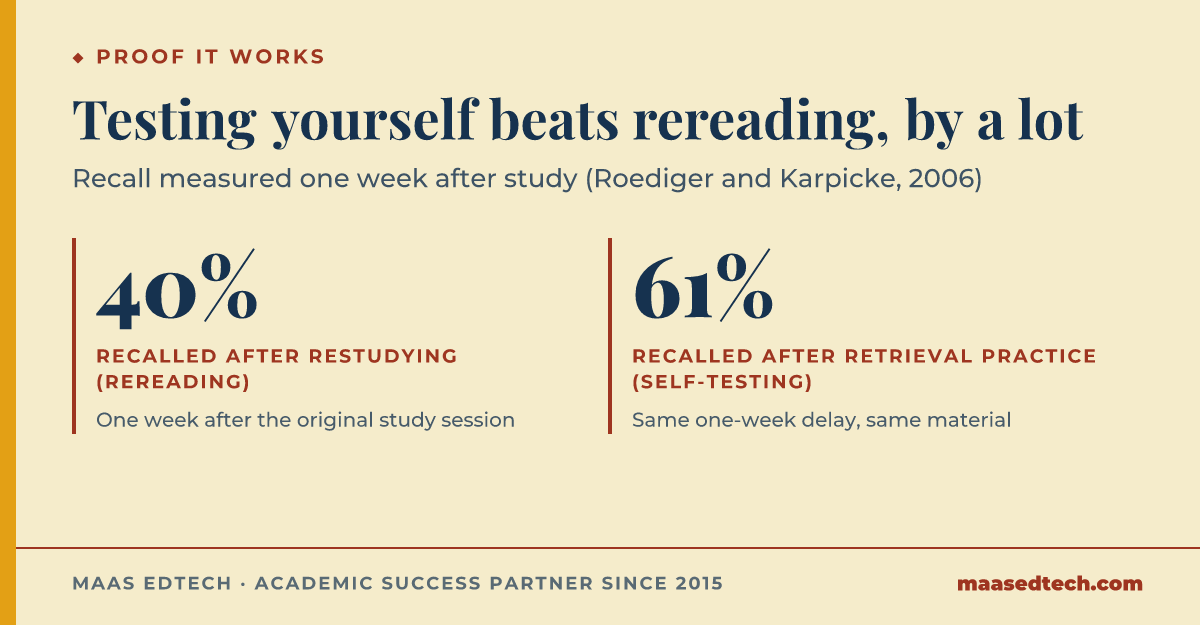
Evidence: In a 7-page paper, Roediger and Karpicke (2006) tested students at 3 different delays, 5 minutes, 2 days, and 1 week after the original study session, and found that students who were tested on the material remembered substantially more at the longer delays than students who simply restudied it, even though restudying felt more productive at the time. A week after studying, students who had restudied the passage recalled 40% of it, while students who had instead practised retrieving it recalled 61%, a gap that only widened the longer the delay before the final test. Dunlosky et al. (2013) reached the same conclusion across dozens of studies: "Practice testing and distributed practice received high utility assessments because they benefit learners of different ages and abilities and have been shown to boost students' performance across many criterion tasks and even in educational contexts" (Dunlosky et al., 2013, p. 5). Bjork and Bjork (2011), in a 9-page book chapter, call the effortful feeling of retrieval a "desirable difficulty": the struggle to recall is exactly what strengthens the memory.
Example: A MAAS engineering mentee built a deck of past-exam questions and answered them cold, three times a week. The questions he kept missing became his revision priority list, so his time went to weak spots instead of comfortable ones.
How should you schedule revision before an exam?
Direct answer: Start early and revisit each topic several times across the weeks before the exam, leaving gaps between sessions on the same topic. A few spaced sessions beat one long cram, because forgetting a little and then recalling it is what builds durable memory.
Evidence: In a quantitative synthesis drawing on 184 sources and 317 separate experiments, Cepeda et al. (2006) found that spreading study across separate sessions reliably improved retention compared with massing it together, with longer gaps helping most when the test is further away. The practical rule for finals is simple: touch each topic on several different days rather than in one marathon.
Example: A MAAS law student mapped her 5 exam topics across a calendar spanning 3 weeks so each one recurred every few days. By exam week she was reviewing, not learning, and her revision felt like maintenance instead of panic.
How do you practise under real exam conditions?
Direct answer: Sit past papers to time, closed-book, in one go. Practising under the real constraints trains your timing, exposes gaps a re-read would hide, and lowers the shock of the actual exam room.
Evidence: Timed practice is a form of retrieval practice, which Dunlosky et al. (2013) rate as high-utility, with the added benefit of rehearsing exam-day conditions. Coaches use it because it surfaces the two things that sink otherwise-prepared students: misreading the question, and running out of time on the high-mark sections.
Example: A MAAS finance student kept scoring well in revision but poorly in mocks. A timed past paper revealed the cause: he spent 40 minutes perfecting question one and rushed the rest. A simple time budget per question fixed a problem his content revision never would have.
How do you manage exam anxiety?
Direct answer: Manage exam anxiety with preparation you can trust, plus a few simple regulation habits: slow breathing before you start, reading every question first, and a planned order of attack. Anxiety drops most when you have rehearsed the conditions, so good revision is itself the strongest calming tool.
Evidence: A meta-analytic review spanning 30 years and running to 11 pages, drawing on 238 studies published between 1988 and 2018, by von der Embse et al. (2018) confirmed that test anxiety is consistently linked to lower performance, and that it is most damaging when it disrupts attention during the exam. Familiarity with the format and self-testing beforehand reduce that disruption, which is why mock conditions matter as much as content.
Example: A MAAS nursing student who blanked in exams practised 3 timed mocks in the same room layout. By the real exam the setting felt routine; she described the difference as "boredom instead of dread", and her recall held.
What revision mistakes waste the most time?
Direct answer: The biggest time-wasters are rereading notes, highlighting, and last-minute cramming. They feel productive because the material looks familiar, but familiarity is not the same as being able to recall and apply it under pressure.
Evidence: Dunlosky et al. (2013) rated highlighting and rereading as low-utility precisely because they create an illusion of competence without building retrievable memory. Cepeda et al. (2006) show why cramming fails: massed study gives a short-term boost that fades fast, leaving little by exam day. The fix for all three is the same: convert passive review into active self-testing, spaced out.
Example: A MAAS student arrived at coaching with beautifully colour-coded notes and a failing mock. We did not add material; we converted her notes into questions and spaced the practice. Same content, very different result.
Frequently asked questions
How many hours a day should I revise for finals?
Quality and spacing matter more than raw hours. Several focused 45 to 60 minute sessions with breaks, spread across the day and the weeks, beat one exhausting block. If you are revising for 8 hours but only rereading, you are working hard at the wrong technique.
Is it better to revise alone or in a group?
Both, for different jobs. Test yourself alone to build retrieval, then use a study group to explain topics aloud, which is itself a powerful form of recall. Avoid groups that turn into shared rereading.
How far in advance should I start revising?
As early as you can timetable it. Spaced practice needs gaps to work, so a topic seen across three weeks will stick far better than the same hours crammed into 3 days (Cepeda et al. 2006).
Does rewriting my notes count as revision?
Only weakly. Copying is closer to rereading than to retrieval. Rewriting from memory, then checking, is far better, because it forces recall instead of recognition.
What if English is my second language?
Build in time to rehearse answering in English under timed conditions, not just understanding the material in your first language. Practising the output, written exam answers, is what closes the gap between knowing and showing.
Ready to turn revision into results?
Exam coming up? Book a free consultation lasting 20 minutes with a MAAS exam coach. Bring your syllabus and exam date, and we will build a spaced, self-testing revision plan matched to your subject through the Outline → Draft → Final coaching model. We coach you to sit the exam with confidence; we never sit it for you.
References
- Bjork, E. L., & Bjork, R. A. (2011). Making things hard on yourself, but in a good way: Creating desirable difficulties to enhance learning. In M. A. Gernsbacher, R. W. Pew, L. M. Hough, & J. R. Pomerantz (Eds.), Psychology and the real world (pp. 56–64). Worth Publishers.
- Cepeda, N. J., Pashler, H., Vul, E., Wixted, J. T., & Rohrer, D. (2006). Distributed practice in verbal recall tasks: A review and quantitative synthesis. Psychological Bulletin, 132(3), 354–380. https://doi.org/10.1037/0033-2909.132.3.354
- Dunlosky, J., Rawson, K. A., Marsh, E. J., Nathan, M. J., & Willingham, D. T. (2013). Improving students' learning with effective learning techniques: Promising directions from cognitive and educational psychology. Psychological Science in the Public Interest, 14(1), 4–58. https://doi.org/10.1177/1529100612453266
- Roediger, H. L., III, & Karpicke, J. D. (2006). Test-enhanced learning: Taking memory tests improves long-term retention. Psychological Science, 17(3), 249–255. https://doi.org/10.1111/j.1467-9280.2006.01693.x
- Von der Embse, N., Jester, D., Roy, D., & Post, J. (2018). Test anxiety effects, predictors, and correlates: A 30-year meta-analytic review. Journal of Affective Disorders, 227, 483–493. https://doi.org/10.1016/j.jad.2017.11.048
Tools & resources
- University of Manchester. (n.d.). Revision and exam skills. Retrieved June 29, 2026, from https://www.manchester.ac.uk/study/experience/student-life/study-support/
- The University of Melbourne. (n.d.). Preparing for exams. Academic Skills. Retrieved June 29, 2026, from https://services.unimelb.edu.au/academicskills
Related guides
- How do you prepare for a viva voce defence when English is your second language?: for oral and defence-style assessments
- Exam coaching pillar: the full MAAS approach to exam preparation
- Exam Support service: methodology coaching and pre-scheduled online assistance
- Tutoring service: 1:1 subject tutoring to shore up weak topics before the exam
This article is part of the MAAS Journal series for international students. MAAS Exam Support coaches students through evidence-based revision and exam technique. We do not sit exams or complete assessments on a student's behalf.