
◆ Writing Tips
How to write an essay conclusion that does more than repeat
A good essay conclusion states your answer as the evidence has left it, explains why it matters, and stops without opening a new argument. It is not a copy of the introduction, because by the end of the body the reader has learned something and the conclusion has to show it. University guides disagree on one detail, whether to restate the thesis, so this guide explains where they differ, gives a four-move structure that works under either view, and compares a weak conclusion with a strong one on the same essay. Every claim traces to a university writing page listed under References.
◆ Question 1 / 7 · What it is for
What is an essay conclusion for?
Direct answer: Its job is to tell the reader how the points in the body have answered the question. Monash University (2026b) describes the conclusion this way, and the University of Canterbury Department of History (2024) gives it two purposes: to summarise and to synthesise.
A conclusion is the last thing the marker reads before deciding how to feel about the essay as a whole. Monash University (2026b) says it is the last thing your reader will remember. That raises the stakes for a paragraph that students often write in a hurry as a deadline approaches.
The University of Canterbury Department of History (2024) separates the two purposes usefully. Summarising means reiterating the key findings of the essay in different phrasing. Synthesising means going on to assess their broader significance. A conclusion that only summarises leaves the reader with a list, and a conclusion that only claims significance has no evidence behind it. The University of North Carolina at Chapel Hill Writing Center (n.d.) says the conclusion allows you "to have the final say on the issues you have raised in your paper", which is a fair description of what a marker hopes to find. The same centre puts the idea into a short instruction: synthesise, do not summarise, and ask the question "So what?" of each statement you make.
◆ Question 2 / 7 · Restating the thesis
Should a conclusion restate the thesis?
Direct answer: Return to your thesis, but do not copy it. Most of the pages cited here ask for a restated thesis, and the one dissenting page objects only to a restatement that changes nothing, so the safe course is to restate your answer and show what the body added to it.
Here is the disagreement in the writers' own words. Purdue Writing Lab (n.d.) lists "restate your thesis/claim" as the second step of its conclusion outline. The University of Technology Sydney (n.d.) lists a reiteration or confirmation of the thesis among the core elements. Tai Poutini Polytechnic (n.d.) says the conclusion will restate your argument in different words. The University of North Carolina at Chapel Hill Writing Center (n.d.), by contrast, lists among strategies to avoid ending with a rephrased thesis statement without any substantive changes, and also stating the thesis for the very first time in the conclusion.
These positions fit together once you ask what the restated thesis is doing. A restatement that returns to the claim and adds nothing is what the North Carolina page warns against. A restatement that returns to the claim in the light of the evidence, perhaps with a qualification the body has earned, is what the other pages ask for. The practical rule is to restate the answer, then show what the body added to it. If your conclusion could be pasted over your introduction without anyone noticing, it is repeating and not concluding.
◆ Question 3 / 7 · The four moves
What are the four moves of a strong conclusion?
Direct answer: The four moves are to answer the question plainly, pull the reasoning into one line, say why the answer matters, and mark a limit or next step only when the evidence points to one. This sequence is MAAS's synthesis of several university pages, not a model taken from any single one.
- Give the answer. Return to the question and answer it plainly, in different words from the introduction. The University of Technology Sydney (n.d.) suggests paraphrasing the assignment question when you restate the topic, which keeps the conclusion tied to what the marker asked.
- Compress the reasoning. Pull together the main points so the reader sees how they add up, without walking through every paragraph again. The University of Technology Sydney (n.d.) advises keeping the summary brief and synthesised, and making it support the thesis as a whole. Purdue Writing Lab (n.d.) adds that opposing viewpoints can be addressed here, with an explanation of why readers should align with your position.
- Say why it matters. The Monash example outline pairs the final contention with a statement of broader significance (Monash University, 2026a). In its stronger version the conclusion restates that police culture is an obstacle to accountability and then adds that both internal and external regulation are needed to preserve the integrity of law enforcement in Australia. The first half answers; the second says why it matters.
- Mark a limit or a next step. Purdue Writing Lab (n.d.) offers a call for action or an overview of future research possibilities, and the University of Technology Sydney (n.d.) lists recommendations, further research and broader implications as optional extras. Use one of these only if the essay's own evidence points to it.
Oxford's essay guidance (University of Oxford, n.d.) compresses the whole job into one instruction: reiterate the argument in light of the evidence you have provided, and do not use the conclusion to introduce new information.
◆ Question 4 / 7 · Weak versus strong
What does a weak conclusion look like next to a strong one?
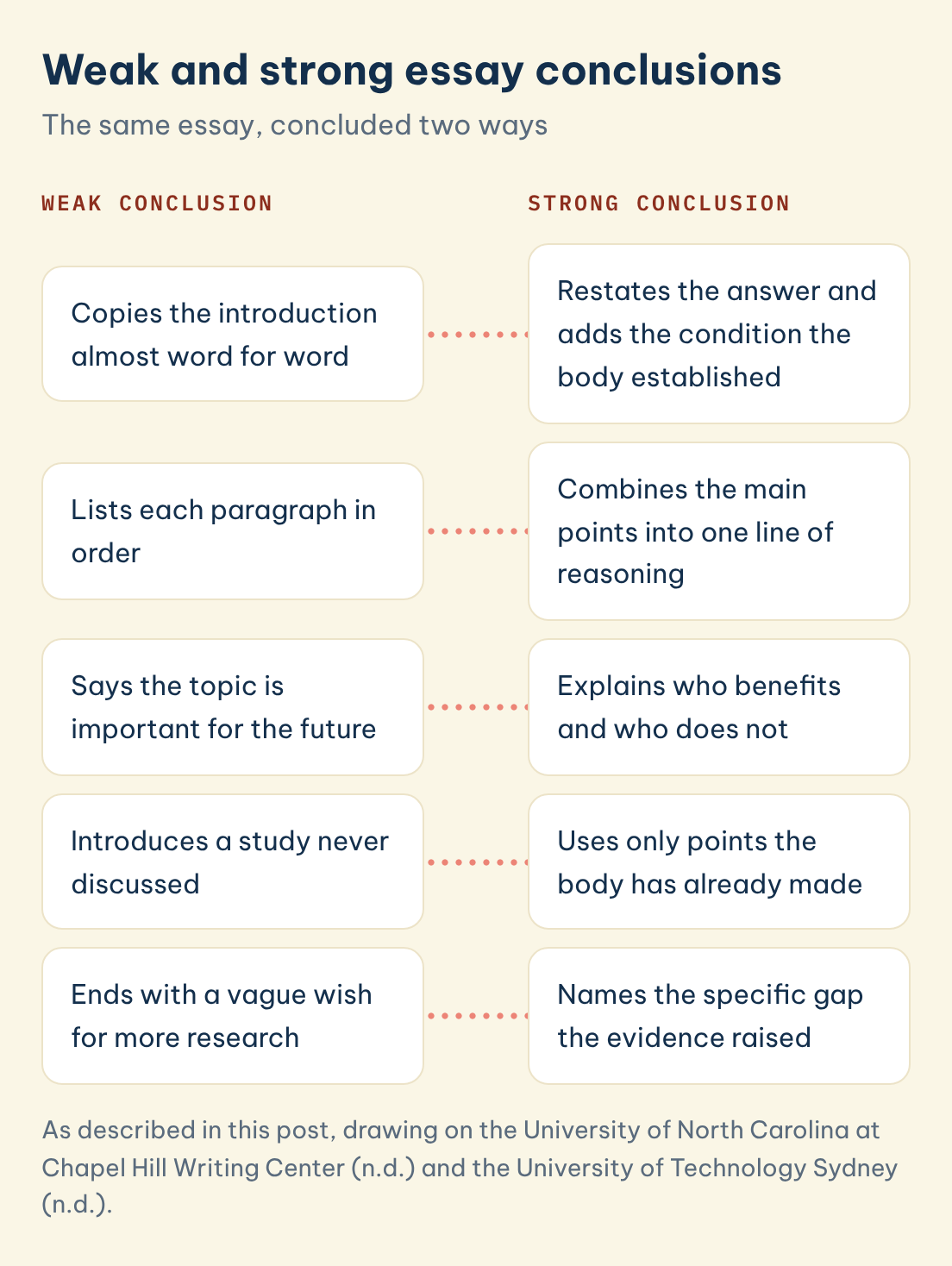
Direct answer: A weak conclusion repeats the introduction, lists the body paragraphs in order and ends on a vague wish, while a strong one answers the question, shows what the evidence added and stops at a limit the argument has earned. The table below compares the two on one invented essay.
Weak and strong essay conclusions
The same essay, concluded two ways
Weak conclusion
Strong conclusion
Copies the introduction almost word for word
Restates the answer and adds the condition the body established
Lists each paragraph in order
Combines the main points into one line of reasoning
Says the topic is important for the future
Explains who benefits and who does not
Introduces a study never discussed
Uses only points the body has already made
Ends with a vague wish for more research
Names the specific gap the evidence raised
Save this figure
Imagine an essay on the question Does a four-day working week improve employee wellbeing? whose argument is that it can, but only where workload is cut along with hours. The two conclusions below are invented for this guide and are not drawn from any source.
| Feature | Weak conclusion | Strong conclusion |
|---|---|---|
| Opening | "In conclusion, this essay has discussed the four-day week." | "The evidence suggests that a shorter week improves wellbeing only where the workload shrinks with it." |
| Treatment of the thesis | Copies the introduction almost word for word | Restates the answer and adds the condition the body established |
| Summary of the body | Lists each paragraph in order: "First... Second... Third..." | Combines the main points into one line of reasoning |
| Significance | "The four-day week is an important topic for the future." | Explains who benefits and who does not, which is the "so what" |
| New material | Introduces a new study that was never discussed | Uses only points the body has already made |
| Ending | A vague wish: "More research is needed." | Names the specific gap, such as whether the effect lasts beyond the first year of a scheme |
The weak version is not wrong in any single sentence. It fails because it gives the reader nothing they did not already have, which the University of North Carolina at Chapel Hill Writing Center (n.d.) describes as ending with a rephrased thesis without substantive change. Compare the strong ending's last line with the vague "more research is needed" in the left column: the first points to a specific question that the essay's own evidence raised, and the second could be attached to any essay on any topic.
◆ Question 5 / 7 · Mistakes to avoid
Which mistakes should you avoid in a conclusion?
Direct answer: Avoid new material, stock phrases such as "in conclusion", a thesis stated for the first time, a dramatic flourish, and an attempt to solve a huge problem in the last sentence. Each of these appears in at least one of the university pages cited here.
- New points. Purdue Writing Lab (n.d.) says not to bring in new points. The University of Technology Sydney (n.d.) says to avoid introducing any new information, and Tai Poutini Polytechnic (n.d.) states that the conclusion will not include any new material. If a point matters, it belongs in the body.
- Stock openers. The University of North Carolina at Chapel Hill Writing Center (n.d.) lists beginning with an overused phrase such as "in conclusion", "in summary" or "in closing" among the strategies to avoid. Start with the answer instead.
- A first-time thesis. The same page warns against stating the thesis for the very first time in the conclusion, which usually means the introduction had no position.
- The grand finish. Purdue Writing Lab (n.d.) warns against a "whiz bang" ending and against trying to solve a massive problem in the final sentence, and says simplicity is best for a clear, convincing message.
- Needless citations. The University of Technology Sydney (n.d.) says you do not need to include in the conclusion any of the citations used to support your discussion, because the conclusion is your own synthesis. Check your department's convention, since disciplines differ.
◆ Question 6 / 7 · Checking it
How do you check a conclusion before you submit?
Direct answer: Run three tests: the "So what?" test on every sentence, the swap test against your introduction, and the source test on every claim. If any sentence fails, rewrite it or move it to the body. Each test takes only a few minutes and works as well on a printed copy as on screen.
- The "So what?" test. The University of North Carolina at Chapel Hill Writing Center (n.d.) suggests asking "So what?" or "Why should anybody care?" about each statement and answering it. A sentence you cannot defend this way is filler.
- The swap test. Place the conclusion over the introduction. If they could be exchanged without anyone noticing, the conclusion repeats the opening and has not moved the argument on.
- The source test. Point to the paragraph of the body that supports each claim in the conclusion. A claim with no paragraph behind it is new material.
Then read the essay's first and last paragraphs together. The University of Canterbury Department of History (2024) recommends that the conclusion reiterate the key findings in different phrasing and assess their broader significance, so the pair should read as a question opened and a question answered. For the opening half of that pair, see our guide on how to write an essay introduction, and for the planning that comes before both, see how to start an essay. The dissertation version of this task has its own conventions, covered in how to write a dissertation conclusion.
◆ Question 7 / 7 · How MAAS helps
How can MAAS help with your conclusion?
Direct answer: A MAAS mentor reads your own draft, shows you where the conclusion repeats the introduction or leans on new material, and explains how to fix it. You write the conclusion yourself, and nothing is written or submitted for you. The aim is that you learn to judge your own endings.
MAAS's essay and assignment support works from your outline through your draft to the final version, so the conclusion rests on an argument you have built and understood yourself. If you are unsure whether your ending answers the question, a free 20-minute discovery with MAAS, a Ho Chi Minh City company, is a conversation about your draft with no obligation. You can book one here. The wider structure of the essay is covered in our university essay guide, and our editing and proofreading checklist covers the final pass.
Frequently asked questions
What should an essay conclusion include?
An answer to the question, a short synthesis of the main points, and a statement of why the answer matters. Purdue Writing Lab (n.d.) and the University of Technology Sydney (n.d.) both add optional elements such as recommendations or future research.
Should a conclusion repeat the thesis statement?
It should return to the thesis, but not copy it. Tai Poutini Polytechnic (n.d.) says to restate the argument in different words, while the University of North Carolina at Chapel Hill Writing Center (n.d.) warns against a rephrased thesis with no substantive change.
How long should an essay conclusion be?
The sources cited here give no fixed length. The University of Technology Sydney (n.d.) gives no word count or proportion, so follow your module guide and keep the summary brief and synthesised.
Can I add a new quotation or idea in the conclusion?
No. Purdue Writing Lab (n.d.), the University of Technology Sydney (n.d.) and Tai Poutini Polytechnic (n.d.) all say not to bring in new material. The University of Oxford (n.d.) adds that the conclusion reiterates the argument in light of the evidence given.
How do I start a conclusion without writing "in conclusion"?
Open with the answer to the question. The University of North Carolina at Chapel Hill Writing Center (n.d.) lists overused openers such as "in conclusion" or "in summary" among strategies to avoid, so state your answer in the first sentence and let the reader see it is the ending.
References
Monash University. (2026a). Example essay outlines. Student Academic Success. https://www.monash.edu/student-academic-success/excel-at-writing/how-to-write/essay/example-essay-outlines
Monash University. (2026b). Writing an essay. Student Academic Success. https://www.monash.edu/student-academic-success/excel-at-writing/how-to-write/essay
Purdue Writing Lab. (n.d.). Conclusions. Purdue University. https://owl.purdue.edu/owl/general_writing/common_writing_assignments/argument_papers/conclusions.html
Tai Poutini Polytechnic. (n.d.). The essay writing process. https://tpp.ac.nz/assets/Explore/Services-and-facilities/Library/The-essay-writing-process.pdf
University of Canterbury, Department of History. (2024). Department of History concise guide to essay writing. https://www.canterbury.ac.nz/content/dam/uoc-main-site/documents/pdfs/guides/concise-guide-to-writing-history-essays-2024-final.pdf
University of North Carolina at Chapel Hill Writing Center. (n.d.). Conclusions. https://writingcenter.unc.edu/tips-and-tools/conclusions/
University of Oxford. (n.d.). Essay and dissertation writing skills. https://www.ox.ac.uk/students/academic/guidance/skills/essay
University of Technology Sydney. (n.d.). How to write a conclusion. HELPS academic skills. https://www.uts.edu.au/current-students/support/helps/self-help-resources/academic-skills/how-write-conclusion
Not sure how this guide applies to your own case? Talk it through with MAAS in a free 20-minute consultation.
Book a free consultation ▸