
◆ Study skills
How to proofread your assignment: a 5-pass editing checklist
To proofread your assignment, edit first and proofread last: check structure, then sentence clarity, then referencing, then surface errors, then the brief. Students preparing to submit an assignment often treat checking it over as one activity, folding structural revision and error-hunting into a single read-through under time pressure. That habit is where marks get lost: a paragraph rewritten late can still carry a typo nobody catches, and a tightened argument can leave a stray sentence behind. If you are weighing whether someone else should check your work, our hub on academic proofreading and editing covers what help a university permits.
This guide separates the two skills, gives you a multi-pass checklist you can run against any assignment, and lists the techniques with the best evidence for actually catching errors. Every claim traces to a university writing centre, library guide, or APA Style, and the full source list sits at the end.
◆ Part 1 / 10 · Two skills
Editing and proofreading are not the same skill
Direct answer: Edit and proofread as two separate passes, in order, the distinction UNC's Writing Center draws. Editing checks whether the argument, structure and paragraphs work; proofreading catches the surface errors left once that work is done. Eastern Washington University (2024) warns proofreading "is not just running a spell checker." Treat them as one pass and risk deleted sentences.
The Writing Center at UNC Chapel Hill treats editing and proofreading as distinct stages of the revision process, not two words for the same task (The Writing Center, University of North Carolina at Chapel Hill, n.d.). Editing works above the surface of the text, on content, overall structure, the structure within paragraphs, clarity, style and citations, and happens once the bigger structural revision is done; proofreading is the final stage, focused on surface errors such as misspellings and mistakes in grammar and punctuation (The Writing Center, University of North Carolina at Chapel Hill, n.d.). Eastern Washington University's Writers' Center draws the same line: proofreading targets "surface level errors like typos, misspellings, and formatting errors" and explicitly warns that it "is not just running a spell checker" (Eastern Washington University, 2024). For a surface-level pass on a finished assignment, the assignment editing service covers that stage.
The distinction matters because the two passes ask different questions of the same text. Editing asks whether a paragraph belongs and whether the argument holds together; proofreading asks whether the sentence in front of you is correctly built and correctly punctuated. Running both checks at once means neither gets done properly, because attention to a comma competes with attention to the argument it sits inside.
◆ Part 2 / 10 · The fixed order
Why the order is fixed: edit first, proofread last
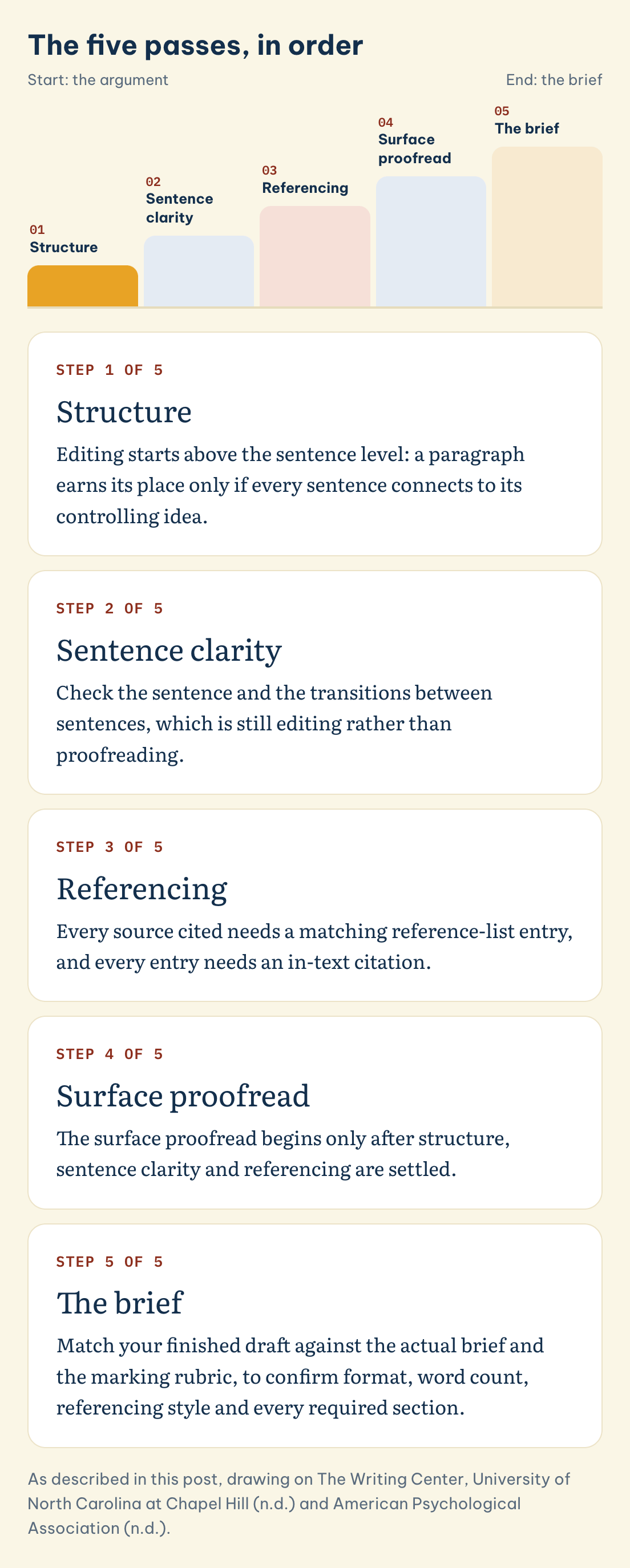
Direct answer: The order is not interchangeable: UNC's Writing Center says proofread only after all other editing revisions are finished. Eastern Washington University (2024) gives the reason, no point correcting mistakes you may delete while revising. A sentence polished too early may belong to a paragraph cut an hour later, wasting the effort twice.
The five passes, in order
Tap a pass to see what it checks.
Step 1 of 5
Structure
Editing starts above the sentence level: a paragraph earns its place only if every sentence connects to its controlling idea.
Step 2 of 5
Sentence clarity
Check the sentence and the transitions between sentences, which is still editing rather than proofreading.
Step 3 of 5
Referencing
Every source cited needs a matching reference-list entry, and every entry needs an in-text citation.
Step 4 of 5
Surface proofread
The surface proofread begins only after structure, sentence clarity and referencing are settled.
Step 5 of 5
The brief
Match your finished draft against the actual brief and the marking rubric, to confirm format, word count, referencing style and every required section.
Save this figure
Both universities are explicit that the order is not interchangeable. UNC's guidance states plainly that "you should proofread only after you have finished all of your other editing revisions" (The Writing Center, University of North Carolina at Chapel Hill, n.d.), and Eastern Washington University gives the practical reason: "there's no point in correcting mistakes that you may delete/change" (Eastern Washington University, 2024). A sentence you polish for word choice may belong to a paragraph you cut an hour later once you notice it does not support your argument. Proofreading a paragraph before you have confirmed it survives the structural pass wastes the effort twice, once on the sentence and once again after you rewrite it.
This also means editing should not wait for a "final" draft that proofreading then finishes off. The two passes are sequential precisely because editing decisions change what there is to proofread.
◆ Part 3 / 10 · Pass one
Pass one: does the argument and structure hold up
Direct answer: Editing starts above the sentence level, the concern UNC's Writing Center places alongside clarity, style and citations: a paragraph earns its place only if every sentence connects to its controlling idea. Reverse outlining tests this, write the one-sentence point of each paragraph, then check whether points follow logically or repeat.
Editing starts above the sentence level. UNC's guidance places paragraph structure and citations alongside clarity and style as concerns of the editing stage (The Writing Center, University of North Carolina at Chapel Hill, n.d.), and the same centre's paragraph guidance gives the specific test: "all of the sentences in a single paragraph should be related to a single controlling idea (often expressed in the topic sentence of the paragraph)," and further, "the sentences should all refer to the central idea, or thesis, of the paper" (The Writing Center, University of North Carolina at Chapel Hill, n.d.-b). A paragraph earns its place in the assignment only if every sentence inside it connects to that controlling idea and that idea connects back to your overall argument; a paragraph that drifts, however well written its individual sentences, is a structural fault that a later grammar check will never catch.
A practical technique for testing this is reverse outlining: write down the one-sentence point of each paragraph in order, then read that list on its own. If a point does not follow logically from the one before it, or repeats a point already made, the structural problem is visible before you have re-read a single full sentence (The Writing Center, University of North Carolina at Chapel Hill, n.d.-b). This first pass should also check transitions between paragraphs and whether your evidence for each claim is actually doing the work the claim needs (The Writing Center, University of North Carolina at Chapel Hill, n.d.). If your assignment is an essay, the university essay guide covers building that argument structure from the outset; if it is a report, the report-writing guide covers the section-by-section version of the same discipline.
◆ Part 4 / 10 · Pass two
Pass two: sentence clarity and cohesion
Direct answer: Once paragraphs are confirmed to belong, UNC's Writing Center groups the next pass as cohesion, checking the sentence and the transitions between sentences, still editing rather than proofreading. Ask of each sentence: is this the clearest way to say it, does it match the paragraph's terms, and does the next sentence need a signal word.
Once the paragraphs are confirmed to belong, the next pass moves down to the sentence and the transition between sentences. This is still editing, not proofreading: you are checking clarity, consistency of terminology, and whether ideas flow logically from one sentence to the next, which the writing centre groups under "cohesion" separately from unity (The Writing Center, University of North Carolina at Chapel Hill, n.d.-b). A sentence can be grammatically correct and still fail this pass if a reader has to reread it to see how it connects to the sentence before it.
Practically, this pass asks of each sentence: is this the clearest way to say this, does it use the same term for the same concept as the rest of the paragraph, and does the sentence that follows it need a signal word to show the relationship between them. This is also the point at which to check length and density; a paragraph made of uniformly long, clause-heavy sentences is harder to mark than one with some variation, and unclear sentences are exactly what forces a marker to re-read, which costs you goodwill even before it costs you marks.
◆ Part 5 / 10 · Pass three
Pass three: referencing consistency
Direct answer: Referencing gets its own pass because APA Style (American Psychological Association, n.d.) requires the correspondence to run both ways: every source cited needs a matching reference-list entry, and every entry needs an in-text citation. Go through the list entry by entry, then the citations, confirming no orphans either way.
Referencing is deliberately treated as its own pass rather than folded into either editing or the final proofread, because it needs its own dedicated check against the reference list rather than against the argument. APA Style is explicit that the in-text citation for a work corresponds to its reference list entry, and that this correspondence runs in both directions: every source cited in the body needs a matching entry, and every entry needs to be cited somewhere in the body (American Psychological Association, n.d.). The same guidance stresses that "consistency in reference formatting allows readers to understand the types of works you consulted," across author, date, title and source elements (American Psychological Association, n.d.). That rule traces back to the 7th edition of the Publication Manual of the American Psychological Association (American Psychological Association, 2020), the edition most Vietnamese universities and MAAS both currently require.
In practice, this pass means going through your reference list entry by entry and confirming each has a matching in-text citation, then going through your in-text citations and confirming each has a matching entry: no orphaned references, no in-text citations pointing at nothing. Where a discipline requires a specific style, run this same matching check against that style's rules; our guide to referencing correctly in APA 7th covers the entry formats most students get wrong, and the decision rule for when a source needs citing at all is worth checking before you assume a claim is safely uncited.
◆ Part 6 / 10 · Pass four
Pass four: the final surface proofread
Direct answer: The surface proofread begins only after structure, sentence clarity and referencing are settled, per UNC's Writing Center. University of Sheffield recommends splitting it into several narrow passes: one for referencing, one for grammar and spelling, one for layout, and one for facts, dates and quotes, with formatting checked last.
Sentence-level errors
4
errors are listed by La Trobe University Library as the ones markers see most often: sentence fragments, run-on sentences, comma splices, and slips in subject-verb agreement
Narrow passes
4
separate passes are recommended by the University of Sheffield for the surface proofread, with formatting checked last
The surface proofread, split into narrow passes
Tap a pass to see what it checks.
Narrow pass 1 / 4
Referencing
One pass for referencing.
Narrow pass 2 / 4
Grammar, punctuation and spelling
One pass for grammar, punctuation and spelling.
Narrow pass 3 / 4
Layout and structure
One pass for layout and structure.
Narrow pass 4 / 4
Facts, dates, quotes, tables and text boxes
One pass for facts, dates, quotes, tables and text boxes, with formatting checked last.
Save this figure
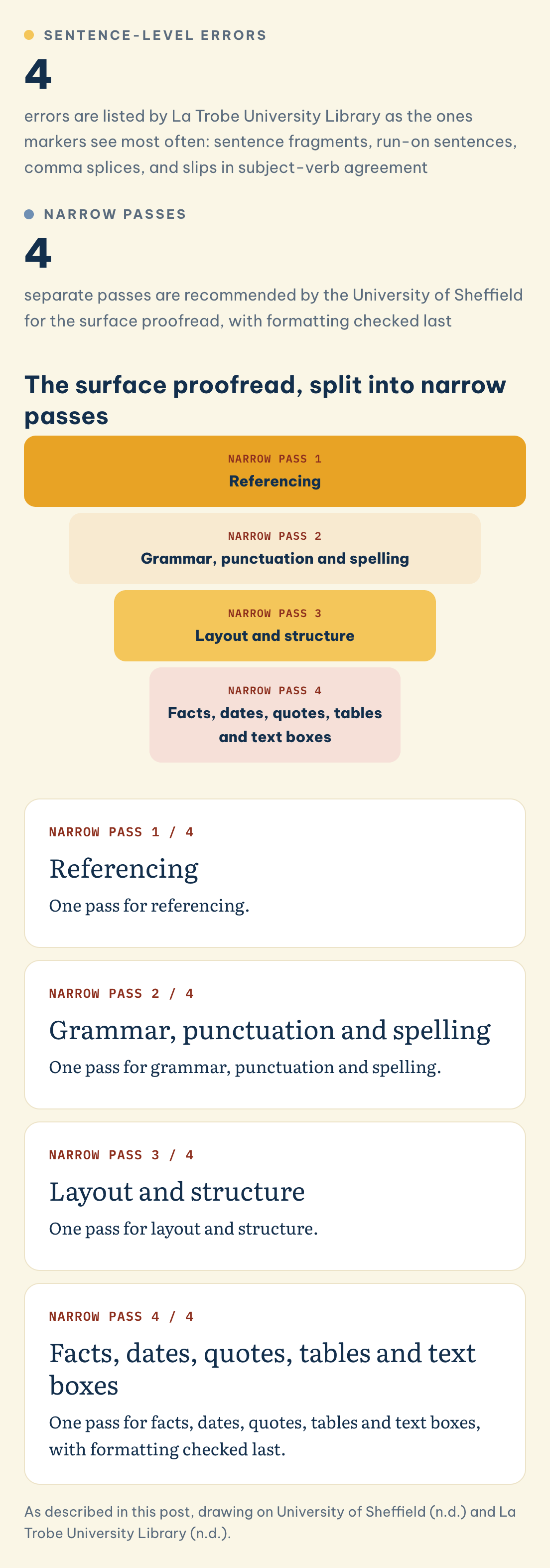
Only after structure, sentence clarity and referencing are settled does the surface proofread begin. UNC frames this as reading for "misspellings and mistakes in grammar and punctuation" once everything else is finished (The Writing Center, University of North Carolina at Chapel Hill, n.d.), and the University of Sheffield's guidance recommends running it as several separate, narrow passes rather than one pass that tries to catch everything: one pass for referencing, one for grammar, punctuation and spelling, one for layout and structure, and one for facts, dates, quotes, tables and text boxes, with formatting checked last (University of Sheffield, n.d.). Splitting the proofread into single-purpose passes matters for the same reason editing and proofreading are kept apart: a reader who is checking for a comma splice is not simultaneously checking whether a date is correct, and trying to do both at once means both get done less carefully.
Errors markers see most often
La Trobe University Library's guidance to student writers lists the sentence-level errors markers encounter most often: sentence fragments, run-on sentences, comma splices, and slips in subject-verb agreement (La Trobe University Library, n.d.). A run-on or fused sentence joins two independent clauses with no connecting word or punctuation between them, and a comma splice is the same fault with only a comma at the join; both are compound sentences that are not punctuated correctly (Purdue Online Writing Lab, n.d.-a). A fragment is the opposite problem, a group of words punctuated as a sentence without a complete independent clause. Subject-verb agreement is easiest to slip in longer sentences, because a noun in a phrase that sits between the subject and the verb can pull a writer toward the wrong verb form; the verb has to agree with the actual subject, not with a noun in that intervening phrase (Purdue Online Writing Lab, n.d.-b). Each of these is a small, local error, and each is exactly the kind of fault a structural edit will not surface, because the sentence can be perfectly placed in an otherwise well-organised paragraph and still be broken at the clause level.
◆ Part 7 / 10 · Pass five
Pass five: check the assignment against the brief
Direct answer: One last check sits apart from both editing and proofreading, and it means matching your finished draft against the actual brief and the marking rubric. Rather than judging quality, it confirms format, word count, referencing style and every required section were delivered as instructed. Skip it and a polished, error-free submission can still shed marks over an unmet instruction.
A final pass belongs outside both editing and proofreading in the strict sense: checking the finished document against your assignment brief and marking rubric. This is a completeness check rather than a quality check, confirming the format, word count, referencing style, and any required sections match what was actually asked for, the same discipline the report-writing guide covers in more depth for formal report structure. Skipping this pass means a well-edited, well-proofread assignment can still lose marks for missing a requirement that had nothing to do with the writing itself.
◆ Part 8 / 10 · Thesis formatting
The formatting pass a thesis needs and an essay does not
Direct answer: A thesis needs a pass an essay does not, because universities write their own layout rules and those rules contradict each other. Manchester bars Roman numerals from the preliminary pages while Newcastle requires them. Check the document your own institution publishes, then make every heading, caption and margin match it.
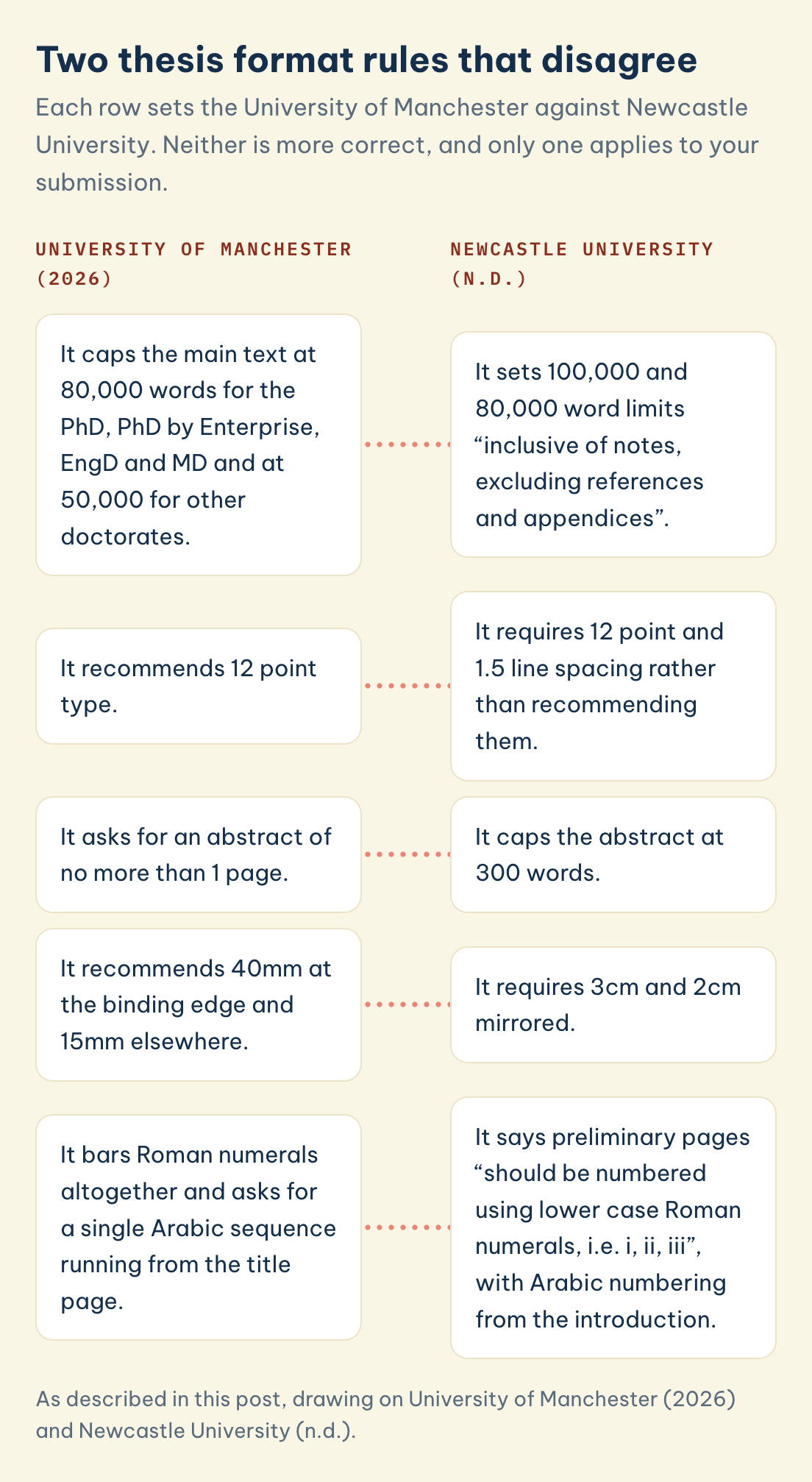
Two thesis format rules that disagree
Each row sets the University of Manchester against Newcastle University. Neither is more correct, and only one applies to your submission.
University of Manchester (2026)
Newcastle University (n.d.)
It caps the main text at 80,000 words for the PhD, PhD by Enterprise, EngD and MD and at 50,000 for other doctorates.
It sets 100,000 and 80,000 word limits “inclusive of notes, excluding references and appendices”.
It recommends 12 point type.
It requires 12 point and 1.5 line spacing rather than recommending them.
It asks for an abstract of no more than 1 page.
It caps the abstract at 300 words.
It recommends 40mm at the binding edge and 15mm elsewhere.
It requires 3cm and 2cm mirrored.
It bars Roman numerals altogether and asks for a single Arabic sequence running from the title page.
It says preliminary pages “should be numbered using lower case Roman numerals, i.e. i, ii, iii”, with Arabic numbering from the introduction.
Save this figure
Formatting consistency is a separate job from proofreading because it is checked against a document rather than against the language. A marker reading a 15,000-word dissertation notices when chapter headings change size midway, when Table 1.2 is captioned above and Table 3.1 below, and when the contents page lists a section that was renamed 2 drafts ago. None of that is caught by reading for sense, and none of it is a matter of taste, because the answer sits in a regulation your institution publishes.
The scale of the disagreement between institutions is the reason a generic checklist fails. Presentation policy at the University of Manchester (2026) caps the main text at 80,000 words for the PhD, PhD by Enterprise, EngD and MD and at 50,000 for other doctorates, recommends 12 point type, and asks for an abstract of no more than 1 page. Guidelines at Newcastle University (n.d.) set 100,000 and 80,000 word limits "inclusive of notes, excluding references and appendices", require 12 point and 1.5 line spacing rather than recommending them, and cap the abstract at 300 words. Margins move as well: Manchester recommends 40mm at the binding edge and 15mm elsewhere, Newcastle requires 3cm and 2cm mirrored, and the University of Western Australia (n.d.) asks for at least 4cm on the left and 2cm elsewhere for single-sided printing, switching to 2cm inner and 4cm outer on even pages when printed double-sided, inside a bound volume of no more than 6cm and 2.5kg.
Page numbering and captions are where the rules openly contradict. Manchester (2026) bars Roman numerals altogether and asks for a single Arabic sequence running from the title page. Newcastle University (n.d.) states the opposite, that preliminary pages "should be numbered using lower case Roman numerals, i.e. i, ii, iii", with Arabic numbering from the introduction and the number centred at the foot of the page, and it places both table and figure captions below the item, numbered by chapter. Neither is more correct. Only 1 of them applies to your submission.
Vietnamese university regulations add a third pattern that MAAS students meet constantly. The master's thesis format at Trường Đại học Lâm nghiệp (n.d.) requires Times New Roman at 13 or 14 point with 1.5 spacing, margins of 3.5cm, 3.0cm, 3.5cm and 2.0cm, the page number centred at the top of the page rather than the foot, the table title above the table and the figure title below it, section numbering of at most 4 digits, and a rule that any numbered group must contain at least 2 subsections (Trường Đại học Lâm nghiệp, n.d.). Regulations at Trường Đại học Lạc Hồng (2025), issued under Quyết định 670, set the thesis at 60 to 80 pages excluding appendices, chapter titles at 16 point bold capitals, Roman numerals for the preliminary pages, and appendix pages numbered PL-1 and PL-2. A student who formats a Vietnamese thesis to a British template gets almost every one of those details wrong.
Where your institution is silent, a style manual fills the gap. APA Style specifies that the figure number "appears above the figure title and image in bold font" and that "the figure title appears one double-spaced line below the figure number", with any notes below the figure and text inside a figure set in a sans serif face between 8 and 14 point (American Psychological Association, 2021b). For tables the body "may be single-spaced, one-and-a-half-spaced, or double-spaced", vertical borders between data are not used, and where a table runs past 1 page the heading row must repeat, a job the tables feature of your word processor does for you (American Psychological Association, 2021a). The full rules sit in sections 7.8 to 7.21 of the Publication Manual for tables and 7.22 to 7.36 for figures.
Two habits make the whole pass cheap. Build headings with your word processor's built-in heading styles so the table of contents generates itself and updates when a section is renamed, which is the method the University of Michigan Library (2026) teaches for dissertations. Then read your institution's presentation document once with a highlighter, list every measurable rule it states, and check them off one at a time. Consistency here means consistency with one named document, not with a general sense of what a thesis looks like.
◆ Part 9 / 10 · Techniques
Techniques that actually catch errors
Direct answer: Errors are hard to see in your own writing because you read the text the same way every time, per UNC's Writing Center and University of Sheffield guidance. Four techniques interrupt those habits: leaving a time gap, reading aloud, reading in reverse from the last paragraph, and changing the medium, such as printing the text.
Four techniques that interrupt the habits hiding errors
Tap a technique to see what the guidance says.
Leave a time gap
UNC's advice is to “put the paper aside for a few hours, days, or weeks” before reviewing it, and the University of Sheffield says “it can help to leave written work for a day or two before proofreading it”.
Read aloud
UNC notes that reading aloud “forces you to say each word and also lets you hear how the words sound together”, which surfaces missing words and awkward phrasing that silent reading skips over.
Read in reverse
The University of Sheffield recommends beginning “proofreading from your last paragraph to your first paragraph”, because reading in the order you wrote the text “lulls the brain into a false sense of security”.
Change the medium
The University of Sheffield notes “it may be easier to spot mistakes if you proofread from a paper printout of your text rather than from a screen version”, and UNC adds that altering the size, spacing, colour or style of the text on screen has a similar effect.
Save this figure
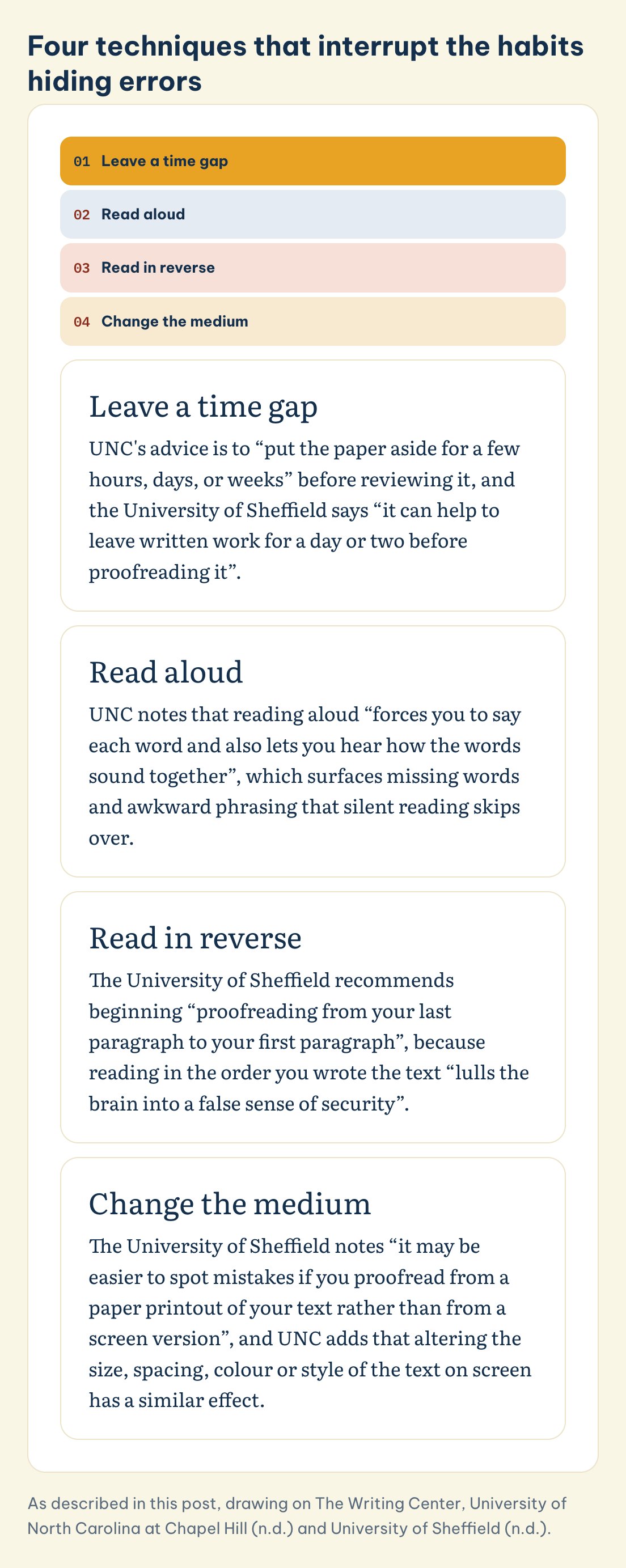
Two things make errors hard to see in your own writing: familiarity with your own text, and reading it in the same medium and the same order every time. University guidance from institutions including UNC Chapel Hill and the University of Sheffield points to four techniques that interrupt those habits: leaving a time gap, reading aloud, reading in reverse, and changing the medium.
Leave a time gap. UNC's advice is to "put the paper aside for a few hours, days, or weeks" before reviewing it (The Writing Center, University of North Carolina at Chapel Hill, n.d.), and the University of Sheffield gives the same reasoning for a shorter deadline: "it can help to leave written work for a day or two before proofreading it" (University of Sheffield, n.d.). The gap breaks your familiarity with the draft, so you read the words actually on the page rather than the ones you remember writing.
Read aloud. UNC notes that reading aloud "forces you to say each word and also lets you hear how the words sound together," which surfaces both missing words and awkward phrasing that silent reading skips over (The Writing Center, University of North Carolina at Chapel Hill, n.d.).
Read in reverse, or start from the end. The University of Sheffield recommends beginning "proofreading from your last paragraph to your first paragraph," because reading in the order you wrote the text "lulls the brain into a false sense of security," and errors that would stand out on their own hide inside a familiar sequence (University of Sheffield, n.d.). UNC's variant works at the word level for spelling specifically: "start with the last word on the last page and work your way back to the beginning, reading each word separately" (The Writing Center, University of North Carolina at Chapel Hill, n.d.).
Change the medium. The University of Sheffield notes "it may be easier to spot mistakes if you proofread from a paper printout of your text rather than from a screen version" (University of Sheffield, n.d.), and UNC adds that altering the size, spacing, colour or style of the text on screen has a similar effect (The Writing Center, University of North Carolina at Chapel Hill, n.d.). Both work for the same reason: a text that looks different reads as unfamiliar, which is exactly the state that makes errors visible again.
◆ Part 10 / 10 · Using tools
Using tools without outsourcing your judgement
Direct answer: Spelling and grammar checkers have a narrow, legitimate role, per Birmingham City University (2026): basic checks that flag errors without rewriting sentences do not significantly alter your ideas, so you can use them to revise. Generative tools that create or substantively rewrite sentences are different, since relying on them can make it hard for your marker to assess your understanding.
Spelling and grammar checkers have a legitimate, narrow role in this process, and university guidance is specific about where that role ends. Birmingham City University's library guidance draws the line at what the tool actually does to your sentences: basic correctness checking, such as "Spelling & Grammar Check" and correctness suggestions that flag spelling, grammar and punctuation without rewriting your sentences, "do not significantly alter the content of your ideas," so you can use them to help revise your assignment (Birmingham City University, 2026). Generative tools that "create sentences, predict sentences, or substantively rewrite your sentences," by contrast, are a different category, because relying on them "can make it difficult for your marker to know how well you have understood the content for yourself" (Birmingham City University, 2026). The guidance frames the underlying goal as writing in your own voice "in order to demonstrate your understanding of the ideas and sources you are presenting" (Birmingham City University, 2026).
The practical test is whether a tool is flagging an error for you to fix or fixing it and rewriting the sentence for you. The first keeps the editing and proofreading decisions with you, where your marker expects them to sit; the second replaces exactly the judgement your assignment is supposed to demonstrate. Check your own institution's policy before relying on any tool for more than surface-level flagging, since policies differ and the consequence for misjudging the line is an academic integrity matter, not a style preference.
WHEN YOU WANT A SECOND PAIR OF EYES ON THE FINAL DRAFT
Structural and sentence-level errors are hardest to see in your own writing because you already know what you meant to say. Through academic support at MAAS, an experienced mentor reviews your draft against your brief, flags where a paragraph has drifted or a pass has been skipped, and talks you through what to fix and why.
Structural problems and sentence-level errors are both hardest to see in your own writing, precisely because you already know what you meant to say. Through academic support at MAAS, an experienced mentor reviews your draft against your brief, flags where a paragraph has drifted from its argument or a pass has been skipped, and talks you through what to fix and why. Your mentor questions, advises and gives structured feedback; the decisions and the writing remain your own.
Frequently asked questions
What is the difference between editing and proofreading?
Editing addresses higher-order concerns such as content, structure, clarity, style and citations, and happens earlier in the revision process; proofreading is the final stage, checking "surface level errors like typos, misspellings, and formatting errors" (The Writing Center, University of North Carolina at Chapel Hill, n.d.; Eastern Washington University, 2024). Editing decides whether the writing is doing its job; proofreading confirms the sentences are correctly built.
Why can't I edit and proofread at the same time?
Because you should "proofread only after you have finished all of your other editing revisions" (The Writing Center, University of North Carolina at Chapel Hill, n.d.); correcting a sentence's grammar before you have confirmed its paragraph survives the structural pass risks correcting text you delete or rewrite later (Eastern Washington University, 2024).
What should I check for in a paragraph-level edit?
Confirm every sentence in the paragraph relates to a single controlling idea, usually stated in the topic sentence, and that the paragraph's idea connects to your paper's overall thesis (The Writing Center, University of North Carolina at Chapel Hill, n.d.-b). Reverse outlining, writing down each paragraph's point in one sentence and reading that list alone, is a fast way to test this.
What sentence-level errors do markers see most often?
Sentence fragments, run-on sentences, comma splices, and subject-verb agreement errors are the errors La Trobe University Library's guidance flags as most common (La Trobe University Library, n.d.). A fragment lacks a complete independent clause, a run-on or fused sentence joins two independent clauses with no punctuation or connecting word, and a comma splice joins them with only a comma (Purdue Online Writing Lab, n.d.-a).
Does reading aloud actually help catch errors?
Yes; reading aloud "forces you to say each word and also lets you hear how the words sound together," which surfaces missing words and awkward phrasing that silent reading tends to skip over (The Writing Center, University of North Carolina at Chapel Hill, n.d.).
Should I proofread on screen or on paper?
University of Sheffield guidance notes "it may be easier to spot mistakes if you proofread from a paper printout of your text rather than from a screen version" (University of Sheffield, n.d.), because the change in medium breaks the familiarity that lets errors hide.
Can I use a grammar checker to proofread my assignment?
Basic spelling and grammar checking that flags errors without rewriting your sentences is generally fine, since it "do[es] not significantly alter the content of your ideas" (Birmingham City University, 2026). Tools that rewrite or generate sentences for you are a different matter, because relying on them can make it hard for your marker to assess how well you understood the material yourself (Birmingham City University, 2026); check your own institution's policy before using any tool beyond surface-level flagging.
References
- American Psychological Association. (n.d.). Basic principles of reference list entries. APA Style. Retrieved July 4, 2026, from https://apastyle.apa.org/style-grammar-guidelines/references/basic-principles
- American Psychological Association. (2020). Publication manual of the American Psychological Association (7th ed.).
- American Psychological Association. (2021a). Table setup. APA Style. https://apastyle.apa.org/style-grammar-guidelines/tables-figures/tables
- American Psychological Association. (2021b). Figure setup. APA Style. https://apastyle.apa.org/style-grammar-guidelines/tables-figures/figures
- Birmingham City University. (2026). AI tools: Student guidelines. Library and Learning Resources. Retrieved July 4, 2026, from https://libguides.bcu.ac.uk/AI-tools
- Eastern Washington University. (2024). Writing your paper 3: Revising, editing, and proofreading. Writers' Center Research Guides. Retrieved July 4, 2026, from https://research.ewu.edu/writers_center_revising_paper
- La Trobe University Library. (n.d.). Writing: Common mistakes. Retrieved July 4, 2026, from https://latrobe.libguides.com/writing/common-mistakes
- Newcastle University. (n.d.). Guidelines for the submission and format of theses. Retrieved September 4, 2026, from https://www.ncl.ac.uk/student-progress/assets/guidelines-submission-format-of-theses/
- Purdue Online Writing Lab. (n.d.-a). Run-ons, comma splices, and fused sentences. Purdue University. Retrieved July 4, 2026, from https://owl.purdue.edu/owl/general_writing/punctuation/independent_and_dependent_clauses/runonsentences.html
- Purdue Online Writing Lab. (n.d.-b). Subject/verb agreement. Purdue University. Retrieved July 4, 2026, from https://owl.purdue.edu/owl/general_writing/grammar/subject_verb_agreement.html
- The Writing Center, University of North Carolina at Chapel Hill. (n.d.). Editing and proofreading. Retrieved July 4, 2026, from https://writingcenter.unc.edu/tips-and-tools/editing-and-proofreading/
- The Writing Center, University of North Carolina at Chapel Hill. (n.d.-b). Paragraphs. Retrieved July 4, 2026, from https://writingcenter.unc.edu/tips-and-tools/paragraphs/
- Trường Đại học Lạc Hồng. (2025). Quy định về cách trình bày luận văn thạc sĩ (Quyết định số 670/QĐ-ĐHLH). https://lhu.edu.vn/Data/News/691/files/QD670_Ban_hanh_Quy_trinh_ve_cach_trinh_bay_luan_van_thac_si.pdf
- Trường Đại học Lâm nghiệp. (n.d.). Quy cách trình bày luận văn thạc sĩ (Mẫu 10). Retrieved September 4, 2026, from https://sdh.vnuf.edu.vn/documents/779420/1759066/Mau%2010-Quy%20cach%20trinh%20bay%20luan%20van.pdf
- University of Manchester. (2026). Presentation of theses policy. https://documents.manchester.ac.uk/display.aspx?DocID=7420
- University of Michigan Library. (2026). Table of contents. Microsoft Word for dissertations. https://guides.lib.umich.edu/c.php?g=1114879&p=8129000
- University of Sheffield. (n.d.). How to proofread your work. StudySkills@Sheffield. Retrieved July 4, 2026, from https://www.sheffield.ac.uk/study-skills/writing/reference-proof/proofread
- University of Western Australia. (n.d.). Preparing your thesis for print. UniPrint. Retrieved September 4, 2026, from https://www.uwa.edu.au/uniprint/guides/preparing-your-thesis-for-print
A free 20-minute discovery call with a MAAS advisor, to talk through your final draft and which passes you still need to run.
Book Free Discovery ▸