
◆ Writing Tips
How do you summarise a journal article, with an example?
Direct answer: Read the article twice, note the research question, method, main findings and the authors' own conclusion, then write those points in your own words, opening with the authors, year and title. Leave out your opinion, minor examples and repeated points. One paragraph of 150 to 250 words suits most article summaries.
This guide draws on handouts from four universities in Canada and the United States and on one classic 1983 study of how expert and novice writers summarise, then summarises that study as a worked example.

◆ Question 1 / 6 · Four passes
How do you write a summary of an article?
Direct answer: Work in four passes: skim the structure, read for the main idea, read again while taking notes in your own words, then draft and cut. The University of Waterloo calls a good summary accurate, clear and concise, and says nothing should appear in it that was not in the original.
The University of Waterloo Writing and Communication Centre (n.d.) recommends reading the text at least twice, once for the general idea and once while taking notes on content and organisation. During that second reading you identify the overall thesis, then the main point of each section, and you write those points in your own words before you start drafting. The same guide warns that a summary is "not an evaluation, commentary, or analysis", so your opinion stays out until a separate critique section, if your assignment asks for one (University of Waterloo Writing and Communication Centre, n.d.).
The University of the Fraser Valley Academic Success Centre (n.d.) adds a useful detail for the note-taking pass. Mark the general, abstract ideas in one colour and the detailed examples in another, so you can see which ideas belong in the summary (University of the Fraser Valley Academic Success Centre, n.d.). The handout also points out that the most important idea is sometimes in the final paragraph, and in that case it should move to the front of your summary.
| Pass | What you do | What you produce |
|---|---|---|
| 1. Skim | Read the title, abstract and headings | A sense of the article's structure |
| 2. Read for gist | Read the whole article once without notes | The main idea in one sentence |
| 3. Read and note | Note the question, method, findings and conclusion in your own words | Short notes, no copied sentences |
| 4. Draft and cut | Write from your notes, then remove detail and repetition | One paragraph of about 150 to 250 words |
The 150 to 250 word range is a working figure for a single article in a coursework assignment, not a rule. Waterloo says there is no standard length, and that an article might need a single paragraph or just a few sentences, so check your brief first.
◆ Question 2 / 6 · What to include
What should a summary of a research article include?
Direct answer: For an empirical article, include the research question and why it matters, the hypotheses, a brief account of the method, the key results, and the authors' interpretation. For an argumentative article, include the topic, the author's thesis, the main supporting points and one key example.
The University of Connecticut Writing Center (n.d.) gives a checklist for empirical papers: state the research question, state the hypotheses tested, describe the methods briefly (design, participants, materials, procedure, and what was measured), describe the results, and explain the key implications without overstating them. The handout advises writing in the same order as the article for a first draft, and expecting that draft to be too long.
Trent University Academic Skills (n.d.) separates two outlines. An empirical article summary moves from topic and research question to methods, then findings, then implications and major limitations. An argumentative article summary moves from topic and the author's approach to the thesis, the main points with a key example or two, and a conclusion on how the points support the thesis. Choosing the right outline before you draft saves a rewrite, because a theory paper has no participants or results to report (Trent University Academic Skills, n.d.).
◆ Question 3 / 6 · Opening sentence
How do you start a summary of an article?
Direct answer: Open with one sentence that names the authors, the year, the title or type of work, and its main claim or finding. That sentence tells the reader what the source is and why it matters before any detail arrives, and its reporting verb, such as "found" or "argues", signals the kind of article.
Waterloo's guide advises introducing the author and title at the start and using reporting verbs. Verbs such as "argues", "found", "examined", "reports" and "concludes" carry meaning: "found" signals an empirical result, while "argues" signals a position the author defends. The verb shows the marker you understood what kind of article you read (University of Waterloo Writing and Communication Centre, n.d.).
| Weak opening | Stronger opening |
|---|---|
| This article is about summarising. | Brown and Day (1983) examined how the ability to summarise develops from school age to adulthood. |
| The authors talk about many interesting things. | The authors argue that good summarising requires writers to add a synopsis in their own words, not only delete text. |
| In this study, it was found that... | Across three studies, older and more expert writers combined ideas across paragraphs more often than younger writers. |
The UConn handout makes the same point about precision: avoid vague references such as "this illustrates" and write "this result illustrates" instead, and remember that one study can "support" a hypothesis but cannot "prove" it (University of Connecticut Writing Center, n.d.).
◆ Question 4 / 6 · Why it is hard
Why is summarising harder than it looks?
Direct answer: Research on summarising shows that novices mostly delete and copy, while experts generalise and write new topic sentences in their own words. The step of inventing a sentence that states an implicit main idea is the hardest, and it is the step that separates a summary from a shortened copy.
Kintsch and van Dijk (1978), writing in Psychological Review, modelled how readers reduce a text to its gist through macrorules such as deletion, generalisation and construction. Brown and Day (1983), at the Center for the Study of Reading in Illinois, turned those operations into five summarising rules and tested them with students at several ages. Younger writers relied on a strategy known as copy-delete: they removed trivial or repeated material and copied the rest almost word for word. Older students and expert writers also replaced lists with a general term, selected topic sentences, and invented topic sentences where the original had none.
Brown and Day explain why the last rule is the hardest: "The invention rule is difficult because it departs most radically from the favored copy-delete ploy" (Brown & Day, 1983, p. 25). If your draft is mostly the article's own sentences with words removed, you are still at the copy-delete stage. The fix is to close the article, write from your notes, and check afterwards that every point matches the source.
The numbers in the report show how gradual this development is. Experiment 1 tested 18 fifth graders, 16 seventh graders, 13 tenth graders and 20 college students, with mean ages from 10.7 to 18.1, on two texts of 492 and 532 words. In Experiment 2, six graduate students from the English Department at the University of Illinois, all experienced teachers of first-year writing, used the invention rule on .84 of the occasions where it applied, against .49 for four-year college students. Experiment 3 asked 20 junior college students to write summaries of no more than 60 words per text, a constraint that forces writers to combine ideas rather than copy them (Brown & Day, 1983).
◆ Question 5 / 6 · Worked example
What does a good academic summary example look like?
Direct answer: A good academic summary names the source in its first sentence, reports the question, method and findings in the order a reader needs them, keeps numbers that matter, and ends with the authors' own conclusion. The example below summarises Brown and Day (1983), a study of three experiments.
What goes into a summary of an empirical article
Tap each part to see what it reports.
Opening sentence
Authors, year, type of work and main claim or finding (University of Waterloo Writing and Communication Centre, n.d.).
Question and hypotheses
What the study asked and what it tested (University of Connecticut Writing Center, n.d.).
Method
Design, participants, materials, procedure and what was measured, briefly (University of Connecticut Writing Center, n.d.).
Findings
The key results and whether they supported the hypotheses (Trent University Academic Skills, n.d.).
Authors' conclusion
Implications and major limitations, without overstating them (Trent University Academic Skills, n.d.).
Save this figure
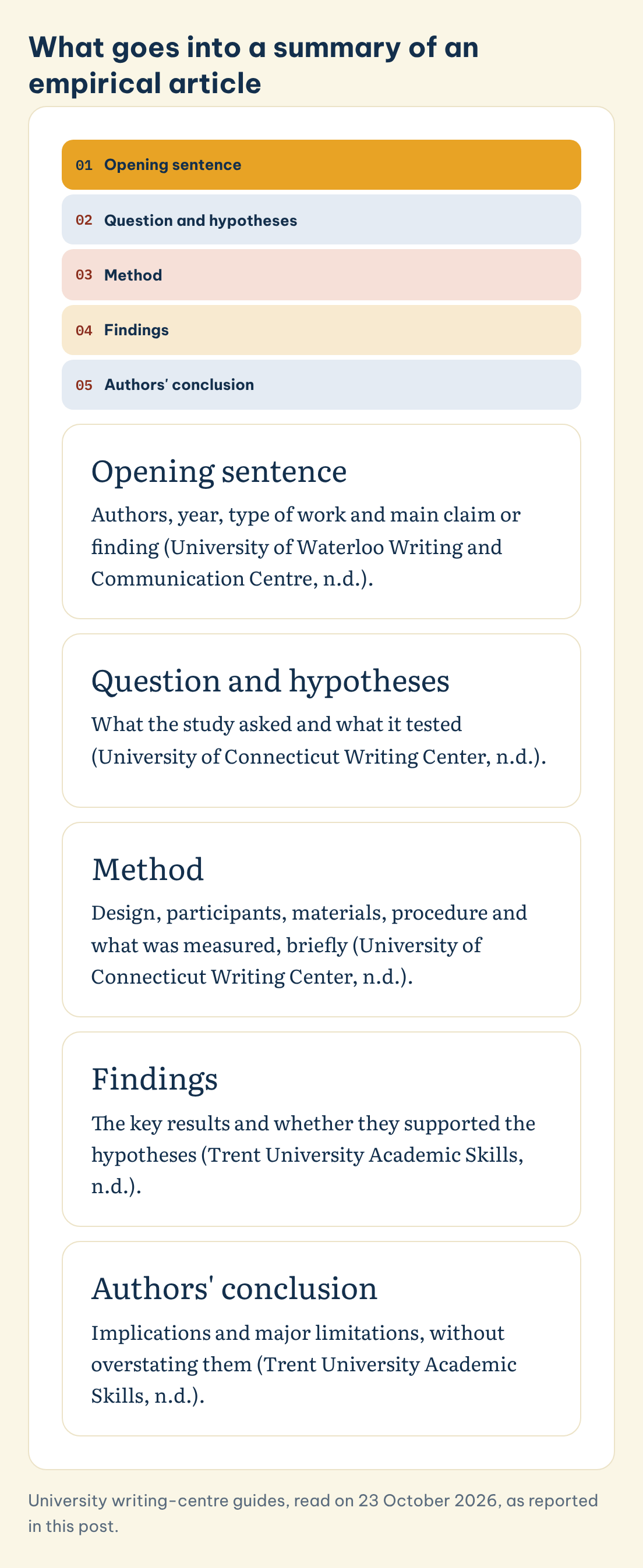
The example below follows the empirical outline from Trent University Academic Skills (n.d.). Notice that it uses no direct quotations, in line with the UConn handout's advice to rely primarily on paraphrase in scientific summaries, and that every figure comes from the report itself.
Brown and Day (1983) examined how the ability to summarise expository texts develops, using summarising rules adapted from Kintsch and van Dijk's model of text comprehension. In the first of three studies, fifth graders, seventh graders, tenth graders and college students summarised short texts written so that five rules could be applied: deleting trivial information, deleting repeated information, replacing a list with a general term, selecting a topic sentence, and inventing a topic sentence. All age groups deleted unimportant material, but use of the more complex rules increased with age, and even college students invented a topic sentence on only about half of the occasions where one was needed. In the second study, college rhetoric teachers outperformed first-year college students in combining information across paragraphs and in writing a synopsis in their own words. In the third study, junior college students deleted trivial and repeated material as well as university students did, but on selecting and inventing topic sentences they performed at about the level of seventh graders. The authors concluded that the rules differ in difficulty because they depart to different degrees from a copy-delete strategy, and that inventing new sentences is the hardest skill and the core of good summarising.
◆ Question 6 / 6 · Summary vs critique
How is a summary different from a critique or an annotation?
Direct answer: A summary reports what the source says and stays neutral. A critique judges the source's strengths and weaknesses. An annotation in an annotated bibliography usually does both, briefly, and then states how the source helps your own research, which is why its length and purpose differ from a plain summary.
Students often lose marks by mixing these tasks, a point both the UConn and Waterloo handouts make. If the brief says "summarise", a sentence such as "this study is very convincing" does not belong, because a summary is not an evaluation (University of Waterloo Writing and Communication Centre, n.d.). If the brief says "summarise and evaluate", write the neutral summary first and the evaluation in a separate paragraph, so the marker can see both. Our guide on how to write an annotated bibliography explains the evaluative part in more detail, and how to reference a journal article in APA covers the citation line that sits above each summary.
| Task | Your opinion? | Typical length | Main question it answers |
|---|---|---|---|
| Summary | No | One paragraph | What does the source say? |
| Critique | Yes | Several paragraphs | How strong is the source? |
| Annotation | Briefly | 100 to 200 words | What does it say, and how does it help my research? |
Frequently asked questions
How long should a summary of a journal article be?
There is no standard length. The University of Waterloo Writing and Communication Centre (n.d.) says an article might need a single paragraph or just a few sentences, so follow your assignment brief first.
Should I use quotations in a summary?
Rarely. The University of Connecticut Writing Center (n.d.) advises relying mainly on paraphrase in scientific writing and citing the author and year.
Can I include my opinion in a summary?
Not in the summary itself. Keep your evaluation for a separate critique paragraph if the task asks for one (University of Waterloo Writing and Communication Centre, n.d.).
Do I have to follow the order of the article?
Not always. A first draft in the article's order is a good start, but the University of the Fraser Valley Academic Success Centre (n.d.) notes that a key idea placed late in the article may need to move to the front.
How do I avoid plagiarism when summarising?
Write from your notes with the article closed, then compare your draft with the source and cite it. Copying sentences and deleting a few words is the copy-delete strategy that Brown and Day (1983) found in fifth and seventh graders.
Is the abstract the same as a summary?
An abstract is the author's own summary. Your summary must be in your own words and written for your purpose, so read the full article rather than paraphrasing the abstract.
Want feedback on your own summaries?
Summarising well is a skill that improves with feedback on real drafts. MAAS experts work through your readings and your own draft summaries with you, using an Outline → Draft → Final process, so you can see where your writing still copies the source and how to move to your own synthesis. Learn more about essay and assignment support.
Related guides
References
Brown, A. L., & Day, J. D. (1983). Macrorules for summarizing texts: The development of expertise (Technical Report No. 270). Center for the Study of Reading, University of Illinois at Urbana-Champaign. https://files.eric.ed.gov/fulltext/ED225136.pdf
Kintsch, W., & van Dijk, T. A. (1978). Toward a model of text comprehension and production. Psychological Review, 85(5), 363–394. https://doi.org/10.1037/0033-295X.85.5.363
Trent University Academic Skills. (n.d.). Writing article summaries. Retrieved October 23, 2026, from https://www.trentu.ca/academicskills/how-guides/how-write-university/how-approach-any-assignment/writing-article-summaries
University of Connecticut Writing Center. (n.d.). How to summarize a research article. Retrieved October 23, 2026, from https://writingcenter.uconn.edu/wp-content/uploads/sites/593/2014/06/How_to_Summarize_a_Research_Article1.pdf
University of the Fraser Valley Academic Success Centre. (n.d.). Summarizing a scholarly journal article. Retrieved October 23, 2026, from https://www.ufv.ca/media/assets/academic-success-centre/handouts/Summarizing-a-Scholarly-Journal-Article-rev2018.pdf
University of Waterloo Writing and Communication Centre. (n.d.). Summary. Retrieved October 23, 2026, from https://uwaterloo.ca/writing-and-communication-centre/summary
Not sure how this guide applies to your own case? Talk it through with MAAS in a free 20-minute consultation.
Book a free consultation ▸