
◆ Study skills
How do you write an annotated bibliography?
An annotated bibliography is an alphabetical list of citations in which each entry is followed by a short paragraph, the annotation, that summarises and evaluates the source (Deakin University, n.d.; Cornell University Library, 2026). Most university assignments expect the evaluative kind: not just what a source says, but whether it is credible and how it serves your own research (University of North Carolina at Chapel Hill Writing Center, n.d.).
This guide walks through what an annotation needs to contain, how to format the list, and the drafting process that keeps you from defaulting to the most common mistake: summarising a source instead of assessing it. Every claim traces to a university library or writing-centre guide, and the full source list sits at the end.

◆ Part 1 / 7 · What it is
What an annotated bibliography is, and what it is for
Direct answer: An annotated bibliography is a list of citations in which each entry carries a short paragraph, the annotation, that describes and evaluates the source rather than only recording that you read it. Its purpose goes beyond bookkeeping: it develops critical thinking, builds research skills through close engagement with each source, and surveys what already exists on your topic.
An annotated bibliography combines standard citation information for a source with a description that explains it, going beyond simply recording what you read to demonstrating your understanding of and engagement with each source (University of North Carolina at Chapel Hill Writing Center, n.d.). Cornell University Library (2026) frames it as a list of citations to books, articles and documents, each followed by a brief descriptive and evaluative paragraph of roughly 150 words.
The purpose is not only bookkeeping. RMIT University (n.d.) lists three goals: developing critical thinking by reviewing the issues and arguments in a research area, building deeper research skills by engaging closely with individual sources, and reflecting on what has already been published on your topic. Monash University (n.d.) adds that the task is often set early in a research project, or ahead of an essay, precisely to force that survey of the existing literature before you start writing your own argument. If your assignment instead calls for weaving that same literature into connected, thematic prose, the literature review guide covers that different genre. If you are asked to assess one source rather than list several, critical review is the relevant guide.
◆ Part 2 / 7 · Descriptive or critical
Descriptive versus critical: the distinction your marker is grading
Direct answer: An informative annotation summarises a source's arguments without judgment, an indicative annotation only names the questions it addresses, while a critical or evaluative annotation assesses the source's credibility and states how useful it is for a field or audience. Most assignments expect the evaluative kind, and defaulting to pure description is the most common way a bibliography under-delivers.
Descriptive and critical annotation, side by side
Each row sets the two kinds against one feature.
Descriptive annotation
Critical annotation
It summarises a source's arguments and conclusions without judgment, or only names the questions the source addresses.
It assesses the source's credibility (bias, lack of evidence, objectivity) and states how useful it is for a given field or audience.
Retelling what a source says without judging it is the single most common way an annotated bibliography under-delivers.
Most assignments expect this evaluative kind, and students are expected to both summarise and critically analyse or evaluate each source.
Save this figure
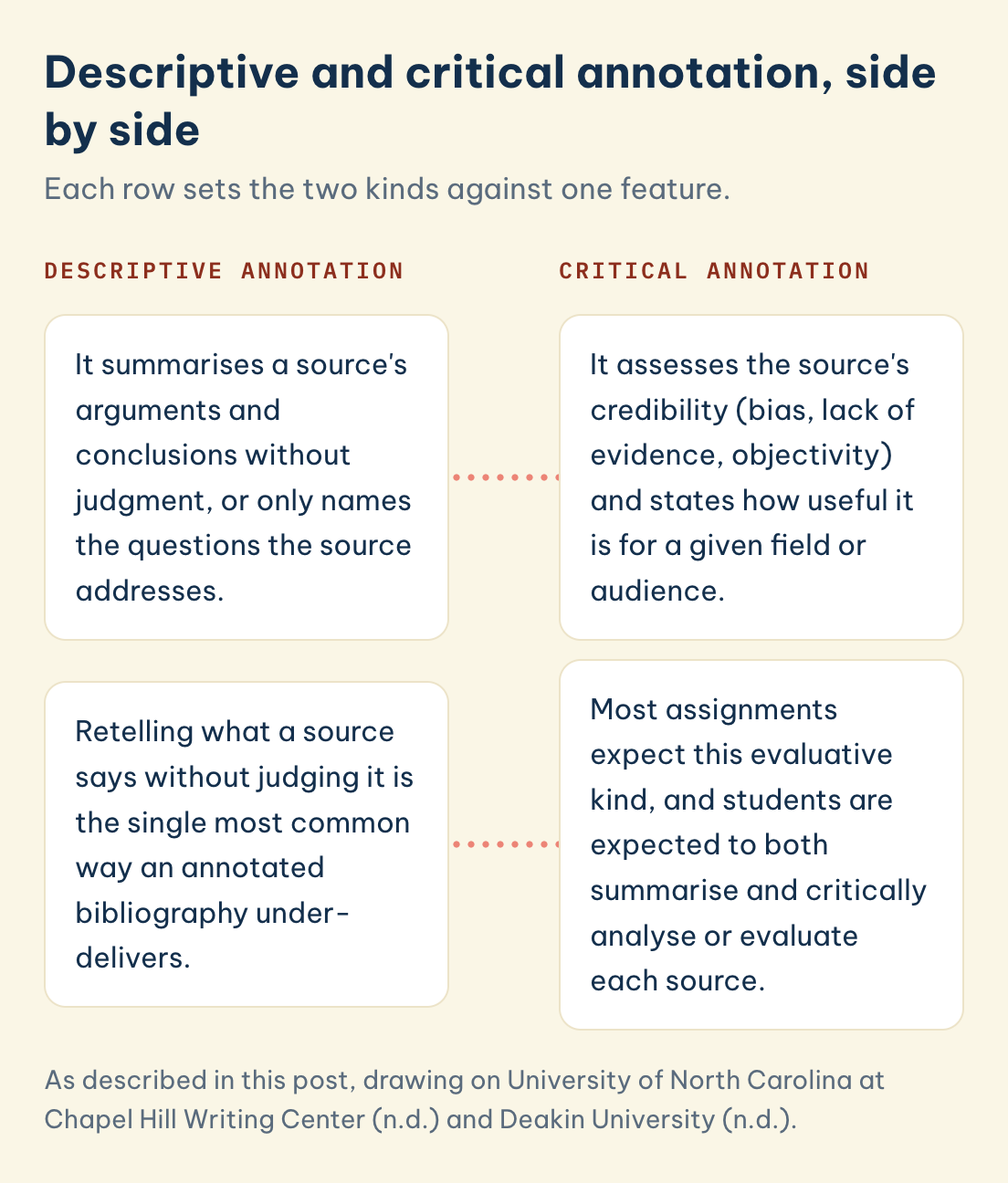
University of North Carolina at Chapel Hill Writing Center (n.d.) distinguishes two summarising styles from a genuinely critical one: "They do not judge the work they are discussing" (University of North Carolina at Chapel Hill Writing Center, n.d.). An informative annotation functions like a summary, presenting the source's arguments and conclusions without judgment; an indicative annotation goes even lighter, naming the questions or issues a work addresses rather than detailing its actual findings. A critical, or evaluative, annotation does more: it assesses the source's credibility (bias, lack of evidence, objectivity) and states how the work may or may not be useful for a given field of study or audience (University of North Carolina at Chapel Hill Writing Center, n.d.).
The descriptive-versus-critical split is the distinction that decides most marks. Deakin University (n.d.) is explicit that students are expected to both summarise and critically analyse or evaluate each source, not one or the other, and the University of Birmingham (2025) frames the annotation as an evaluative summary rather than a plain one. Defaulting to pure description, retelling what a source says without judging it, is the single most common way an annotated bibliography under-delivers against its brief.
Judging which sources deserve a place at all is the harder half of this task. Academic Support coaches that judgement through Outline, Draft and Final, starting from your own marking rubric rather than a generic template.
◆ Part 3 / 7 · A strong annotation
What a strong annotation actually contains
Direct answer: A strong annotation makes three moves: a concise summary of the source's theme, scope, argument or methodology; an evaluation of the author's authority, objectivity, evidence base and any limitations; and a statement tying the source directly to your own research question rather than leaving it to float in isolation.
The three moves of a strong annotation
Tap a move to see what it asks of you.
A concise summary
State the source's central theme, scope, main argument or methodology. This is necessarily brief, because the annotation is not a substitute for reading the source, only a compressed account of what it argues and how.
An evaluation of authority and quality
Evaluate the author's authority or background, and extend this to the source's objectivity, evidence base and any apparent bias. Practically, name who wrote it, what expertise or data stands behind the claim, and where the argument is thinner than it first appears.
A statement of relevance
Tie the source to your research question rather than leaving it to float in isolation. A source can be excellent scholarship and still earn a weak annotation if you never say what it does for your argument.
Save this figure
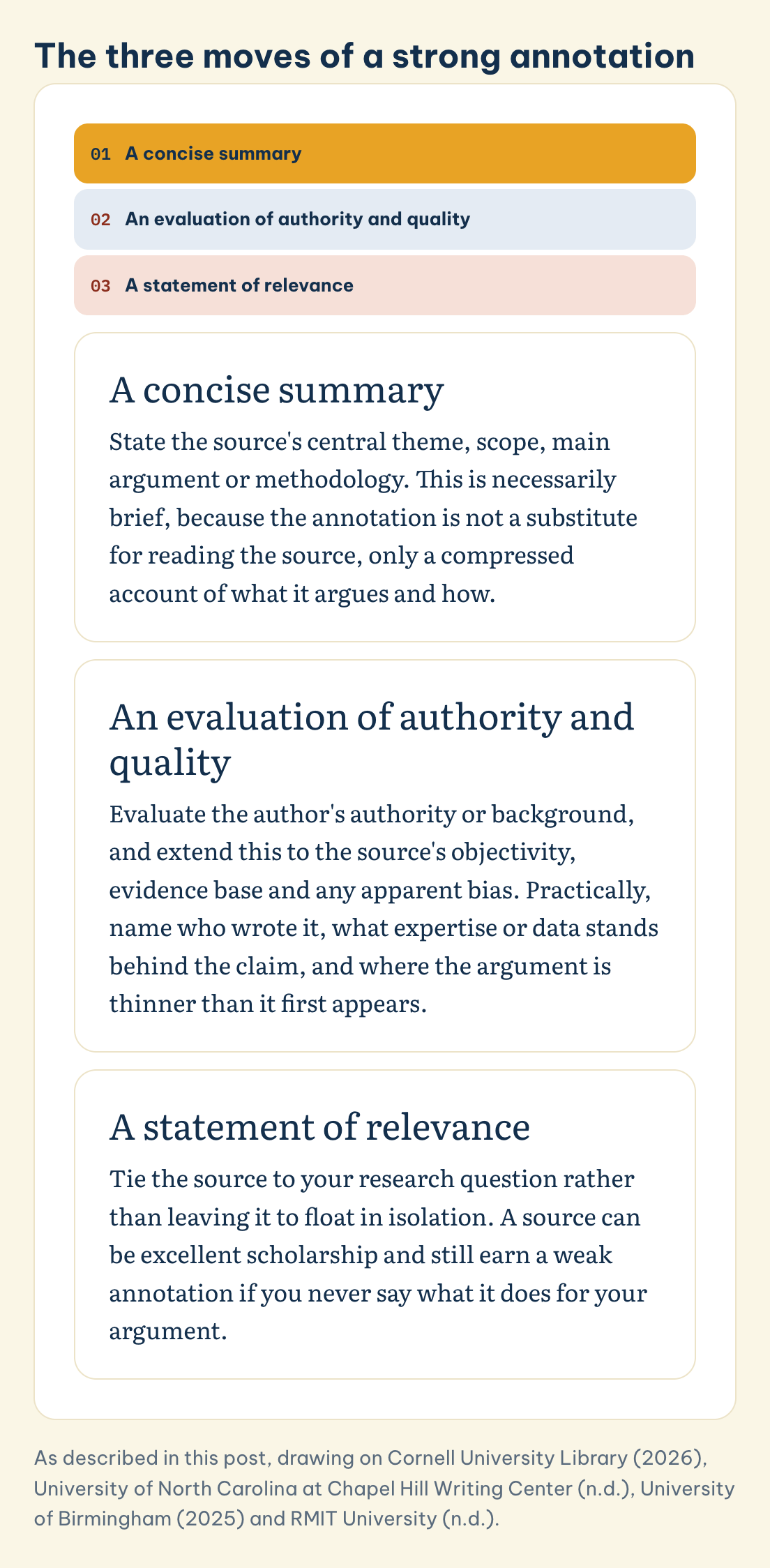
Strip the guidance from several university libraries down to its common core and three moves recur.
A concise summary
State the source's central theme, scope, main argument or methodology (Cornell University Library, 2026; University of Birmingham, 2025). This is necessarily brief: the annotation is not a substitute for reading the source, only a compressed account of what it argues and how.
An evaluation of authority and quality
Cornell University Library (2026) asks you to evaluate the authority or background of the author. University of North Carolina at Chapel Hill Writing Center (n.d.) extends this to the source's objectivity, evidence base and any apparent bias. University of Birmingham (2025) folds in a check on the source's own limitations. Practically, this means naming who wrote it, what expertise or data stands behind the claim, and where the argument is thinner than it first appears.
A statement of relevance to your own work
The final move ties the source to your research question rather than leaving it to float in isolation. Cornell University Library (2026) asks how the work illuminates your bibliography topic; University of Birmingham (2025) asks you to state relevance to your topic directly; RMIT University (n.d.) frames the whole annotation as a comment on how the item contributes to your research. A source can be excellent scholarship and still earn a weak annotation if you never say what it does for your argument.
◆ Part 4 / 7 · Formatting
Formatting: citation first, then the annotation
Direct answer: List entries alphabetically by author surname, with the full citation in a hanging indent and the annotation as a new paragraph in full sentences beneath it. Treat 100 to 200 words as a sensible default length, confirm the source count against your brief, and skip separate in-text citations inside the annotation itself.
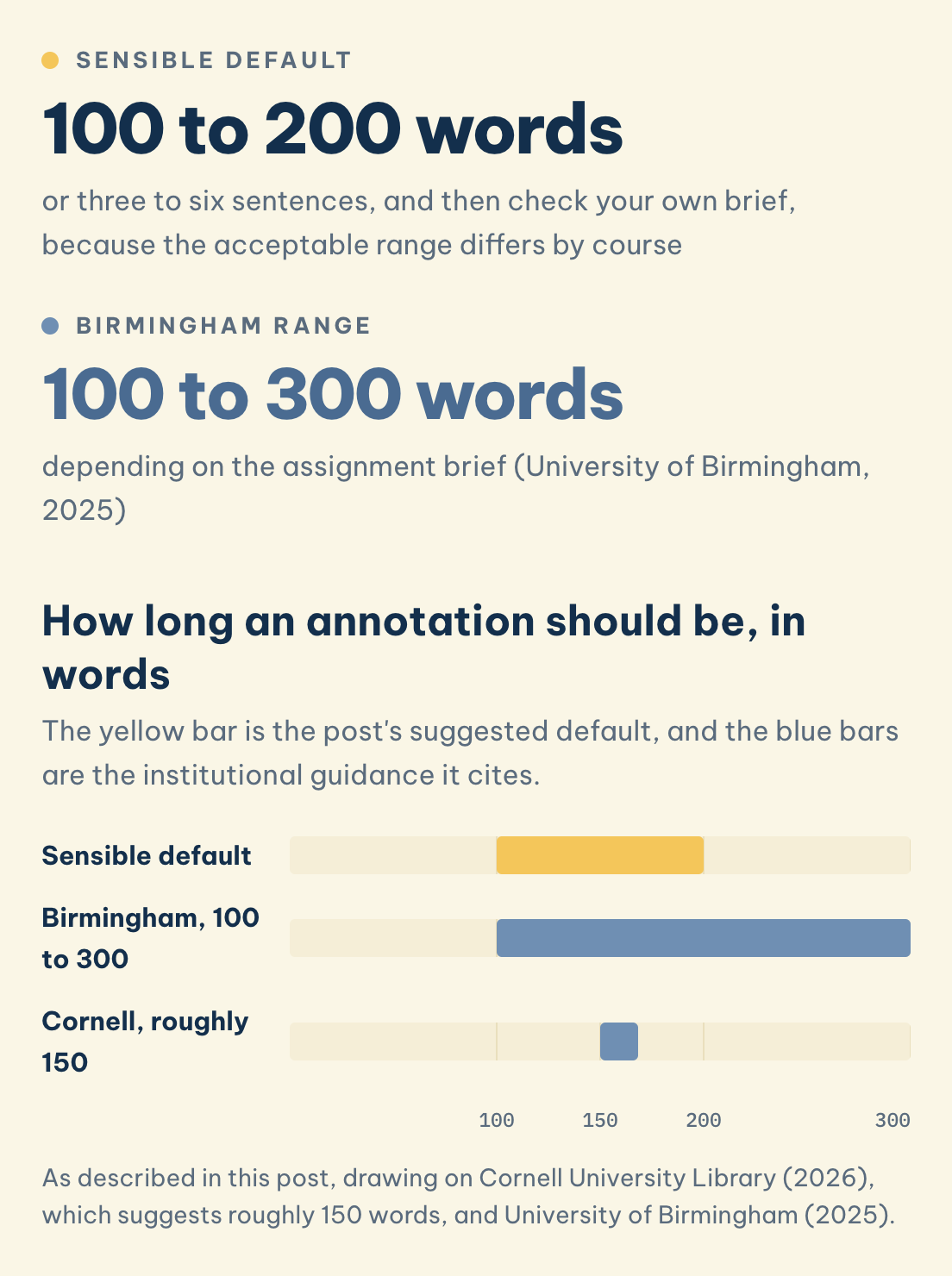
Sensible default
100 to 200 words
or three to six sentences, and then check your own brief, because the acceptable range differs by course
Birmingham range
100 to 300 words
depending on the assignment brief (University of Birmingham, 2025)
How long an annotation should be, in words
The yellow bar is the post's suggested default, and the blue bars are the institutional guidance it cites.
Save this figure
List entries alphabetically by author surname, exactly as you would order a reference list (University of North Carolina at Chapel Hill Writing Center, n.d.). Each entry opens with the full citation in the style your course requires, most commonly APA 7th referencing, formatted with a hanging indent so only the first line sits flush to the margin. The annotation follows directly beneath as a new paragraph, indented half an inch from the left margin and written in full sentences rather than bullet points (University of North Carolina at Chapel Hill Writing Center, n.d.).
Length guidance varies by institution but converges on a similar range. Cornell University Library (2026) suggests roughly 150 words; University of Birmingham (2025) gives a wider band of 100 to 300 words depending on the assignment brief; Deakin University (n.d.) simply instructs students to stay within whatever word limit the brief sets and to write in full sentences using present tense. Treat 100 to 200 words, or three to six sentences, as a sensible default and then check your own brief, because the acceptable range differs by course and by how many sources you are annotating.
How many sources belong on the list is also brief-dependent. Deakin University (n.d.) notes that undergraduate stand-alone assignments often ask for as few as three to ten sources, while postgraduate annotated bibliographies, which typically feed into a larger research paper, usually cover more. Monash University (n.d.) makes the same point: the number and type of sources required varies between units, so the brief and rubric, not a generic rule, set the target.
One formatting habit to avoid: an annotation does not need its own in-text citations, because you are already providing that source's full details in the citation above it and are not meant to discuss other sources within the same annotation (Deakin University, n.d.).
◆ Part 5 / 7 · The process
The process, in order
Direct answer: Work through the task as a sequence: find and vet relevant sources, read each one critically rather than skimming the abstract, write the citation in your required style, draft the annotation by summarising the argument, evaluating its authority and stating its relevance, then arrange the list alphabetically and check it against your brief before submitting.
The process, in order
Tap a step to see what to do.
Step 1 of 5
Find and vet sources
Locate citations to books, articles and documents that look relevant, using your library's databases and search tools.
Step 2 of 5
Read critically
Examine the actual item rather than the abstract alone, and select the sources that offer varied perspectives on your topic rather than repeating each other.
Step 3 of 5
Write the citation
Format it accurately in the referencing style your course requires.
Step 4 of 5
Draft the annotation
Summarise the source's argument, evaluate its authority and quality, and state its relevance to your research, in that order.
Step 5 of 5
Arrange and check
Arrange the list alphabetically and check the whole document against your brief for word count, source count and required style before submitting.
Save this figure
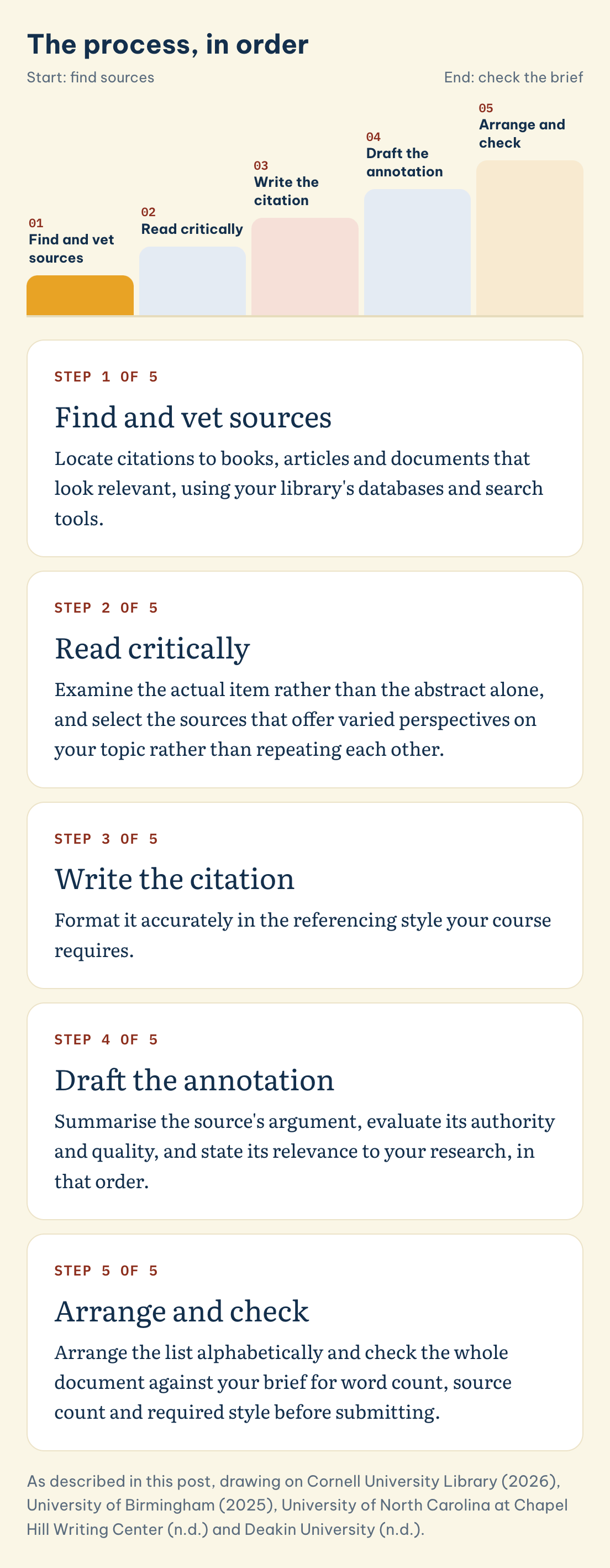
Treat an annotated bibliography as a sequence rather than something you draft in one pass.
- Find and vet sources. Locate citations to books, articles and documents that look relevant, using your library's databases and search tools (Cornell University Library, 2026; University of Birmingham, 2025).
- Read critically, not just skim. Examine the actual item rather than the abstract alone, and select the sources that offer varied perspectives on your topic rather than repeating each other (Cornell University Library, 2026).
- Write the citation. Format it accurately in the referencing style your course requires (University of Birmingham, 2025).
- Draft the annotation. Summarise the source's argument, evaluate its authority and quality, and state its relevance to your research, in that order (Cornell University Library, 2026; University of North Carolina at Chapel Hill Writing Center, n.d.).
- Arrange the list alphabetically and check the whole document against your brief for word count, source count and required style before submitting (University of North Carolina at Chapel Hill Writing Center, n.d.; Deakin University, n.d.).
◆ Part 6 / 7 · Style and register
Style and register
Direct answer: Deakin University and University of Birmingham both direct you to full sentences, present tense and an academic register instead of dot points or casual phrasing. Birmingham adds third person and active voice. Because no entry cross-references another, unlike paragraphs in a literature review, each one must make sense to a reader who has seen no other entry.
Write annotations in full sentences, in the present tense, using an academic register rather than dot points or casual phrasing (Deakin University, n.d.; University of Birmingham, 2025). University of Birmingham (2025) also recommends third person and active voice. Keep each annotation self-contained: it should make sense to a reader who has not seen your other entries, since annotations do not cross-reference each other the way a literature review's paragraphs do.
◆ Part 7 / 7 · Final check
Check before you submit
Direct answer: Before submitting, confirm three things: every entry is a genuine evaluation rather than a repackaged abstract, each citation is complete and correctly formatted with the annotation properly indented beneath it, and the list is alphabetical and meets the source count and word limit your brief sets.
Confirm three things before you hand in the list. First, that every entry is a genuine evaluation and not a repackaged abstract, since the descriptive-only annotation is the failure mode markers flag most often (University of North Carolina at Chapel Hill Writing Center, n.d.; Deakin University, n.d.). Second, that the citation for each entry is complete and correctly formatted in your required style, with the annotation beneath it properly indented (University of North Carolina at Chapel Hill Writing Center, n.d.). Third, that the list is alphabetical, meets the source count and word limit set in your brief, and that every source you cite genuinely serves your stated research question (University of Birmingham, 2025; Deakin University, n.d.).
WHEN YOU WANT A SECOND PAIR OF EYES ON YOUR ANNOTATIONS
A mentor through academic support at MAAS reviews a draft annotation against your brief, checks whether your evaluation of a source's authority and relevance actually comes through on the page, and points out where description has crept in where judgement was expected. The decisions and the writing remain yours.
That descriptive-only slip is easy to make: you read a source, understand it, and still write an annotation that only describes it. Through academic support at MAAS, an experienced mentor reviews a draft annotation against your brief, checks whether your evaluation of a source's authority and relevance actually comes through on the page, and points out where description has crept in where judgement was expected. Your mentor questions, advises and gives structured feedback; the decisions and the writing remain your own.
Frequently asked questions
What is an annotated bibliography?
An annotated bibliography is an alphabetical list of citations in which each entry is followed by a short paragraph, the annotation, that summarises and evaluates the source (Deakin University, n.d.; Cornell University Library, 2026). Most university assignments expect the evaluative kind, which assesses the source's credibility and how it serves your own research (University of North Carolina at Chapel Hill Writing Center, n.d.).
What is the difference between a descriptive and a critical annotation?
A descriptive, or informative, annotation summarises a source's arguments and conclusions without judging them; some go further into indicative territory and only name the questions the source addresses (University of North Carolina at Chapel Hill Writing Center, n.d.). A critical or evaluative annotation assesses the source's credibility, objectivity and usefulness to your topic (University of North Carolina at Chapel Hill Writing Center, n.d.), and most university assignments expect this evaluative version (Deakin University, n.d.).
How long should an annotation be?
Guidance varies by institution and by brief. Cornell University Library (2026) suggests roughly 150 words, while University of Birmingham (2025) gives a range of 100 to 300 words depending on the project. Check your own assignment brief first, since the acceptable length differs by course.
How many sources does an annotated bibliography need?
Undergraduate stand-alone assignments often ask for as few as three to ten sources, while postgraduate annotated bibliographies that feed into a larger research paper usually require more (Deakin University, n.d.). The exact number and type of source is set by your unit's brief rather than by a fixed rule (Monash University, n.d.).
Do I list sources alphabetically or by theme?
Alphabetically by author surname, in the same order you would use for a reference list (University of North Carolina at Chapel Hill Writing Center, n.d.).
Does the annotation need its own in-text citations?
No. The citation above the annotation already provides the source's full details, and the annotation itself is not meant to discuss or cite other sources (Deakin University, n.d.).
What is the most common mistake in an annotated bibliography?
Writing a purely descriptive summary when the brief calls for evaluation. Reviewers expect you to assess a source's authority, objectivity and relevance to your topic, not just restate its content (University of North Carolina at Chapel Hill Writing Center, n.d.; Deakin University, n.d.).
What is the difference between an annotated bibliography and a literature review?
An annotated bibliography treats each source as a separate entry with its own citation and self-contained annotation. A literature review instead weaves sources together thematically into connected prose that builds an argument across the body of work. Our literature review guide covers that thematic, critical approach.
References
- Cornell University Library. (2026). The annotated bibliography: How to prepare an annotated bibliography. Retrieved July 4, 2026, from https://guides.library.cornell.edu/annotatedbibliography
- Deakin University. (n.d.). Annotated bibliography. Retrieved July 4, 2026, from https://www.deakin.edu.au/students/study-support/study-resources/study-support-guides/annotated-bibliography
- Monash University. (n.d.). Annotated bibliography. Student Academic Success. Retrieved July 4, 2026, from https://www.monash.edu/student-academic-success/excel-at-writing/how-to-write/annotated-bibliography
- RMIT University. (n.d.). Annotated bibliographies. Learning Lab. Retrieved July 4, 2026, from https://learninglab.rmit.edu.au/assessments/annotated-bibliographies/index.html
- University of Birmingham. (2025). Researching and writing an annotated bibliography: Annotated bibliographies, a short guide. Retrieved July 4, 2026, from https://libguides.bham.ac.uk/c.php?g=696161&p=4997358
- University of North Carolina at Chapel Hill Writing Center. (n.d.). Annotated bibliographies. Retrieved July 4, 2026, from https://writingcenter.unc.edu/tips-and-tools/annotated-bibliographies/
A free 20-minute discovery call with a MAAS advisor, to talk through your annotations and your marking rubric.
Book Free Discovery ▸