
◆ Citation & Formatting
How do you reference a journal article in APA 7th edition?
To reference a journal article in APA 7th edition, write the authors, the year in brackets, the article title in sentence case, then the journal title and volume in italics, the issue in brackets, the page range and the DOI. American Psychological Association (n.d.) says to include the DOI whenever the article has one.
◆ Question 1 / 8 · How do you reference
How do you reference a journal article in APA 7th edition?
Direct answer: A journal article reference has a fixed order: authors, year, article title, journal title, volume, issue, pages and DOI. James Cook University Library (2026) gives the pattern: Author, A. A., & Author, B. B. (Date). Title of article: Subtitle. Title of Journal, volume number (issue number), page numbers of the whole article or article number. https://doi.org/xx.xxx/xxxx.
Each part has its own punctuation. The University of Huddersfield guide says the article title has its first letter capitalised and ends with a full stop, and APA 7 also capitalises the first word after a colon and any proper nouns. The journal title is italic with the main words capitalised and is followed by a comma. The volume number is italic, and the issue number sits in round brackets without italics. University of Huddersfield (2024, p. 49) says, "Some online articles may not have volumes, or issues or page numbers, so the DOI or URL will be sufficient."
The parts of an APA 7th journal article reference
Tap a part to see the rule for it, using Altbach and Knight (2007) as the example.
Authors
Altbach, P. G., & Knight, J. Surname first, then initials, with an ampersand before the last author.
Year
(2007). The year only, in brackets.
Article title
The internationalization of higher education: Motivations and realities. Sentence case, ending with a full stop.
Journal, volume, issue, pages
Journal of Studies in International Education, 11(3-4), 290-305. Journal title and volume in italics, issue in brackets.
DOI
Written as a full https://doi.org/ link, with no full stop after it, as in 10.1177/1028315307303542.
Save this figure
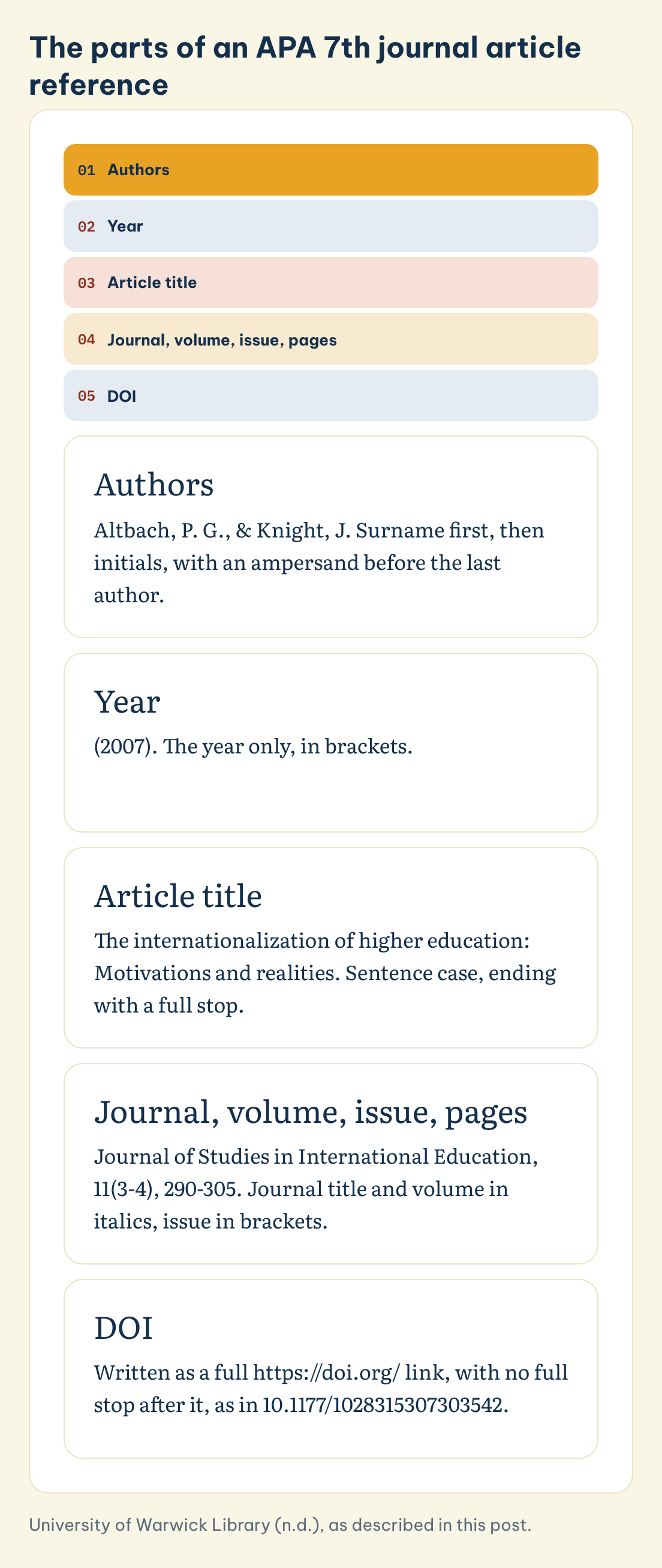
University of Warwick Library (n.d.) gives a worked example: Altbach, P. G., & Knight, J. (2007). The internationalization of higher education: Motivations and realities. Journal of Studies in International Education, 11(3–4), 290–305. https://doi.org/10.1177/1028315307303542 (with no full stop after the DOI). Notice that the volume is 11, the issue is 3–4 and the pages run from 290 to 305. For the year, JCU asks for the year only, and notes that newspapers and some other periodicals need a fuller date.
Our APA 7th referencing guide covers every source type, and our guide to how to cite a book in APA 7 covers books. This post stays with journal articles.
◆ Question 2 / 8 · What does a journal article
What does a journal article reference look like at a glance?
Direct answer: The core pattern stays the same and only a few details change from case to case. The table below sets out the four cases that come up most often, with the reference form and the in-text form side by side, using examples drawn from the Warwick, JCU, Huddersfield and APA Style pages.
| Case | Reference pattern | In-text example |
|---|---|---|
| Two authors, with a DOI | Altbach, P. G., & Knight, J. (2007). The internationalization of higher education: Motivations and realities. Journal of Studies in International Education, 11(3–4), 290–305. https://doi.org/10.1177/1028315307303542 | (Altbach & Knight, 2007) |
| Three to twenty authors | Grady, J. S., Her, M., Moreno, G., Perez, C., & Yelinek, J. (2019). Emotions in storybooks: A comparison of storybooks that represent ethnic and racial groups in the United States. Psychology of Popular Media Culture, 8(3), 207–217. https://doi.org/10.1037/ppm0000185 | (Grady et al., 2019) |
| Article number, not pages | Kitts-Morgan, S. E., Caires, K. C., Bohannon, L. A., Parsons, E. I., & Hilburn, K. A. (2015). Free-ranging farm cats: Home range size and predation on a livestock unit in northwest Georgia. PLoS ONE, 10(4), Article e0120513. https://doi.org/10.1371/journal.pone.0120513 | (Kitts-Morgan et al., 2015) |
| Database article, no DOI | Kingston, B. (1994). Women in nineteenth century Australian history. Labour History, (67), 84–96. | (Kingston, 1994) |
The first and fourth rows follow Warwick and JCU, the second follows APA Style, and the third follows JCU and APA Style. The sections below explain what changes in each row.
◆ Question 3 / 8 · With or without a DOI
How do you reference a journal article with a DOI, or without one?
Direct answer: Add the DOI as a full https://doi.org/ link at the end of the reference whenever the article has one. American Psychological Association (n.d.) says, "If a journal article has a DOI, include the DOI in the reference." If it has no DOI, the next step depends on where you found the article.
American Psychological Association (2022) adds that you should include a DOI "regardless of whether you used the online version or the print version". If an article has both a DOI and a URL, include only the DOI. You do not write "Retrieved from" or "Accessed from" before the link. Do not put a full stop after the DOI or URL, because American Psychological Association (2022) warns it "may interfere with link functionality".
For an article with no DOI, there are two cases. If it comes from an academic research database, APA Style says to end the reference after the page range, so that the reference is the same as for a print article. James Cook University Library (2026) states, "Do not include a URL for a journal article only available within an academic research database." The Kingston (1994) row in the table shows this. If the article sits on an online journal outside a database and has a URL that works for readers, add that URL at the end. The Huddersfield guide says, "If the article does not have a DOI, use the URL of the website" (University of Huddersfield, 2024, p. 49).
One more case is an advance release version. The Huddersfield guide says to insert the words Advance online publication before the DOI or URL, and the APA Style page points to the Publication Manual for in-press articles.
◆ Question 4 / 8 · Article numbers, not pages
How do you reference an article that has an article number instead of pages?
Direct answer: Write the word Article and then the article number in the place where the page range would go. American Psychological Association (n.d.) says, "If the journal article has an article number instead of a page range, include the word “Article” and then the article number instead of the page range."
James Cook University Library (2026) explains why this happens: some online-only journals start every article at page 1, so page numbers mean nothing. In the Kitts-Morgan et al. (2015) example the reference ends with 10(4), Article e0120513 and then the DOI. Copy the number exactly as the journal gives it, including any letter at the start.
Some journals have no volume or issue at all. JCU says to skip the missing element and move to the next part of the pattern, and American Psychological Association (n.d.) says to omit any element the journal does not use. American Psychological Association (n.d.) also says, "Always include the issue number for a journal article" when the journal has one, so check the article page before you leave it out.
◆ Question 5 / 8 · Several authors
How do you reference a journal article with several authors?
Direct answer: List every author in the reference up to 20, with an ampersand before the last one. For 21 or more, list the first 19, add an ellipsis, then the final author. University of Huddersfield (2024, p. 14) says, "Up to twenty authors list them all and use an ampersand before the final author's name."
For 21 or more authors, the same page says, "include the first 19 authors' names, insert … (3 dots called an ellipsis) no ampersand, and then add the final author's name." So the pattern is nineteen names, then the dots, then the last name, and nothing else between them.
The in-text form is shorter. Huddersfield says that a work with 3 to 20 authors takes the first author's family name followed by et al. in the text. With two authors you name both: Ramsden and Jones (2019) in narrative form, or (Ramsden & Jones, 2019) in brackets. With three or more, it becomes Ramsden et al. (2019) or (Ramsden et al., 2019). The reference list keeps all the names, but the in-text citation shortens to one.
◆ Question 6 / 8 · No author
How do you reference a journal article with no author?
Direct answer: Move the title to the author position, and in the text cite the title instead of a name. University of Huddersfield (2024, p. 11) puts it as "Cite the title in place of the author." Before you choose this route, look hard for a named author or a group author, because most journal articles have one.
In the reference list, the article title moves to the author position, without quotation marks, followed by the year in brackets and then the journal details. In the text, APA 7 puts the article title in quotation marks and title case, so a hypothetical article called "Sunflowers require a sunny spot" would be cited as ("Sunflowers Require a Sunny Spot," 2019). Some university guides use a slightly different local form, so check the one your department follows.
Be careful, though. If you cannot find a named author, ask whether the article is the right kind of source for your assignment. If you are not sure, check with your tutor before you build an argument on it.
◆ Question 7 / 8 · In-text, with pages
How do you cite a journal article in the text, with page numbers?
Direct answer: Use the authors' surnames and the year, and add a page number after a comma when you quote or point to a passage. University of Warwick Library (n.d.) shows the quotation form as (Altbach & Knight, 2007, p. 292), with the quotation itself in quotation marks.
You have two shapes to choose from. In parenthetical form, the names and year sit inside the brackets: (Altbach & Knight, 2007). In narrative form the authors are the subject of the sentence and only the year follows in brackets: Altbach and Knight (2007) note that… Warwick gives both forms, and its quotation example points to page 292 of the Altbach and Knight (2007) article, which sits inside the 290–305 page range of the reference. American Psychological Association (n.d.) lists the same pair for several articles, such as (Grady et al., 2019) and Grady et al. (2019).
Add the page when you quote or when you point to one claim, because a marker can then find it in seconds. If you paraphrase the whole article, the year alone is enough. A habit that saves time is to write down the page number when you take the note, since it is far harder to find it again afterwards. For more on the in-text rules across all sources, see our guide to APA 7 in-text citations.
◆ Question 8 / 8 · How can MAAS help
How can MAAS help with journal article references?
Direct answer: MAAS works as a tutor and advisor. A MAAS expert reads your draft reference list with you, explains why an entry is wrong and shows the pattern to follow, while you correct the entries and decide what goes into the submission.
If journal articles are the sources that keep tripping you up, essay and assignment support from MAAS follows an Outline, Draft, Final sequence. With the guidance of a MAAS expert, you bring your own reading and your own draft, and the mentor gives feedback at each stage so you understand each fix. Most students begin by sending their reference list and the assignment brief, and the first conversation is free.
Frequently asked questions
Do I need the DOI if I used the print version of the article?
Yes, if the article has one. American Psychological Association (2022) says to include a DOI regardless of whether you used the online version or the print version.
What do I do if the article has no DOI and I found it in a database?
End the reference after the page range, with no URL. American Psychological Association (n.d.) says the reference is then the same as for a print journal article.
How do I show an article number instead of pages?
Write the word Article and then the number where the pages would go. American Psychological Association (n.d.) gives Article e0193972 as one example.
How many authors do I list in the reference?
All of them up to 20, with an ampersand before the last. For 21 or more, University of Huddersfield (2024, p. 14) says to list the first 19, add an ellipsis, then the final author.
What do I write in the text for an article with three or more authors?
The first author's family name followed by et al., for example (Grady et al., 2019), as American Psychological Association (n.d.) shows.
Should the volume number be in italics?
Yes. University of Huddersfield (2024, p. 49) says the volume number is in italics and the issue is in round brackets, so only the volume is italic.
Where can I check the rules myself?
On the APA Style journal article page, American Psychological Association (n.d.), or in the library guide your department recommends.
References
American Psychological Association. (n.d.). Journal article references. APA Style. https://apastyle.apa.org/style-grammar-guidelines/references/examples/journal-article-references
American Psychological Association. (2022). DOIs and URLs. APA Style. https://apastyle.apa.org/style-grammar-guidelines/references/dois-urls
James Cook University Library. (2026). Journal articles. In APA (7th edition) referencing guide. https://libguides.jcu.edu.au/apa/articles
University of Huddersfield. (2024). APA 7th referencing guide [PDF]. https://library.hud.ac.uk/webpages/files/referencing/APA_7th_Ref_Guide_Full.pdf
University of Warwick Library. (n.d.). Quick guide to referencing: APA 7th [PDF]. https://warwick.ac.uk/services/library/students/referencing/referencingstyles/guide-to-apa-referencing.pdf
This guide is general information about APA 7th edition journal article references. Always check your own department's referencing guide and assignment brief for the rules that apply to your work.
Not sure how this guide applies to your own case? Talk it through with MAAS in a free 20-minute consultation.
Book a free consultation ▸