
◆ Citation & Formatting
How do you write APA 7 in-text citations, with page numbers?
An APA 7 in-text citation names the author and year, in parentheses at the end of a sentence or woven into the sentence itself. Add a page number, written as p. or pp., whenever you quote directly. American Psychological Association (n.d.-a) calls these two formats parenthetical and narrative, and you can use either one for the same source.
◆ Question 1 / 9 · Narrative vs parenthetical
What is the difference between a narrative and a parenthetical citation?
Direct answer: In a parenthetical citation the author and year sit in brackets after the idea. In a narrative citation the author is part of your sentence and only the year follows in brackets. American Psychological Association (n.d.-a) treats both as correct, so choose by what you want the sentence to emphasise.
The two formats do different jobs. A parenthetical citation puts the idea first and the source second, which suits a sentence about a finding, for example: "Feedback that arrives quickly is easier to act on (Smith, 2021)." A narrative citation puts the researcher first, which suits a sentence about what a particular author argued, for example: "Smith (2021) argued that quick feedback is easier to act on." Monash University Library (n.d.) uses the labels "information prominent" and "author prominent" for the same distinction, which is a helpful way to remember it.
American Psychological Association (n.d.-a) adds a rare third case. If both the author and the date appear in the running text, as in "In 2021, Smith argued that quick feedback is easier to act on", you do not use brackets at all. Varying the first two formats within a paragraph reads better, because a page of identical (Author, year) endings reads as a list rather than an argument. If you are building the matching reference list at the same time, the APA 7th referencing guide covers that half, and this post stays with the in-text side.
◆ Question 2 / 9 · Multiple authors
How do you cite two, three or more authors?
Direct answer: For one or two authors, name them every time. For three or more, give the first author plus "et al." from the very first citation. American Psychological Association (n.d.-b) also asks for an ampersand between two names inside brackets, and the word "and" in narrative citations.
The ampersand rule catches many students out, because the same two names are written differently depending on the format. The table below sets out the pattern American Psychological Association (n.d.-b) gives. The names in it are teaching examples, not real sources.
| Number of authors | Parenthetical | Narrative |
|---|---|---|
| One | (Luna, 2020) | Luna (2020) |
| Two | (Salas & D'Agostino, 2020) | Salas and D'Agostino (2020) |
| Three or more | (Martin et al., 2020) | Martin et al. (2020) |
This answers the common search about narrative citations with multiple authors: write "and" in full, never the ampersand, and use "et al." from the first mention once there are three or more names. American Psychological Association (n.d.-b) states that, for a work with three or more authors, you include only the first author's name plus "et al." in every citation, even the first. Older guides and some course handbooks still use the earlier rule of listing every author on first mention, so if your marker's feedback contradicts this table, check the unit handbook before changing your habit.
◆ Question 3 / 9 · Page numbers
When do you use p. and pp. for page numbers?
Direct answer: Use "p." for a single page and "pp." for a range or for separate pages, and always give one when you quote directly. American Psychological Association (n.d.-d) says a direct quotation needs the page number or other location information.
The forms are short, but the comma placement matters. University of Queensland Library (n.d.) shows a comma after the year and "p." for one page, as in (Harris, 2012, p. 164), and "pp." for several pages, as in (Lewis, 2016, pp. 56-58). Where the pages are not next to each other, separate them with a comma, for example pp. 67, 72. The table gives the main patterns, using example sources.
| Situation | Example |
|---|---|
| One page | (Smith, 2021, p. 25) |
| Page range | (Smith, 2021, pp. 34–36) |
| Separate pages | (Smith, 2021, pp. 67, 72) |
| Narrative, quote after | Smith (2021) argued that "quick feedback is easier to act on" (p. 25). |
| Parenthetical, quote first | "Quick feedback is easier to act on" (Smith, 2021, p. 25). |
For a paraphrase, a page number is optional. University of Queensland Library (n.d.) says it is not required but can be useful to include, for instance when it helps readers find the passage in a long work. Check with your lecturer, because some units ask for pages on every citation.
◆ Question 4 / 9 · Multiple sources
How do you cite multiple sources in one citation?
Direct answer: Put the sources in one set of brackets, in alphabetical order by first author, separated by semicolons. American Psychological Association (n.d.-c) uses this pattern for several works, and it adds that two or more works by the same authors are ordered by year, with the surnames given once.
A parenthetical string of sources looks like this: (Adams et al., 2019; Shumway & Shulman, 2015; Westinghouse, 2017), which is the example American Psychological Association (n.d.-c) gives. The order follows the first author's surname, not the year, so a 2019 paper can sit before a 2015 one. When the authors are the same, the surname appears once and the dates follow in order, giving a form such as Zhou (n.d., 2000, 2016, in press), where the undated work comes first and the in-press work last.
Two refinements are worth knowing. If you want to signal one source as the main one, American Psychological Association (n.d.-c) describes putting the most relevant first and then "see also" before the rest. And when two references share the same author and year, the reference list adds a lowercase letter after the year, so your in-text citation carries it too. In a narrative citation of several authors, Monash University Library (n.d.) notes there is no requirement to put the citations in alphabetical order.
◆ Question 5 / 9 · Mid-sentence
Can an in-text citation go in the middle of a sentence?
Direct answer: Yes. Place a parenthetical citation where the borrowed idea ends, which may be mid-sentence, and keep the sentence punctuation after the closing bracket. A narrative citation can open or sit inside the sentence. American Psychological Association (n.d.-a) shows citations with extra text, using a semicolon.
Mid-sentence placement is useful when a sentence draws on one source for its first half and another for its second half, because each citation then sits directly after the idea it supports. For example, "Quick feedback is easier to act on (Smith, 2021), although too much of it can overwhelm a learner (Luna, 2020)." Each source is named exactly where its claim ends, which is clearer than one bracket at the end covering both.
When you add words inside the brackets, American Psychological Association (n.d.-a) gives two patterns. A phrase can come first, as in (see Smith, 2021, for more detail), and an example can be joined to the citation with a semicolon, as in (e.g., quick feedback; Smith, 2021). For a quotation, American Psychological Association (n.d.-d) asks you to put the end punctuation after the closing bracket. Avoid a citation that interrupts a sentence so often that the sentence is hard to follow, and split it instead.
◆ Question 6 / 9 · No page, block quotes
What if a quotation has no page number, or runs to a block?
Direct answer: Use a paragraph number, a heading name or a time stamp instead of a page. Quotations of 40 words or more become an indented block without quotation marks. American Psychological Association (n.d.-d) requires a full citation with a location for every direct quotation.
Many web pages and e-books have no page numbers. American Psychological Association (n.d.-e) lists the alternatives: a section heading, a paragraph number (counted by hand if the paragraphs are not numbered) or both together, giving forms like (Chamberlin, 2014, para. 1) and (DeAngelis, 2018, Musical Forays section, para. 4). For video or audio, give the time stamp where the quotation begins, such as (Cuddy, 2012, 2:12). It adds that Kindle location numbers should not be used. Monash University Library (n.d.) gives the same advice for websites: use a paragraph number if no page numbers are available.
Length changes the layout. A quotation under 40 words stays in your paragraph inside quotation marks, while American Psychological Association (n.d.-d) says a block quotation starts on a new line, is indented 0.5 inches, is double-spaced and does not use quotation marks. Put the citation after the final punctuation, with no full stop after the closing bracket. Quote sparingly, and paraphrase when the exact wording is not what matters.
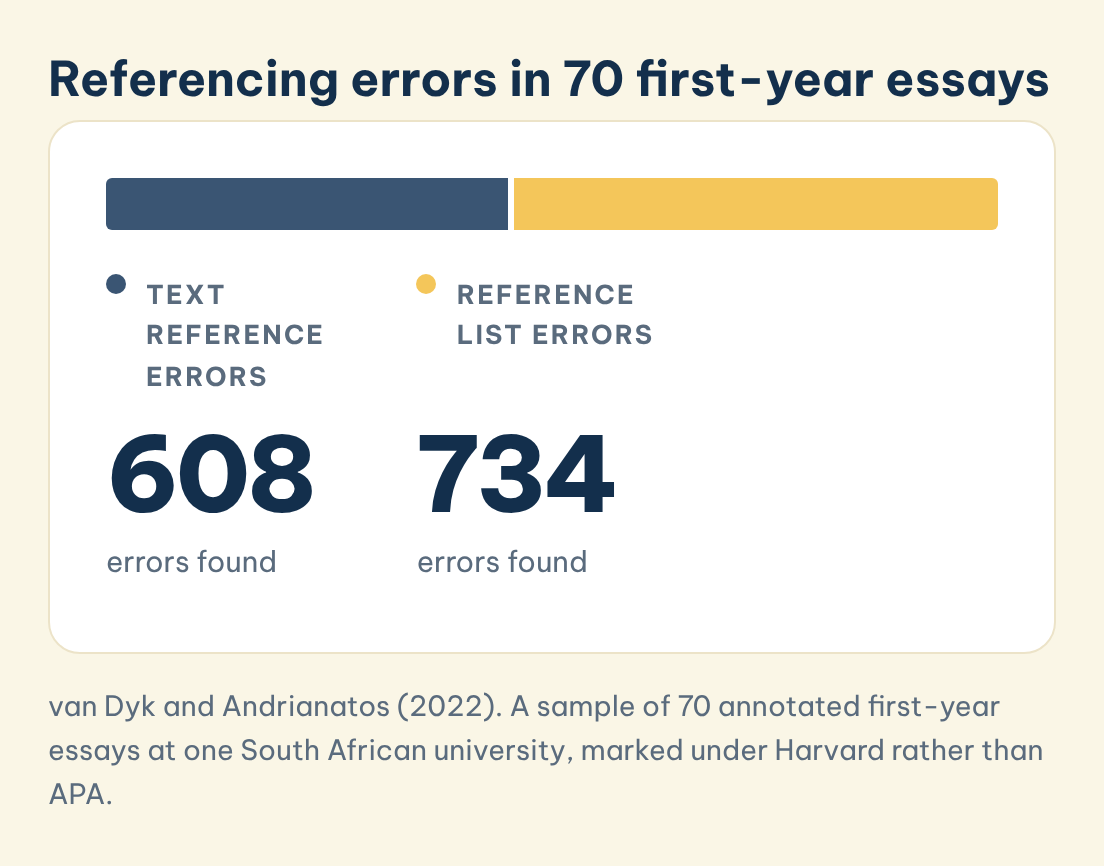
Evidence that this is worth getting right comes from one South African study. van Dyk and Andrianatos (2022) found that "there was not a single essay of which the text references and the reference list were error free" (p. 10), in a sample of 70 first-year essays marked under Harvard, not APA. The page is the PDF's own numbering, because the article carries no journal page range.
Referencing errors in 70 first-year essays
van Dyk and Andrianatos (2022), counts of errors found by type.
Text reference errors
608
errors found
Reference list errors
734
errors found
Save this figure
◆ Question 7 / 9 · Group authors
How do you cite a group author, and do you repeat a citation in a paragraph?
Direct answer: Name the group in full on first use, with an abbreviation if you will repeat it, then use the abbreviation afterwards. Repeat the full citation each time; "ibid." is not used. After the first narrative mention in a paragraph, American Psychological Association (n.d.-b) says the year need not be repeated.
For a group author with a well-known abbreviation, the first parenthetical citation shows the name and abbreviation together, as in (National Institute of Mental Health [NIMH], 2020), and later ones use (NIMH, 2020). In narrative form the first is National Institute of Mental Health (NIMH, 2020) and the next is NIMH (2020). American Psychological Association (n.d.-b) adds that you define the abbreviation once, in either format, and use the abbreviation after that. A group with no abbreviation, such as Stanford University (2020), is written out each time.
Repetition is where students either over-cite or under-cite. American Psychological Association (n.d.-b) states that when repeating a citation you show the whole citation and do not include only a page number. Every parenthetical citation carries the author and year. For narrative citations, the year is left out from the second mention onwards within one paragraph, but it returns in the first narrative citation of the next paragraph. If you cite several works by the same author, the date goes in every citation to prevent confusion.
◆ Question 8 / 9 · Secondary sources
How do you cite a secondary source?
Direct answer: Name the original author, then "as cited in" the source you actually read, and list only the source you read in the reference list. Use this sparingly, for example when the original is unavailable. Monash University Library (n.d.) gives the pattern and warns to include only what you have read.
A secondary citation looks like (Farrow, 1968, as cited in Ward & Decan, 1988), where Ward and Decan is the work in your hands and Farrow is the original they discussed. Monash University Library (n.d.) says to do this only when the original is unavailable, and only to include what you have actually read. That second condition matters for honesty: if you cite Farrow without reading Farrow, a marker who checks will see a source you could not have used.
The safer habit is to find the original. If it is out of print or in a language you cannot read, the secondary route is acceptable, but keep it rare. The wider rules on when a sentence needs a citation at all are in our guide to referencing in university assignments, and if your department uses a different style, the comparison in APA 7th vs Harvard referencing shows how the in-text forms differ.
◆ Question 9 / 9 · MAAS help
How can MAAS help with in-text citations?
Direct answer: MAAS works as a tutor and advisor. You and a MAAS expert go through your draft in the Outline, Draft and Final stages, with the expert explaining where a citation form needs changing and why, while the writing and the submission remain yours throughout.
If your citations keep coming back marked, essay and assignment support from MAAS follows an Outline, Draft, Final sequence with the guidance of a MAAS expert, who reads your draft and points out the pattern behind the errors. The most useful thing to bring is the marker's feedback and your unit handbook, since local rules such as pages on every citation vary. The first conversation is free.
Frequently asked questions
How do I do APA 7 in-text citations?
Give the author and year, in brackets after the idea or in your sentence with the year in brackets, and add a page number for any direct quotation. American Psychological Association (n.d.-a) describes both formats as correct.
Is an APA in-text citation p. or pp.?
Both. University of Queensland Library (n.d.) uses "p." for one page and "pp." for several, for example (Harris, 2012, p. 164) and (Lewis, 2016, pp. 56-58).
Do I need a page number when I paraphrase?
Not by APA's rule. University of Queensland Library (n.d.) says it is not required, though it can be useful to include. Ask your lecturer, because some units require it.
Do I use "and" or "&" in a narrative citation?
Use "and". American Psychological Association (n.d.-b) says to spell out "and" in narrative citations and to use the ampersand inside brackets.
When do I use "et al."?
For three or more authors, from the first citation onwards. American Psychological Association (n.d.-b) says to give only the first author's name plus "et al." every time.
Can I cite a source I have not read?
Only through a secondary citation, written "as cited in" the source you read. Monash University Library (n.d.) says to do this only when the original is unavailable.
References
American Psychological Association. (n.d.-a). Parenthetical versus narrative citations. APA Style. https://apastyle.apa.org/style-grammar-guidelines/citations/basic-principles/parenthetical-versus-narrative
American Psychological Association. (n.d.-b). Author-date citation system. APA Style. https://apastyle.apa.org/style-grammar-guidelines/citations/basic-principles/author-date
American Psychological Association. (n.d.-c). Citing multiple works. APA Style. https://apastyle.apa.org/style-grammar-guidelines/citations/basic-principles/multiple-works
American Psychological Association. (n.d.-d). Quotations. APA Style. https://apastyle.apa.org/style-grammar-guidelines/citations/quotations
American Psychological Association. (n.d.-e). Quotations from sources without page numbers. APA Style. https://apastyle.apa.org/style-grammar-guidelines/citations/quotations/no-page-numbers
Monash University Library. (n.d.). In-text citation. APA 7th referencing guide. https://guides.lib.monash.edu/apa-7/getting-started/in-text-citation
University of Queensland Library. (n.d.). Direct quotes. APA 7th referencing guide. https://guides.library.uq.edu.au/referencing/apa7/direct-quotes
van Dyk, T., & Andrianatos, K. (2022). They just don't get it! Towards informing course and syllabus design – an error analysis of referencing in undergraduate writing. Journal for Language Teaching, 56(1). https://doi.org/10.56285/jltvol56iss1a5385
Tools & resources
- APA Style: in-text citations (American Psychological Association)
- Monash University Library: APA 7th in-text citation
Not sure how this guide applies to your own case? Talk it through with MAAS in a free consultation.
Book a free consultation ▸