
◆ Citation & Formatting
How do you cite a secondary source in APA 7 (as cited in)?
To cite a secondary source in APA 7th edition, name the original author in the text, write "as cited in", then give the source you actually read. American Psychological Association (2022) says the reference list holds only the source you read. Use this sparingly, and find the original work when you can.
◆ Question 1 / 9 · What is a secondary citation
What is a secondary citation source?
Direct answer: A secondary source is a work that refers to content first reported somewhere else. American Psychological Association (2022) defines it this way: a primary source reports original content, and a secondary source refers to content first reported in another source.
University of Queensland Library (n.d.) puts the same idea in terms of your own reading. It describes an indirect citation as one where the ideas of one author are published in another author's text but you have not read or accessed the original author's work. So the test is not what kind of book you hold. The test is whether the idea you want to use came to you through someone else's pages.
University of Lincoln Library (n.d.) describes the split in similar words: a primary source contains original research, and a secondary source provides information about or refers to a primary source. If your textbook says "Smith found that students retain more when they test themselves", Smith is the primary source and your textbook is the secondary source. Cite Smith only if you have read Smith. If you have not, you are in "as cited in" territory.
◆ Question 2 / 9 · How do I reference
How do I reference a secondary source?
Direct answer: Do two things. In the text, identify the original author and add "as cited in" followed by the secondary source you used. In the reference list, give an entry for the secondary source only. American Psychological Association (2022) states both rules on its official page.
Here are the two steps in the words of the APA page. In the reference list, provide an entry for the secondary source that you used. In the text, identify the primary source and write "as cited in" the secondary source that you used. University of Lincoln Library (n.d.) adds a warning that is easy to forget: do not provide a reference list entry for the original author, because you have not read that work.
The parts of an APA 7 secondary citation
Tap a part to see its rule, using (Harris, 2009, as cited in Lewis, 2019) as the example.
Original author
Harris. The author whose idea you want to use but have not read.
Original year
2009. Include it if known, and leave it out if the year of the primary source is unknown.
As cited in
The linking words that tell the reader you found the idea in another work.
Source you read
Lewis, 2019. This is the only entry that goes in the reference list.
Save this figure
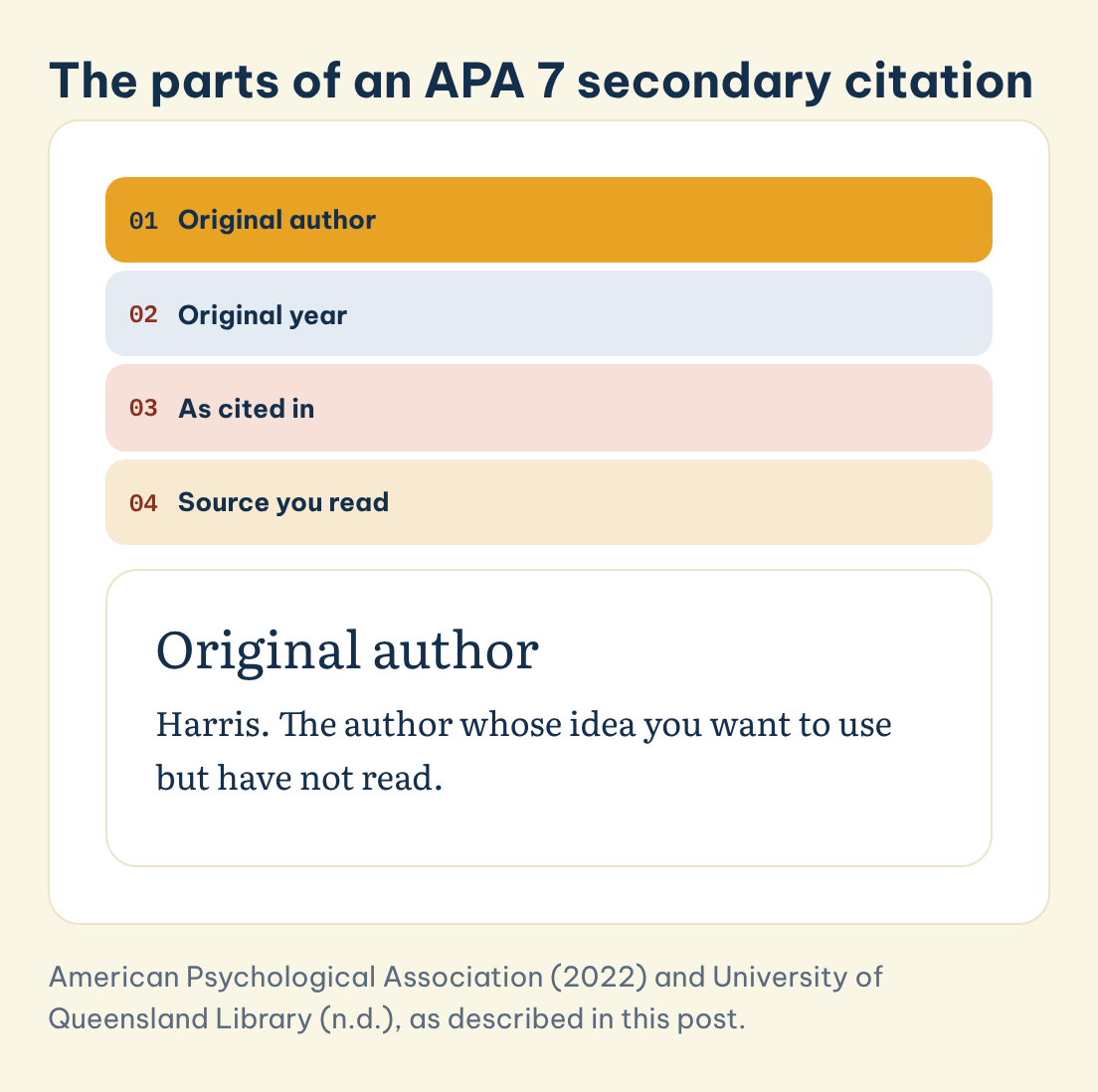
The pattern in the text has a fixed order. University of Queensland Library (n.d.) gives it as (Harris, 2009, as cited in Lewis, 2019). Harris is the idea's original author and Lewis is the work in your hands. APA's own example looks the same: (Rabbitt, 1982, as cited in Lyon et al., 2014). The comma after the original year is part of the APA form. University of Notre Dame Australia Library (n.d.) prints a version without that comma, and APA's example is the one to follow.
Two points are easy to miss. First, the year belongs to the original author. American Psychological Association (2022) says that if the year of the primary source is known, you include it, and if it is unknown, you leave it out. Second, you can still write the citation in narrative form. University of Queensland Library (n.d.) shows Miller (1953, as cited in Agrios, 2005) found that, with the same "as cited in" wording inside the brackets.
◆ Question 3 / 9 · What does a secondary
What does a secondary citation look like at a glance?
Direct answer: The table below sets out the forms used in the library guides we checked, from a basic parenthetical citation to a quotation with a page number. All of them keep the original author first and the source you read second.
| Situation | In-text form | Reference list entry |
|---|---|---|
| Parenthetical, original year known | (Harris, 2009, as cited in Lewis, 2019) | Lewis (2019) only |
| Narrative, original year known | Miller (1953, as cited in Agrios, 2005) found that | Agrios (2005) only |
| Original work is a diary, no year | Allport's diary (as cited in Nicholson, 2003) | Nicholson (2003) only |
| Quotation with a page number | (Khan & Poppins, 1998, as cited in Sizemore, 2011, p. 143) | Sizemore (2011) only |
The first, second and fourth rows come from University of Queensland Library (n.d.) and University of Huddersfield (2024). The third row is the form American Psychological Association (2022) shows for a source with no year. In every row the reference list gets the name on the right-hand side of "as cited in", never the name on the left.
◆ Question 4 / 9 · When is it acceptable
When is it acceptable to cite a secondary source?
Direct answer: Only rarely. American Psychological Association (2022) asks you to cite secondary sources sparingly, with examples such as an original that is out of print, cannot be obtained, or is written in a language you cannot read. Where possible, find the original and cite it directly.
The same APA page calls reading the original "good scholarly practice". University of Lincoln Library (n.d.) says it is best academic practice to find and read the primary source and then cite it directly in your work. The University of Huddersfield guide quotes the Publication Manual on this point, which makes it a secondary citation in its own right: "Use secondary sources sparingly, for instance, when the original work is out of print, unavailable through usual sources, or available only in a language that you do not understand" (American Psychological Association, 2020, p. 258, as cited in University of Huddersfield, 2024, p. 10).
Some universities are stricter than APA. University of Notre Dame Australia Library (n.d.) says secondary referencing is discouraged in scholarly writing, and if you want to use it, to contact your lecturer or tutor first. If they do not allow it, you need to find a different source for your discussion. So check your unit guide before relying on "as cited in" in a graded piece of work.
There is also a reason that goes beyond rules. Martella et al. (2021) list citing a secondary source instead of the primary source as one of the types of errors that can affect citation accuracy. They explain that accepting and copying another author's interpretation of a cited article, rather than going back to the original, can cause the spread of incorrect information. Agarwal et al. (2023) make a similar point: repeated paraphrasing in secondary sources can eventually distort the original information. Your marker may not mention this, but it is the real reason the original is better.
◆ Question 5 / 9 · How do you cite a secondary
How do you cite a secondary source in the reference list?
Direct answer: Write a normal reference entry for the source you read, and leave the original author out entirely. University of Lincoln Library (n.d.) says to provide an entry only for the secondary source that you used. The "as cited in" wording lives in the text, not in the list.
University of Queensland Library (n.d.) says to provide the details of the work in which you found the quotation or idea. In its Miller (1953, as cited in Agrios, 2005) example, the reference entry is for Agrios: Agrios, G. N. (2005). Plant pathology (5th ed.). Elsevier Academic Press. Miller never appears in the list.
Curtin University Library (n.d.) shows the same split with a real article. Its in-text example is "We are part of the land, it is part of us" (Philippe, 2008, as cited in Maldonado et al., 2013, p. 610), and its reference list holds only Maldonado, J. K., Shearer, C., Bronen, R., Peterson, K., & Lazrus, H. (2013). The impact of climate change on tribal communities in the US: Displacement, relocation, and human rights. Climatic Change, 120(3), 601-614. https://doi.org/10.1007/s10584-013-0746-z.
If you want help with the entry itself for a book, see how to cite a book in APA 7th edition. When the secondary source gives you the original author's exact words, the page-number and block-quote rules in our guide to quoting in APA 7 apply as well.
◆ Question 6 / 9 · How do you add a page number
How do you add a page number to a secondary citation?
Direct answer: Put the page number of the source you read, not the original, after the secondary source's year. Curtin University Library (n.d.) and the University of Huddersfield (2024, p. 10) both show it at the end of the brackets, such as "as cited in Sizemore, 2011, p. 143".
Curtin University Library (n.d.) describes the whole citation as the author and year from the original source, followed by "as cited in" and the author, year and page number of the source you actually read. The page is the one in your hands, because that is the only page you can vouch for. Its narrative example puts the page after the quotation: Philippe (2008, as cited in Maldonado et al., 2013) states "we are part of the land, it is part of us" (p. 610).
Page tracking is also where honest note-taking pays off. If you copy a quotation from a textbook and forget to note its page, you cannot cite it properly later, and you may find that you cannot say who wrote it.
◆ Question 7 / 9 · What about two sources
What about two sources or several authors?
Direct answer: The guides we checked do not give a separate rule for several original authors, so follow the general APA pattern and confirm it with your own guide. Their one multi-author example lists both names of a two-author original: (Khan & Poppins, 1998, as cited in Sizemore, 2011, p. 143).
The two-author example comes from University of Huddersfield (2024, p. 10). We could not find a stated rule for three or more original authors in the guides we read, so we will not invent one. If your original has three or more authors, check the Publication Manual or ask your tutor which form to use.
Citing two different secondary sources for the same idea is a separate matter, and the guides we checked do not set a rule for it. What they do agree on is that every work you actually read gets its own reference list entry. If both sources quote the same original, the safest fix is usually to go and read that original yourself.
◆ Question 8 / 9 · What are examples
What are examples of secondary sources?
Direct answer: Anything that reports or discusses someone else's original content can be a secondary source in your argument. A textbook that summarises a study, a review article, or a book that quotes a researcher are typical cases, because you meet the original idea through another author.
University of Lincoln Library (n.d.) uses a book on research with children to show the idea, with the original author appearing only in its in-text example. Curtin University Library (n.d.) says to credit the original author when a source you read quotes it and you use the quote, or when a study is discussed in the secondary source and you use its findings without accessing the primary source. In both cases, the work you actually read is the one that goes in your list.
◆ Question 9 / 9 · How can MAAS help
How can MAAS help with secondary citations?
Direct answer: MAAS works as a tutor and advisor. A MAAS expert reviews your draft with you, shows where an "as cited in" is needed or where you can replace it by reading the original, and explains each fix, while you write and submit your own work.
If secondary citations keep getting your drafts marked down, essay and assignment support from MAAS follows an Outline, Draft, Final sequence. With the guidance of a MAAS expert, you bring your own reading and draft, and the mentor gives feedback at each stage so you understand the pattern. A useful thing to bring is the marker's comments and your unit handbook. The first conversation is free. For the wider rules on in-text forms, see our guide to APA 7 in-text citations.
Frequently asked questions
Do I put the original author in the reference list?
No. American Psychological Association (2022) says to provide an entry for the secondary source that you used. University of Lincoln Library (n.d.) says not to list the primary source because you have not read it.
When is "as cited in" allowed?
American Psychological Association (2022) says to cite secondary sources sparingly, such as when the original is out of print, unavailable, or in a language you do not understand.
Do I include the original year?
If you know it, yes. American Psychological Association (2022) says to leave it out if the year of the primary source is unknown.
Where does the page number go?
After the year of the secondary source, as in "as cited in Sizemore, 2011, p. 143" (University of Huddersfield, 2024, p. 10).
Is there a comma before "as cited in"?
In APA's own example there is: (Rabbitt, 1982, as cited in Lyon et al., 2014). Follow APA's form when your guide does not say otherwise.
Why do tutors tell students to find the original?
Martella et al. (2021) and Agarwal et al. (2023) both describe how copying from secondary sources can spread errors from one paper to the next.
Can my university ban secondary citations?
Yes. University of Notre Dame Australia Library (n.d.) discourages them and tells students to ask their lecturer or tutor first.
References
Agarwal, A., Arafa, M., Avidor-Reiss, T., Hamoda, T. A.-A. A.-M., & Shah, R. (2023). Citation errors in scientific research and publications: Causes, consequences, and remedies. The World Journal of Men's Health, 41(3), 461. https://doi.org/10.5534/wjmh.230001
American Psychological Association. (2022). Secondary sources. APA Style. https://apastyle.apa.org/style-grammar-guidelines/citations/secondary-sources
Curtin University Library. (n.d.). APA 7th referencing [PDF]. https://uniskills.library.curtin.edu.au/assets/docs/APA-7th-referencing-printable-guide-UniSkills.pdf
University of Lincoln Library. (n.d.). Secondary referencing. In APA 7th edition. https://guides.library.lincoln.ac.uk/APA7th/secondary-referencing
Martella, A. M., Yatcilla, J. K., Martella, R. C., Marchand-Martella, N. E., Ozen, Z., Karatas, T., Park, H. H., Simpson, A., & Karpicke, J. D. (2021). Quotation accuracy matters: An examination of how an influential meta-analysis on active learning has been cited. Review of Educational Research, 91(2), 272-308. https://doi.org/10.3102/0034654321991228
University of Queensland Library. (n.d.). Secondary source (indirect citation). In APA 7th referencing style. https://guides.library.uq.edu.au/referencing/apa7/indirect-cite
University of Notre Dame Australia Library. (n.d.). Other sources. In APA referencing 7th edition. https://library.nd.edu.au/instruction/referencing/apa7/other
University of Huddersfield. (2024). APA 7th referencing guide [PDF]. https://library.hud.ac.uk/webpages/files/referencing/APA_7th_Ref_Guide_Full.pdf
This guide is general information about APA 7th edition secondary citations. Always check your own department's referencing guide and assignment brief for the rules that apply to your work.
Not sure how this guide applies to your own case? Talk it through with MAAS in a free 20-minute consultation.
Book a free consultation ▸