
◆ Citation & Formatting
How do you quote a source in APA 7: short quotes and block quotes?
A quotation under 40 words stays inside your sentence between double quotation marks. A quotation of 40 words or more becomes an indented block with no quotation marks. Both need the author, year and a page or other location. American Psychological Association (2022c) sets out these rules on its Quotations page.
◆ Question 1 / 8 · Short quotes
How do you format a short direct quote in APA 7?
Direct answer: Put quotation marks around the exact words, keep the quote inside your own sentence, and add the author, year and page number in the same sentence. American Psychological Association (2022c) calls anything under 40 words a short quotation, and it needs no other formatting.
The rule has three working parts. First, the words inside the marks must match the source exactly. Second, the citation sits in the same sentence as the quotation, because American Psychological Association (2022c) says a direct quotation always needs a full citation, parenthetical or narrative, with a page number or other location. Third, you do not add an ellipsis at the start or end of the quotation unless the original source had one there.
American Psychological Association (2022c) gives this example: Effective teams can be difficult to describe because "high performance along one domain does not translate to high performance along another" (Ervin et al., 2018, p. 470). The same pattern works in narrative form. University of Queensland Library (n.d.) offers, "As Crane (2017) said, 'Mindfulness has become a trend word conveying a diversity of understandings dependent on context' (p. 586)", with double quotation marks around the quote itself. The names in these examples are teaching examples from the guides, so do not copy them into your own reference list.
◆ Question 2 / 8 · Block quotes
How do you format a block quotation in APA 7?
Direct answer: Start a new line, indent the whole block 0.5 inches from the left margin, double-space it and leave out the quotation marks. American Psychological Association (2022c) applies this to quotations of 40 words or more, and the citation goes after the final punctuation.
Short quotation and block quotation in APA 7
Each row sets the short form (under 40 words) beside the block form (40 words or more).
Short quotation, under 40 words
Block quotation, 40 words or more
Double quotation marks
No quotation marks
Inside your sentence
New line, indented 0.5 in. from the left margin
Same spacing as your text
Double-spaced, no extra space before or after
Citation in the same sentence
Citation after the final punctuation
Full stop after the closing bracket
No full stop after the closing bracket
Save this figure
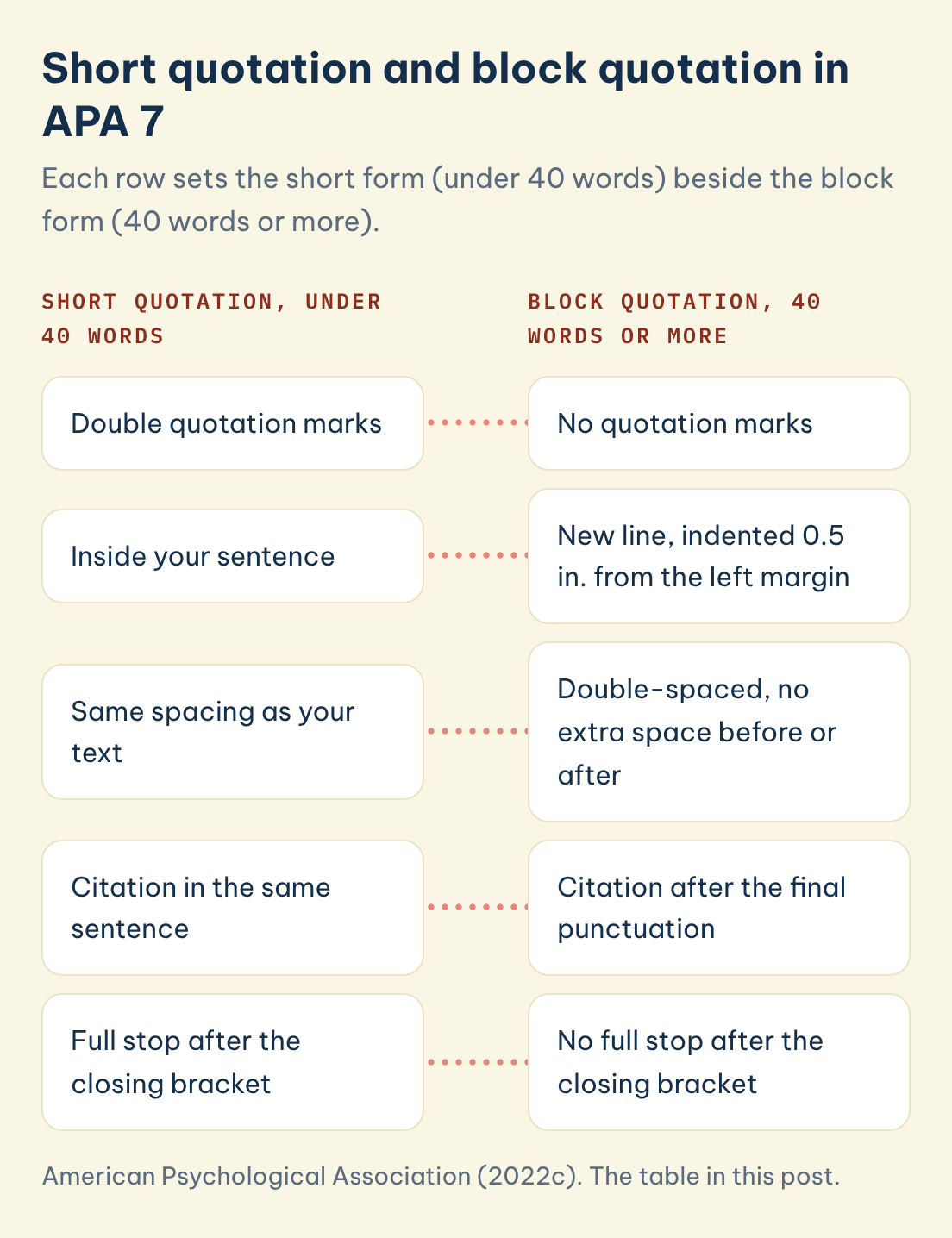
The block has its own layout rules, which the table sets out using the Quotations page of American Psychological Association (2022c).
| Feature | Short quotation (under 40 words) | Block quotation (40 words or more) |
|---|---|---|
| Quotation marks | Yes, double | No |
| Position | Inside your sentence | New line, indented 0.5 in. from the left margin |
| Spacing | Same as your text | Double-spaced, no extra space before or after |
| Further paragraphs | Not applicable | Indent the first line of each later paragraph a further 0.5 in. |
| Citation | In the same sentence | After the final punctuation of the block |
| Full stop after the bracket | Yes, ends the sentence | No |
You have two ways to cite a block. Either place the full citation in parentheses after the final punctuation, or name the author and year in your lead-in sentence and put only the page number in parentheses after the block. American Psychological Association (2022c) adds that you do not add a period after the closing parenthesis in either case. A narrative lead-in might read "Okafor (2020) described the pattern in these terms:", followed by the indented block and then (p. 14). Okafor is a made-up name for teaching purposes.
Check one local detail before you format a long assignment. American Psychological Association (2022c) says instructors, programs, editors and publishers may set limits on direct quotations. The University of Melbourne Library (n.d.) heading says "more than 40 words" and describes the indent as about half an inch, or 1.27 cm, whereas APA says 40 words or more. A source of exactly 40 words is the only case where the two readings differ, so read your own unit guide.
◆ Question 3 / 8 · Punctuation
Where do the punctuation marks go around a quotation?
Direct answer: Place commas and periods inside the closing quotation marks. Place other marks inside only when they belong to the quoted material. When the citation ends the sentence, the full stop follows the closing bracket, as American Psychological Association (2022c) specifies for short quotations.
Students often put the full stop twice, once inside the quotation and once after the citation. The pattern to copy is the Ervin example above: the quote ends without a period, the citation follows in brackets, and a single period closes the sentence. University of Melbourne Library (n.d.) states the same thing for its short example, ending "(Palladino & Wade, 2010, p. 147)." and telling readers to place a full stop after the bracket.
The block quotation reverses the habit. Because a block ends with its own final punctuation, the citation comes after that punctuation and nothing follows the bracket. The opening is different too. American Psychological Association (2022c) tells you not to start or finish a quotation with an ellipsis unless the original did, so a quotation that begins mid-sentence needs no dots to signal that.
A smaller point concerns the first letter. American Psychological Association (2022a) allows you to change the first letter of the first word to upper or lower case so that the quote fits your sentence, and you need not mark the change.
◆ Question 4 / 8 · Changing quotes
How do you change a quotation with an ellipsis, brackets, [sic] or emphasis?
Direct answer: Some small changes need no explanation, but omissions, insertions and emphasis must be marked. American Psychological Association (2022a) says to use an ellipsis for omitted words, square brackets for additions, italics followed by [emphasis added] for emphasis, and [sic] for errors in the original.
American Psychological Association (2022a) lists the changes you can make silently: the first letter of the first word, single quotation marks swapped for double or the reverse, and footnote or endnote numbers. Everything else must be shown. The table sets out the marker for each case.
| What you change | What to do | Source |
|---|---|---|
| Omit words inside a quotation | Insert an ellipsis, three spaced periods or the ellipsis character | American Psychological Association (2022a) |
| Omit material across a sentence break | Use four periods, a period plus an ellipsis | American Psychological Association (2022a) |
| Add or explain a word | Put it in square brackets, never parentheses | American Psychological Association (2022a) |
| Emphasise words | Italicise them, then add [emphasis added] immediately after | American Psychological Association (2022a) |
| The original has an error | Insert italic [sic] in brackets right after the error | American Psychological Association (2022d) |
The error rule has a firm edge. American Psychological Association (2022d) states that the quotation must match the wording, spelling and interior punctuation of the original even if the source is incorrect, and it suggests paraphrasing instead when an error would distract. Its example is Nowak (2019), who wrote that "people have an obligation to care for there [sic] pets" (p. 52). Do not silently fix the spelling, because that misrepresents what the author wrote.
The manual also covers quotations that sit inside other quotations. The Quotations page only points to the Publication Manual for that case, so check the manual or your library guide rather than relying on a rule you half remember.
◆ Question 5 / 8 · No page number
What if the source has no page number?
Direct answer: Give another way to find the passage: a heading, a paragraph number, or both. For audio and video, give a time stamp. American Psychological Association (n.d.) lists these options, and your quotation still needs a full citation with some location in the same sentence.
The examples in American Psychological Association (n.d.) show each pattern: (Gecht-Silver & Duncombe, 2015, Osteoarthritis section) for a heading, (Chamberlin, 2014, para. 1) for a numbered paragraph, and (DeAngelis, 2018, Musical Forays section, para. 4) for both. If the paragraphs are not numbered, count them manually. For a talk or video, give the time at which the quotation begins, such as (Cuddy, 2012, 2:12). In an e-book, American Psychological Association (n.d.) says not to include Kindle location numbers.
Older works and religious or dramatic texts follow other conventions. American Psychological Association (n.d.) recommends book, chapter and verse for canonical works, and act, scene and line for plays, written like 1.3.36 to 37. University of Queensland Library (n.d.) reaches the same conclusion for ordinary web material: give the paragraph number or a time stamp. For paraphrases the demand is lighter, because American Psychological Association (2022b) says a page or paragraph number is not required but may help interested readers.
◆ Question 6 / 8 · Famous quotes
How do you cite a famous quote in APA?
Direct answer: Treat it as any direct quotation: quote the exact wording and cite the work where you read it, with the author, year and location. American Psychological Association (2022c) says quotations are suitable when an author has said something memorably or succinctly.
The APA pages used for this guide do not have a separate section for famous lines, so this is a reading of the general rule rather than a special one. The principle in American Psychological Association (2022c) is that a direct quotation always needs a full citation with a location. If you found a well-known line in a book, article or website, the citation points to that text, and the reference list entry describes the same text. If you cannot find where the wording first appeared, a safer route is to paraphrase the idea and cite what you actually read, because a quotation you cannot trace is hard for a marker to check.
The same checking habit applies to paraphrases. American Psychological Association (2022b) notes that published authors paraphrase their sources most of the time, and it asks student authors to do the same. A famous line is the most tempting thing to drop in as decoration. Use it when the exact words carry the point, for example when you respond to the wording itself, and otherwise give the idea in your own sentence with a citation.
◆ Question 7 / 8 · Quote or paraphrase
When should you quote and when should you paraphrase?
Direct answer: Paraphrase by default and quote only when the exact wording matters. American Psychological Association (2022c) lists three reasons to quote: an exact definition, a memorable or succinct statement, or exact wording you want to respond to. Quotation marks do not replace your own writing.
The cost of too much quoting is more than style. In a study of 44 first-year Portuguese university students writing summaries, Festas et al. (2022) reported that "Copying with quotation marks and patchwriting were the most widely used, while the summary technique was utilized to a much lesser extent (Table 2)" (p. 7). The study was a small sample on one degree course, so treat it as an illustration rather than a measure of all students. A passage that is correctly marked as a quotation is not plagiarism, but strings of quotations leave little of your own analysis for the marker to assess.
A practical test: could you put the idea into your own words without losing meaning? If so, paraphrase and cite. If the author's phrasing is the evidence, quote it, keep it short, and let your own sentences do the explaining before and after. A block quotation is the hardest to justify in a short essay, since 40 words of someone else's text takes up a large share of a 1,000 word piece.
◆ Question 8 / 8 · MAAS help
How can MAAS help with quotations and citations?
Direct answer: MAAS works as a tutor and advisor. You and a MAAS expert go through your draft in the Outline, Draft and Final stages, and the expert explains where a quotation or citation needs changing and why, while the writing and the submission remain yours.
If your quotations keep coming back marked, essay and assignment support from MAAS follows an Outline, Draft, Final sequence with the guidance of a MAAS expert. The most useful things to bring are the marker's feedback and your unit handbook, since local rules on quotation length and page numbers vary. The wider in-text rules are in our guide to APA 7 in-text citations, and the APA 7th referencing guide covers the reference list that every quotation must point to.
Frequently asked questions
How many words is a block quote in APA 7?
Forty words or more. American Psychological Association (2022c) says quotations of fewer than 40 words stay in the text with quotation marks, and longer ones become indented blocks without marks.
Do I need a page number for every direct quote?
Yes, or another location. American Psychological Association (2022c) says a direct quotation always needs a full citation with a page number or other location information such as a paragraph number.
Do I use quotation marks on a block quote?
No. American Psychological Association (2022c) says not to enclose a block quotation in quotation marks. Indent it 0.5 inches and double-space it.
What does [sic] mean in a quotation?
It tells the reader that an error is in the original. American Psychological Association (2022d) says to put italic [sic] in brackets directly after the error rather than correcting it.
How do I show that I added emphasis?
Italicise the words, then put [emphasis added] in square brackets straight after them, according to American Psychological Association (2022a).
How do I quote a website with no page numbers?
Use a heading, a paragraph number, or both, such as (Chamberlin, 2014, para. 1). American Psychological Association (n.d.) also gives time stamps for audio and video.
Is it better to quote or paraphrase?
Paraphrase in most cases. American Psychological Association (2022b) asks student authors to paraphrase more than they quote.
References
American Psychological Association. (n.d.). Direct quotation of material without page numbers. APA Style. https://apastyle.apa.org/style-grammar-guidelines/citations/quotations/no-page-numbers
American Psychological Association. (2022a, August). Changes to quotations. APA Style. https://apastyle.apa.org/style-grammar-guidelines/citations/quotations/changes
American Psychological Association. (2022b, July). Paraphrases. APA Style. https://apastyle.apa.org/style-grammar-guidelines/citations/paraphrasing
American Psychological Association. (2022c, July). Quotations. APA Style. https://apastyle.apa.org/style-grammar-guidelines/citations/quotations
American Psychological Association. (2022d, August). Quotations that contain errors. APA Style. https://apastyle.apa.org/style-grammar-guidelines/citations/quotations/errors
Festas, I., Seixas, A., & Matos, A. (2022). Plagiarism as an academic literacy issue: The comprehension, writing and consulting strategies of Portuguese university students. International Journal for Educational Integrity, 18, Article 25. https://doi.org/10.1007/s40979-022-00119-8
University of Melbourne Library. (n.d.). APA 7. https://library.unimelb.edu.au/recite/referencing-styles/apa7
University of Queensland Library. (n.d.). Direct quotations. In APA 7th referencing style. https://guides.library.uq.edu.au/referencing/apa7/direct-quotes
Tools & resources
- APA Style: quotations (American Psychological Association)
Not sure how this guide applies to your own case? Talk it through with MAAS in a free 20-minute consultation.
Book a free consultation ▸