
◆ Citation & Formatting
How do you cite a book in APA 7th edition?
To cite a book in APA 7th edition, write the author, the year in brackets, the title in italics with sentence case, the edition in brackets if it is not the first, and the publisher. University of Warwick Library (n.d.) says the publisher location is no longer required, and that print books and ebooks share the same format. If the book has a DOI, add it after the publisher name.
◆ Question 1 / 8 · How do you cite a book
How do you cite a book in APA 7th edition?
Direct answer: A book reference has four parts in this order: author, year, title with any edition, and publisher. University of Portsmouth Library (n.d.) gives the pattern as Author, Initials. (Year). Title of book (Edition if not first). Publisher. A DOI or URL follows the publisher only when the book has one.
Each part has one rule that students often get wrong. University of Warwick Library (n.d., p. 1) states, "The publisher location is no longer required in the 7th edition." If your notes or an older reference list still carry a city before the publisher, delete it. The same page says, "Only include the edition if it is not the first edition. Add the edition information after the title." So a first edition has no bracket at all, and a third edition gets (3rd ed.) straight after the title.
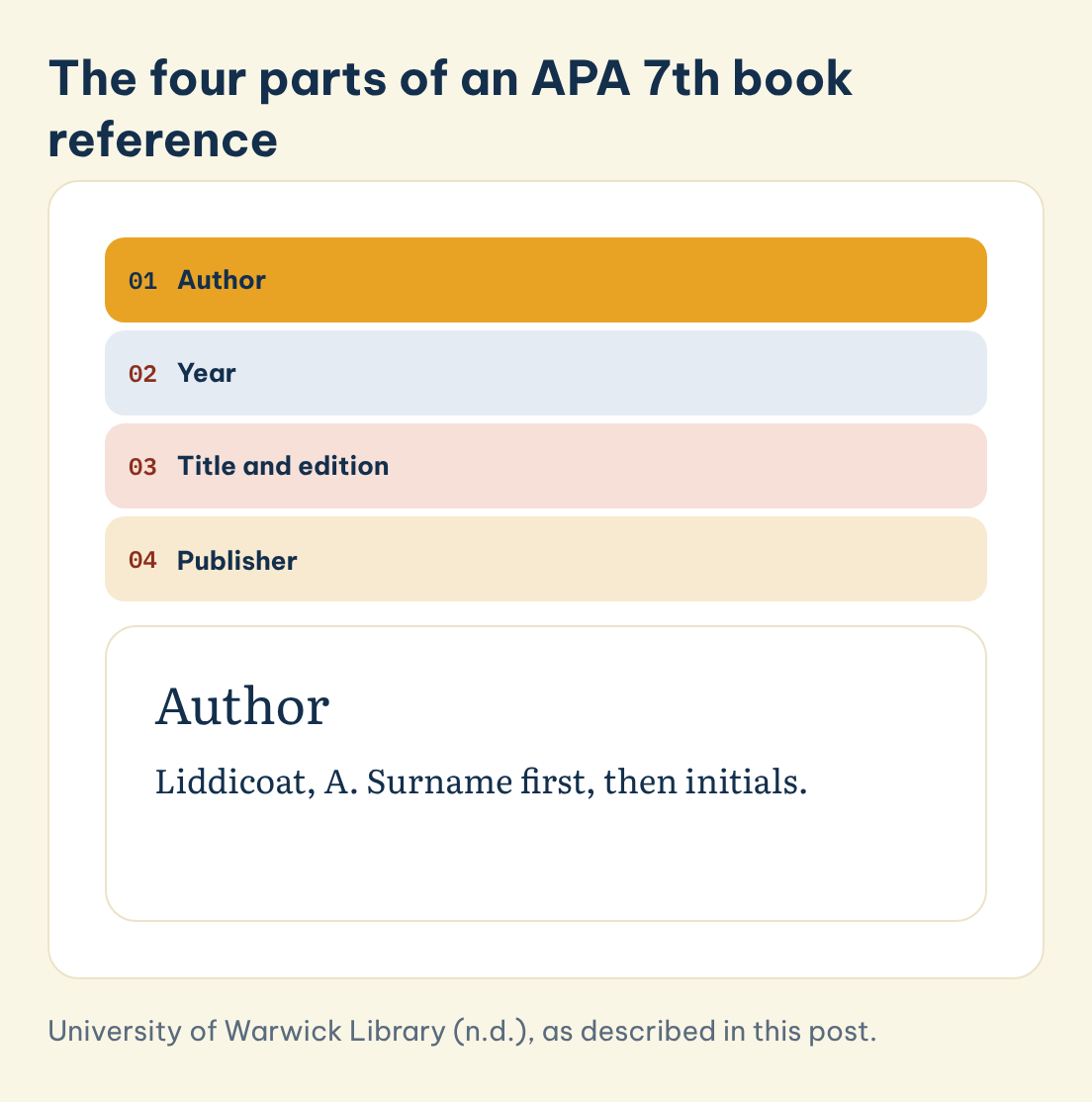
The four parts of an APA 7th book reference
Tap a part to see the rule for it, using Liddicoat (2022) as the example.
Author
Liddicoat, A. Surname first, then initials.
Year
(2022). The year of the edition you read, in brackets.
Title and edition
An introduction to conversation analysis (3rd ed.). Italic title in sentence case, edition only if it is not the first.
Publisher
Bloomsbury. No publisher location in the 7th edition, and a DOI after the publisher if the book has one.
Save this figure
Warwick's own example is Liddicoat, A. (2022). An introduction to conversation analysis (3rd ed.). Bloomsbury. Notice that only the first word of the title and the first word after a colon (if there is one) take a capital letter, and that the title is italic while the edition bracket is not. Warwick also keeps one format for both print and e-books. For the year, take the publication year of the edition you are using from the copyright page, since the University of Huddersfield guide tells students plainly to "Ignore the reprint dates" (University of Huddersfield, 2024, p. 21). You do not need to write "[E-book]" or name a reading app in the reference.
The DOI rule sits on the next page of the Warwick guide. University of Warwick Library (n.d., p. 2) says, "If the book includes a DOI, include the DOI in the reference after the publisher name." University of Portsmouth Library (n.d.) adds that a print book needs no URL. If you want the wider picture of how APA works across every source type, our APA 7th referencing guide covers it. This post stays with books.
American Psychological Association (2020) is the authority behind all of these library guides, because the Publication Manual sets the rules and the libraries explain them. When two guides seem to disagree, go back to the manual or to the guide your department tells you to follow.
◆ Question 2 / 8 · What does a book citation
What does a book citation look like at a glance?
Direct answer: The pattern changes only a little between book types, and the table below puts them side by side. Each row shows the reference pattern and the matching in-text form, using the example sources named by the Warwick and Portsmouth library guides.
| Book type | Reference pattern | In-text example |
|---|---|---|
| Standard book, later edition | Liddicoat, A. (2022). An introduction to conversation analysis (3rd ed.). Bloomsbury. | (Liddicoat, 2022, p. 78) |
| Book with a DOI | Author, A. (Year). Title. Publisher. https://doi.org/... | (Author, Year, p. 12) |
| Chapter in an edited book | Twigg, C. (2005). Overseas students in higher education. In C. Cullingford & S. Gunn (Eds.), Globalisation, education and culture shock (pp. 86-106). Ashgate. | Twigg (2005, p. 92) |
| Translated book | Jaroszyński, P. (2007). Science in culture (H. McDonald, Trans.). Brill. (Original work published 2002) | (Jaroszyński, 2002/2007) |
| Republished book | Stoker, B. (2014). Dracula. Open Road Integrated Media. (Original work published 1897) | (Stoker, 1897/2014) |
The first, third, fourth and fifth rows come from University of Warwick Library (n.d.) and University of Portsmouth Library (n.d.). The second row shows the DOI pattern with placeholder wording, so replace it with your own details. The sections below explain each row.
◆ Question 3 / 8 · How do you write the in-text
How do you write the in-text citation for a book with a page number?
Direct answer: Put the author surname and the year in brackets, then add a page number after a comma. University of Warwick Library (n.d.) shows (Liddicoat, 2022, p. 78) for a specific idea from page 78. Use the page number whenever you quote or point to a particular passage.
You can also write the citation narratively, with the author as the subject of the sentence. University of Warwick Library (n.d.) gives the example Twigg (2005, p. 92), where the year and page sit in brackets straight after the name. Narrative form is a good habit because it tells your reader who is speaking before they see the evidence.
The number of authors changes how the names appear. University of Portsmouth Library (n.d.) says that for three or more authors you give the first author followed by et al. in the text. For two authors, it says to use an ampersand inside brackets and the word "and" in running text.
One more point is easy to miss. A page number is not decoration. If you paraphrase a whole book, the year alone is enough. If you point to a single claim or a quotation, a page number lets your marker find it in seconds. A useful habit is to add the page whenever they remember where the idea came from, because it is far harder to find the page afterwards than to write it down at the time.
◆ Question 4 / 8 · How do you cite an edited
How do you cite an edited book or a chapter in an edited book?
Direct answer: If you use one chapter, reference the chapter, name the editors with (Eds.), and add the chapter page range after the book title. University of Warwick Library (n.d., p. 3) says, "Give the chapter details followed by the book details."
The same Warwick page adds, "Add the page numbers of the chapter after the book title." In the Twigg example, the chapter title comes first, then In, then the editors with their initials before their surnames, then the book title in italics and the pages in brackets: Twigg, C. (2005). Overseas students in higher education. In C. Cullingford & S. Gunn (Eds.), Globalisation, education and culture shock (pp. 86-106). Ashgate. The in-text citation is Twigg (2005, p. 92).
Do not confuse the author of the chapter with the editor of the book. The author in front of the year is the person who wrote the chapter. Editors appear only after In, and University of Portsmouth Library (n.d.) notes that their initials come before their surnames inside a chapter reference. Mixing those two up is the most common reason an edited-book reference looks wrong to a marker.
University of Portsmouth Library (n.d.) also says you would usually reference each chapter you use rather than the whole edited book. The exception is a book whose chapters have no separate authors, and then you cite the whole edited book. If you are not sure which case you have, look at the contents page and see whether each chapter carries a name.
◆ Question 5 / 8 · How do you cite a translated
How do you cite a translated or republished book?
Direct answer: Name the translator in brackets after the title, add the first publication year as a closing note, and pair the two years with a slash when you cite in the text. University of Portsmouth Library (n.d.) illustrates this with a 2007 English translation of a 2002 book, cited as (Jaroszyński, 2002/2007).
The year directly after the author is the year of the edition you read, here 2007. The original year goes at the end, in its own brackets. In the text, University of Portsmouth Library (n.d.) says to give both dates in numerical order with a slash between them, earliest first. That is why the example reads 2002/2007 and not 2007/2002.
Republished books follow the same logic. University of Portsmouth Library (n.d.) uses a 2014 edition of a novel first published in 1897, with the note (Original work published 1897) at the end of the reference. The in-text form is then (Stoker, 1897/2014). You are telling the reader that the idea is old, but that you read it in a recent printing.
A practical tip is to check the copyright page of your copy. It normally lists the year of this printing and the year of the first publication, and both are needed here. If you only record one date in your notes, you will have to find the book again later.
◆ Question 6 / 8 · How do you cite an ebook
How do you cite an ebook with no page numbers?
Direct answer: An ebook reference is built exactly like a print one, and the in-text citation simply drops the page number. University of Warwick Library (n.d., p. 1) treats print and digital copies alike, while University of Portsmouth Library (n.d.) confirms that a Kindle copy with no fixed pages carries no page locator.
The reference itself does not change. You still give author, year, title, edition if needed, publisher and DOI if there is one. What changes is your in-text citation, because (Liddicoat, 2022, p. 78) becomes just (Liddicoat, 2022) when no page is available. If you quote from a reflowable ebook, APA (2020) asks for another locator instead, such as a chapter, a section heading or a paragraph number, for example (Liddicoat, 2022, Chapter 3).
A simple workaround is to quote less and paraphrase more. When you paraphrase a section of a book, the author and year are all your reader needs. If you must quote, use the chapter or section locator above, and check whether your department prefers one form.
◆ Question 7 / 8 · Should you cite the whole
Should you cite the whole book or a single chapter?
Direct answer: It depends on who wrote the chapters. James Cook University Library (2026) says that when the same authors wrote the whole book, you cite the book as one source, even if you used three chapters. When the book is edited and each chapter has its own authors, you cite the chapters separately.
The first case is the simpler one. A textbook written by one author or one team is a single source, and your reference list carries one entry. The second case matches the edited-book rule above. University of Portsmouth Library (n.d.) says you would usually reference each chapter you use, which means two chapters from one edited book give you two entries with the same book details.
Ask yourself one question while reading: "Does the chapter I am using have its own author name on its first page?" If yes, you are working with an edited book and the chapter is your source. If no, it is one author's argument, and the whole book is your source. That test takes seconds and avoids a reference list that confuses your marker.
◆ Question 8 / 8 · How can MAAS help
How can MAAS help with citing books?
Direct answer: MAAS works as a tutor and advisor. A MAAS expert looks at your draft reference list with you, explains why an entry is wrong and shows the pattern to follow, while you correct the entries and decide what goes into the submission.
If books are the sources that keep tripping you up, essay and assignment support from MAAS follows an Outline, Draft, Final sequence. With the guidance of a MAAS expert, you bring your own reading and your own draft, and the mentor gives feedback at each stage so you understand each fix. Most students begin by sending their reference list and the assignment brief, and the first conversation is free.
Frequently asked questions
Do I need the publisher location in APA 7?
No. University of Warwick Library (n.d., p. 1) states, "The publisher location is no longer required in the 7th edition."
When do I write the edition of a book?
Only when it is not the first edition. University of Warwick Library (n.d., p. 1) says to add the edition information after the title, as in (3rd ed.).
Is an ebook cited differently from a print book?
No. University of Warwick Library (n.d., p. 1) says to use the same format for both print and ebooks. If the ebook has no page numbers, leave them out.
Where does the DOI go?
After the publisher name. University of Warwick Library (n.d., p. 2) says to include it there if the book has one. A print book with no DOI needs no URL, according to University of Portsmouth Library (n.d.).
How do I show a translated book in the text?
Give both years in numerical order with a slash, such as (Jaroszyński, 2002/2007), according to University of Portsmouth Library (n.d.).
How do I cite three chapters from the same edited book?
Usually as three separate chapter entries, because University of Portsmouth Library (n.d.) says to reference each chapter you use. If one author wrote the whole book, James Cook University Library (2026) says it counts as one source.
Where can I check the rules myself?
In American Psychological Association (2020), the Publication Manual, or in the library guide your department recommends.
References
American Psychological Association. (2020). Publication manual of the American Psychological Association (7th ed.). https://doi.org/10.1037/0000165-000
James Cook University Library. (2026). Books & book chapters: APA (7th edition) referencing guide. https://libguides.jcu.edu.au/apa/books
University of Huddersfield. (2024). APA 7th referencing guide [PDF]. https://library.hud.ac.uk/webpages/files/referencing/APA_7th_Ref_Guide_Full.pdf
University of Portsmouth Library. (n.d.). Books (APA 7). https://library.port.ac.uk/ref/page498.html
University of Warwick Library. (n.d.). Quick guide to referencing: APA 7th [PDF]. https://warwick.ac.uk/services/library/students/referencing/referencingstyles/guide-to-apa-referencing.pdf
This guide is general information about APA 7th edition book references. Always check your own department's referencing guide and assignment brief for the rules that apply to your work.
Not sure how this guide applies to your own case? Talk it through with MAAS in a free 20-minute consultation.
Book a free consultation ▸