
◆ Assignment writing
How to write a university assignment: 7 steps from brief to submission
To do a university assignment, read the brief and rubric, find sources, outline an argument, draft with evaluation, reference and revise: 7 steps. An assignment is a graded task at university, and for international and multilingual students the marks are most often lost not on knowledge but on approach: describing when the brief asks you to evaluate, writing at length when the rubric rewards argument. This guide walks through 7 steps, informed by study-skills research such as Cottrell (2019), covering the points students most often raise with a MAAS mentor. You are the writer; this guide points the way.

◆ Question 1 / 4 · What it is
What is a university assignment?
Direct answer: An assignment is a task counted towards your final mark at university, usually asking you to analyse a problem and present an evidence-based argument rather than a right-or-wrong answer like a test. The two most common forms are the essay, organised around a thesis, and the report, organised into sections and sub-sections, marked against a published rubric.
The point many students miss: on most international programmes, assignments are criterion-referenced, meaning marks are awarded for how well you meet the rubric criteria, not ranked against your classmates (Cottrell, 2019). That is why understanding the rubric, not adding another 200 to 300 words, is what raises a grade.
◆ Question 2 / 4 · Seven steps
How to do an assignment: 7 steps
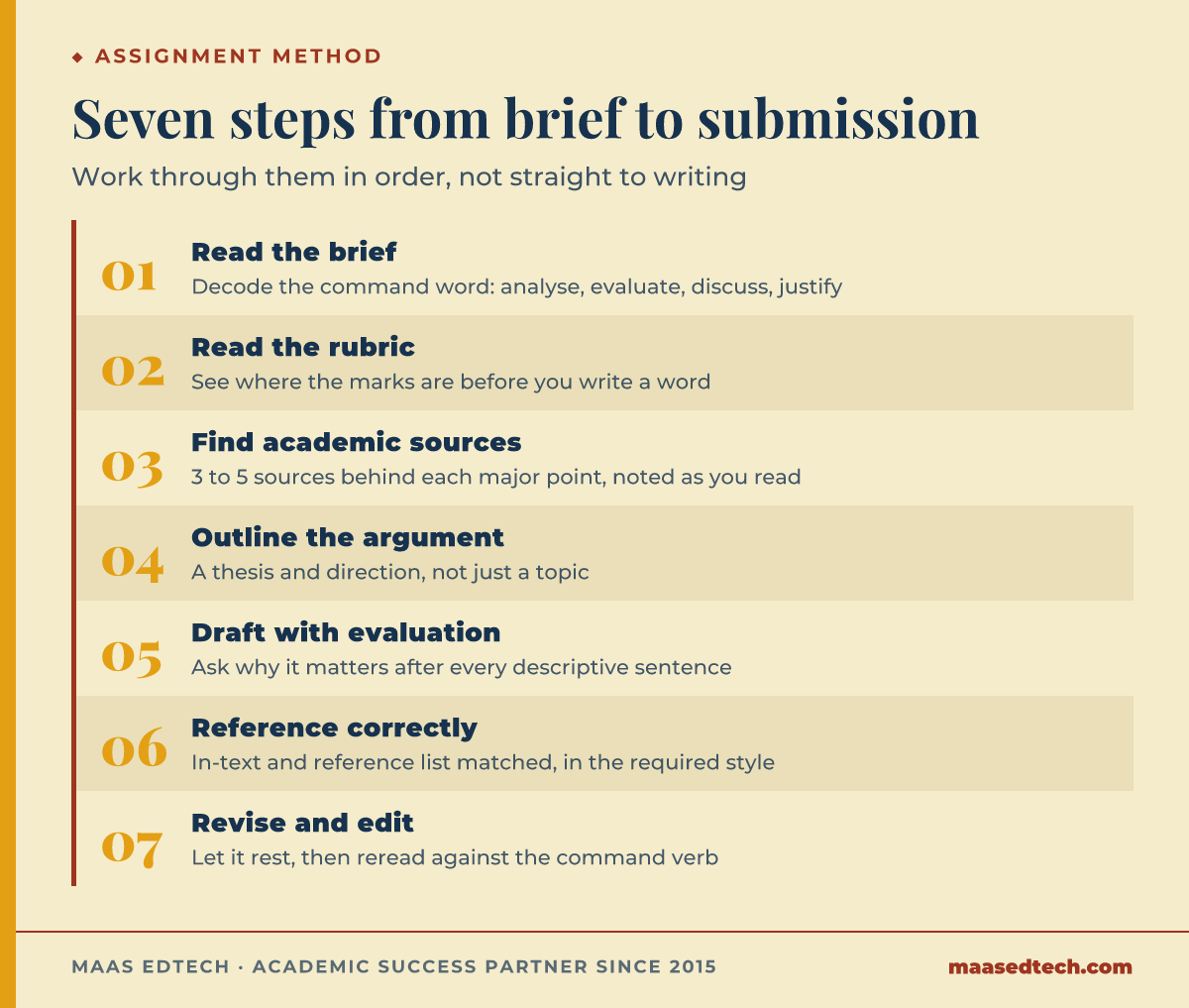
Direct answer: The process has seven steps: (1) read the brief and decode its command words; (2) read the rubric to see where the marks are; (3) find and note academic sources; (4) outline around an argument; (5) draft, favouring evaluation over description; (6) reference correctly; (7) revise and edit before you submit. Work through them in order rather than jumping straight to writing.
Steps
7
from the brief to submission, worked in order rather than jumping straight to writing
Sources
3 to 5
sources to aim for, at least, behind each major point
The seven steps, from brief to submission
Tap a step to see what it asks of you.
Step 1 / 7
Read the brief
Decode the command verb (analyse, evaluate, discuss, justify), because it sets the type of answer, not just the topic.
Step 2 / 7
Read the rubric
See what the marker rewards and in what proportion, often broken down by criterion into weightings such as 20%, 30% and 50%.
Step 3 / 7
Find sources
Use academic sources rather than blogs or aggregator sites, and note the source alongside each idea so you never lose the reference when you cite.
Step 4 / 7
Outline an argument
Organise the assignment around an argument (a thesis), not around a topic.
Step 5 / 7
Draft
For every descriptive sentence, ask why that matters, who benefits and whether the evidence is sufficient, and write that answer.
Step 6 / 7
Reference
Cite every idea that is not your own, both in-text and in the reference list at the end, in the style your school requires.
Step 7 / 7
Revise and edit
Let the draft rest for at least a session, then check that it answers the command verb, that each paragraph evaluates rather than only describes, that in-text citations match the reference list, and that the word count is within limits.
1. Read the brief and decode its command words
The command verb in the brief (analyse, evaluate, discuss, justify) sets the type of answer, not just the topic. "Describe" wants you to recount; "critically evaluate" wants you to weigh strengths and weaknesses and reach a judgement. Misreading the verb sends the whole assignment off course from the start. See our guide to assignment command words. A unit-specific example of reading a brief is the 6BUS1035 knowledge management and business intelligence assignment guide.
2. Read the rubric to see where the marks are
The rubric tells you what the marker rewards and in what proportion, often broken down by criterion into weightings such as 20%, 30% and 50%. For most undergraduate assignments, the jump from a middle grade to a high one is defined by the word "critical" (critical analysis), not by adding more content (Cottrell, 2019). Reading the rubric before you write, rather than after the first draft, lets you spend your word count where the marks actually are (Bailey, 2018).
3. Find and note academic sources
Use academic sources (scholarly books, peer-reviewed articles, your module's set readings) rather than blogs or aggregator sites, and aim for at least 3 to 5 sources behind each major point. As you read, note the source alongside each idea so you never lose the reference when you cite. For students writing in a second language, recording the academic phrasing you meet while reading, the same approach behind the University of Manchester's Academic Phrasebank (University of Manchester, n.d.), a resource built for English for Academic Purposes, or EAP, students, helps you express ideas more naturally later (Bailey, 2018). The Phrasebank describes its own purpose this way: "it aims to provide you with examples of some of the phraseological 'nuts and bolts' of writing organised according to the main sections of a research paper or dissertation" (University of Manchester, n.d.).
4. Outline around an argument
A strong assignment is organised around an argument (a thesis), not around a topic. The introduction states the thesis and the direction; each body paragraph develops one point, opening with a topic sentence before the evidence; the conclusion synthesises rather than repeats. A clear outline lets you see in advance where you are only describing, so you can shift to evaluation in time.
5. Draft, favouring evaluation over description
Drafting while favouring evaluation over description is the step that decides the grade, and it is where second-language writers most often default to description (Bailey, 2018). For every descriptive sentence ("this company does X"), ask "why does that matter, who benefits, is the evidence sufficient" and write that answer. In the drafts MAAS mentors commonly see, description tends to outweigh evaluation, and shifting that balance with the same evidence and the same example is exactly where the rubric's higher bands are defined. Do not wait for a perfect draft; write first, edit later.
6. Reference correctly
Every idea that is not your own must be cited, both in-text and in the reference list at the end, in the style your school requires (APA 7th, Harvard, MLA or another). Incorrect or missing citation is an academic-integrity risk, not just a matter of losing formatting marks. See our guide to referencing in university assignments.
7. Revise and edit before you submit
Let the draft rest for at least a session, then reread it: check that the assignment answers the command verb, that each paragraph evaluates rather than only describes, that in-text citations match the reference list, and that the word count is within limits. Reading aloud helps you catch unclear sentences. This is the cheapest step, and the one most often skipped when writing close to the deadline.
◆ Question 3 / 4 · Science and engineering
How do these 7 steps change for a science or engineering assignment?
Direct answer: The 7 steps hold, but 3 of them change shape. Command verbs such as calculate, derive and show carry different instructions from discuss. The report takes fixed sections with fixed tenses. And the marks concentrate in interpretation, since 1 Michigan rubric gives Discussion 5 of 10 points and Methods none.
Discussion
40 to 45%
of a lab report, roughly, in the space Trent University publishes
Introduction
15 to 20%
of a lab report, roughly, in the space Trent University publishes
Where the space goes in a lab report
The share of the report each part should take, in percent of the whole.
Step 1 changes first, because the verbs are different. Guidance from the Open University notes that "mathematicians use process words with slightly different meanings", grouping find, calculate, determine, derive, solve and evaluate under a single instruction to "work out and show your working", and putting prove, show and deduce under a harder one, that "you must justify each step and provide a convincing argument" (The Open University, n.d.). The word explain appears in both lists with different force, which is exactly the kind of overlap that costs marks. Cambridge Assessment International Education (2022) defines the same verbs for A Level physics, where calculate means "work out from given facts, figures or information" and show (that) means "provide structured evidence that leads to a given result", a distinction Vietnamese students on an A Level programme usually meet there before they meet it again at university. Task-word guidance at Loughborough University illustrates the difference with real science prompts rather than generic ones, such as "briefly describe the behaviour of ferromagnetic materials under an applied magnetic field" against an explain prompt about rock mass and soil (Towle, 2023). Cleeland (n.d.), writing for James Cook University, defines prove in laboratory language: you "establish something with certainty by evaluating and citing experimental evidence, or by logical reasoning".
Step 4 changes next, because the structure is given rather than designed. A lab report follows a fixed order, and Trent University (n.d.) publishes how much space each part should take: roughly 15 to 20% of the report for the introduction, 10 to 15% for the methods, 10 to 15% for the results excluding tables and figures, and 40 to 45% for the discussion. Tense is fixed too, and University of Toronto (n.d.) gives the reason rather than the rule, since "the experiment is already finished. Use the past tense when talking about the experiment", while "the report, the theory and permanent equipment still exist; therefore, these get the present tense". Turning a lab handout into a report is itself a rewriting task, and Monash University (n.d.) demonstrates it directly: a numbered list of instructions becomes a method "written in the past tense as a cohesive paragraph". The general layout of a university report is covered in university report format. The six-step guide to how to write a university assignment sets out the wider process this rewriting task belongs to.
Step 5 changes most, because description and evaluation split across sections. UNC's guidance on scientific reports draws the line inside the results: "in this section, you're reporting facts. Nothing your readers can dispute should appear in the Results section" (University of North Carolina at Chapel Hill, n.d.). The judgement belongs in the discussion, and the University of Regina (n.d.) states the distinction in 1 sentence students remember: "pointing out a trend in the data is not interpretation, telling the reader what the trend means is interpretation."
Published rubrics show where that lands in marks, though the picture needs stating honestly. Two sample lab-report rubrics published by the University of Michigan (n.d.) sit side by side on 1 page. In its 200-level biology example, worth 10 points, the introduction takes 2, results 3 and discussion 5, and methods is not scored at all. In its generic 30-point example on the same page, materials and methods does score, but only 3 of 30 while results, discussion and summary take 4 each. A rubric at Alabama A&M University weights materials and methods at 20% and the conclusion, the part that asks for "proper interpretation of results", at another 20%, with data analysis and discussion at 25% (Verghese, 2017). No single number transfers, and every rubric with published percentages that we could open belongs to a North American university, so the general shape is well evidenced while the specific split at any British or Australian department is not. Read your own rubric.
The errors are documented, and they follow from the same split. Guidance from the Nesbitt-Johnston Writing Center (n.d.) at Hamilton College calls omitting "the narrative in the results section" one of the most common mistakes beginning students make, and adds two more instructions: do not "regurgitate the lab handout" instead of writing your own introduction, and do not "declare the experiment a success or failure" rather than evaluating the results against the purpose of the experiment. Each of those is step 5 of this guide reappearing in a different subject, which is the point: the process does not change, only the shape the answer takes.
◆ Question 4 / 4 · Lost marks
Why do assignments lose marks even when they cover the content?
Direct answer: The three most common reasons an assignment loses marks are: it describes instead of evaluating, it answers the wrong command verb, and it uses weak sources or cites them incorrectly. None of these is about missing content, so writing more does not fix them; you have to fix the right thing.
From describing to evaluating
Each row pairs a habit that loses marks with what to do instead.
Instead of
Do this
A descriptive sentence that says what something does, such as "this company does X"
An evaluative sentence that answers why that matters, who benefits and whether the evidence is sufficient
Reading "critically evaluate" as "describe", which wants you only to recount
Weighing strengths and weaknesses and reaching a judgement, which is what "critically evaluate" wants
Adding a new sentence
Adding a clause after each fact that answers "so what does this mean", which keeps the word count the same
Where the assignment is presented rather than only submitted, see what a graded presentation rubric measures, since the mark allocation differs from a written brief.
For international students there is an added layer: rubrics on international programmes use the language of evaluation (critically evaluate, justify, synthesise), which can differ from the assessment style students met at school at home and from the writing tested by the International English Language Testing System, or IELTS, and the Test of English as a Foreign Language, or TOEFL (Bailey, 2018), so a draft can slip into simply retelling the sources. Recognising that difference early is half the way to a strong grade.
Check your work before you submit: you can use MAAS's free Grade Check tool to get an estimated grade against a rubric and see where to improve, before you hand in the real thing.
Frequently asked questions
How do you write an assignment for university?
Follow seven steps in sequence, starting with the brief and its command words and the rubric, then sources, an argument-led outline, a draft that evaluates rather than describes, correct referencing and a final revision. For most undergraduate assignments the move from a middle grade to a high one comes from critical analysis, not extra content (Cottrell, 2019).
What is a uni assignment, and what forms does it take?
A uni assignment is a piece of work that counts towards your final mark. Rather than a right-or-wrong test answer, it expects an analysed problem and an argument backed by evidence. It most often takes the form of an essay built around a thesis or a report split into headed sections, and either is graded against a published rubric.
How is an assignment different from an essay and a report?
Assignment is the general name for a graded task; the essay and the report are two forms of assignment (Cottrell, 2019). An essay is organised around a single argument running through the piece, with no sections. A report is divided into sections and sub-sections (introduction, method, results, discussion, recommendations) and is often used for applied case analysis.
How long should an assignment be?
Write to the word count stated in the brief, which usually allows about a 10% margin. For a 2,000-word brief, that typically means 1,800 to 2,200 words is safe. Writing well over does not add marks and is often a sign of surplus description; the marks are in the density of analysis, not in length.
How can I make a piece more "critical" without making it longer?
Replace a descriptive sentence with an evaluative one rather than adding a new sentence: after each fact, add a clause answering "so what does this mean". This raises the quality of analysis while keeping the word count the same.
Does MAAS write assignments for students?
No. If you already have a draft and want a mentor to read it, mark corrections and point out what to fix in Track Changes, that is the Assignment Editing & Revision service, and the writing stays yours. For module-specific help, see our course-code guides.
References
Bailey, S. (2018). Academic writing: A handbook for international students (5th ed.). Routledge.
Cambridge Assessment International Education. (2022). Cambridge International AS & A Level Physics 9702 syllabus for 2025, 2026 and 2027 [PDF]. https://www.cambridgeinternational.org/Images/664565-2025-2027-syllabus.pdf
Cleeland, L. (n.d.). Academic writing: Understanding task words [PDF]. The Learning Centre, James Cook University. Retrieved September 4, 2026, from https://www.jcu.edu.au/__data/assets/pdf_file/0008/987380/Understanding-Task-Words.pdf
Cottrell, S. (2019). The study skills handbook (5th ed.). Red Globe Press.
Monash University. (n.d.). Science: Lab report. Student Academic Success. Retrieved September 4, 2026, from https://www.monash.edu/student-academic-success/excel-at-writing/annotated-assessment-samples/science/science-lab-report
Nesbitt-Johnston Writing Center. (n.d.). Biology lab reports. Hamilton College. Retrieved September 4, 2026, from https://www.hamilton.edu/academics/centers/writing/writing-resources/lab-reports-for-biology
The Open University. (n.d.). Revision and examinations: 3.8 Understanding process words. OpenLearn. Retrieved September 4, 2026, from https://www.open.edu/openlearn/education-development/revision-and-examinations/content-section-3.8
Towle, G. (2023). Instruction words/task words [PDF]. Academic Language Support Service, Loughborough University. https://www.lboro.ac.uk/media/wwwlboroacuk/external/content/services/alss/downloads/Instruction%20words_Loughborough%20University.pdf
Trent University. (n.d.). Writing lab reports. Academic Skills. Retrieved September 4, 2026, from https://www.trentu.ca/academicskills/how-guides/how-succeed-math-and-science/writing-lab-reports
University of Manchester. (n.d.). Academic Phrasebank. https://www.phrasebank.manchester.ac.uk
University of Michigan. (n.d.). Sample laboratory report rubrics. Center for Research on Learning and Teaching. Retrieved September 4, 2026, from https://crlt.umich.edu/gsis/p7_11
University of North Carolina at Chapel Hill. (n.d.). Scientific reports. The Writing Center. Retrieved September 4, 2026, from https://writingcenter.unc.edu/tips-and-tools/scientific-reports/
University of Regina. (n.d.). Common errors. U of R Biology Lab Reports. Retrieved September 4, 2026, from https://moodle.uregina.ca/urbiolabreport/common-errors
University of Toronto. (n.d.). The lab report. Writing Advice. Retrieved September 4, 2026, from https://advice.writing.utoronto.ca/types-of-writing/lab-report/
Verghese, M. (2017). Rubric: Laboratory report [PDF]. Department of Food and Animal Sciences, Alabama A&M University. https://www.aamu.edu/academics/colleges/agricultural-life-natural-sciences/departments/food-animal-sciences/_documents/rubrics2017.pdf
A free 20-minute discovery call with a MAAS advisor, to talk through your own brief and rubric.
Book Free Discovery ▸